Rabbit! Rabbit!

art, Astrology, autumnal equinox, brain plasticity, change, cognitive decline, coronavirus, cosmology, Creativity, Family, Great American Eclipse, greek myths, Helios, nature, Painting, pandemic, photography, rabbits, Reflection, The Lord of The Rings, trees, vision

Welcome to August!

In the long summer evenings, after an extended car trip, and way beyond the too many times I’d asked my mother and daddy rabbits, “Are we there yet?” I would get their firm reminders I wasn’t to bother them any more, for they too were hot, tired, and daddy had to pay attention to the road. In the gathering darkness, I’d rest my blonde curls on the door near the open window. We had God air conditioning back then. We rolled down the window glass of our old Pontiac and drove as fast as the road would allow.

Go Faster!

I’d watch the darkening shadows as the landscape passed by this opening, noticing how the kudzu vines changed the trees into strange and monstrous shapes in the growing gloom, but I couldn’t take my eyes off of these apparitions. I was certain if I did, they’d begin to make their way toward our family car. I think I was at the age of magical thinking, for I believed I could keep these haints at bay by my will alone.

The soft flup flup of rubber tires half melting on the overheated concrete road, combined with my brother rabbits’ body heat in the seat beside me, and the enforced silence of our parents who’d had a long day with their hyperactive bunny brood finally had an effect on my eyelids. Try as I might, I would fall asleep at my watch, only to be awakened by my daddy’s sing song voice as he tickled my toes:

“This little piggy went to market, this little piggy stayed home.
This little piggy ate roast beef, and this little piggy had none!
And this little piggy cried wee-wee-wee all the way home!”

I’d rub my eyes as he picked me up to carry me into the house and into my bedroom. On the way, I’d always say,

“I see the moon, and the moon sees me,
God bless the moon, and God bless me!”

Perhaps this is a generational gift in my family, for when my own dear bunny child was small, we repeated these same scenes until she was too heavy for me to carry. The moon blessing dates from 1784 and the little piggy rhyme is even older: 1728.

That latter date is when horses and carriages were banned from Boston Common. Since I went to school in Boston, I can attest no horses, carriages, or cows are now on the grounds of the Common, which is now a 50 acre public park. The Common dates from 1634, when William Blaxton sold the remainder of his land to the Puritans, receiving six shillings or more from each shareholder to purchase the land for this public land. This was the site of the Boston Massacre, in which five people died. One good thing about going to school in an historic community, everywhere you went, you weren’t far from history.

When I think of history, I think not only of the stories we pass down to the next generation, but also of the stories we weave for ourselves. How do we remember our childhood or our families of origin? This is a generational gift of privilege, for those who lost their families when they were young may not have memories to weave together. Refugees from wars and violence might not want to recall traumatic experiences. Yet Abraham, the father of the Jewish nation, is remembered as “My ancestor was a wandering Arameam” (Deut 26:5).

Some of us choose to write about our better days, for they outnumber our bad days. Everyone has imperfections, but each of us rabbits are still going on to perfection with the help of the good God above. Perhaps when we see the beauty of the full bright moon against a dark, clear night, our heart leaps inside and says,

“I see the moon, and the moon sees me,
God bless the moon, and God bless me!”

For some of us rabbits, nature brings us closer to God than anything else. The majesty of the summer thunderclouds rising in the heated air, and giving way to either refreshing rain or flashing floods, reminds us once again of the powers of God unleashed in God’s creation. The rainbow after the storm is the promise once again of that covenant made so long ago: the earth will never be destroyed by floods again. In the rainbow, in the light of all the colors, we hear God’s promise of love and care for God’s creation and God’s creatures.

DeLee: Blue Moon

I’m looking at a full super moon tonight, July 3, but August will have TWO super moons. Looking ahead to September 29, we’ll have our FOURTH super moon in a row. The moon on the 31st of August will be a blue moon. This is the second full moon in the same month. We won’t have another blue moon until May, 2026. This is why things that don’t happen often are called “once in a blue moon” events.

Once upon a time, we were agrarian people who eked out a subsistence living on the land. The persistence of The Old Farmer’s Almanac and other ancient weather wisdom lore is proof you can take the bunny out of the country, but you can’t take the country out of the bunny. Yet as our alphabetical generations accumulate beyond the boomers, like Lucy on the Honeymooners, we often “got some explaining to do” to make ourselves understood.

Sirius in the Night Sky

We can count the “Dog Days of Summer” among the sayings folks don’t understand today. The term has nothing to do with the four legged creatures known as our best friends, but instead, it’s an astronomical term. The name comes from Sirius, the Dog Star, which rises before dawn. We find it on a vertical line below the three stars of Orion’s Belt. Sirius was named from the Greek Seirios, which means ‘glowing’ or ‘scorcher.’ This is an apt description of the warmest days from mid July to mid August.

Crepe Myrtle Bark Peeling in the Heat

Aratus, a Greek 3rd BCE poet wrote in his astronomical poem Phaenomena, (p. 328 ff, trans. Mair):

“A star that keenest of all blazes with a searing flame and him men call Seirios (Sirius). When he rises with Helios (the Sun), no longer do the trees deceive him by the feeble freshness of their leaves. For easily with his keen glance he pierces their ranks, and to some he gives strength but of others he blights the bark utterly. Of him too at his setting are we aware.”

These Dog Days of Summer in the ancient Mediterranean were marked not only by heat, but also by drought and pistelence. This year, with an El Niño weather pattern, wild fires, floods, and extreme heat have settled on the area due to a heat dome, which the European meteorologists have named Cerebus, after the three-headed dog guardian to Hades. The ruins on the Acropolis now close from noon to late afternoon to prevent heat illness.

Porch of the Maidens, Acropolis, Athens

Although the ancient Greeks and Romans believed Sirius was the reason for summer’s intense heat, we know now that star is too far away to affect our weather. What does affect our weather today is the result of human activities. Back in the Eemian period, around 116,000 to 129,000 years ago, the earth’s axis was tilted more towards the sun than now. This caused our northern polar region to be warmer and grow trees, which kept snow from accumulating. As a result, the earth’s temperature was 2 degrees C hotter than preindustrial levels, while today’s temperatures average 1 degree C warmer.

Today, we have evidence of geographic drift caused by climate change in our crops. Areas once known for coffee or wheat are shrinking, moving further north or to higher altitudes. We also see shrinking polar ice sheets, which cause ocean levels to rise. More water, combined with more heat leads to more intense storms. We also have rivers of wind, aka the jet stream, which lock in the heat domes. These can persist for days, while the rest of the earth gets flooding and storms.

Not a Watermelon Chart: Similar to the National Weather Service’s heat index chart, this chart translates combinations of air temperature and relative humidity into critical environmental limits, above which core body temperature rises. The border between the yellow and red areas represents the average critical environmental limit for young men and women at minimal activity.

Extreme heat is the number-one weather-related cause of death in the U.S., and it kills more people most years than hurricanes, floods and tornadoes combined. Despite the fact that extreme heat has been the number one cause of weather-related deaths in the United States over the last three decades, the federal government has repeatedly declined to declare extreme heat a federal disaster. The US government has never issued a federal disaster declaration for an extreme heat event in the three times it’s been requested, even as heat domes and long, uninterrupted stretches of 100-plus degree days have claimed lives in cities and states across the country in recent years.

The 10 hottest years on record have occurred since 2010 and the month of June alone in the USA has broken over 1,000 high temperature records. The combination of El Niño, a warming ocean current, and climate change is the cause. The excessive heat in the oceans are causing coral diebacks, which have negative implications for future hurricane shore losses, since coral reefs break the incoming waves.

We bunnies can blame the Stafford Act for this. Natural disasters in the USA are handled by FEMA—Federal Emergency Management Agency. The Robert T. Stafford Disaster Relief and Emergency Assistance Act, PL 100-707, was signed into law November 23, 1988 when Congress amended the Disaster Relief Act of 1974, PL 93-288. Named for the Vermont senator who was instrumental in its passage, this is one of the 100 laws a President can use to declare a national emergency or disaster. Former President Trump used it to declare the COVID pandemic an emergency. It’s this Stafford Act that defines “Emergency.”

According to Congressional laws, a disaster emergency is “any occasion or instance for which, in the determination of the President, Federal assistance is needed to supplement state and local efforts and capabilities to save lives and to protect property and public health and safety, or to lessen or avert the threat of a catastrophe in any part of the United States in a Major Disaster.

The act defines “major disaster” as any natural catastrophe (including any hurricane, tornado, storm, high water, winddriven water, tidal wave, tsunami, earthquake, volcanic eruption, landslide, mudslide, snowstorm, or drought), or, regardless of cause, any fire, flood, or explosion, in any part of the USA, which in the determination of the President, causes damage of sufficient severity and magnitude to warrant major disaster assistance under this chapter to supplement the efforts and available resources of states, local governments, and disaster relief organizations in alleviating the damage, loss, hardship, or suffering caused thereby.

Fires of Mordor have nothing on Phoenix Heat

To get heat relief, it will require an Act of Congress. In plain speak, we’ll see snowfall before heat relief legislation becomes law in today’s divided and polarized congressional body. In the last century, we bunnies weren’t thinking about climate change, extreme weather events, or even naming our winter storms. Perhaps next summer we’ll begin naming our extended heat waves and treat them with the same seriousness as we give to hurricanes and blizzards.

In the meantime, this bunny has set her AC to cool and is keeping the ice bin filled and the tea jar full. I’m feeling the siren call of the school supply aisle, so I’ll find a cool morning in mid August to go buy ink pens, notebooks, and some postynotes. A bunny who keeps learning will always stay young. Building new pathways for the neurons is like cleaning out the clutter in our brain box.

Write now, Edit later. The stories are more important than the form.

I always recommend picking up a new skill or renewing an old one, for not only do creative activities give us an opportunity to focus on something other than how hot it is, but also we can enjoy our progress as we continue to work. If you’ve ever wanted to write about your family history, begin now, for the day will come for all of us when we won’t remember the ones we love. This bunny hopes you have bunnies who love you and honor you for who you’ve always been, even if you become the “one who comes to kiss me every afternoon at 4 o’clock.”

Pluto: Now a Dwarf Planet

I’ll probably go buy my journal supplies on August 24th, and sit in my favorite coffee shop for a bit to drink in memory of Pluto, who was worthy enough to be a planet for my generation,but has been demoted to a dwarf planet because it hasn’t cleared its neighborhood of other objects.

I look forward to cooler breezes, falling leaves, and Pumpkin Spice lattes. See you in September!

Joy, peace, and iced tea,

Cornelia

The Project Gutenberg eBook of Gammer Gurton’s Garland, or, The Nursery Parnassus, by Joseph Ritson.
https://www.gutenberg.org/files/34601/34601-h/34601-h.htm

Teaching Early Math to Children—This Little Piggy
https://www-tc.pbs.org/parents/earlymath/pdf/LittlePiggy.pdf

Origin of This Little Piggy
https://www.rhymes.org.uk/this_little_piggy.htm

Boston Common Master Plan
https://www.bostoncommonmasterplan.com/history

Super Moons, Blue Moons
https://www.fullmoonphase.com/

What is a blue moon and when will the next one occur? | Royal Observatory Greenwich https://www.rmg.co.uk/stories/topics/what-blue-moon-how-often-does-it-occur

SIRIUS (Seirios) – Greek God of Dog-Star https://www.theoi.com/Titan/AsterSeirios.html

THE DOG DAYS OF SUMMER: European heat wave takes toll on tourists – Travel Industry Today
https://travelindustrytoday.com/the-dog-days-of-summer-european-heat-wave-takes-toll-on-tourists/

42 U.S. Code § 5122 – Definitions | U.S. Code | US Law | LII / Legal Information Institute FEMA STAFFORD ACT
https://www.law.cornell.edu/uscode/text/42/5122
https://www.fema.gov/disaster/stafford-act

Extreme Heat Is Deadlier Than Hurricanes, Floods and Tornadoes Combined – Scientific American
https://www.scientificamerican.com/article/extreme-heat-is-deadlier-than-hurricanes-floods-and-tornadoes-combined/

From Japan to Louisiana to Rome, Here Are Ten Heat Records Earth Has Broken Since June | Smart News| Smithsonian Magazine https://www.smithsonianmag.com/smart-news/ten-heat-records-earth-has-broken-since-june-180982562/

Pears and Apples

adult learning, Altars, apples, Aristotle, art, brain plasticity, change, cognitive decline, color Wheel, Creativity, exercise, Fear, Habits, Holy Spirit, inspiration, Lent, Leonardo da Vinci, Painting, perfection, Physical Training, purpose, risk, Thomas Merton, Van Gogh

Still Life with canvas, pallet, and brushes

Aristotle said in his Poetics, “The aim of art is to represent not the outward appearance of things, but their inward significance, and this, and not the external manner and detail, is true reality.”

He spoke mainly about poetry, which was the highest art of his age, but his words also apply to the fine arts. Today, many people are still mesmerized by artists who practice various styles of realism, but they overlook the artists who show us the realities of emotion and inner vision.

The good news about art.

“Art enables us to find ourselves and lose ourselves at the same time,” said the spiritual writer, Thomas Merton. Some people use art as a cathartic exercise, and pour out their inner emotions on the canvas or their chosen media. Jackson Pollock’s drip paintings and Van Gogh’s late works are good examples of emotional expression. We all know folks who have a project going in their garage. They go work on “that worthless piece of junk” to focus their attention and energy on fixing something on which they can make a difference, instead of getting tied up in knots about things they can’t change and must accept. Gardening and knitting are also good hobbies for focusing this energy.

We know our nervous system grows to the modes in which it has been exercised. This is what we call building a habit over time. Just as a child doesn’t walk straight out of the womb, they have preparatory skills that must be acquired by stages as they grow. Exercising their muscles by rolling over also helps to strengthen their necks to hold their heads up. Crawling leads to pulling up, and that leads to letting go to learn balance.

Each time a child repeats these movements, he or she will simplify the movements required to achieve the needed result, make them more accurate, and diminish fatigue. In this, they’re building habits that bring them closer to walking. Rushing them to achieve “early” walking actually puts them behind cognitively.

Not only are there twenty five body parts in a baby’s body that are used in the crawl movement, but crawling also strengthens the hip sockets, so the baby will have a strong platform on which to stand. Crawling helps the corpus callosum, which is a band of nerve fibers between the hemispheres of the brain. Criss-cross crawling on the knees and hands stimulates the corpus callosum to develop in a balanced way, facilitating the hemispheres of the brain to communicate. These cross lateral movements work both sides of the body evenly and involve coordinated movements of the eyes, ears, hands, feet, and core muscles. This helps support cognitive function, problem solving, and ease of learning. Exploring the floor in a baby proofed home allows your baby to achieve his or her optimal potential.

Gail’s Painting

“Practice makes perfect” is only as true as the practice is directed in a true direction. This is where a teacher, a parent, a coach, or a spiritual guide comes into play. Only one who’s been led well can lead others with grace. We don’t tear down the learner, but ask questions, give guidance, help them see alternative paths, and allow them a safe place to explore their choices.

Art class isn’t brain surgery. No one will die if the painting isn’t successful, and no one’s salvation is at risk if the painting doesn’t come out the way we hoped it might. Art class is a safe place to take risks, unlike jumping from a tall tower without a parachute. Learning to accept failure on our canvases and coming back next time to try again is a mark of resilience and courage. Every time we fail closer to our target, we realize we’re gaining on it! We never say I CAN’T in art class.

Crawl before you Walk or Run

The sad reality is we can teach and expand the horizons of young people up til the age of 25 or 30. After that, they seem to lose energy and desire to learn more or to change. They “habitually” repeat their previous acts, for good or for ill. We’ve all heard the old saying, “You can’t teach an old dog new tricks.” Those of us who are no longer young have sometimes been accused of being set in our ways. Some of us are afraid we won’t excel at a new challenge, for we’ve always been held to a high standard of achievement. Since none of us will be the next Georgia O’Keefe or Leonardo da Vinci, we can set that worry aside. They both had more years to practice than we have left in front of us. Instead, we should give our remaining time our most focused attention, so we can get the most from our experience.

My high school chemistry book had the same information in it which my daddy’s college chemistry book covered. He was amazed I was learning “advanced” ideas at my young age. In 1982 R. Buckminister Fuller introduced the idea of the “knowledge doubling curve.” Up until 1900, knowledge doubled every century. By 1945, knowledge doubled every 25 years and by 1982, it doubled every year. Some say it’s now doubling twice a day! The newest computer we buy off the shelf today is already obsolete.

We can’t train our students for the jobs of today because these jobs likely won’t exist tomorrow. We need to train people to be lifetime learners instead. Luckily, we don’t have to know all things, but we do need the skills to find the knowledge and sort through the best sources for the best possible information.

1930-2006

Today, knowledge we acquire in high school, college, graduate school, and our last job may already be obsolete. (I’m one who still grieves the loss of Pluto as a planet; it exists but is a dwarf planet in the Kuiper Belt). This is especially true in fast moving fields like technology. As futurist Alvin Toffler wrote, “the illiterate of the 21st century will not be those who cannot read and write, but those who cannot learn, unlearn, and relearn.”

This means all of us will need to become lifelong learners or we’ll risk losing touch with an ever evolving world. Maybe we think our brains can’t handle something new, for we’ve heard about the effect of aging. Cognitive process studies with older brains show learning, memory, and problem-solving in humans are often less efficient in these areas.

However, it has recently been established that dogs show many of the same kind of age related changes that humans do. A study in Vienna showed that older dogs learned new tasks just as well as younger dogs, although they took longer to do so and required more repetitive corrections. This aptitude is also known as “resilience training.”

I think it’s also important to know why we want to keep our brains agile as we move into our later years. John Wesley was fond of repeating William Law’s summary from the Practical Treatise on Christian Perfection,

“Do all the good you can, to all you can,
by any means you can, as long as you can.”

Because Wesley was better known than William Law, this quote is now attributed to Wesley alone. We Methodists have made it our own, however, and have carried its banner around the globe in our world wide mission efforts made possible by our Connectional ministries. Wesley thought enough of Law’s writing to reprint 19 editions of his work.

My late mother, at the age of eighty, learned how to use a laptop computer. She was motivated because she wanted to see emailed photos of her grandchildren, but then she realized she also could find recipes. When a child in her hometown needed a Mercy Flight, she used her new skills to get him transportation to an out of state hospital for treatment. I occasionally had to reteach her on how to double click quickly on her icons, rather than slowly, but she finally caught on.

iPad drawing of pear and apple

If we want to keep our brains agile throughout our middle, silver, and golden years, we always need to try new things. Doing art challenges makes our brain build new neural pathways. Every time we look at a still life or a landscape, we have to make multiple decisions: what shapes do I see—circles, squares, triangles, or rectangles; how do these shapes relate to one another on the plane of our canvas; what is most important; what colors will I use; what emotions do I want to express; and where will I begin?

Eventually, we will find our “style.” We don’t find a style by copying another’s work, but we create enough works until our hand becomes one with our spirit. Since God has placed a special spark of God’s own creative Spirit within each of us, eventually we’ll experience the joy of being one with God when we are in our painting moments. As Paul said to the Romans (8:16):

“The Spirit Himself bears witness with our spirit
that we are children of God.”

Last Friday we had a simple still life as our inspiration. Half our class was out sick with spring pollen troubles, but it was good to see those who could come after a two week hiatus. After a brief show and tell to get us inspired by other artists’ takes on the subject for the day, we got started. I reminded everyone not to make the fruit too tiny, so it wouldn’t get lost on the canvas. I believe everyone succeeded with this goal!

Mike’s painting

Mike painted his whole canvas with one brush. This gave the fruit a certain texture with contrasting colors, and the background, which was in a close value, didn’t show much brush strokes or texture. I like the perspective he chose, which brings the viewer in close to these fruit.

Gail tried a larger canvas with bolder colors than she normally uses. It was more dramatic and stronger in contrast than usual, while she kept her smooth strokes of paint as usual. She also took a view from above.

Cornelia’s Fruits

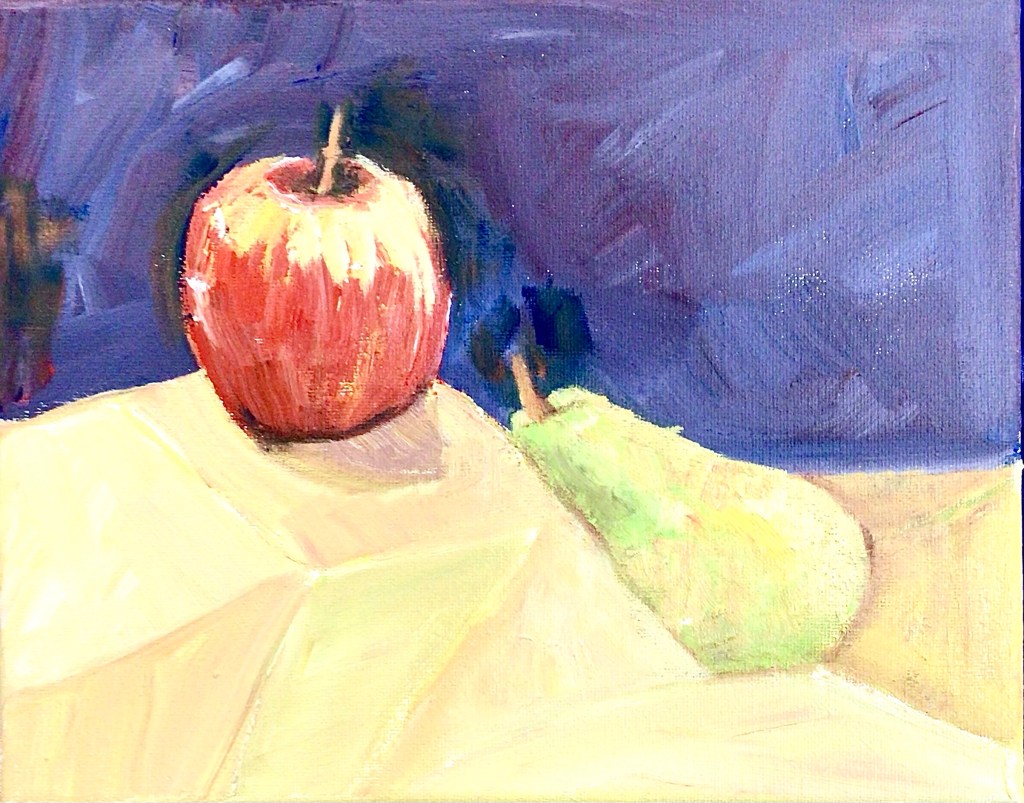
I stuck to a traditional rendering of the still life, since I do many abstract paintings in my own studio. I’d call these two Day and Night, for the Apple is quite awake and the Pear seems to need a little nap. It’s a study in contrasts: red and green, blue violet and yellow orange—a color wheel study masquerading as a still life.

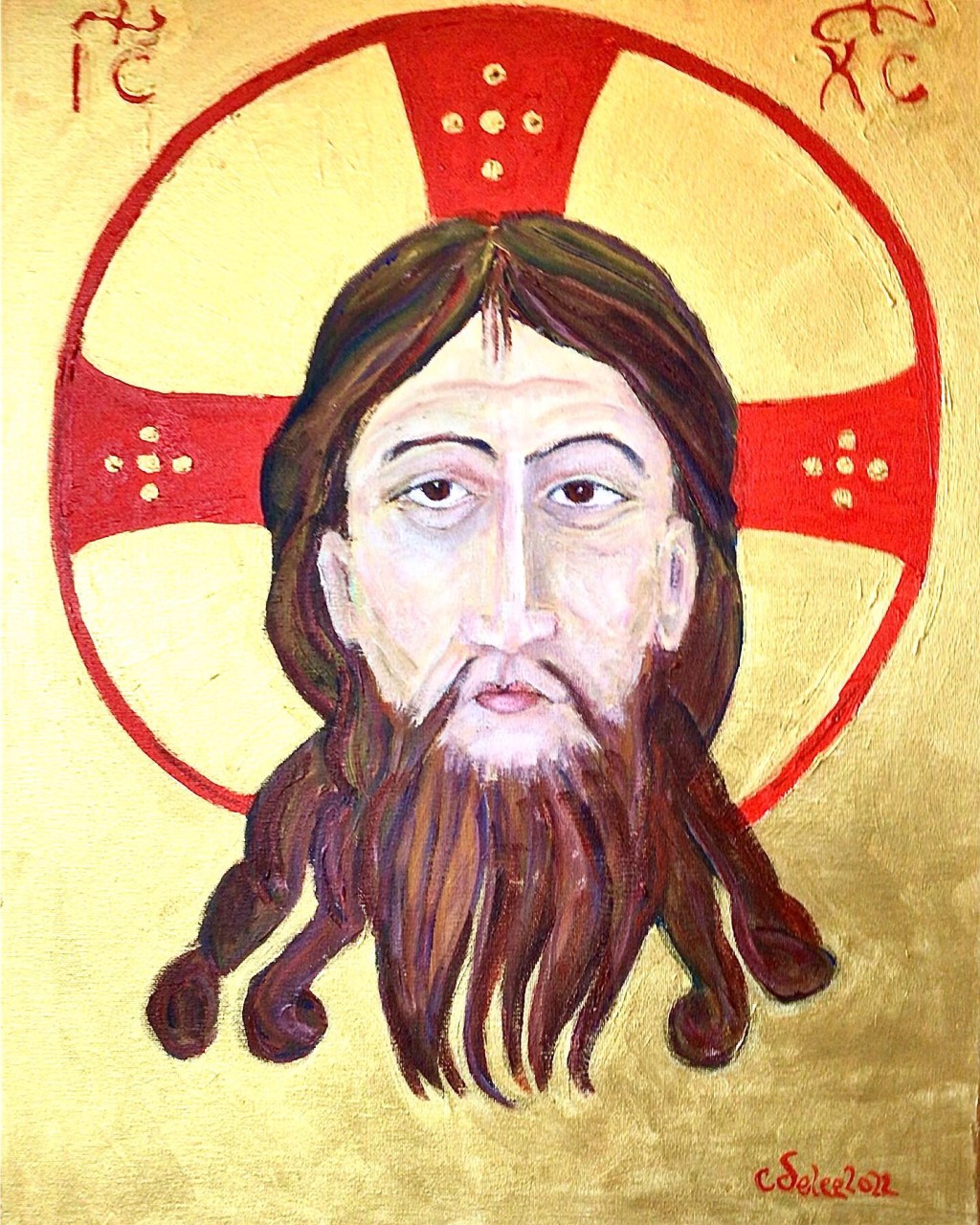
Next week we’re in the season of Lent. As Christ turns his face towards Jerusalem, we’ll begin a study on the icons. This will be accessible and interesting. You’ll end up with your own icon for your personal worship center also.

Joy and Peace,

Cornelia

Classics in the History of Psychology — James (1890) Chapter 4
https://psychclassics.yorku.ca/James/Principles/prin4.htm

Crawling is important for childhood brain development
https://thefnc.com/research/crawling-is-important-for-childhood-brain-development/

You Can Teach an Old Dog New Tricks | Psychology Today
https://www.psychologytoday.com/us/blog/canine-corner/201602/you-can-teach-old-dog-new-tricks

Letters of John Wesley – John Wesley, Augustine Birrell – Google Books, p.423
https://books.google.com/books/about/Letters_of_John_Wesley.html?id=zgYu6NpqWDEC

What It Takes To Change Your Brain’s Patterns After Age 25 https://www.fastcompany.com/3045424/what-it-takes-to-change-your-brains-patterns-after-age-25

Growth in Faith and Art is a Risky Business

adult learning, arkansas, art, brain plasticity, change, Children, Creativity, Faith, Holy Spirit, hope, Icons, Imagination, inspiration, john wesley, Ministry, New Year, Painting, Pantocrator, perfection, photography, purpose, risk, Spirituality, vision

Oscar Wilde famously said, “Life imitates art far more than art imitates life.” This is because the self-conscious aim of life is to find expression and art offers it certain beautiful forms, through which it may realize that energy. Yet most people who look at artworks judge them for the degree to which they represent “three dimensional reality,” in either two or three dimensions (painting, draw,or sculpture and assemblage).

Often I’ve been asked about my colorful landscapes, “Don’t you ever paint these in normal colors?”

My answer is usually, “How do we know the colors we see today are the original colors of Creation? After all, we now live in a fallen and broken world. Perhaps these bright colors were God’s original palette.” I’m not painting just what I see, but what was and what is yet to come. These are visions of a better world, where the leaves clap their hands for joy.

In art class, we not only struggle to master drawing shapes “as they are,” but also to challenge our minds to break free of our need to exactly reproduce the shapes before us. We always have the tension to make only a “copy of the image before us,” rather than to meet the image on a spiritual plane and portray an intimate portrait of its inner truth.

When we meet a stranger, we can hide behind our masks and keep our distance. Likewise, we can fail to become intimate with our painting’s subject matter. The resulting work is cold and dead, like a limp handshake. It’s a risky business to bare your heart to the canvas and paint. The brush will tell if your heart and soul is in it or not.

We get more comfortable with this risky business by practicing risk taking. It’s not like we’re facing tigers in a circus cage or jumping out of an airplane without a parachute. We can’t lose our salvation in Christ if we make a bad painting. We only have a new level from which to start afresh. All growth requires risk and failure. We discover what works, keep that, and eliminate the unuseful.

Willingness to learn is related to the “growth mind-set.” This is the belief your abilities aren’t fixed but can improve. This willingness is a belief not primarily about the self, but about the world. It’s a belief every class or learning experience offers something worthwhile, even if we don’t know in advance what that something is. Every teacher or parent worth their salt has to believe their students or children can learn and grow, or they need to give up their profession so another can grow. The first lesson even the most recalcitrant student needs to learn is to believe growth and progress is possible.

Christ on Tree of Life, San Clemente Basilica, 12th Century mosaic, Rome, Italy.

The Christian life has a parallel to the growth mindset. The whole of the Christian life is wrapped up in this faith: with God’s help, we can go on to perfection. This is a basic Methodist belief known as sanctification. We also call it going on to perfection in love of God and neighbor. Some of us think because we’re not able to change on our own, we don’t need to grow in our love. God has done all the work for us in Christ. The Holy Spirit was sent to be a truthful guide:

“When the Spirit of truth comes, he will guide you into all the truth;
for he will not speak on his own, but will speak whatever he hears,
and he will declare to you the things that are to come.” (John 16:13)

Christ in Majesty, Book-Cover Plaque, French, Limoges, enamel, ca. 1200 CE, Metropolitan Museum of Art, NYC.

Paul speaks of this truth in Philippians 3:20-21, when he reminds the people of their present state as sojourners in this world, while their citizenship is elsewhere:

“But our citizenship is in heaven, and it is from there that
we are expecting a Savior, the Lord Jesus Christ.
He will transform our humble bodies that they may be conformed
to his glorious body, by the power that also enables him
to make all things subject to himself.”

Mother About to Wash Her Sleepy Child Mary Cassatt, 1880

If life is a journey, the Christian life is even more of a pilgrimage. We all go through stages of faith if we seriously reflect and consider our beliefs when our life experiences intersect with our faith. Our earliest stage of faith begins with our parents or caregivers. Here we learn to trust or distrust, as we experience an embodied faith. The next stage is early childhood (age 3-7). Faith at this stage is experiential and develops through encounters with stories, images, the influence of others, a deeper intuitive sense of what is right and wrong, and innocent perceptions of how God causes the universe to function.

Michaelangelo: Creation of Adam, Sistine Chapel Ceiling

The next stage has been labeled “Mythic-Literal Faith” (Ages 7-12). Children at this stage have a belief in justice and fairness in religious matters, a sense of reciprocity in the workings of the universe (e.g. doing good will result in a good result, doing bad will cause a bad thing to happen) and an anthropomorphic image of God (e.g. a man with a long white beard who lives in the clouds). Religious metaphors are often taken literally, thus leading to misunderstandings. If God’s rewards or punishments don’t apply in proper retribution, in the believer’s mind, their faith in God’s system becomes fragile.

Théodore Géricault, Raft of the Medusa, 1818–19, oil on canvas, Louvre, Paris.

“The Conventional Faith” stage (12-adult) arises when individuals join a religious institution, belief system, or authority, and begin the growth of a personal religious or spiritual identity. Conflicts occur when one’s beliefs are challenged are often ignored because they represent too much of a threat to one’s faith-based identity.

Théodore Géricault’s “Raft of the Medusa,”painted in 1818–19, is nearly 17 by 23 feet large. It commands its space as any proper historic painting of the past ever did. Rather than present a moral lesson from the past, the artist instead chose to paint an event from his present time: the rescue of the abandoned sailors and slaves from a wrecked ship. The French nation had sent the new governor of the Senegal colony, his family, and some other government officials and others on the Medusa. The government officials went to secure French possession of the colony and to assure the continuation of the covert slave trade, even though France had officially abolished the practice. Another group aboard the Medusa was composed of reformers and abolitionists who hoped to eliminate the practice of slavery in Senegal by engaging the local Senegalese and the French colonists in the development of an agricultural cooperative that would make the colony self-sustaining.

On the way, the ship ran aground and broke up. The officials and their families were put in lifeboats, but the 150 others on board got a makeshift raft, which was tied to the lifeboats. When the raft impeded the lifeboats, the officials cut the raft loose and all the lives with it. Only 15 were rescued after days at sea, and only ten lived to tell their tales. It was a scandal of the times. Géricault read all the newspapers, interviewed survivors, and made studies from ancient sculptures to inform his design. When younger artists saw his inspirational work in the Paris Salon, they knew a sea change had happened. Conservative critics and writers were appalled and accused Géricault of creating a disgusting, repulsive mistake. They were not yet ready to leave the past behind.

William Faulkner once said, “You cannot swim for new horizons until you have courage to lose sight of the shore” (The Mansion , 1959). When we meet that initial storm, our first thought is to bring our fragile bark into port. In life, we batten down the hatches and book it for a safe harbor. In art class, we want to fall back on what we’ve always done before, what we know we can do, and what we’ve been successful with in the past. This is our “safe harbor.”

“Individuative-Reflective Faith” (Mid-Twenties to Late Thirties). The individual takes personal responsibility for her beliefs or feelings, often by angst and struggle. Religious or spiritual beliefs can take on greater complexity and shades of nuance, and a greater sense of open-mindedness. These can also open up the individual to potential conflicts as the different beliefs or traditions collide.

To progress and grow in our art skills, or to move through the “dark night of the soul” when we question our formerly held spiritual truths, is a crucial time. Crucial is a word sharing the same root as crucifix. The crux of both of these situations results in a life and death situation. Not that the person quits breathing or their heart stops beating, but will their old life die and their faith be reborn anew? Also, will they trust a power greater than themselves to bring them back from the depths? Many of us aren’t willing to give up control to anyone, and certainly not to a God we can’t see. We’re two year olds in our spiritual lives too often, for “I can do it myself!” Is our answer to everything and everyone. (Test it out—how many of you read the directions after you start putting a project together?)

The Cross that Spoke to St. Francis, San Damiano Chapel, Italy, 1205 CE

“Conjunctive” Faith (Mid-Life Crisis). A person at this stage acknowledges paradoxes and the mysteries attendant on transcendent values. This causes the person to move beyond the conventional religious traditions or beliefs he may have inherited from previous stages of development. A resolution of the conflicts of this stage occurs when the person is able to hold a multi-dimensional perspective that acknowledges ”truth’ as something that cannot be articulated through any particular statement of faith. This is where the Holy Awe begins to fill all the nooks and crannies from which it was once forbidden.

Face of Christ (All People of the World), photo montage

“Universalizing” Faith (or ”Enlightenment”). (Later Adulthood). This stage is only rarely achieved by individuals. A person at this stage is not hemmed in by differences in religious or spiritual beliefs among people in the world, but regards all beings as worthy of compassion and deep understanding. Here, individuals ”walk the talk” of the great religious traditions (e.g. ”the kingdom of God is within you”).

“Jesus of the People” by Janet McKenzie.

In 1999 Janet McKenzie’s painting “Jesus of the People” was selected winner of the National Catholic Reporter’s competition for a new image of Jesus by judge Sister Wendy Beckett, host of the PBS show “Sister Wendy’s Story of Painting.” In the words of Sister Wendy, “This is a haunting image of a peasant Jesus—dark, thick-lipped, looking out on us with ineffable dignity, with sadness but with confidence. Over His white robe He draws the darkness of our lack of love, holding it to Himself, prepared to transform all sorrows if we will let Him.” The model was an African-American woman and the painting includes a yin-yang symbol of Eastern traditions and feather of Native American traditions. (Photo courtesy of Paul Smith)

Next week, we’ll still be working on order and chaos. We got started on this at our first meeting, and the concept is a challenge. I’ll write about our class work then. We’re always open to anyone joining us, for you come as you are and begin where you are. Our art group is a “one room schoolhouse” with all levels of students mixed together. We may all be doing the “same project,” but everyone does it at their own skill level. I give you special attention according to your needs.

Remember, “The only way you can be behind is if you never start.”

Joy and peace,

Cornelia

Life Imitates Life | Lapham’s Quarterly
https://www.laphamsquarterly.org/swindle-fraud/life-imitates-life

The Stages of Faith According to James W. Fowler | Thomas Armstrong, Ph.D.
https://www.institute4learning.com/2020/06/12/the-stages-of-faith-according-to-james-w-fowler/

Théodore Géricault, Raft of the Medusa – Smarthistory
https://smarthistory.org/theodore-gericault-raft-of-the-medusa/

Video and photo slideshow: The many faces of Jesus
https://religionnews.com/2014/01/28/video-photo-slideshow-many-faces-jesus/

Rabbit! Rabbit!

art, Attitudes, autumn leaves, autumnal equinox, brain plasticity, cognitive decline, Faith, Imagination, ministry, nature, Painting, perfection, poverty, pumpkins, rabbits, renewal, Rosh Hoshanah

Welcome to September

On September 5, we celebrate Labor Day, and our kids are already back in school. We’re once again slowing down in school zones in the morning and afternoon, and setting an extra plate at the kitchen table for our absent college freshman. We might even see the first fall colors when the Fall Equinox comes around at the end of the month.

Edwardian Summer Gown, 1905

September is when we set aside our summer white clothes and shoes to change our closet over for darker colors and longer lengths. My dear mother had a rule of never wearing white past Labor Day. This quaint fashion principle dates from before Memorial Day, which was instituted in 1868 after the Civil War. This rule helped to separate the old money families, who summered in the country and at the seashore, from those who stayed to struggle on in the grimy cities, which were polluted by coal fired engines. These urban families usually wore dark clothes year round, as the rich did when they returned to their city residence.

Air conditioning has changed this now, but wearing starched, white cotton still reminds people you either have money to send your clothes to the cleaners or hire laborers to do it for you. Or, you might just work extra hard to look like one of the first two. This bunny has reached the age of dripping dry all those cotton clothes. I actually do more ironing when I do a craft project, such as quilting, since those seams need to be pressed open to make a good square. As this bunny has aged, I’ve changed my mind about what I think is important enough to worry about.

Rabbit Ironing

September is also a time to reassess the three core myths which animate much of American life. These myths are we can give 100% to our work, 100% to our family, and 100% to our personal health. I don’t know about you, but I’ve never been able to do this type of higher math without going bananas or feeling significant amounts of guilt that I’m not doing enough in one of those areas. Eventually I learned I was only Wonder Woman in my fantasies, but not in real life. I also realized other people who managed better than I hired help for the housework to free themselves up for family time.

My Wonder Woman Fantasy

Somewhere along the line we’ve bought into the myth of the “ideal worker,” who “has no competing obligations that might get in the way of total devotion to the workplace.” The second myth is the “perfect parent,” who “always puts family first.” The last myth is the “ultimate body,” which is cultivated through diligent dieting and exercise, and doesn’t deteriorate with age.

The authors of Dreams of the Overworked, note in the digital age, when people can post curated images of their best lives, “Achieving even one of these myths would be impossible, but achieving all three is ludicrous.” If your daily stress has increased and you feel like everything you do isn’t enough, I suggest deep breathing with your eyes closed (unless you’re driving a vehicle!). Once you get some extra oxygen to your brain, you’re in a position to calmly reconsider your situation. Not all situations are hair on fire, unless you’re a two year old with separation anxiety. Most of us beyond this age have experience and memories which can guide our future behaviors. An ancient proverb is “Experience is the mother of wisdom,” or as my folks used to say, “The school of hard knocks is the most expensive degree you’ll ever pay for.” Live and learn. With age comes wisdom.

Now that you’re calmer, you can decide, “Do I have options? Do I have a support system with people who can help me discern my way? Can I lay down my false self image of competence so I can ask for help? Can I triage my priorities to say NO to the less important ones, even if it means not pleasing everyone in my social circle?”

Google it, Ask friends for recommendations, and Breathe!

Speaking of options, women are primarily responsible for housework and childcare, not only in America, but also across the pond. About 91% of women with children spend at least an hour per day on housework, compared with 30 % of men with children. The latest available data shows that employed women spend about 2.3 hours daily on housework; for employed men, this figure is 1.6 hours. Gender gaps in housework participation are the largest among couples with children, at 62 p.p., demonstrating an enduring imbalance in unpaid care responsibilities within families. This leads to women taking lower and slower career paths.

Animated Map of 2022 Fall Color Change

September 22 is the Fall Equinox. We’re already seeing signs of seasonal leaf color changes, due to heat stress and drought. Some call this “False Fall,” but I call it a sign of hope. Trees will drop their leaves in order to survive in extreme conditions. Although some claim plants are sentient, they don’t have a brain or consciousness that we can recognize. They do interact and react to their environments. Their first priority is survival.  Photosynthesis and the subsequent leaf abscission after changing color is part of this process. I always look for the change of light which precedes this event. One morning last week, I noted the color of the morning light had turned cooler, and wasn’t the warm yellow of summer. I also had a spark of energy I hadn’t had before. I look forward to more daylight.

This bunny is very fond of September, since I’ve always been eager to start fresh and new. I always got new pencils and a new manilla paper writing pad when I started elementary school. Later on, as I progressed up in grades, ink pens with cartridges were a special treat. Even to this day, I keep my journals with hand written ink in good paper books. I love the feel of these materials in my hands. I probably would have stayed in school my whole life if possible. The day our brains quit learning something new is the day our minds begin to die.

School Bunnies and Friends

That leads me to remind my bunny friends that Alzheimer’s disease is the 7th leading cause of death in the USA and it’s the most common cause of dementia in persons over 65. While most of you may not be baby boomers, you young bunnies have grandparents or parents of that age. Today, about 6.5 million Americans have Alzheimer’s disease, but that number is expected to almost double to 12.7 million by 2050. Perhaps beginning September with World Alzheimer’s Day is a good reminder for all of us to be proactive about our health choices, so we can live independently as long as possible into our senior years.

Talk Like a Pirate

I also like Positive Thinking Day, since reframing negative thoughts into positive ones changes our attitude, our behaviors, and then we get better outcomes as a result. If you don’t feel like being Batman on the 17th, you can ARRRGUH yourself about, MATEY, as you Talk Like a Pirate on the 19th. Bonus points if you wear an eye patch, earring, and tricorne hat or bandana on your head.

The Jewish New Year of Rosh Hashanah begins at sunset on the 25th. It’s one of the four “new year” celebrations in their religious calendar. This one recalls God’s creation of humanity, as well as the legal new year. On this one night in September, when the faithful eat apples dipped in honey or other sweet sauces, they remember how God originally created humans in a sinless state and wish each other a good year to come.

Magic Bacon Carpet Ride

Did I forget International Bacon Day? How can any rabbit forget bacon? Someone will cut my carrot rations for the future, I fear. But if I remember to keep the coffee pot full, I’ll probably get out of the rabbit hoosegow before National Coffee Day on the 29th.

Some interesting holidays we can celebrate this month are: Better Breakfast Month (I suggest bacon, eggs, and pancakes on the weekend and old fashioned oatmeal during the week). There’s also Hispanic Heritage Month and National Sewing Month. Finally, every year on September 30th is National Love People Day. The purpose of the day is to show love to everyone—no exceptions. National Love People Day offers us the opportunity to show unconditional love, which many have never experienced. When we genuinely love our neighbors and express it with kind words and thoughtful deeds, we make our world a better place. This the true meaning of “love your neighbor as yourself.”

Maybe one meaning of loving your neighbor is offering a meal to them. Food insecurity is increasing once again, this time due to increased rents and costs of transportation. Consider a weekly meal service from your church building or organization’s meeting place. It doesn’t need to be fancy, but calories and nutrition would help hungry people have the strength to move on from their current situations. Joining with other groups to cover all the days of the week would be a bonus to your community, not only for the hungry, but also for the smaller groups who could team up to share in the blessing of loving their neighbors.

Until the spice is on the pumpkin, I wish all my bunny friends

Joy, peace, and Bacon,

Cornelia

America’s Ideal of Working Parents Has Become Unattainable – The Atlantic
https://www.theatlantic.com/family/archive/2020/06/working-parents-impossible/613429/

Beckman and Mazmanian: Dreams of the Overworked: Living, Working, and Parenting in the Digital Age

Gender differences on household chores entrenched from childhood | European Institute for Gender Equality https://eige.europa.eu/publications/gender-equality-index-2021-report/gender-differences-household-chores

Debunking a myth: plant consciousness | SpringerLink. https://link.springer.com/article/10.1007/s00709-020-01579-w

September Monthly Observances – National Day Calendar
INTERNATIONAL CHOCOLATE DAY – September 13, 2022 – National Today

Home – National Love People Day – National Love People Day

Alzheimer’s Facts and Figures Report | Alzheimer’s Association
https://www.alz.org/alzheimers-dementia/facts-figures


OAKLAWN FRIDAY ART CLASS

adult learning, art, Attitudes, brain plasticity, cognitive decline, Creativity, Faith, Imagination, inspiration, john wesley, Ministry, Painting, perfection, purpose, Retirement, United Methodist Church, vision

WE’RE BACK!!!

Ready or not, the creative juices must be stirred. If the brain has lain fallow all summer, or it’s been overworked keeping the youngsters occupied, now you can find your own groove again. Yes, it’s time for Adult Art Class at Oaklawn UMC.

Our first meeting will be Friday, September 9, at 10 am in the old fellowship hall. Bring your own acrylic paints, brushes, and a canvas or canvas panel to paint on. We begin with a short visual inspiration from some great art works, I’ll give some direction on the skill we’ll work on in the session, and then everyone is free to bring their own unique expression to their paintings. We don’t copy my work and judge how well a person can match it. We learn from the great masters and stretch our own skills to create something new.

Walter Nowatka: Abstract Ferris Wheel

Of course, making great art isn’t our first purpose. As we age, we will lose our ability to learn new skills until we lose our memory of what we just ate for breakfast. Challenging our brains is one of the best ways to keep our brain cells firing and “chatting with one another.” Our brains have the immensely powerful ability to remodel themselves because each of us have 1,000 trillion synapses, which are constantly being modified every second of every day. Socialization and encouragement also helps to keep our brains young.

Frank Lloyd Wright: March of Balloons

Of course, we have to give up our desire to be perfect. Perfection comes from practice, or working at it. Every baby stumbles and falls when they learn to walk, but dotting adults encourage every trembling step. This is what art teachers also do. I’ve always had a rule in my classes, especially when I taught in middle school: No Negative Talking about People or Art. This included a student’s own art works. They always had to give at least three positive comments about their work before they spoke about the negative. “My work needs improvement” became the replacement phrase for “My work stinks!”

De Fem. Titel saknas, 1908. HAK 1274. Kat. 12. 52,5 x 62,8 cm

Of course, we’ve all grown up and worked in environments where negativity is the rule. Art class is a place of grace because this is how life should be. If we can transform a blank canvas into a field of color, why can’t we transform our communities and our world into fields of hope, joy, and love? Perhaps because we try to make everyone copy/fit into our idea of the proper end product, rather than allow everyone discover their own creative response to the given subject of the day. The museums of our world are richer and more vibrant because artists have listened to the Spirit of the Creating God. We might do well to realize God’s creative energies are varied and vibrant also, just as Isaiah wrote about his vision of God’s Glorious New Creation:

“For I am about to create new heavens and a new earth;
the former things shall not be remembered or come to mind.
But be glad and rejoice forever in what I am creating;
for I am about to create Jerusalem as a joy, and its people as a delight.” (65:17-18)

James Wyper: City of Dreams

I hope to see you there. I don’t charge for the class sessions, since this is one of my ministries as a retired elder in the United Methodist Church. As John Wesley once said, “The World is my Parish.”

Joy and Peace,

Pastor Cornelia

Wes Ely: How long covid reshapes the brain — and how we might treat it

https://www.washingtonpost.com/outlook/2022/08/25/long-covid-brain-science-fog-recovery/

Rabbit! Rabbit!

adult learning, at risk kids, brain plasticity, Children, city, Dreamscape, Faith, Family, flowers, Healing, holidays, Icons, Love, mandala, Mandylion, Ministry, ministry, nature, Prayer, purpose, rabbits, Reflection, renewal, risk, school shootings, shame, Spirituality, Stonehenge, summer solstice, texas, Uncategorized

Welcome to June! I’ve found my sunshades and my flip flops, so this rabbit is ready for a summer vacation. Old school teachers never die, they just take the summer off. And teachers, as well as students, will need a summer off, along with some intensive counseling, to get them ready to return in a healthy frame of mind next fall.

Summer Solstice Mandala

In my early years in ministry, I served in a certain county where many people were caught up in despair. I often complained to my district superintendent of my desire to pour mood elevators into the public water supply.

“You do know drugging the water supply isn’t exactly an acceptable activity for a Methodist minister?”

“Oh, yeah, but it sure would make my job easier.”

Rabbits Love One Another

Remember, June 3 is Love Conquerors All Day. I need to remind myself of this on occasion when I want to take the easy road. As Jesus reminds us in Matthew 7:13—

“Enter through the narrow gate; for the gate is wide
and the road is easy that leads to destruction,
and there are many who take it.”

Taking the easy way out isn’t always the best choice, but it’s the one we rabbits most often choose. We rabbits don’t like to rock the boat, and we like to make all the other rabbits happy if at all possible. The only problem is if we please A, B gets upset. If we please B, A gets upset. We don’t even try to please C, since C is so cranky, even the good Lord Jesus couldn’t fry an egg to please them. We set our hearts and minds on pleasing God, as best we can, and hope to hear the words, “Well done, good and faithful servant, enter into the joy of your master.”

Make Mine Chocolate Ice Cream Day

Chocolate ice cream brings me joy any day of the year, but June 7 is a day dedicated to this frozen delight. Don’t worry about frying eggs, but keep it frozen. I like mine plain, but fresh strawberries or peaches are a nice addition, plus some chopped nuts. Always go for complex, unless you just can’t wait. Then grab a spoon and eat it straight from the pint. (Mark it with your name, since you ate from it.)

Often we cut the Gordian Knot and go for the shortcut to our complex problems. Sometimes this is a good solution, for the shortest distance between two points is a straight line. My daughter used to call my vacation navigation shortcuts “the long cuts,” since I’m directionally challenged. Most of the time, that straight line went through swamp land and alligators. I can hear her voice now, “NOOOOO!!!” I’m known for taking the scenic route, so I often see America’s less known sights, which are off the beaten path.

In the gospel of Luke (14:34), Jesus quotes a proverbial saying:

“Salt is good; but if salt has lost its taste, how can its saltiness be restored?”

Another translation of the latter portion of this verse is “how can it be used for seasoning?”

When I think of loss, I think of a life snuffed out. Some people are burned out, so we can say they’ve lost their seasoning ability. There’s no vim or vigor in them. Other lives are cut short and aren’t able to fulfill their purpose to season the great soup of our community. Our past month was marked by 47 mass shooting incidents in May alone. A mass shooting incident is defined as one in which at least four people are injured or killed, not including the shooter. Suicides aren’t included.

Suicides are also a public health problem. They are the “deaths of despair” that leave ripples of grief and hopelessness in the survivors. They’re the ultimate shortcut solution to a problem, the placing of a period where life has placed a comma or a semicolon. My daughter once attempted suicide by downing half a bottle of aspirin. I noticed the open bottle and pills scattered across the floor. She said the “dog ate it.”

“That’s too bad, I’m going to miss that dog. She won’t be long for this world. We’ll need to make burial plans for her.”

“Well, actually, I’m the one who ate the aspirin.”

“Then we’re going to the hospital. You aren’t going to like getting your stomach pumped, but it’s better than being dead. You want to have a chance to grow up and have a good life. A dog we can replace. You—not so much.”

It was a rough time in her life, and mine too. But God was with us. And we had support from counselors, friends, family, and our church family. My work family and my clients supported me too. I must be the most extroverted rabbit in the patch, because I asked everyone for help. It turned out my problem was shared by everyone else. I discovered I wasn’t alone, but was the most ordinary of rabbits around.

This is a humbling experience, especially when you’re a first child and the only girl. I admit to being spoiled, but don’t let my brother rabbits hear me say this. I’ll deny it to my last breath: I’m like every other rabbit I know. I want to think I’m someone special, even when I’m just as fluffy as every other bunny out there on Gods green earth.

June 21—Summer Solstice

Unfortunately, half the suicides today are committed with a gun, not aspirins. When looking at overall gun deaths, roughly two-thirds are attributed to suicides—a proportion that is consistent across most states. Gun suicides are on the rise and data also indicates men, white Americans, older people, and individuals living in rural areas present higher rates of gun suicides. Another group presenting a unique risk for suicide is current and former members of the armed forces, especially those with PTSD.

Compared with the general population, current and former military members have significantly higher rates of gun ownership. According to a 2015 study, nearly 50% of U.S. veterans own a gun. In contrast, studies suggest that only about 22% of the general U.S. population owns firearms. Similarly, the age groups of 50 to 64 years old and 65 and older have the highest rates of gun ownership, according to a 2017 Pew Research Center study. This can further explain the high rates of suicide among older veterans.

According to data from the U.S. Department of Veterans Affairs (VA), in 2019, close to 4,332 veterans died by gun suicide in the United States, representing close to 18 percent of the total number of gun suicides reported by the Centers for Disease Control and Prevention (CDC) during that year. Perhaps more alarming is the fact this figure shows a veteran is killed by gun suicide every two hours. In 2019, active duty military members committed suicide by gun 64% of the 498 total (318), almost one gun suicide per day.

Why isn’t anyone speaking about this? For all the lip service our politicians give to the flag and to the armed service members, they seem to forget them once they’re no longer useful to fight their wars or march in their parades. Perhaps because Congress won’t devote any money to study the effects of gun violence on the citizens of our Beautiful America, so we have to fund private studies here and there to piece together a patchwork of facts of this scourge on the peace of our people.

My young neighbor, only 8 years old, was in a panic as he knocked on my door the other day. His parents hadn’t come straight up the elevator, as they’d said they would. He was crying to beat the band and was sure something bad had happened to them. I invited him inside and left the door open so we could see them come past. He was so worked up, he couldn’t sit down. I suggested a call to his daddy, but they came walking past just at that moment.

June 19—Father’s Day

We don’t realize what terror these school shootings put our children through. There’s no safe place for them any more, no matter how “hardened” we make the buildings. Some person always breaks the shell at the most inopportune moment.

Some rabbits will have empty seats at their family reunion tables because someone decided to act impulsively. Father’s Day (June 19) won’t be a celebration without the son or daughter to give Dad the tie, the golf balls, or breakfast in bed.

I think back to my own childhood. We worried in the 1950’s more about the urban legends of Halloween candy poisoning, when we were more likely to get killed crossing Highway 1, a four lane highway running through our town. My mother rabbit would wait for me to ride the trolley home from school. She would wait until the near lane of traffic cleared before she walked out to the center median and time this so the far lane’s cars would finish passing so she could walk across the newly empty lanes to meet me on the other side. We held hands and crossed in the same manner on the way back to our home.

This was our routine from the start of school until sometime in the autumn. Mother was delayed one day, so I sat down to wait for her and opened my book to read. I was wearing a brown jacket against the early cool spell, and my dirty blonde hair blended in with the pile of dry leaves on the ground. Intent on my book, I failed to see her come outside. She overlooked me and went inside thinking I’d missed my ride.

A bit later, I decided if she wasn’t coming for me, I’d come to her. Gathering up my possessions, I stood on the curbside. I watched the comings and goings of the quickly moving traffic. Once I saw the break in the pattern, I walked out into the clearing, waited at the median, and crossed behind the trailing traffic of the second lane. When I walked inside, my mother had a conniption fit. After this, I began riding my bicycle to school, and my brother got to come with me.

Brain Functions

Not everyone is mature enough to cross a four lane busy highway by themselves when they’re in the fourth grade, which is the same age as the children who lost their lives at Robb Elementary in Uvalde, Texas. . Some people still need to be supervised at work even in their 20’s. The brain keeps maturing past age 21, as the frontal lobes, which are home to key components of the neural circuitry underlying “executive functions” (such as planning, working memory, and impulse control) are among the last areas of the brain to mature; they may not be fully developed until halfway through the third decade of life. Although neuroscience has been called upon to determine adulthood, there is little empirical evidence to support age 18, the current legal age of majority, as an accurate marker of adult capacities.

Since May 24, the date of this tragedy in Uvalde, Texas, the gunviolencearchive.org has recorded 16 mass shootings in six days, with 79 killed or wounded. Some of these are high school graduation parties where uninvited guests arrived and gunfire broke out, others are the result of young people wandering about in the late hours and getting into trouble with guns. During my time of ministry, youth, alcohol, and firearms were usually a recipe for trouble. Maybe parental rabbits’ brains are still developing too, if they aren’t able to put their rabbit foot down and tell the junior rabbits to leave their weapons at home. Visiting Jack Rabbit in jail for accidental death or intentional use of a firearm will throw a curve into your best laid plans for your progeny.

Rabbits in Cars Going for a Joyride

Instead, cities may have to reinstitute curfews after dark to curtail the opportunities for gun violence. Or they could raise the age to buy a weapon and require a longer waiting time and a more thorough background check. I wouldn’t be opposed to a training class and a test to see if the owner knows how to use the weapon safely. After all, we do this for the 2 ton weapon of mass destruction known as the family automobile. So what if the founding fathers never had autos; they also never had automatic pistols or large magazine weapons, modeled on the ones used in combat.

Did I mention June is National Safety Month? Its emphasis is workplace safety, but as a former teacher, this old rabbit reminds you, between 2009 and 2020, teachers’ workplaces are in schools, which is where 30% of mass shootings occurred in public places (schools, malls, or bars), while 61% of mass shootings occurred entirely in the home and another 9% occurred partially in a home and partially in a public location. The common factor in these is the gun and the presence of domestic violence. In at least 53 percent of mass shootings between 2009 and 2020, the perpetrator shot a current or former intimate partner or family member during the rampage.

Richard Small seen posing with his rifle before turning it over to police.
(Joshua Lott/The Washington Post)

I know y’all usually expect a bright and cheery note from me at the beginning of the month, but my heart is broken. Thoughts and prayers are nice, but they don’t stop the carnage. We need to make some changes. At least one man has turned in his assault weapon to his local police station, so it doesn’t fall into the wrong hands. He couldn’t bear the thought of it being used to perpetrate a similar crime if he were to sell it. If we parents don’t say no to our children, if we keep voting for politicians who are doing nothing, then we get to keep the distinction of having the highest rate of violent gun deaths for any of the developed countries.

That’s not the American Exceptionalism I believe in. We can do better. These are crimes against the common good and against the innocent. The shooter shares the primary blame, but everyone who does nothing to change our society for the better also shares the blame and shame for the next group of victims. At the rate we’re going, we’re having about one mass shooting per day. Eventually this scourge will come to YourTown, USA, and your small town police force will be just as flabbergasted as poor Uvalde’s. How could this happen in our little corner of the world?

I cry along with Jeremiah ( 8:21-22):

For the hurt of my poor people I am hurt,
I mourn, and dismay has taken hold of me.
Is there no balm in Gilead?
Is there no physician there?
Why then has the health of my poor people
not been restored?

Time Magazine Cover from 2019 with all the Mass Shooting Locations Named

Sometimes we go along with the attributes of cultural Christianity, rather than practicing the Christianity of Jesus Christ. Romans 12:2 reminds us

“Do not be conformed to this world, but be transformed
by the renewing of your minds, so that you may discern
what is the will of God—what is good and acceptable and perfect.”

Joy, peace, and balm for hurting souls,

Rev. Cornelia

Deadly Dreams: What Motivates School Shootings? – Scientific American
https://www.scientificamerican.com/article/deadly-dreams/

You can view a report of any 2022 mass shooting incident by visiting the list on the Gun Violence Archive’s website:
https://www.gunviolencearchive.org/reports/mass-shooting

Poisoned Halloween Candy | Snopes.com
https://www.scientificamerican.com/article/deadly-dreams/

Mass Shootings in America | Everytown Research & Policy | Everytown Research & Policy
https://everytownresearch.org/maps/mass-shootings-in-america/

Adolescent Maturity and the Brain: The Promise and Pitfalls of Neuroscience Research in Adolescent Health Policy – PMC
https://www.ncbi.nlm.nih.gov/pmc/articles/PMC2892678/

Guns and Mass Shootings: Data Show Why US Is Outlier on Deaths From Firearms
https://www.bloomberg.com/graphics/2022-us-gun-violence-world-comparison/

Texas romance with guns tested by Uvalde school shooting – The Washington Post
https://www.washingtonpost.com/nation/2022/05/30/uvalde-shooting-guns/

To Be or Not To Be

Alexander the Great, art, city, Civil War, cognitive maps, Creativity, Faith, Forgiveness, Healing, Holy Spirit, hope, inspiration, Painting, picasso, Reflection, renewal, Spirituality, vision

Hamlet’s famous soliloquy begins with these very words,”To be, or not to be: that is the question.” In seminary I learned one of those big fifty cent words I often had to check my dictionary for its meaning. Ontological is a word we don’t throw around in ordinary conversations. I never used it in a sermon, for its strangeness would have been a stumbling block to folks without similar training. Who am I kidding? It was often a stumbling block when I tripped over it in my reading. I finally understood it after my first year of Greek. I needed to know its meaning fully and completely to comprehend it.

Current events, however, make an auspicious teaching moment for this weird word. Ontology is a branch of metaphysics concerned with the nature and relations of being. Ontology is the the branch of philosophy which deals with abstract entities. It’s concerned with the nature of being or the kinds of things that have existence, but are outside objective experience. It deals with the first principles of things, including abstract concepts such as being, knowing, substance, cause, identity, time, and space. Our word essence carries the meaning well, for it means “the permanent as contrasted with the accidental elements of being.”

An example of an ontological statement in scripture is the discussion Jesus has in John 8:56-58 with some of the Jews who opposed him:

“Your ancestor Abraham rejoiced that he would see my day; he saw it and was glad.”

Then the Jews said to him, “You are not yet fifty years old, and have you seen Abraham?”

Jesus said to them, “Very truly, I tell you, before Abraham was, I am.”

In Shakespeare’s play of the same name, Hamlet’s whole soliloquy is about his existence, and whether he should live or die:

Whether ’tis nobler in the mind to suffer
The slings and arrows of outrageous fortune,
Or to take arms against a sea of troubles,
And by opposing end them? To die: to sleep;
No more; and by a sleep to say we end
The heart-ache and the thousand natural shocks
That flesh is heir to, ’tis a consummation
Devoutly to be wish’d. To die, to sleep;

Ontology comes from the Greek root ontos, ōn, which is the present participle of einai, of the verb to be. As I’ve watched the unfolding horror of this “Russian special exercise” on Ukrainian soil, I’m struck by the sense of Hamlet’s description of the struggles of life:

To sleep: perchance to dream: ay, there’s the rub;
For in that sleep of death what dreams may come
When we have shuffled off this mortal coil,
Must give us pause: there’s the respect
That makes calamity of so long life;
For who would bear the whips and scorns of time,
The oppressor’s wrong, the proud man’s contumely,
The pangs of despised love, the law’s delay,
The insolence of office and the spurns
That patient merit of the unworthy takes,
When he himself might his quietus make
With a bare bodkin?

“To be” is the ontological insistence for the Ukrainians, for they desire to exist as a free people in a free nation. They resist occupation and occupiers. Dictatorship isn’t in their five year plan, or in their distant future, if they can help it. The surrounding nations have suddenly come alive in their recognition of Russia’s unfortunate foray into this breadbasket of Europe.

Yet even as the Ukrainian people are being killed in their streets, for no reason other than their citizenship; and their homes, hospitals, museums, and public buildings are reduced to smithereens by cluster bombs and artillery fire; they fight for their land and their freedom. I watch for one hour on the evening news, for I believe our world must stand witness to this horror.

Yes, some will turn away, for they have too much trauma in their own lives to bear the pain of others. Others will watch and say this isn’t our problem. If we remember our scripture, the chosen disciples abandoned Jesus in his hour of pain and need, but the women stayed by his side until his last breath. Then they came to dress his dead body’s wounds, but found an empty grave, while the men were holed up in a locked room for fear of the Jews (John 20:19).

Humanity is always our concern and when inhumane acts or conditions prevail, the human responsibility is to bear witness and to share the burden. As Paul writes in Galatians 6:2—

“Bear one another’s burdens, and in this way you will fulfill the law of Christ.”

Hamlet muses on, dithering as contemplates taking his own life, but he takes no action for fear of what awaits him in the world beyond.

who would fardels (burdens) bear,
To grunt and sweat under a weary life,
But that the dread of something after death,
The undiscover’d country from whose bourn (boundary)
No traveller returns, puzzles the will
And makes us rather bear those ills we have
Than fly to others that we know not of?
Thus conscience does make cowards of us all;
And thus the native hue of resolution
Is sicklied o’er with the pale cast of thought,
And enterprises of great pith and moment
With this regard their currents turn awry,
And lose the name of action.

While none of us know with certainty what lies beyond this world, for no one has ever returned with souvenirs, people of faith have trusted God to be always with them, even in the worst of times. As Paul writes in Romans 8:35, 37-39—

“Who will separate us from the love of Christ? Will hardship, or distress, or persecution, or famine, or nakedness, or peril, or sword?…No, in all these things we are more than conquerors through him who loved us. For I am convinced that neither death, nor life, nor angels, nor rulers, nor things present, nor things to come, nor powers, nor height, nor depth, nor anything else in all creation, will be able to separate us from the love of God in Christ Jesus our Lord.”

Battle of Issus Mosaic, Detail: Portrait of Alexander the Great

Artists across the centuries have responded to the horrors of war, if they aren’t held in thrall to the purveyors of such deeds. Those who exist to magnify the glories of battle are there as servants of powerful leaders, not as representatives of the fragility of the human condition. Think of Alexander the Great and his route to deification, first as a glorious leader, then as a god.

The Alexander Mosaic depicts a moment of victory in Battle of Issus in which Alexander has broken through to Darius of Persia, whom he defeated and shocked, before Darius was at the verge of fleeing. The mosaic is as great as Alexander himself, for it’s about 9 feet by 17 feet in size and contains over 1.5 million individual blocks of color, or tesserae. This Roman copy of an original Greek fourth century BCE painting dates from the second century BCE and is in the Museo Nazionale, Naples, Italy.

Goya: The 3rd of May 1808 in Madrid, or “The Executions”, oil on canvas, 1814, Prado Museum, Spain.

Here we see Goya painting the horrors of war and its impact on humanity. His inspiration comes from the French army’s assassination of a group of Spanish patriots during the 1808 rebellion. The Spanish heroes are illuminated by the intense light, but their faceless enemies aren’t easily visible in the darkness from which they operate. Not only does the design make plain Goya’s feelings, but his psychological understanding of the scene as well.

As Matthew writes in Jesus’ teaching kernel known as “The Sound Eye,”

“The eye is the lamp of the body. So, if your eye is healthy, your whole body will be full of light; but if your eye is unhealthy, your whole body will be full of darkness. If then the light in you is darkness, how great is the darkness!” (6:22-23)

Picasso: Guernica

Probably the best known war painting of our modern era is Picasso’s Guernica. He painted it in response to the Nazi bombing of Guernica, a Spanish town in the Basque region during the Spanish Civil War. At about 16:30 on Monday, 26 April 1937, warplanes of the German Condor Legion, commanded by Colonel Wolfram von Richthofen, bombed Guernica for about two hours. Germany, at this time led by Hitler, had lent material support to the Nationalists and were using the war as an opportunity to test out new weapons and tactics. Later, intense aerial bombardment became a crucial preliminary step in the Blitzkrieg tactic.

Guernica, Picasso’s most important political painting, has remained relevant as a work of art and as a symbol of protest. It has kept the memory of the Basque town’s nightmare alive. While Picasso was living in Nazi-occupied Paris during World War II, one German officer allegedly asked him, upon seeing a photo of Guernica in his apartment, “Did you do that?” Picasso responded, “No, you did.”

Käthe Kollwitz, Woman with Dead Child, 1903, etching on paper. Courtesy: © Getty Research Institute, Los Angeles and Artists Rights Society (ARS), New York

Lest we forget, while wars are often started by those in power, it’s the mothers who suffer when young soldiers are killed in action. Some are fortunate enough to have the body of their loved one to hold, but it’s a sad consolation prize. How heart rending it must be for the families whose children were left behind as casualties of war. As the old Cold War era 1985 Sting song about nuclear war reminds us—

There’s no such thing as a winnable war
It’s a lie we don’t believe anymore…
We share the same biology, regardless of ideology
But what might save us, me and you
Is if the Russians love their children too.

The great sadness of this brutal war foisted on the Ukrainian people is while we’re free to see and own the pain inflicted on others, too many of us will turn away. Then again, we often have difficulty acknowledging our own pain and weakness, for we prefer to see ourselves as whole, strong, and unconquerable. All of us have a weak place and we all have an emptiness that needs to be filled. Some of us fill this emptiness by seeking power and control, while others choose various substances or activities to overuse. A few will let God’s Spirit fill us, as Paul writes in 2 Corinthians 4:7—

“But we have this treasure in clay jars, so that it may be made clear that this extraordinary power belongs to God and does not come from us.”

Cornelia DeLee: Obliterated Ukrainian Landscape, Maxar Satellite Image, Apple Pencil, 2022.

When I see the satellite imagery of the obliterated Ukrainian towns, I recall my childhood memories of the old ones in my family repeating their ancestors’ stories of the troubled times during the Civil War. I can easily imagine in Ukraine, for several generations to come, all the stories of pain, survival, and resilience that will be told as they rebuild their nation from the ground up. In the midst of this ongoing disaster, they’re already thinking “How can we build back better?”

This is a great lesson for all of us. If our life hits a major roadblock, we can either give up, scale the wall, or find a way around the wall. Another option is to make peace with the wall and find a way to be happy there. Since Putin is tearing down all the walls for the Ukrainian people, they’ve decided to double down on being Ukrainian. “To be me” is “to be free” and that means “to be Ukrainian.” As their land lies in ashes about them, those who once also spoke Russian, a similar language to Ukrainian, now find that language dead as ashes in their mouths.

Cornelia DeLee: Ukrainian Town Reduced to Ashes, acrylic on canvas, 2022.

To win friends and influence people requires a gentle hand, not the ham-fist of a dictator. I only wonder if the Russian people will ever understand this. But they may have been slaves of their state for so long, they don’t know the sweet taste of freedom. Perhaps only those who believe in a forgiving God, who allows God’s people the freedom to make mistakes and gives them through the reconciling grace of renewed fellowship, are able to come through such disasters. Those who are “sinners in the hands of an angry god” must think their fate is destiny and accept it.

So the questions remain:

  1. What IS the nature of YOUR God?
  2. How does God’s nature affect your understanding of human nature?
  3. Does your view of humanity reflect your image of God or do you see humanity through “God’s eyes?”
  4. Read the Prodigal Son in Luke 15:11-30 and answer the questions again

Some days I AM Joy and Peace,
Cornelia

Hamlet, Act III, Scene I [To be, or not to be] by William Shakespeare
https://poets.org/poem/hamlet-act-iii-scene-i-be-or-not-be

Why is the Alexander mosaic significant?
https://www.rampfesthudson.com/why-is-the-alexander-mosaic-significant/

The 3rd of May 1808 in Madrid, or “The Executions” – The Collection – Museo Nacional del Prado
https://www.museodelprado.es/en/the-collection/art-work/the-3rd-of-may-1808-in-madrid-or-the-executions/5e177409-2993-4240-97fb-847a02c6496c

Pablo Picasso: Guernica
https://www.pablopicasso.org/guernica.jsp

The Heart of the City

arkansas, art, change, city, cognitive maps, Creativity, Historic neighborhood, hope, Imagination, mystery, Painting, trees

Cities are growing organisms, each having their central growth from their place of origin. Some begin on a waterfront, as a place of trade. Other communities began along a creek, where people would meet to connect, trade, and settle differences in peace. These were safe spaces, welcoming places, but they existed only so long as everyone acknowledged them.

In our cities today, safe spaces are rare. Some reasons are we don’t know everyone anymore, since our populations are so large. We don’t know who to trust, so we trust no one. If we’re anonymous, we think can do what we want, since no one knows who we are and we don’t know whom we harm. Of course, this is absurd, for if we do harm to another, we aren’t living out our best life, not to mention we’re not living out the wisdom of “Do unto others what you want done unto yourself.”

“Who knows what lurks in the heart of man?” the old radio program asked. “The Shadow knows,” was the answer. Most of what we know as the city is hidden behind the layers of paint, wallpaper, and various accretions of dust in our historic district. In Hot Springs, we can eat hamburgers in buildings where mobsters would hang out, walk the streets where old time baseball players strolled, and take hot baths where our ancestors took the “cure” for every disease known to humankind. They got clean, but the cure didn’t take.

Autumn Facade, Downtown Hot Springs

We have a civic interest in renewing our old buildings, for they attract tourists and provide incomes for owners and workers in our restaurants, shops, and hotels of all sizes and qualities. We have dive bars and first-class accommodations within a mile of each other. This is a sure sign of a community in transition. I won’t name either, but if Hot Springs were to be the setting of an old-time radio show, it wouldn’t lack for interesting characters or venues.

During this pandemic era, for it’s stretched long enough now to be called such a lengthy time, I’ve been working on a group of cognitive maps. A cognitive map is any visual representation of a person’s (or a group’s) mental model for a given process or concept. Cognitive maps have no visual rules they need to obey. There’s also no restriction on how the concepts and the relationships between them are visually represented. If we were to take a number of people to the same place, we’d most likely end up with the same number of maps. Some parts might overlap, but everyone would notice different aspects of the landscape.

My own cognitive maps start with a screen shot of a google map of a place I’ve been prepandemic, and work in process through sketches, then several layers of paint, and finally, the end product. This last stopping point sometimes comes only after I think I’ve finished the painting, but I leave it sitting out where I can look at it some more. In the looking, I discover, I’m not ready to release this image out to the world. It lacks unity, power, focus, or some other defining quality I can’t put words to. I only know I am unhappy with it the longer I look at it.

When I cook a recipe, I have a certainty if I follow the directions, I measure correctly, and my oven is true to temperature, I’ll come out with a good approximation of the original recipe. Afterall, I’m recreating someone else’s process and instructions. Making something new, from the imagination is part of the creative process. Sometimes the end product arrives easily, but other times, its birth is a struggle, and the child arrives crying to beat the band.

Creekside Landscape, Hot Springs, 2021 springtime

Most of us are used to seeing the landscape from our upright view, for we walk through our world with our head up every day as we reconnoiter along our daily paths. Some of us keep our heads buried in our phones, so we depend on the good nature of others to keep us from bumping into them, or these people must have particularly good side vision to avoid collisions with other walkers. We don’t have the bird’s eye view of the city, so we don’t see how the streets connect or how they follow the elevation changes. We also don’t get to see the patterns of tree growth, or the hidden waterways. Mostly we have a patchwork vision of just the immediate areas we inhabit, but not a vision of the whole.

Greenway Park Map: Apple Pencil Drawing on Google Map

I saved a screenshot to my iPad so I could draw on it. Color for me has emotional energy, so as I drew, I over laid the first colors with others. The changes the drawing went through prepared me for the changes through which the painting would transition. This pandemic has certainly been a time of change, but life has always been changing. One of my old friends always said, “Human beings are meant to change. We’re brand-new people every 27 days! That’s how often we get a whole new skin.”

I spent many years in the church, an organization not noted for changing. It’s not the organization that doesn’t want to change, but the people. We find those same people resistant to change in NASCAR fans, football fans, and any other group you want to name. As one wag said, “It was the 56th Super Bowl and they finally had rap music in Los Angeles, and NASCAR had Pit Bull at the LA Coliseum for the Clash for the first time in 43 years. If you have a point, it’s time to make it.” If we don’t like change, we should quit washing our bodies, since we’re just hurrying those dead skin cells off to their final demise.

First Stage of Greenway Park Map Painting

Artists must embrace change, however, for the moment we put a mark on a canvas or tap a stone with a chisel and hammer, we’ve changed the surface before us. We can’t be afraid to go into the emptiness or the unknown, for there we’ll find the beauty of the unspoken or the hope of the silence in which we work.

This stage of the painting adheres closely to the drawn image. The blue streets define the city blocks and a few building shapes are notated. It’s a complicated street map from one of our older sections of town.

Second Stage of Greenway Park Map Painting

On this repainting, I balanced the colors better, but kept the greens and oranges. I signed it, for I thought I was “finished.” I set it down in my living room to observe it for a while. I often do this with my work, for if it still looks good after six months, I think it’ll survive for a year. If it lasts a year, I think it’ll last longer. If I look at it three years later and it doesn’t survive, I’ll destroy it. This was painted during the winter, with the worst low light of the season. No wonder it looked grim under the brightening light of the returning sun.

Final Stage Greenway Map

Some sunshine has come into my life here in the middle of February. I’m very sensitive to the transition of light across the seasons, so when it begins to leave in October, I start shutting down. When the light begins to return again, I awake, as if from a hibernation. Perhaps this is the reason I took all my yellows and reds and overpainted the other colors on the canvas. Now my canvas is almost monochromatic, except for small streaks and blobs of color in places. You can still see the city blocks and streets, but now the over all feeling is less of a map and more of an energy record of the city area.

This is the city as it grows, as it lives, and as it changes. The dynamics and life blood of the city move and pulse as it transforms. Hot Springs is unique in that we keep as much of our old as possible and build new when we must. I’m thankful for this city, for its love of the arts, and its honor of its history, as well as its embrace of the future.

After all, that’s all any of us can do, is remember who we are, whose we are, and give thanks to the one whose steadfast love remains forever.

Joy and Peace,

Cornelia

How Often Does the Epidermis Renew?
https://www.webmd.com/beauty/cosmetic-procedures-overview-skin

Paper Valentines

Abraham Lincoln, adult learning, art, brain plasticity, butterflies, Civil War, Creativity, Faith, Gettysburg Address, holidays, Love, Super Bowl, Valentine’s Day

Does anyone else find it unusual that Lincoln’s Birthday, the Super Bowl, and Valentine’s Day all fall within a single three day period? When I was young, we celebrated every holiday possible in public school, since these were teaching opportunities. I always loved them for the art periods and the story telling events. Not that I was deeply invested in the facts of history, but I cared about the personalities and the principles of their lives’ work.

This meant February focused on Lincoln and Washington both. Of the two, I always preferred Lincoln, perhaps because my teacher had our class memorize the Gettysburg Address. I was entranced by the thought Lincoln wrote this speech on the back of an envelope on the train ride out to that fateful battle field. It wasn’t true, but that’s just one of the hallowed myths of history we’ve spun about the giants of the past.

Of course, we always celebrated Valentine’s Day in the classroom with decorated boxes or bags for exchanging cards. The rule in class was to bring a card for everyone and leave no one out. No one meant no one. The cards didn’t have to be fancy, but everyone needed to get a card, handmade or bought. Of course, we always had some parental snack provided. I think we overdosed on sugar back in those days.

When we’re young, we don’t really have a sense of history, so we don’t see the connections from one act to the later consequence of another. It takes time for young people to mature, process, and grasp the connections between past, present, and future in order to navigate their place in time. When someone says the past is meaningless to them, they’ve built their house on a foundation of sand. The first lesson I always taught in art class was “Attitude, Behavior, and Consequences.” The second lesson was “Clean up after yourself and leave the art room good for the next group.” That first lesson was about how individual actions affected their own work and grades. The second was about community responsibility. And some folks thought I was just letting the kiddos have fun with colors, scissors, and glue.

But back to this Trifecta weekend. The very first Super Bowl was January 15, 1967. I’ve slept several decades since then, so I don’t remember if I watched it. Super Bowl XXXVI, was the first one held in February, but all of the prior February games have been held in the first week until this LVI event. That’s 56, for the non Romans among us. This is quite a streak, but all streaks are meant to be broken. This is how we get the great Trifecta of Lincoln, Super Bowl, and Valentine’s all in a row.

Scrap Paper Valentine: Civil War Era

Back during the Civil War, supplies were scarce. The supply chain nightmare isn’t a recent issue, for during the war, the South lacked supplies due to the Union embargo for imports and their crops were confiscated by both armies as they marched through the areas near the battlefields. One of the touching homemade valentines of the era was made in 1862 from scrounged paper by the Confederate soldier Robert King for his wife. The basket weave folded card, when opened up, showed two crying lovers, a particularly sad foretelling of his death.

Our class brought scrapbook papers, doilies, craft store items, and leftover crafting materials from past projects. All crafters seem to be packrats, but we also share our largess with others. None of us can say NO to the offer of free stuff. Our materials filled one whole table, so settling on a few items was our first choice. Sometimes we get overwhelmed with too many choices, but our group has learned to go with what strikes their fancy first. Digging through everything to look for a better option often is just a waste of time in a short class. Go with what calls your name. As my daddy would say, “Decide to fish or cut bait, honey. The day’s not getting any longer.”

Lauralei’s Valentine

As Lauralei was working on her Valentine, Jerry came into the room. Immediately she called out, “Don’t look—go away!” He laughed, and took a wide berth around our work tables. If you want to surprise someone, it’s hard if they’re also working at the church. I like the energy of the patterns on her Valentine. Love is never a static thing, even if it is steadfast and forever, but it’s constantly reaching out and pulling us toward one another.

Gail’s Valentine

Gail added another dimension to her work by bending the central heart image so it would stand up. This gave it depth and made the heart into a basket from which the butterflies could exit into the open space around it. That took an extra level of thought.

Outside of Gail’s Valentine

The birds and butterflies on the outer cover of Gail’s card are another variation on the theme.

Mike’s Valentine

I can always count on Mike to fill the surface with texture and color. He has no fear whatsoever. Exuberance is his middle name. He claims sarcasm is his love language, but that’s just his outward personality speaking. The inner messages on his card to his lovely wife tell her how wonderful she is and how glad he is to be with her.

Cornelia’s Valentine

I made mine as a landscape, rather than a card. The message, “Live, Laugh, Love” is a variation on a message my grandmother often wrote. I’ve always liked both butterflies and flowers, for they remind me both of the beauty and the transient nature of life. My Valentine is for those of blessed memory, as well as for those I love today, and maybe even for those I’ll love in the days to come.

“Love never fails, But where there are prophecies, they will cease; where there are tongues, they will be stilled; where there is knowledge, it will pass away. For we know in part and we prophesy in part, but when perfection comes, the imperfect disappears…. And now these three remain: faith, hope and love. But the greatest of these is love.”

The verse above is an example of historical consciousness in the arena of faith. All religions “take up the past by telling stories and making visible the arches that span over all times and join them together into a unified whole,” just as writers observe the facts of history and draw conclusions about the streams of history and the direction in which they flow. Yet we humans are also capable of forgetting, sometimes because we don’t want to remember and other times because we can’t recall events due to illness, lack of sleep, or inattention. We depend on trusted others to build the narrative for us, so we need to take care from whom we receive our instruction.

On this Super Bowl weekend, much will be made of the heroic efforts of the athletes on the field. There’ll be hype galore, costly commercials, illustrious and notorious folks in attendance for sure, and excessive eating and drinking across America. It may be a different game day than what we’ve been accustomed to, but then as Bob Dylan sings, “The times, they are a-changing.” If the NFL is writing a different narrative, it’s only because they’re finally including voices once suppressed. We can know the facts of history, yet fail to have an historical consciousness, just as we can identify the different styles of art and put them in historical order, but fail to have an aesthetic appreciation of the art itself.

President Lincoln delivered the 272 word Gettysburg Address on November 19, 1863 on the battlefield near Gettysburg, Pennsylvania on the occasion of the dedication of the national cemetery for the war dead. Overall, casualties in that three day battle were enormous. At least 25,000 Confederates fell, representing nearly one-third of its army. One-third (12 out of 53) of Robert E. Lee’s generals were killed, wounded, or captured. More than 20,000 Union soldiers fell; General Meade’s subordinate command also suffered heavy losses. Lincoln helped to reframe citizens’ thinking about the cost and nature of this war.

The Super Bowl extravaganza will last nearly four hours and play $500 million in advertisements (about 70 in all),not to mention a preface of more than three hours of entertainment. Compare that to Lincoln’s speech, which lasted three minutes at most:

“Fourscore and seven years ago our fathers brought forth, on this continent, a new nation, conceived in liberty, and dedicated to the proposition that all men are created equal. Now we are engaged in a great civil war, testing whether that nation, or any nation so conceived, and so dedicated, can long endure. We are met on a great battle-field of that war. We have come to dedicate a portion of that field, as a final resting-place for those who here gave their lives, that that nation might live. It is altogether fitting and proper that we should do this. But, in a larger sense, we cannot dedicate, we cannot consecrate—we cannot hallow—this ground. The brave men, living and dead, who struggled here, have consecrated it far above our poor power to add or detract. The world will little note, nor long remember what we say here, but it can never forget what they did here. It is for us the living, rather, to be dedicated here to the unfinished work which they who fought here have thus far so nobly advanced. It is rather for us to be here dedicated to the great task remaining before us—that from these honored dead we take increased devotion to that cause for which they here gave the last full measure of devotion—that we here highly resolve that these dead shall not have died in vain—that this nation, under God, shall have a new birth of freedom, and that government of the people, by the people, for the people, shall not perish from the earth.”

Go Bengals!

Joy, love, peace, and Go Bengals!

Cornelia

Super Bowl Winners and Results – Super Bowl History – National Football League – ESPN
http://www.espn.com/nfl/superbowl/history/winners

The Gettysburg Address
https://www.lincolncollection.org/discover/ask-an-expert/qa-archive/did-lincoln-write-the-gettysburg-address-on-the-back-of-an-envelope/

https://rmc.library.cornell.edu/gettysburg/good_cause/transcript.htm

View of Historical Consciousness in Youth. Theoretical and Exemplary Empirical Analyses | Forum Qualitative Sozialforschung / Forum: Qualitative Social Research
https://www.qualitative-research.net/index.php/fqs/article/download/904/1974?inline=1

The City

adult learning, art, city, cognitive maps, Creativity, hope, Imagination, inspiration, Painting, pandemic

As an itinerant Methodist pastor I, along with my sisters and brothers, have had the privilege of answering God’s call to minister in different cities and towns. Sometimes I questioned the wisdom of the Holy Spirit working through my district superintendents and bishop, but I wasn’t alone in this. Other clergy have wondered why they were sent to “exile cities, ” just as our congregations often wondered why the bishop sent them the very last person at the bottom of the clergy bucket.

The prophet Jeremiah spoke to the people taken from their homeland into exile in Babylon after the fall of Jerusalem in 587 BCE:

“But seek the welfare of the city where I have sent you into exile, and pray to the LORD on its behalf, for in its welfare you will find your welfare.” (29:7)

God has a way of putting us where we need to be, just as God has a way of providing the leaders we need. Maybe not the leader we want, but the leader we need. Also maybe not the location we’d put at the top of our bucket list, but the place where God needs us to be in this present moment.

Making a painting has some of this same expectation and disappointment. In class we had the inspiration of “The City.” We don’t paint just the shapes, but also the emotions we feel about the subject matter. If we like the city, we’ll respond well, but if the idea of the city is distressing to us, we might not even be able to work at all. If I don’t have sufficient caffeine by 10 am, my creative juices don’t flow swiftly.

City in the Dark of Night

This was one of the inspiration images. It may be best understood as, “Who knows what evil lurks in the hearts of men? The Shadow knows!” Also a poem, “The Cities Inside Us,” by Alberto Ríos, says “what the Shadow knows:”

We live in secret cities
And we travel unmapped roads.

We speak words between us that we recognize
But which cannot be looked up.

They are our words.
They come from very far inside our mouths.

You and I, we are the secret citizens of the city
Inside us, and inside us

There go all the cars we have driven
And seen, there are all the people

We know and have known, there
Are all the places that are

But which used to be as well. This is where
They went. They did not disappear.

We each take a piece
Through the eye and through the ear.

It’s loud inside us, in there, and when we speak
In the outside world

We have to hope that some of that sound
Does not come out, that an arm

Not reach out
In place of the tongue.

Overpainted Houses

These brightly colored houses are the last layer of a heavily overpainted canvas. Underneath the house shapes with their gabled roofs, we can still see the faint images of rectangular buildings. The artist also scratched through the paint in places for texture and stumbled colors on top of other colors. This technique takes more time than two hours, since the bottom layers need to dry before the upper layers are added. The quality of paint is different also, since thin paint isn’t able to handle this type of work. It yields a much livelier and more optimistic image than the dark one above.

Seaside Houses

This image has not only the brightly colored houses of a seaside city, but also their reflections in the water below. The sky is broken up into planes of various tints of blue. There’s three distinct sections: foreground, middle ground, and background. It’s located in a real space, even though it’s rendered in flat and decorative colors.

Dusty’s Buildings on the Lawn

Dusty painted his buildings on a green lawn for a nice landscape setting. While he didn’t have time to render any details in our short class time, I could tell he was thoughtful about the placement of his colors and shapes.

Mike’s Atmospheric Sky and Cityscape

I asked Mike what his Myers Briggs Type was, since he has no trouble making a plan and executing it. My guess his first and last letters are E and J, and most likely S and T in the middle. Not everyone can make a plan right away, but some have to work on the canvas and let the painting begin to call itself into being. It becomes more of a conversation between the artist and the artwork.

Mike enjoyed bringing to life the night sky with its clouds and full moon. The mystery of a city and its buildings’ windows blazing with light in the night must be a memory he holds dear.

Lauralei’s City Under the Clouds

Lauralei’s city had some moody, overhanging clouds. The buildings underneath were transparent and fragile. It was as if they were a glass city, and a threatening storm cloud hung over the city. Worry and stress can wear a person down. I know anxiety is something I’ve had to deal with my whole life. “You can’t cross the bridge until you get to it,” my mother always said. My Nannie would chime in, “Today’s trouble is enough. Don’t go borrowing trouble from tomorrow!” It’s best sometimes to put the work down and try again after giving our concerns over to God:

“The prayer of the humble pierces the clouds,
and it will not rest until it reaches its goal;
it will not desist until the Most High responds.”
~~ Sirach 35:21

Sally’s City

Sally would have liked to work some more on last week’s painting, but tried this project instead. She’s still learning the limits of her paints, so this is why the building on the left has one green dot darker than the others. It was painted into the wet ground, so it picked up that color and dulled it. I saw that move out of the corner of my eye and suggested she let the building dry first. If we work all over the surface, or “do the big before the small,” we have a good chance our colors will stay clean and fresh. If we want grayed colors, we go ahead and paint into wet areas. The orange and blue complementary colors contrast nicely with the grays and violets.

Gail’s Copenhagen Painting

Gail used a photo to do her painting at home while under quarantine. She made a good rendering. I’d suggested to the group the week before we would do a city scene, so if they had a photo on their phone, or a postcard from a vacation, they were welcome to bring it. I guess the dog ate everyone’s homework! Except for Gail.

Gail’s inspiration image and painting
Cornelia’s Cognitive Map—1

My work went through several stages, rather like our continuing COVID pandemic. The map covers the area between our two city hospitals, National Park Medical Center and CHI St. Vincent. The former is at 100% occupancy in its ICU beds and the latter is at half capacity. National Park’s regular beds are almost 80% full, while CHI’s are about 55% full. In class time, I laid down some base colors according to a pattern from Google maps. Then it was time to pick up, clean our tools, and go home.

Cognitive Map—2

At home, after I recovered from a weekend of four exciting football games, I took several of my oldest fabric face masks, which are inadequate for our latest highly transmissible omicron variant. Abandoned masks are a common sight, joining the rest of the urban detritus that sully our city sidewalks now. I also added some of my grandmother’s crocheted rickrack for one of the main streets. I overpainted the bright colors with dark blue colors. Somehow rolling into the third year of this pandemic has sucked some of the energy out of me.

Cognitive Map—3

The dark night of COVID couldn’t last long for me, for I always have hope. I picked up my iridescent colors: silver, gold, and bronze. Mixing these, as I scumbled them over the base colors, I thought of the Psalmist (104:30):

“When you send forth your spirit, they are created;
and you renew the face of the ground.”

Cognitive Map—4

I wasn’t truly satisfied until I pulled the gold, silver, and bronze mix over all the whole surface. Only a few of the bright colors from the original under painting remained as key notes to bring the eye around the canvas. I think I might have to make more three dimensional areas in another work. This one doesn’t have quite enough.

When I taught young children, I used to remind their parents children have a different purpose in art than adults do. Children are excited about the process, while adults want a finished image. Kids will push a work beyond its “boundary” just to experience the activity of making art, while adults often hold themselves back for fear they might go over the edge. We grownups need to have more of that childlike abandon, since going over the edge in art isn’t going to threaten life or limb.

This week we’ll paint from wildflowers. Drawing from our imagination is difficult if we haven’t practiced this skill. Drawing from an object we can see is much easier. We can look at it and sort out the basic shapes and lines. We can check the proportions to see if they relate to one another correctly. Sometimes we discover drawing from real life is actually just as hard as making something up out of our own creative ideas. Actually, everything about art is equally easy and difficult at one and the same time. We just have to relax and make the colors and shapes appear on the surface.

Remember the words of hope from Jeremiah to the captives in Babylon:

“For surely I know the plans I have for you, says the LORD, plans for your welfare and not for harm, to give you a future with hope. Then when you call upon me and come and pray to me, I will hear you. When you search for me, you will find me; if you seek me with all your heart, I will let you find me, says the LORD, and I will restore your fortunes and gather you from all the nations and all the places where I have driven you, says the LORD, and I will bring you back to the place from which I sent you into exile (29:11-14).”

Joy and peace,

Cornelia

The Cities Inside Us by Alberto Ríos – Poems | Academy of American Poets
https://poets.org/poem/cities-inside-us

COVID-19 (Coronavirus) Hospital Capacity in Garland County, Arkansas
https://data.progress-index.com/covid-19-hospital-capacity/arkansas/05/garland-county/05051/