Learning Creativity

adult learning, art, brain plasticity, Children, Creativity, Painting, photography, renewal

Is creativity innate or can we learn creativity? From my experience, children are creative up until about age eight, at which time peer pressure begins to suppress their imagination and willingness to experiment and exercise their own inner truths. About this age, children acquire an understanding of the “real world,” as opposed to the worlds of their imagination. This is when they want to draw “realistic images.” Their skies begin to meet the earth, rather than being a single ribbon of blue across the top of the page. They often attempt textures of clothing and realistic renderings of hair and facial details in their artwork.

This is part of their artistic growth, but not every child grows at the same pace. Because adults often praise these early achievements, those children whose brains haven’t matured often begin to give up on their creative endeavors. We can’t rush brain development. Therefore, we shouldn’t disparage children who don’t progress as quickly. Children all go through predictable stages, but the environment and their innate nature determines how quickly they progress through these levels, or if they quit at some point.

This nature and nurture process is part of what we call “neuroplasticity.” This is a fancy $2 word meaning the brain has the “ability to reorganize pathways, create new connections, and, in some cases, even create new neurons.” At birth, every neuron in the cerebral cortex has an estimated 2,500 synapses. By the age of three, this number has grown to a whopping 15,000 synapses per neuron! Yet the adult brain has only about half that number of synapses. This is because as we gain new experiences, synaptic pruning strengthens some connections in our brains, while others are eliminated. Those we don’t use, we lose.

This is why as we age, we should learn something new everyday. As Mary Oliver, the Pulitzer Prize winning poet said: “Instructions for living a life. Pay attention. Be astonished. Tell about it.”

We are building new brain synapses. Getting out to socialize is also important. While people used to believe the brain became fixed after a certain age, newer research has revealed our brains never stop changing in response to learning. In this sense we are always able to learn, even if we’re a little slower than younger people. As I age, I realize I don’t move as fast, but I’ve never quit waking up and looking forward to the challenge of the day.

The day might come when we have a stroke, or damage to the brain. At that time, a belief in the ability of our brain to rebuild itself will be important, for recovery of speech or the ability to walk or feed ourselves will be our goal. Art class helps us face small challenges in non-consequential situations and prepares us to have courage and confidence to meet with optimism the greater challenges of life. Art, like life, is a growth process. Because art is a creative experience, we always are working with God’s help, and not by our own power:

“So neither the one who plants nor the one who waters is anything, but only God who gives the growth.” —1 Corinthians 3:7

SCRIBBLE STAGE

The scribble stage is a critical part of early childhood because it helps children develop their hand-eye coordination and fine motor skills. This age is from the child’s ability to hold a crayon to around 4 years old. Characteristics of this initial stage are:

  1. Random scribbling
  2. Purposeful scribbling
  3. Naming scribbles

The best way to encourage these young artists is to ask, “Can you tell me more about this?” This allows children to share all the things they enjoy about their work. Make sure the supplies you use are easy to control, like thick tempera paint, unwrapped crayons, washable markers, and chalk. Children use their imagination, rather than looking at things to copy. Copying is frustrating and confusing for children.

Tadpole People of the Pre Schematic Stage

PRE-SCHEMATIC STAGE

This a stage beginning from 3 1/2 years old to 7 years old. Children begin to make patterns in their drawings and label it as a representation of the things they know in their world. They begin to draw human figures by merging the circle with lines. Initially, these figures look like “tadpoles” or “head feet” symbols. Often children’s first figures are unrealistic or lack body parts. Yet this is an important stage in which helps children develop their own sense of identity by allowing them to explore different self-images before they arrive at a satisfactory one. Art plays an important part in defining who we are at this stage. We can encourage our children by asking them to tell us about the stories behind their artworks and not requiring them to match the reality we see.

Schematic Stage, age 7-9

SCHEMATIC STAGE

Between age 7 to 9, children develop their own symbols for each object they’re trying to create. Their drawings follow a specific pattern: the sky is a strip across the top of the page, just as the ground is a strip across the bottom. Objects no longer float in the middle space, but are attached to the ground. The most important objects are larger than the less important ones. Perspective doesn’t follow any one rule. We can encourage children to look at their environment more closely, but without correcting their artwork. Any corrective actions we make to get our child to progress more quickly than they are capable will just set them back.

Pre Realism drawing by young girl

PRE-REALISM STAGE

The child’s inner critic awakens between age 8 to 12 years old. They still create images according to their own symbols , but begin to overlap them. They still use flat coloring, but add more details. They begin to care what others think about their work. We can encourage them best by showing them how to do things and not trying to push them into skills beyond their ability.

Young artist, pseudo realism: note everything is a pattern or symbolic representation of reality, but the overall image is flat, rather than three dimensional.

PSEUDO REALISM STAGE

Between 11 to 14 years old, children begin to add shadows and try realistic perspective in their artwork. They look more intentionally at their environment and at individuals, while they attempt to record these details in their art projects. They’re also more critical of their product. Therefore, they need more positive feedback. My rule in middle school art class was, “Say three positive statements about your work before you tell me three negative criticisms.” This helped my students know they had succeeded on some levels before they looked at the areas that needed improvement.

Learning and exploring new art methods are a wonderful way to keep these youths engaged. Not all these youths are ready for perspective, but they can learn to see simple stacked boxes and draw them.


Period of Decision (Ages 14-17)

DECISION MAKING STAGE

Beyond the age of 14 is a critical time, for young people will make the decision to continue with art or drop it altogether. Their inner critic combined with the judgement of outsiders (parents, teachers, other influencers) confirms their belief art is a pointless exercise. A few others, who have been rewarded with positive reinforcement, will decide to continue with their art experience by mastering skills, learning perspective, and developing their own personal style. We can encourage all students at this age by reminding them art is important in their everyday lives. When we expose students to art history, we expand not only their cultural awareness, but also show them the possibilities of artistic expression and creativity. We also have to offer opportunities for both visual and haptic (hands on) learners.

As a result, many adults come to art classes at the Pseudo Realism Stage. This isn’t an insult to them, as if saying they’re at “arrested development,” but if they haven’t had training beyond this age, this is a realistic assessment of their skill level. This is why we go through lessons on color mixing, perspective and drawing skills. Each person looks at the image from their own viewpoint and tries to translate their best impression of the three-dimensional world on to a two-dimensional canvas. This skill is the equivalent of translating German into Italian by an English speaker. It’s a learned skill, but one can practice it and develop it over time with repetitive exercises.

The brain actively uses its thinking processes to create a work of art. We always need to remember, this art work isn’t a representation of a thing, but of our experiences with the thing. Our choices of color, line, size, weight, and value all speak volumes of our emotions as we relate to the subject matter. When we look at an artwork that seems dead, but is technically proficient, we know the artist had no emotional connection to the subject matter. Likewise, we can see a more primitive painter who put their heart and soul into their artwork and judge this work to be “fine.” What we artists try to do is keep an open and tender heart and stay emotionally invested in our subject matter so we can allow our work to come alive.

As a teacher, I always hope to discern where each adult student is in their artistic development. The old saying, “Rome wasn’t built in a day,” also applies to building our art skills. The more we work and get positive critiques on how to improve our work (this criticism involves what we did well also), the faster we usually progress. In fact, when we critique our own work, we see what we did well and what we could improve. Our next experience builds on that learning.

One thing I always underestimate is the length of time students take to do a project. Children fly through projects, but many adults have an inner critic who second guesses their decisions. I often say, “Just dab some colors on the tip of your brush and dab them on those trees for leaves. Pretend like you’re the god of your painting, and “let there be leaves!” They laugh at me, but I’m just trying to keep them from painting every single leaf individually. We see trees as a mass of leaves, not as individuals, especially if we look from a distance.

Sometimes I look over at someone working and suggest, “Maybe you might want to work in a different area. Your wet brush is just picking up the paint on your canvas now. Let that area dry and come back later.” Some of my students have been around long enough to have this lesson ingrained in them. If we hit this wall often enough, we learn how futile this behavior is. My old daddy always said, “Experience is the best teacher.” In truth, if we make a mistake often enough, we’ll learn that’s not the right fork in the road to take. Thankfully, we’re not working with electricity.

Our paintings from these two weeks were from photographs which we edited in our phones using the available digital tools. We weren’t trying to work towards a good photograph, but toward an image we could use as a photographic sketch for our painting. Gail S. took two images and blended them together. This is a challenge because each image had a different light and perspective. She solved it by placing the wall behind the tree, rather than using the actual photo image of the wall itself. We also used the color wheel to find a good grey color for the wall. Gail got some good details in the leaf mass. She is more used to creating her images from life.


Gail W. had a spring forest image with a footpath through it. She changed that footpath to a stream. She spent the second session putting shadows and highlights on the trees, as well getting the leaf masses to cover the timber stand. She even used a thin marker to get some dark shadows when she didn’t have a thin enough brush to make those details. Our two Gail’s are putting these lessons to effective use.

Black and white photo of retreat area

I used a photo I took on a recent retreat at Mount Eagle. A photo records everything before it. An artist can use the tools of the camera and the developing room to bring out the best qualities of the scene. My iPhone editing software did its best.

Then I made my painting from it. The great benefit of art is the maker’s decision to include only those parts of the image which stand out. We don’t have to draw every tree in the forest. We only have to paint those who call out to us to be remembered. This decision making action is part of making new neural pathways. Each new experience is a challenge and every challenge is a fresh opportunity for new growth.

The most important achievement we can make at any age is rewriting our brains. Neuroplasticity is the brain’s ability to reorganize itself by forming new neural pathways throughout life and in response to experiences. While the brain usually does this itself in response to injury or disease, when humans focus their attention enough, they can slowly rewire these pathways themselves. We can also do this intentionally by engaging in learning a new language, writing in a journal, doing creative art projects, quilting, woodworking, dancing, or creating new recipes. Anything we do to try a new experience helps to rewire our brains.

After all, we want to be around for many days to say with the writer of Psalms 90:14—

“Satisfy us in the morning with your steadfast love,

so that we may rejoice and be glad all our days.”

Joy and peace,

Cornelia


Neuroplasticity: How Experience Changes the Brain

https://www.verywellmind.com/what-is-brain-plasticity-2794886


Victor Lowenfeld: Creative and Mental Growth, 3rd edition, copyright 1957, The Macmillan Company, New York.


Great American Eclipse Paintings

adult learning, art, Creativity, Faith, Great American Eclipse, Imagination, inspiration, Love, Ministry, nature, Painting, photography, salvation, Spirituality, vision

After the Great American Eclipse, I’m reminded once again how great and wide is the love of our God. We say, “Our God,” as if we could own or possess the one who holds us, since God is beyond our knowing or possession. We can own a boat, a house, or a work of art. In the bad old days before the Civil War in America, people once owned other human beings. We fought a mighty conflict so our nation could be made up of free people, all of whom have equal rights. Unfortunately, not all have equal opportunity.

Patriotic Sunglasses

In America, we are so privileged, we often look at most everything through red, white, and blue lenses. We don’t take off our “American eyes” to see as God sees. To make this point, the Great American Eclipse actually began over the Pacific Ocean, so perhaps whales and sea birds would have been the first to experience it. When the eclipse reached land in Mexico, those in Mazatlán saw it before anyone in Texas did. I have lived in Texas, so I know they like to be the “first, best, and biggest” in everything, so they’ll ignore the fact this eclipse actually was seen by others first.

Eclipse Path: you are here

We don’t need to be first or best to deserve God’s love and providence. God proves God’s love for us every day the sun rises and sets. God gives us the rain in its season and grass for the herds to feed upon. We don’t have to exclude others to get God’s love, for God’s love is wide enough to include all. A God, who can call an entire universe into being with just a word, has the infinite resources to love all fully and completely. We are the finite ones, having limited resources and understanding, who find the need to limit God’s love to a few.

We tend to think in human terms of competition, in which one person gets a blue ribbon or a trophy and everyone else is a “loser.” That’s the Rickey Bobby of Talladega Nights school of theology. God made the entire universe, even tiny Pluto, which our astronomers demoted from planet status to a dwarf planet in the Kuiper Belt. Just because we relegated Pluto to a minor status doesn’t mean God diminishes God’s love, care, and concern for God’s creation.

Bill Maxey: Total Eclipse at Hot Springs AR

When we have the opportunity to view an awesome event of creation, such as a total eclipse of the sun, we have to consider ourselves privileged to be alive and part of God’s care. When the moon fully covers the sun and darkness falls upon the face of the earth where you stand, the cool air touches your skin, and your heart burns within. The excitement and rush of energy is so great I had to shout! I’ve heard some people cry. I guess I’m an exuberant sort.

Nana’s Poem: typed from memory

On 20 August 1892, “The Times” published an article by Kipling, “Half-a-Dozen Pictures”: it was one of a series of travel articles called From Tideway to Tideway. The article described a visit to an art gallery and Kipling’s reflections on the failure of most painters to match the beauty and vitality of the world around them. He offered some attractive verbal sketches of his own, though it wasn’t part of his purpose to contrast the approaches to nature of writers and painters. His main concern was to urge artists of all kinds to get out and see the world for themselves: (Letters of Travel 1892-1913 p. 40):

Now, disregarding these things and others – wonders and miracles all – men are content to sit in studios and, by light that is not light, to fake subjects from pots and pans and rags and bricks that are called “pieces of color”. Their collection of rubbish costs in the end quite as much as a ticket, a first-class one, to new worlds where the “props” are given away with the sunshine. (Letters of Travel 1892-1913 p.77).

Eight days later, the same article was published in the New York Sun. This time it closed with the untitled poem ‘When Earth’s Last Picture is Painted…’ which changed the article’s emphasis from an exhortation to artists to become travelers and pioneers, to what sounds very much like a manifesto for realism in art:

“And only Rembrandt shall teach us, and only Van Dyck shall blame:

And no one shall work for money, and no one shall work for fame,

But each for the joy of working, and each, in his separate star,

Shall draw the Thing as he sees It for the God of Things as They are!

Four years later, Kipling changed the first line of that stanza to:

“And only the Master shall praise us, and only the Master shall blame,”

Kipling, the son of an artist, knew the true joy in life comes from one’s dedication to whatever work is in hand, and the task of the Artist is to convey to others the excitement and wonder of an expanding world. By changing the last line from artists’ names to the Master, Kipling heightened the spirituality of his poem. The artist’s task isn’t merely to render a faithful image of the landscape or person before them, but to bring forth all the inner energies and personality they see and feel.

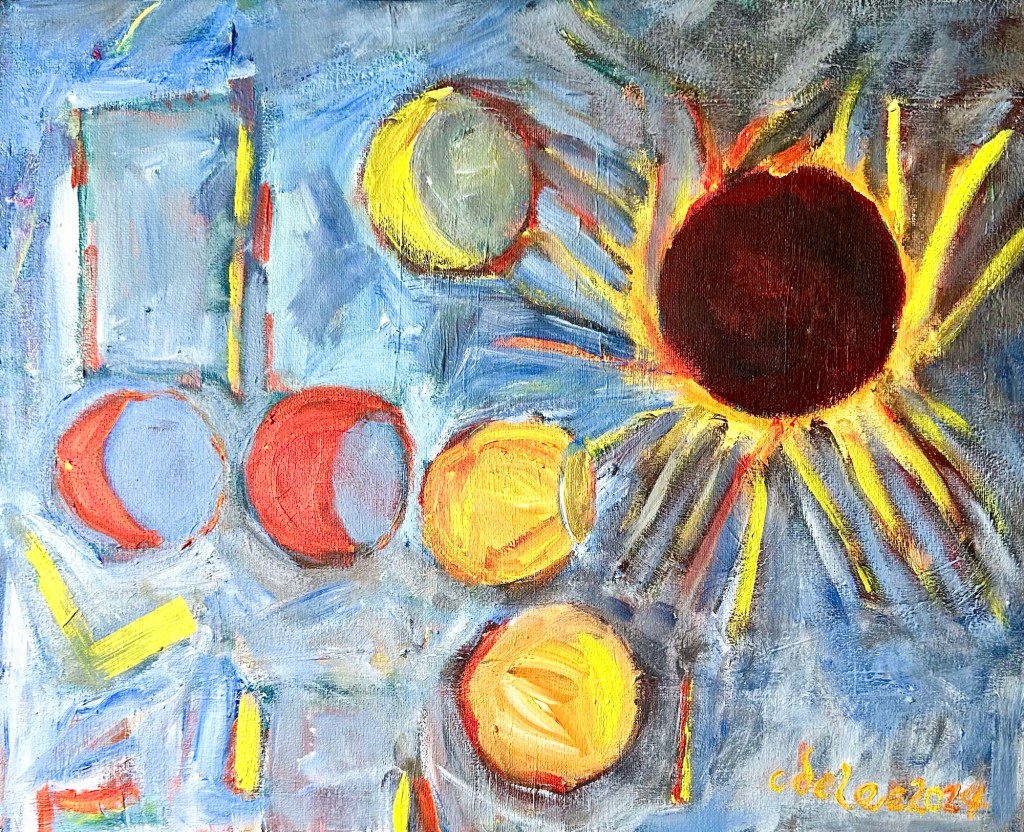
Cornelia DeLee: Memory of the Last Great Eclipse, acrylic on canvas, 12” x 24”

This is why we don’t copy nature, since it’s three dimensional and we have a two-dimensional surface on which we make our marks to represent what we see. Perspective is our visual language to fool the eye into believing our flat surface has depth. Often we paint abstract shapes and colors because these are the best means to convey our emotions about an experience. Photography captures one way of seeing, but painting can render emotions with brush strokes and colors.

Cornelia DeLee: Door to Another Reality in the Eclipse, acrylic on canvas, 18” x 24”

I subscribe to a wonderful poetry series by Steve Garnaas-Holmes, which I receive daily. This poem’s theme of universal love spoke to me as I felt the in-flooding joy of God’s creating power during the Great American Eclipse:

I have other sheep that do not belong to this fold.   I must bring them also, and they will listen to my voice. —John 10.16


We think we’re being open-minded
when we include “all of us,” Protestant and Catholic,
Orthodox and Coptic, as if we see the whole landscape.
But the pasture and the Shepherd are far greater than that.
Believer, unbeliever and other-believer alike
are all shepherded, each in their own language.
And still there are more, and more other, sheep. 
Like, well, sheep.
Do not the deer and otter, whale and fungus
follow the Shepherd faithfully?
Is not the bird migrating its continents shepherded as well?
Christ is not the partisan figurehead of a religion,
Christ is the infinite embodied grace of God,
the Shepherd of all Creation,
who leads rivers to the sea and winter into spring
and each of us into life.
So there are still other, and more “other,” sheep.
For Copernicus isn’t done with us yet:
we admit the sun doesn’t revolve around the earth,
but we still think God does.
No, little one: we are in a small corner.
Yet even the far galaxies,
the trillion trillions of stars and their planets,
and yes, their doubtless forms of life,
are also under the calm eye of the Shepherd,
and follow the Shepherd’s voice.
All of us, Baptist and Sufi, fish, bug and bird,
earthling and alien, village and nebula, all are one flock. One.
And, behold, even on the remotest planet
in the farthest flung galaxy—like ours—
or the most desolate spot in a life like yours,
under the loving gaze of the Shepherd who seeks out the one,
there is no one who is not at the center.


May you each find joy in your working, each in your separate stars, and draw the Thing as you see It, for the God of Things as They are!

Not only can God watch the sparrow, but also all the many suns and planets of creation.

Joy and peace,

Cornelia


When Earth’s last picture is painted – The Kipling Society

Steve Garnaas-Holmes: Unfolding Light 
www.unfoldinglight.net


Total Eclipse of the Heart

adult learning, arkansas, art, Astrology, cosmology, Creativity, Faith, Great American Eclipse, Imagination, inspiration, Light of the World, Love, mystery, nature, Painting, photography, shadows, Spirituality, Travel, Uncategorized, vision

In the Bonnie Tyler song, “Total Eclipse of the Heart,” her rock and roll soul pines for a young man as she sings:

“Every now and then

I know there’s no one in the universe

As magical and wondrous as you.”

Love struck teen heart ballads tend to elevate the beloved to a high pedestal, while hymns lift the praises of God to the highest heavens. If we look at John Wesley’s Notes on the New Testament, one of the doctrinal standards of the United Methodist Church, his commentary on 2 Corinthians 4:6 (KJV) is instructive:

“For God, who commanded the light to shine out of darkness, hath shined in our hearts, to give the light of the knowledge of the glory of God in the face of Jesus Christ.”

We might be more familiar with this verse in the NRSV, a more modern translation, which wasn’t available in the middle of the 18th century:

For it is the God who said, “Let light shine out of darkness,” who has shone in our hearts to give the light of the knowledge of the glory of God in the face of Jesus Christ.

Bailey’s Ring, from an earlier total eclipse over the South Pacific Ocean

Wesley’s commentary in his Notes on this text is succinct:

  1. For God hath shined in our hearts—The hearts of all those whom the God of this world no longer blinds.
  2. God who is himself our light; not only the author of light, but also the fountain of it.
  3. To enlighten us with the knowledge of the glory of God—Of his glorious love, and of his glorious image.
  4. In the face of Jesus Christ—Which reflects his glory in another manner than the face of Moses did.

What do the Total Eclipse of the Heart and Paul’s words to the Corinthian community have to do with art and faith? We’ve just experienced, what was for most of us, was a once in a lifetime experience. The last time a total solar eclipse was visible across the entire continent was in June 1918, when a total solar eclipse was visible from Washington to Florida, according to the US parks service. Nearly 100 years passed until this present Great American Eclipse.

At the 1878 total eclipse, Maria Mitchell led the Vassar College eclipse party, an all-female expedition from that pioneering women’s institution, which came to Denver in an era when science was a male bastion. Even higher education was deemed risky for the “fairer sex.” In 1873, the prominent Boston physician Edward H. Clarke had warned in an incendiary book titled “Sex in Education,” that the recent push for female colleges and coeducation could undermine women’s health by taxing their brains and causing their reproductive organs to atrophy — leading to “a dropping out of maternal instincts, and an appearance of Amazonian coarseness and force.” Nearly 150 years later some men still concern themselves with outmoded and 19th century views on women’s health concerns.

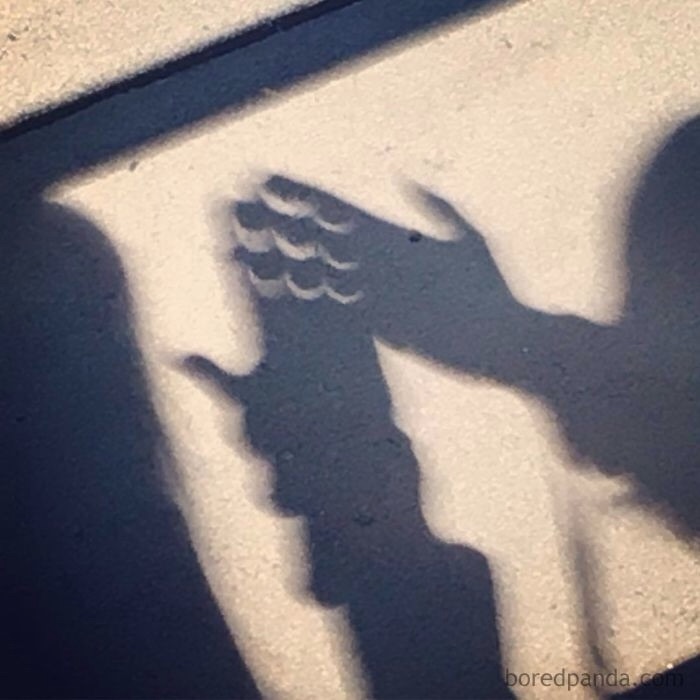
Eclipse as seen through the hands

I drove over four hundred miles to Kentucky in 2017 for the prior Great American Eclipse and got to stay home to see this second Great American Eclipse in my own front yard. Some folks couldn’t have been bothered about this current grand event, while others were convinced God was informing America of her impending doom. Moreover, multiple conspiracy theories abounded, none of which came true, of course. For instance, the world didn’t come to an end and our cell phones still work. Even the electric grid held up, even though the sun didn’t shine for all of a few minutes as the shadow traveled at over 1,600 miles per hour as it raced along the path of totality. This wasn’t even Y2K, which we all remember was a nonstarter at least and a dud at best.

Eclipse over Niagara Falls, 2024

In art class Friday Tim and I talked about the experience of this celestial event. We humans often elevate our own importance when we measure ourselves against one another and the works of our hands. When we go out into nature, we’re faced with the grandeur of God’s creation, especially when we visit the Grand Canyon or Niagara Falls. In Psalms 19:1, we read:

The heavens are telling the glory of God; and the firmament proclaims his handiwork.”

We see the beauty of nature and feel a warmth in our hearts. Our spirits soar. This intimacy with nature is one of the reasons we send our children to our United Methodist Church Camps, not just because they’ll have a great Christian experience, but because they’ll have that faith experience in nature with trusted leaders. I still remember my adventures and experiences in nature at those camps as part of my spiritual journey.

Towering Cumulus Clouds

Even in seminary, when I was having difficulty with some of my courses, I could go for a walk on the campus under the tree lined walks and search the skies for hopeful signs. Sometimes I saw the towering cumulus clouds in the Texas sky as a sign God was with me “in the cloud by day.” In those times of difficulty, even the cloistered realm of preparation seemed like a wilderness journey, but I was glad for a guide.

Bill Maxey, from Nebraska, taken at Hot Springs, AR.

When I was actively serving as a pastor, sometimes I just had to get away. I’d drive until I found some nature, a national park, national forest, or some fields outside of town. If it was a hot summer, I looked for some deep woods and cool shade to shelter me. In the cool spring, I drove until I found flowers. Maybe this is why I retired to a lake in a national park. I don’t need a big house, since I’d rather go out into nature instead.

Totality on Lake Hamilton, with sunset in the west, outside the path of totality

It was the heat of summer in 2017, so you’d think I’d remember the temperature drop right before the eclipse was halfway through. This year I was on Lake Hamilton, and the breeze off the lake combined with the cooler air was decidedly noticeable. When we entered totality, the lights on the Highway 70 bridge and at Bubba Brews automatically came on. The distant sky in the southwest, outside the path of totality, looked like a summer sunset. My neighbors and our visitors from afar were cheering.

Bill Maxey: multiple exposure of the Great American Eclipse, 2024

Not everyone can make an artwork that expresses their emotions as well as the shapes of the image. We can learn the rules of perspective and color, but then we have to learn to let our heart rule our head. This is what I call an “artistic leap of faith.” When we were young, we accepted the basic ideas of Christianity. As we got older, life happened, and we might have begun to struggle with our childhood beliefs not being equal to our adult needs. If we keep our childlike faith, we risk losing our faith. If we are able to wrestle with our faith and find a new and more mature faith, we can handle the major challenges of later life. As Paul says in 1 Corinthians 13:11-12—

“When I was a child, I spoke like a child, I thought like a child, I reasoned like a child; when I became an adult, I put an end to childish ways. For now we see in a mirror, dimly, but then we will see face to face. Now I know only in part; then I will know fully, even as I have been fully known.”

Tim’s Partial Eclipse painting using red, blue and brown to build the sky

Tim experimented with mixing colors to get richer depth. Using the Prang watercolor palette, he mixed the red, blue, and brown to get the black sky of the eclipse event. The red orange of the sun has some brown in it too. He layered the colors with multiple strokes, with a nod to Van Gogh. He worked from a photograph I brought. I pulled many of them off the internet, and many of my friends sent me some too.

Cornelia: Total Eclipse of the Sun

I worked on an image I’d taken from my iPhone. I had placed one of my eclipse glasses over the lens and was wearing another pair. It wasn’t that easy to get the sun lined up with all that blocking! My image looked a lot like a fried egg or an eyeball. I used several jar lids to get the circles painted cleanly. My dark sky is red, blue, and violet. The shape of the corona was not distinct, due to the quality of my camera. NASA has a very high-resolution image, which breath taking. Our tax dollars at work are bringing great scientific research and development to benefit us in everyday life, such as solar panels and heart implants.

NASA: High Resolution Image of the Total Eclipse

Thomas Merton, in No Man is an Island, in a chapter called “Being and Doing,” wrote—

“We cannot be happy if we expect to live all the time at the highest peak of intensity. Happiness is not a matter of intensity but of balance and order and rhythm and harmony. Music is pleasing not only because of the sound but because of the silence that is in it: without the alternation of sound and silence there would be no rhythm.”

I was a bit exhausted after all the excitement of this big event. I’d met new people from three different states, visited around our patio, and been gifted crystals that had been dug from Mt. Ida and “energized by the eclipse.” I’m not a crystal person, but I understand from those that are these crystals are “special.” I was feeling every bit of my new age as the calendar flipped over for another year.

Bourbon Codex: Aztec priestly document recording astronomical observations: eclipse

But today is another day, I had a night to sleep, and we had fun in art class. As long as we find joy in life, we know we’re alive. Our joys aren’t just collections of peak experiences, but some are the joy of the assurance of God’s enduring presence in our later lives when our youthful vigor has left us. We need to remember just as the moon eclipses the sun, once it passes, it also reveals the sun’s glory. One day this Bible verse from Philippians 3:21 will be true for each one of us, who has a heart full of love for God and neighbor:

“He will transform our humble bodies that they may be conformed to his glorious body, by the power that also enables him to make all things subject to himself.”

Joy and peace,

Cornelia


Bonnie Tyler – Total Eclipse Of The Heart Lyrics | AZLyrics.com

https://www.azlyrics.com/lyrics/bonnietyler/totaleclipseoftheheart.html

John Wesley: Explanatory Notes on the New Testament (With Active Table of Contents) [Kindle Edition], first published 1757

John Wesley: Wesley’s Notes on the Bible – Christian Classics Ethereal Library—online free edition of this book

https://ccel.org/ccel/wesley/notes/notes.toc.html

The Solar Eclipse Is the Super Bowl for Conspiracists | WIRED

https://www.wired.com/story/solar-eclipse-conspiracies/

Solar Eclipse 2017: Sun and moon put on celestial performance – CBS News

https://www.cbsnews.com/news/2017-eclipse-dazzles-million-watch-celestial-performance-sun-moon/

Thomas Merton—“No Man is an Island” in a chapter called “Being and Doing” [TMHI]: 1955

 A Woman in Eclipse: Maria Mitchell and the Great Solar Expedition of 1878

https://undark.org/2017/08/17/wilo-maria-mitchell-astronomer-eclipse/

NASA: Benefits Stemming from Space Exploration

https://www.nasa.gov/wp-content/uploads/2015/01/benefits-stemming-from-space-exploration-2013-tagged.pdf?emrc=ca90d1#:~:text=Overcoming%20the%20challenges%20of%20working,information%20technology%2C%20and%20industrial%20productivity


Rabbit! Rabbit!

arkansas, art, autumnal equinox, Children, Christmas, Civil War, Constitution, Declaration of Independence, elections, Fall Equinox, Family, holidays, Imagination, inspiration, Labor Day, perfection, photography, rabbits, St. Patrick’s Day, summer vacation, texas, US Constitution

Rabbits under a Harvest Moon

September marks the return to order and organization, since the summer for most of us meant a relaxation of rules and schedules. “Vacay mode” of late mornings, pajama days, and snack meals are now a fading figment of our fevered frenzies. I remember these days all too well. My little girl threw a conniption fit one morning as I hurriedly dressed her so we wouldn’t be late for her pre-k class and my teaching assignment at the same school. We dashed out of the house, I locked her in the car seat, and flew to my workplace. I delivered her to the precare room and made a beeline for my art shack.

Two Types of Teachers

Later on at lunch, her teacher informed me I’d brought my fussy child to school without panties. Oops! Luckily, all the children were required to have a spare change of clothes “just in case of emergency.” Saved by those who are more organized than most. My art classroom always had the paint organized by rainbow colors, the scissors numbered, and shelves labeled. The moral of this annecdote is, “Innanimate objects are easy to organize; people not so much.” Murphy’s Law also comes to mind: “Anything that can go wrong will go wrong,” and Murphy’s First Corrollary: “It will cause the most damage possible.”

For Bunnies, maybe…

In the “No Pants Scandal,” of four decades ago, only my pride was injured. I’m not as organized or as perfect as I thought I was. This brings me to a little chat on appearances vs. our true selves. Our “false self” wants to appear organized, on top of things, spiritual, magnanimous, and virtuous. We’d like to be “perfect” in thought and deed. Yet the more we try to attain perfection or to act perfectly, the more likely dark, hateful, or mean thoughts arise from the depths of our hearts. We see this is our dualist world view, which divides our world into pure evil or pure good. The book of Proverbs reminds us, “Pride goes before destruction, and a haughty spirit before a fall” (16:18). It’s always better to admit, as I did, “I didn’t have a great morning and she wasn’t cooperative. I’m surprised we got here at all.”

Welcome to September 2023

Speaking about regular and organized, our earth is about to have another equinox on September 23, 2023, at 1:50 am CDT. The Fall Equinox happens yearly on or around September 22nd. The date of the fall equinox is variable because the 365 day Gregorian calendar doesn’t match up perfectly with the position of Earth in its orbit around the sun. When we add the leap year, the equinox date also changes. While the September equinox usually occurs on September 22 or 23, it can very rarely fall on September 21 or September 24. A September 21 equinox has not happened for several millennia. However, in the 21st century, it will happen twice—in 2092 and 2096. The last September 24 equinox occurred in 1931, the next one will take place in 2303. This rabbit won’t be around for any of these rare events, so don’t send me an invite.

Rabbits on the Playground

The September 29 full moon occurs at 4:57 AM CDT. It’s called the Harvest Moon in some years, or the Hunter’s Moon in other years. Technically, the Harvest Moon, which is the Anglo-Saxon name, is the Full Moon closest to the September equinox on September 22/23. The Harvest Moon is the only Full Moon name determined by the equinox rather than a month. Most years, it’s in September, but around every three years, it falls in October. We also know this September full moon as the Corn Moon from the Native American tribes harvesting their corn in this time. Other names for this month’s full moon are Celtic and Old English names: Wine Moon, Song Moon, and Barley Moon.

E. Irving Couse: Harvest Moon

Just as summer’s laissez-faire moments will give away to school and work routines, so the onset of autumn and the fall equinox herald another change. You might not yet recognize it over the insistent hum of your air conditioning system or feel it due to the heat waves rising from the black asphalt of your company’s parking lot, but autumn is just around the corner.

ERCOT Service Zones cover most of Texas

Don’t look at your utility bill just yet, and don’t pack your bags for Texas. I talked to my brother down there who has his AC set to “stun”—he said when the bill comes, “It will stun him a second time.” Texas doesn’t belong to the national energy grid, but to ERCOT, the Electric Reliability Council of Texas. It’s not connected to the two major electrical systems of the lower 48 states, but has its own grid to avoid federal regulation. When Thomas Edison started the first electric power plant in Manhattan in 1882, he set off a gold rush of independent power companies. During WWI, they began to unite and even more joined after WWII.

Don’t Mess With Texas

Texas takes seriously its “Don’t mess with Texas” rhetoric. Only on rare, catastrophic instances has it briefly joined either the American or Mexican utility grids. While Texas is a large state with rich energy resources, the USA is larger. When extreme weather events happen, energy costs rise. Rates can vary wildly as a result. The economic lesson is ERCOT is Dollar Store trying to outbid the Walmart of the national grids who can share energy with those in need.

Thomas Nast: The Lightening Speed of Honesty, 1877

Speaking of nations, on September 7, 1813, the United States got its nickname: Uncle Sam. Samuel Wilson from New York, a meat supplier to the US Army, stamped his barrels with US for United States. The soldiers began calling their rations “Uncle Sam’s,” a name the local newspaper noted, which began to spread and soon became the personification of the federal government. Thomas Nast (1840-1902) popularized the image of Uncle Sam. In Nast’s evolving works, Uncle Sam acquired the white beard and the stars-and-stripes suit we associate with the character today. The satirical cartoon of yesteryear’s dithering Congress is apropos of our modern chambers, which can’t seem to come a reasonable compromise to get the people’s business done by funding our country’s basic needs.

Columbia, The Gem of the Ocean

Over a century before Uncle Sam, Columbia was an idealized feminine figure that personified the new nation of America. She was created in 1697 when Chief Justice Samuel Sewall of the Massachusetts Bay Colony wrote a poem that suggested the American colonies be called Columbina, a feminized version of Christopher Columbus’ last name. Over 70 years later, the name evolved further when former slave, Phillis Wheatley, wrote an ode to George Washington invoking Columbia in 1775. Born around 1753, Phillis Wheatley was the first black poet in America to publish a book. She was listed among the enslaved persons at Mount Vernon. You can read her amazing poem here:

His Excellency General Washington by Phillis Wheatley— https://poets.org/poem/his-excellency-general-washington

Over time, the image of Columbia became a symbol for American ideals during wars, such as the American Revolution, the War of 1812, and World War I, as well as the subject of political cartoons and literary works. With her liberty cap and patriotic shield, Columbia stood as the spirit of the country. We even see her name, image, and likeness in modern industry in the Columbia Broadcasting System or CBS, as well as in the seat of our national government, the District of Columbia.

Well Done Labor Poster

Uncle Sam also has honored workers on Labor Day, which we celebrate on September 4th. Many rabbit families treat this three day weekend as the last hurrah of summer. Let’s remember those essential workers who serve and protect the rest of us while we barbecue in our backyards and national parks. The first Labor Day “parade” in 1882 was a strike. Workers marched en masse from New York City Hall to Union Square to protest terrible working conditions during the Industrial Revolution. Workers, including children as young as five years old, labored in unsafe factories, farms, mills and mines for 12 hours or more per day, seven days a week, often without breaks, fresh air or even clean water.

Credits: NASA’s Goddard Institute for Space Studies

This map shows global temperature anomalies for July 2023 according to the GISTEMP analysis by scientists at NASA’s Goddard Institute for Space Studies. Temperature anomalies reflect how July 2023 compared to the average July temperature from 1951-1980.

Only 5 States Provide Heat Relief Laws for Workers. Arkansas doesn’t protect workers from dangerous heat inside or outside.

Today, 141 years later, during the hottest July since 1880, some states are passing laws to prevent workers from getting “special treatment due to the heat” such as extra breaks for cooling or water. Currently only five states have protections for workers in these extreme conditions. According to the U.S. Bureau of Labor Statistics, between 1992 and 2019, extreme heat killed more than 900 workers and sickened tens of thousands more. Those numbers, however, are likely an undercount due to the lack of reporting by negligent employers or by workers who are worried about retaliation or deportation. In addition to the physical implications, time off from a job due to illness can lead to missed wages or the loss of a job altogether.

Bain photograph: LC-USZ62-49516: Four women strikers from Ladies Tailors union on picket line during the “Uprising of the 20,000,” garment workers strike, New York City, 1910 February, glass negative photo, Library of Congress.

As a rabbit who once endured a few days in an unairconditioned art shack at the beginning of school and then fainted from heat exposure, I have a heart for all workers in extreme circumstances. I made sure to take care of my people, since my bosses didn’t care about me. It’s never right to treat others poorly just because you were wronged.

Reading The Constitution Online is also an Option

In late September, we celebrate Constitution Week (Sept. 17-23). The Declaration of Independence, written in 1776, was a list of grievances against the king of England and intended to justify separation from British rule. The Constitution was written and signed in 1787. It was a charter of government ratified by the states, and continues to be the supreme law of the land. All members of the armed services and Congress take a vow to defend the constitution, as do the President and Vice President of our country.

We rabbits will all need to brush up on our civics lessons in the days to come, for the upcoming presidential candidates may be affected by their lack of appreciation for the constitution and the consequences as a result. As I always told my students, “Attitudes drive Behavior and Behavior leads to Consequences. You can choose the good or the negative. It’s all up to you. Try for a good attitude every day.”

Tales of a Bunny Who Went to School

The 14th Amendment, section 3, passed after the Civil War, or the last great insurrection by the southern secessionist states, forbids holding office in the US government by former office holders who then participate in insurrection or rebellion. This constitutional provision is currently being tested in the courts. September is back to school for all us rabbits. The last time I remember a civics lesson was the seventh grade in Mrs. Tampke’s class, but “ex post facto” might have been “non sequitur,” as I was passing notes rather than paying attention.

Mr. Flopsy’s Rabid Rabbit Pirate won’t be Messed with.

We rabbits can only take so much seriousnes in our short lives until we need a break. Thank you September 19th: International Talk Like a Pirate Day! Everyone can ARRGG their way MATIES through a Tuesday, and if Monday is a pain, who says we rabbits can’t Pirate on that day too? After all, pirates rob and steal, lawless vagabonds that they are. Let’s just take over the good ship Monday and drink our strong Pirate Coffee with vigor and daring.

The Bluebird of Happiness

National Bluebird of Happiness Day is September 24th. I love these little blue glass figurines. Dorothy in the Wizard of Oz sings, “If happy little bluebirds fly beyond the rainbow, why, oh, why can’t I?” Bluebirds uplift the heart into joy when we see them in nature. The blue glass iconic sculptures, made in Arkansas by the Ward family, have sold over 9 million birds, large and small. They’re no longer made due to concerns about climate change because the glass production process requires large amounts of natural gas and electricity. I treasure the blue bird in my possession and greet it daily. You might find one in a secondhand store.

God Please Keep My Children Safe, by Grayson Perry, 2005

Love Note Day is September 26, so I suggest you write a sweet letter to your beloved. This might be a spouse, significant other, parent, mentor, or even your own self. Share some affirmations to those who mean something to you. Don’t stop at one note of love, but make a whole symphony of blessings. In our world today, folks don’t hear many positive messages. You can help balance the scales for your recipients.

If the Sears Catalog were still a thing, we bunnies would be wishing

September 30, the last day of this month marks 92 days left in 2023. Where has this year gone?! Don’t ask this rabbit. I’ve already bought a couple of little Christmas gifts for my bunny friends. I’m never this organized. This means I’ll likely lose or misplace these items in the 86 days before Christmas Day. Then again, this is also enough time for this rabbit to find these packages once again! Live with optimism! Expect the best and work for it.


May the Blue Bird of Happiness bring you

Joy and Peace,


Cornelia


The September Equinox

https://www.timeanddate.com/calendar/september-equinox.html


Traditional Full Moon Names

https://www.timeanddate.com/astronomy/moon/full-moon-names.html


Why does Texas have its own power grid? | The Texas Tribune
https://www.texastribune.org/2011/02/08/texplainer-why-does-texas-have-its-own-power-grid/


How The United States Got its Nickname

https://www.history.com/this-day-in-history/united-states-nicknamed-uncle-sam


The lightning speed of honesty [Uncle Sam seated on snail “45th Congress” carrying Army and Navy payroll and money, with Resumption Act (of honesty) in his pocket] / Th Nast.
https://loc.getarchive.net/media/the-lightning-speed-of-honesty-uncle-sam-seated-on-snail-45th-congress-carrying


Database of Mount Vernon’s Enslaved Community · George Washington’s Mount Vernon
https://www.mountvernon.org/george-washington/slavery/slavery-database/


Heat Stress Is Killing Workers. States Can Protect Them.

https://www.nrdc.org/stories/heat-stress-killing-workers-states-can-protect-them


Short Summary—The Character to Lead: Republicans’ Fork in the Road Between Trump and the Constitution’s Eligibility Requirements for President

https://www.justsecurity.org/87750/the-character-to-lead-republicans-fork-in-the-road-between-trump-and-the-constitutions-eligibility-requirements-for-president/


Deep Dive— The Sweep and Force of Section Three. 172 U. PA. L. REV. (forthcoming 2024). William Baude & Michael Stokes Paulsen. https://deliverypdf.ssrn.com/delivery.php?ID=791101027092090122082025003064104018105084007031052035109090080088105005086003018089043050055106031007050097096000078089031112025019027055033023110008092018116067055086024100075002015088106075126126082029114024094102088002003074126075030067104090009&EXT=pdf&INDEX=TRUE

U.S. Senate: The Senate’s First Act—the Oath Act and 1862 Ironclad Oath
https://www.senate.gov/legislative/landmark-legislation/oath-act.htm

Arkansas Bluebird of Happiness – Encyclopedia of Arkansas. https://encyclopediaofarkansas.net/entries/arkansas-bluebird-of-happiness-3822/


Rabbit! Rabbit!

art, Astrology, autumnal equinox, brain plasticity, change, cognitive decline, coronavirus, cosmology, Creativity, Family, Great American Eclipse, greek myths, Helios, nature, Painting, pandemic, photography, rabbits, Reflection, The Lord of The Rings, trees, vision

Welcome to August!

In the long summer evenings, after an extended car trip, and way beyond the too many times I’d asked my mother and daddy rabbits, “Are we there yet?” I would get their firm reminders I wasn’t to bother them any more, for they too were hot, tired, and daddy had to pay attention to the road. In the gathering darkness, I’d rest my blonde curls on the door near the open window. We had God air conditioning back then. We rolled down the window glass of our old Pontiac and drove as fast as the road would allow.

Go Faster!

I’d watch the darkening shadows as the landscape passed by this opening, noticing how the kudzu vines changed the trees into strange and monstrous shapes in the growing gloom, but I couldn’t take my eyes off of these apparitions. I was certain if I did, they’d begin to make their way toward our family car. I think I was at the age of magical thinking, for I believed I could keep these haints at bay by my will alone.

The soft flup flup of rubber tires half melting on the overheated concrete road, combined with my brother rabbits’ body heat in the seat beside me, and the enforced silence of our parents who’d had a long day with their hyperactive bunny brood finally had an effect on my eyelids. Try as I might, I would fall asleep at my watch, only to be awakened by my daddy’s sing song voice as he tickled my toes:

“This little piggy went to market, this little piggy stayed home.
This little piggy ate roast beef, and this little piggy had none!
And this little piggy cried wee-wee-wee all the way home!”

I’d rub my eyes as he picked me up to carry me into the house and into my bedroom. On the way, I’d always say,

“I see the moon, and the moon sees me,
God bless the moon, and God bless me!”

Perhaps this is a generational gift in my family, for when my own dear bunny child was small, we repeated these same scenes until she was too heavy for me to carry. The moon blessing dates from 1784 and the little piggy rhyme is even older: 1728.

That latter date is when horses and carriages were banned from Boston Common. Since I went to school in Boston, I can attest no horses, carriages, or cows are now on the grounds of the Common, which is now a 50 acre public park. The Common dates from 1634, when William Blaxton sold the remainder of his land to the Puritans, receiving six shillings or more from each shareholder to purchase the land for this public land. This was the site of the Boston Massacre, in which five people died. One good thing about going to school in an historic community, everywhere you went, you weren’t far from history.

When I think of history, I think not only of the stories we pass down to the next generation, but also of the stories we weave for ourselves. How do we remember our childhood or our families of origin? This is a generational gift of privilege, for those who lost their families when they were young may not have memories to weave together. Refugees from wars and violence might not want to recall traumatic experiences. Yet Abraham, the father of the Jewish nation, is remembered as “My ancestor was a wandering Arameam” (Deut 26:5).

Some of us choose to write about our better days, for they outnumber our bad days. Everyone has imperfections, but each of us rabbits are still going on to perfection with the help of the good God above. Perhaps when we see the beauty of the full bright moon against a dark, clear night, our heart leaps inside and says,

“I see the moon, and the moon sees me,
God bless the moon, and God bless me!”

For some of us rabbits, nature brings us closer to God than anything else. The majesty of the summer thunderclouds rising in the heated air, and giving way to either refreshing rain or flashing floods, reminds us once again of the powers of God unleashed in God’s creation. The rainbow after the storm is the promise once again of that covenant made so long ago: the earth will never be destroyed by floods again. In the rainbow, in the light of all the colors, we hear God’s promise of love and care for God’s creation and God’s creatures.

DeLee: Blue Moon

I’m looking at a full super moon tonight, July 3, but August will have TWO super moons. Looking ahead to September 29, we’ll have our FOURTH super moon in a row. The moon on the 31st of August will be a blue moon. This is the second full moon in the same month. We won’t have another blue moon until May, 2026. This is why things that don’t happen often are called “once in a blue moon” events.

Once upon a time, we were agrarian people who eked out a subsistence living on the land. The persistence of The Old Farmer’s Almanac and other ancient weather wisdom lore is proof you can take the bunny out of the country, but you can’t take the country out of the bunny. Yet as our alphabetical generations accumulate beyond the boomers, like Lucy on the Honeymooners, we often “got some explaining to do” to make ourselves understood.

Sirius in the Night Sky

We can count the “Dog Days of Summer” among the sayings folks don’t understand today. The term has nothing to do with the four legged creatures known as our best friends, but instead, it’s an astronomical term. The name comes from Sirius, the Dog Star, which rises before dawn. We find it on a vertical line below the three stars of Orion’s Belt. Sirius was named from the Greek Seirios, which means ‘glowing’ or ‘scorcher.’ This is an apt description of the warmest days from mid July to mid August.

Crepe Myrtle Bark Peeling in the Heat

Aratus, a Greek 3rd BCE poet wrote in his astronomical poem Phaenomena, (p. 328 ff, trans. Mair):

“A star that keenest of all blazes with a searing flame and him men call Seirios (Sirius). When he rises with Helios (the Sun), no longer do the trees deceive him by the feeble freshness of their leaves. For easily with his keen glance he pierces their ranks, and to some he gives strength but of others he blights the bark utterly. Of him too at his setting are we aware.”

These Dog Days of Summer in the ancient Mediterranean were marked not only by heat, but also by drought and pistelence. This year, with an El Niño weather pattern, wild fires, floods, and extreme heat have settled on the area due to a heat dome, which the European meteorologists have named Cerebus, after the three-headed dog guardian to Hades. The ruins on the Acropolis now close from noon to late afternoon to prevent heat illness.

Porch of the Maidens, Acropolis, Athens

Although the ancient Greeks and Romans believed Sirius was the reason for summer’s intense heat, we know now that star is too far away to affect our weather. What does affect our weather today is the result of human activities. Back in the Eemian period, around 116,000 to 129,000 years ago, the earth’s axis was tilted more towards the sun than now. This caused our northern polar region to be warmer and grow trees, which kept snow from accumulating. As a result, the earth’s temperature was 2 degrees C hotter than preindustrial levels, while today’s temperatures average 1 degree C warmer.

Today, we have evidence of geographic drift caused by climate change in our crops. Areas once known for coffee or wheat are shrinking, moving further north or to higher altitudes. We also see shrinking polar ice sheets, which cause ocean levels to rise. More water, combined with more heat leads to more intense storms. We also have rivers of wind, aka the jet stream, which lock in the heat domes. These can persist for days, while the rest of the earth gets flooding and storms.

Not a Watermelon Chart: Similar to the National Weather Service’s heat index chart, this chart translates combinations of air temperature and relative humidity into critical environmental limits, above which core body temperature rises. The border between the yellow and red areas represents the average critical environmental limit for young men and women at minimal activity.

Extreme heat is the number-one weather-related cause of death in the U.S., and it kills more people most years than hurricanes, floods and tornadoes combined. Despite the fact that extreme heat has been the number one cause of weather-related deaths in the United States over the last three decades, the federal government has repeatedly declined to declare extreme heat a federal disaster. The US government has never issued a federal disaster declaration for an extreme heat event in the three times it’s been requested, even as heat domes and long, uninterrupted stretches of 100-plus degree days have claimed lives in cities and states across the country in recent years.

The 10 hottest years on record have occurred since 2010 and the month of June alone in the USA has broken over 1,000 high temperature records. The combination of El Niño, a warming ocean current, and climate change is the cause. The excessive heat in the oceans are causing coral diebacks, which have negative implications for future hurricane shore losses, since coral reefs break the incoming waves.

We bunnies can blame the Stafford Act for this. Natural disasters in the USA are handled by FEMA—Federal Emergency Management Agency. The Robert T. Stafford Disaster Relief and Emergency Assistance Act, PL 100-707, was signed into law November 23, 1988 when Congress amended the Disaster Relief Act of 1974, PL 93-288. Named for the Vermont senator who was instrumental in its passage, this is one of the 100 laws a President can use to declare a national emergency or disaster. Former President Trump used it to declare the COVID pandemic an emergency. It’s this Stafford Act that defines “Emergency.”

According to Congressional laws, a disaster emergency is “any occasion or instance for which, in the determination of the President, Federal assistance is needed to supplement state and local efforts and capabilities to save lives and to protect property and public health and safety, or to lessen or avert the threat of a catastrophe in any part of the United States in a Major Disaster.

The act defines “major disaster” as any natural catastrophe (including any hurricane, tornado, storm, high water, winddriven water, tidal wave, tsunami, earthquake, volcanic eruption, landslide, mudslide, snowstorm, or drought), or, regardless of cause, any fire, flood, or explosion, in any part of the USA, which in the determination of the President, causes damage of sufficient severity and magnitude to warrant major disaster assistance under this chapter to supplement the efforts and available resources of states, local governments, and disaster relief organizations in alleviating the damage, loss, hardship, or suffering caused thereby.

Fires of Mordor have nothing on Phoenix Heat

To get heat relief, it will require an Act of Congress. In plain speak, we’ll see snowfall before heat relief legislation becomes law in today’s divided and polarized congressional body. In the last century, we bunnies weren’t thinking about climate change, extreme weather events, or even naming our winter storms. Perhaps next summer we’ll begin naming our extended heat waves and treat them with the same seriousness as we give to hurricanes and blizzards.

In the meantime, this bunny has set her AC to cool and is keeping the ice bin filled and the tea jar full. I’m feeling the siren call of the school supply aisle, so I’ll find a cool morning in mid August to go buy ink pens, notebooks, and some postynotes. A bunny who keeps learning will always stay young. Building new pathways for the neurons is like cleaning out the clutter in our brain box.

Write now, Edit later. The stories are more important than the form.

I always recommend picking up a new skill or renewing an old one, for not only do creative activities give us an opportunity to focus on something other than how hot it is, but also we can enjoy our progress as we continue to work. If you’ve ever wanted to write about your family history, begin now, for the day will come for all of us when we won’t remember the ones we love. This bunny hopes you have bunnies who love you and honor you for who you’ve always been, even if you become the “one who comes to kiss me every afternoon at 4 o’clock.”

Pluto: Now a Dwarf Planet

I’ll probably go buy my journal supplies on August 24th, and sit in my favorite coffee shop for a bit to drink in memory of Pluto, who was worthy enough to be a planet for my generation,but has been demoted to a dwarf planet because it hasn’t cleared its neighborhood of other objects.

I look forward to cooler breezes, falling leaves, and Pumpkin Spice lattes. See you in September!

Joy, peace, and iced tea,

Cornelia

The Project Gutenberg eBook of Gammer Gurton’s Garland, or, The Nursery Parnassus, by Joseph Ritson.
https://www.gutenberg.org/files/34601/34601-h/34601-h.htm

Teaching Early Math to Children—This Little Piggy
https://www-tc.pbs.org/parents/earlymath/pdf/LittlePiggy.pdf

Origin of This Little Piggy
https://www.rhymes.org.uk/this_little_piggy.htm

Boston Common Master Plan
https://www.bostoncommonmasterplan.com/history

Super Moons, Blue Moons
https://www.fullmoonphase.com/

What is a blue moon and when will the next one occur? | Royal Observatory Greenwich https://www.rmg.co.uk/stories/topics/what-blue-moon-how-often-does-it-occur

SIRIUS (Seirios) – Greek God of Dog-Star https://www.theoi.com/Titan/AsterSeirios.html

THE DOG DAYS OF SUMMER: European heat wave takes toll on tourists – Travel Industry Today
https://travelindustrytoday.com/the-dog-days-of-summer-european-heat-wave-takes-toll-on-tourists/

42 U.S. Code § 5122 – Definitions | U.S. Code | US Law | LII / Legal Information Institute FEMA STAFFORD ACT
https://www.law.cornell.edu/uscode/text/42/5122
https://www.fema.gov/disaster/stafford-act

Extreme Heat Is Deadlier Than Hurricanes, Floods and Tornadoes Combined – Scientific American
https://www.scientificamerican.com/article/extreme-heat-is-deadlier-than-hurricanes-floods-and-tornadoes-combined/

From Japan to Louisiana to Rome, Here Are Ten Heat Records Earth Has Broken Since June | Smart News| Smithsonian Magazine https://www.smithsonianmag.com/smart-news/ten-heat-records-earth-has-broken-since-june-180982562/

Rabbit! Rabbit!

arkansas, art, chocolate, Easter, Faith, Food, Garden of Gethsemane, Good Friday, holidays, Holy Thursday, john wesley, Love, Painting, photography, rabbits, Salvador Dali, Spirituality, Spring Equinox, United Methodist Church


Welcome to April 2023

April Fool! Caught you! Were you the prankster or the pranked? Even an institution as stuffy as the British Broadcasting Corporation isn’t above pranking the public on the first day of April. If a fool and his money are soon parted, then whatever the BBC was selling, they were having a jolly good time in their advertising department. You can watch their mini documentary on Flying Penguins below:

When I was at Perkins Seminary, we editors of the weekly newsletter had a tradition of an April Surprise. This followed the practice of the former Babylonian Schismatic, which was an alternative, satirical student newsletter published occasionally between 1981 and 1988.

One year, when I was coeditor, it was more of an April Debacle. My partner in crime and I were sure the beach ball bouncing off the usual chapel steeple logo would be enough to clue our community into the prank. However, we failed to realize how little sleep our fellow students actually got during school weeks, how seriously they took the printed word, and worst of all, that our newsletter also went to bishops’ widows in faraway places. This last was what got us into the real trouble.

Our faux reports of Perkins losing its accreditation due to shenanigans of prior graduates, who were in the news at the time, had graduate students storming the dean’s office. Even worse, the bishop’s widows were calling him to inquire what kind of school he was overseeing. The fact schools can only lose accreditation for their own failures (and not the trespasses of former students or faculty) never crossed anyone’s mind in the ensuing uproar. So of course, we criminals wrote handwritten letters of apology to the widows and printed retractions in the next newsletter for the students. I now understand why my mother said I sometimes take things too seriously. Still, I’ve have found others who make me look like a giggle queen.

The Giggle Queen and her Pet Rabbit

Speaking of giggles, although the historical roots of April Fool’s Day are shrouded in mystery, the British, who are mostly known for their dry wit and stiff upper lip, seem to enjoy this holiday to excess. Especially at the BBC, which back in 1957, produced a fascinating prank documentary on the Swiss Artisanal Spaghetti Industry. They showed a Swiss family harvesting ripe spaghetti strands from their spaghetti bushes. At the time because of rationing, spaghetti wasn’t widely available. After 1956 in the British Isles, Italian companies opened spaghetti factories and Italian immigrants opened restaurants. The British developed a taste for this food. As a result, some British families were so enthusiastic, they wanted to purchase their own spaghetti bushes for a home garden. Others were unhappy to be pranked. This may be one of the first times the medium of television was used to stage an April Fool’s Day hoax.

Moveable Feasts: Passover and Easter

Israel was an ancient agricultural culture and followed a lunar calendar, so sighting the full moon was important. Passover is always pegged to the Hebrew calendar, which is based on the lunar cycle. It starts in the middle of the month of Nisan, when the moon is full, typically falling in March or April of the modern Gregorian calendar. As a result, Passover typically begins very close to Easter. Easter Sunday is always the first Sunday after the first full moon after the Spring Equinox. However, due to the shorter Hebrew calendar, sometimes it gets a leap month to keep it in tune with the seasons. In 2024, when the leap month plays a part, we’ll have an early Easter on March 21st, but Passover won’t start until April 22nd.

Rabbit Last Supper

These religious holidays are forever entertwined because of the historical events of the Last Supper, which we assume was a ritual meal or Seder, and the crucifixion on a Friday, which required Christ’s body to be taken down from the cross due to the beginning of Passover at sunset.The Last Supper took place on a Thursday night, even though the actual Passover didn’t begin until Friday night.

Dali: The Sacrament of the Last Supper, 1955, oil on canvas, National Gallery of Art, Washington D. C.

As Wesley’s Notes on The New Testament observe, “Jesus took the bread—the bread or cake, which the master of the family used to divide among them, after they had eaten the passover. The custom our Lord now transferred to a nobler use. This bread is, that is, signifies or represents my body, according to the style of the sacred writers.”

We know this because Jesus was arrested in Gesthemane after this meal and then taken to the Roman Governor Pilate on Friday morning, the day of Preparation for the Passover. John 18:28 reminds us how the temple priests “…took Jesus from Caiaphas to Pilate’s headquarters. It was early in the morning. They themselves did not enter the headquarters, so as to avoid ritual defilement and to be able to eat the Passover.”

Early Handdrawn Valentine, 1814, writing in an unending circle

The Jews in the first century kept faithfulness according to laws of separation and purity, so they kept away from unbelievers on holy days. This was the biblical practice of the time. Early Christians continued this practice until Paul began his outreach to the Greek and Roman citizens of the world. When in the later gospel of John (14:15) Christ says, “if ye love me, keep my commandments, Wesley’s commentary understands this to mean: “Immediately after faith he exhorts to love and good works.” This is why we United Methodists practice an open table at Holy Communion, or the Lord’s Supper, for all who love the Lord and desire to be in love and fellowship with their neighbors are welcome at his table. We don’t exclude anyone, for God includes all people into the circle of God’s love.

Love never ends and love never dies

Since Easter Sunday is always the first Sunday after the first full moon after the spring equinox, this makes Easter a “moveable feast.” Unlike a picnic, for which we tote our fixings from our kitchen to a park or to the countryside, or unlike a house to house “progressive dinner,” Easter is called “moveable” because it’s not on a fixed date like Christmas or New Year’s Day.

Baked Ham with Canned Pineapple Rings and Cloves

My family’s Easter feast always centered about a baked ham, often covered with canned pineapple rings and studded with cloves. We were a modern American 1950-60’s family and Betty Crocker reigned in my mother’s kitchen. Just this week I saw a tv advertisement of a family feast with this very same baked ham. I suppose when the economy gets dicey, people pull out old familiar recipes from the great-great-grandmother’s kitchen. Since I have a new great-grandchild on the way, and a knitting project started, I can safely say, this isn’t an April Fool’s joke. I’ve seen the sonogram images!

2012-2022 Top Ten Cities for Extreme Weather Warnings issued by National Weather Service

“April showers bring May flowers” is an ancient rhyme. Unfortunately, these showers also bring pollens of every kind, since trees and flowers both acquire crowns of glory. The Old Farmer’s’ Almanac notes while November has a bit more rain in store for Arkansas than April usually brings, this month’s warmer weather favors conditions for flowers to bloom and trees to bud. While we might tire of the storms and the havoc they wrack upon the populace, we’re always thankful if they only cause damage to property and don’t take human lives.

Sick Bunny

Across North America, the pollen season has lengthened by 20 days since 1990. Pollen concentrations have also increased by 21 percent over the past three decades. This means some of us have been doctoring ourselves or visiting the RD—real doctor—since February. The stubbornest of us waited until almost April because we were convinced we could heal ourselves. If you still have no energy and are grumpy to boot after a month, you too need a RD. Better living through chemistry with put a perk back into your bunny hop.

Stylish Bunnies

Speaking of the weather, I have seen many years now of Easter sunrise services, and even more later noontime Easter feasts. One thing ties them all together: no matter how cute my spring outfit is, no one ever sees it because I’m always wearing a raincoat or a winter coat over it. My guess is rain and cool weather will come and our egg hunts will likely be inside. As long as there’s a dark chocolate Easter rabbit for my personal gratification, I’ll be happy. I discovered last year’s version stored in the cabinet, so I’d better make some chocolate chip cookies soon.

Only hugging can save us

There’s plenty of silly or merchandising holidays in April, but you can read about them at the link below my name. Until May, I remain your April Fool…

Joy, peace, and chocolate rabbits for everyone,

Cornelia

April Daily Holidays, National, International. Holiday Insights.
https://www.holidayinsights.com/moreholidays/april.htm

Why Easter and Passover are observed on different dates each year
https://www.azcentral.com/story/travel/arizona/2018/03/28/why-easter-and-passover-have-different-dates-each-year/466341002/

The worst cities in the U.S. for allergies
https://www.washingtonpost.com/climate-environment/2023/03/16/allergy-season-pollen-count-climate/

BBC Flying Penguin Documentary April Fool Prank
https://youtu.be/9dfWzp7rYR4

BBC 1957 Spaghetti Documentary April Fool Prank
https://youtu.be/8scpGwbvxvI

BBC ON THIS DAY | 1 | 1957: BBC fools the nation
http://news.bbc.co.uk/onthisday/hi/dates/stories/april/1/newsid_2819000/2819261.stm

No spuds please, we’re British
https://www.theguardian.com/g2/story/0,3604,371547,00.html

Is April Really The Month of Showers? – Farmers’ Almanac
https://www.farmersalmanac.com/april-showers-bring-may-flowers-34814

Where the Most Weather Warnings Are Issued in the U.S. | Weather Underground
https://www.wunderground.com/article/safety/thunderstorms/news/2022-03-18-most-national-weather-service-warnings-us

Growth in Faith and Art is a Risky Business

adult learning, arkansas, art, brain plasticity, change, Children, Creativity, Faith, Holy Spirit, hope, Icons, Imagination, inspiration, john wesley, Ministry, New Year, Painting, Pantocrator, perfection, photography, purpose, risk, Spirituality, vision

Oscar Wilde famously said, “Life imitates art far more than art imitates life.” This is because the self-conscious aim of life is to find expression and art offers it certain beautiful forms, through which it may realize that energy. Yet most people who look at artworks judge them for the degree to which they represent “three dimensional reality,” in either two or three dimensions (painting, draw,or sculpture and assemblage).

Often I’ve been asked about my colorful landscapes, “Don’t you ever paint these in normal colors?”

My answer is usually, “How do we know the colors we see today are the original colors of Creation? After all, we now live in a fallen and broken world. Perhaps these bright colors were God’s original palette.” I’m not painting just what I see, but what was and what is yet to come. These are visions of a better world, where the leaves clap their hands for joy.

In art class, we not only struggle to master drawing shapes “as they are,” but also to challenge our minds to break free of our need to exactly reproduce the shapes before us. We always have the tension to make only a “copy of the image before us,” rather than to meet the image on a spiritual plane and portray an intimate portrait of its inner truth.

When we meet a stranger, we can hide behind our masks and keep our distance. Likewise, we can fail to become intimate with our painting’s subject matter. The resulting work is cold and dead, like a limp handshake. It’s a risky business to bare your heart to the canvas and paint. The brush will tell if your heart and soul is in it or not.

We get more comfortable with this risky business by practicing risk taking. It’s not like we’re facing tigers in a circus cage or jumping out of an airplane without a parachute. We can’t lose our salvation in Christ if we make a bad painting. We only have a new level from which to start afresh. All growth requires risk and failure. We discover what works, keep that, and eliminate the unuseful.

Willingness to learn is related to the “growth mind-set.” This is the belief your abilities aren’t fixed but can improve. This willingness is a belief not primarily about the self, but about the world. It’s a belief every class or learning experience offers something worthwhile, even if we don’t know in advance what that something is. Every teacher or parent worth their salt has to believe their students or children can learn and grow, or they need to give up their profession so another can grow. The first lesson even the most recalcitrant student needs to learn is to believe growth and progress is possible.

Christ on Tree of Life, San Clemente Basilica, 12th Century mosaic, Rome, Italy.

The Christian life has a parallel to the growth mindset. The whole of the Christian life is wrapped up in this faith: with God’s help, we can go on to perfection. This is a basic Methodist belief known as sanctification. We also call it going on to perfection in love of God and neighbor. Some of us think because we’re not able to change on our own, we don’t need to grow in our love. God has done all the work for us in Christ. The Holy Spirit was sent to be a truthful guide:

“When the Spirit of truth comes, he will guide you into all the truth;
for he will not speak on his own, but will speak whatever he hears,
and he will declare to you the things that are to come.” (John 16:13)

Christ in Majesty, Book-Cover Plaque, French, Limoges, enamel, ca. 1200 CE, Metropolitan Museum of Art, NYC.

Paul speaks of this truth in Philippians 3:20-21, when he reminds the people of their present state as sojourners in this world, while their citizenship is elsewhere:

“But our citizenship is in heaven, and it is from there that
we are expecting a Savior, the Lord Jesus Christ.
He will transform our humble bodies that they may be conformed
to his glorious body, by the power that also enables him
to make all things subject to himself.”

Mother About to Wash Her Sleepy Child Mary Cassatt, 1880

If life is a journey, the Christian life is even more of a pilgrimage. We all go through stages of faith if we seriously reflect and consider our beliefs when our life experiences intersect with our faith. Our earliest stage of faith begins with our parents or caregivers. Here we learn to trust or distrust, as we experience an embodied faith. The next stage is early childhood (age 3-7). Faith at this stage is experiential and develops through encounters with stories, images, the influence of others, a deeper intuitive sense of what is right and wrong, and innocent perceptions of how God causes the universe to function.

Michaelangelo: Creation of Adam, Sistine Chapel Ceiling

The next stage has been labeled “Mythic-Literal Faith” (Ages 7-12). Children at this stage have a belief in justice and fairness in religious matters, a sense of reciprocity in the workings of the universe (e.g. doing good will result in a good result, doing bad will cause a bad thing to happen) and an anthropomorphic image of God (e.g. a man with a long white beard who lives in the clouds). Religious metaphors are often taken literally, thus leading to misunderstandings. If God’s rewards or punishments don’t apply in proper retribution, in the believer’s mind, their faith in God’s system becomes fragile.

Théodore Géricault, Raft of the Medusa, 1818–19, oil on canvas, Louvre, Paris.

“The Conventional Faith” stage (12-adult) arises when individuals join a religious institution, belief system, or authority, and begin the growth of a personal religious or spiritual identity. Conflicts occur when one’s beliefs are challenged are often ignored because they represent too much of a threat to one’s faith-based identity.

Théodore Géricault’s “Raft of the Medusa,”painted in 1818–19, is nearly 17 by 23 feet large. It commands its space as any proper historic painting of the past ever did. Rather than present a moral lesson from the past, the artist instead chose to paint an event from his present time: the rescue of the abandoned sailors and slaves from a wrecked ship. The French nation had sent the new governor of the Senegal colony, his family, and some other government officials and others on the Medusa. The government officials went to secure French possession of the colony and to assure the continuation of the covert slave trade, even though France had officially abolished the practice. Another group aboard the Medusa was composed of reformers and abolitionists who hoped to eliminate the practice of slavery in Senegal by engaging the local Senegalese and the French colonists in the development of an agricultural cooperative that would make the colony self-sustaining.

On the way, the ship ran aground and broke up. The officials and their families were put in lifeboats, but the 150 others on board got a makeshift raft, which was tied to the lifeboats. When the raft impeded the lifeboats, the officials cut the raft loose and all the lives with it. Only 15 were rescued after days at sea, and only ten lived to tell their tales. It was a scandal of the times. Géricault read all the newspapers, interviewed survivors, and made studies from ancient sculptures to inform his design. When younger artists saw his inspirational work in the Paris Salon, they knew a sea change had happened. Conservative critics and writers were appalled and accused Géricault of creating a disgusting, repulsive mistake. They were not yet ready to leave the past behind.

William Faulkner once said, “You cannot swim for new horizons until you have courage to lose sight of the shore” (The Mansion , 1959). When we meet that initial storm, our first thought is to bring our fragile bark into port. In life, we batten down the hatches and book it for a safe harbor. In art class, we want to fall back on what we’ve always done before, what we know we can do, and what we’ve been successful with in the past. This is our “safe harbor.”

“Individuative-Reflective Faith” (Mid-Twenties to Late Thirties). The individual takes personal responsibility for her beliefs or feelings, often by angst and struggle. Religious or spiritual beliefs can take on greater complexity and shades of nuance, and a greater sense of open-mindedness. These can also open up the individual to potential conflicts as the different beliefs or traditions collide.

To progress and grow in our art skills, or to move through the “dark night of the soul” when we question our formerly held spiritual truths, is a crucial time. Crucial is a word sharing the same root as crucifix. The crux of both of these situations results in a life and death situation. Not that the person quits breathing or their heart stops beating, but will their old life die and their faith be reborn anew? Also, will they trust a power greater than themselves to bring them back from the depths? Many of us aren’t willing to give up control to anyone, and certainly not to a God we can’t see. We’re two year olds in our spiritual lives too often, for “I can do it myself!” Is our answer to everything and everyone. (Test it out—how many of you read the directions after you start putting a project together?)

The Cross that Spoke to St. Francis, San Damiano Chapel, Italy, 1205 CE

“Conjunctive” Faith (Mid-Life Crisis). A person at this stage acknowledges paradoxes and the mysteries attendant on transcendent values. This causes the person to move beyond the conventional religious traditions or beliefs he may have inherited from previous stages of development. A resolution of the conflicts of this stage occurs when the person is able to hold a multi-dimensional perspective that acknowledges ”truth’ as something that cannot be articulated through any particular statement of faith. This is where the Holy Awe begins to fill all the nooks and crannies from which it was once forbidden.

Face of Christ (All People of the World), photo montage

“Universalizing” Faith (or ”Enlightenment”). (Later Adulthood). This stage is only rarely achieved by individuals. A person at this stage is not hemmed in by differences in religious or spiritual beliefs among people in the world, but regards all beings as worthy of compassion and deep understanding. Here, individuals ”walk the talk” of the great religious traditions (e.g. ”the kingdom of God is within you”).

“Jesus of the People” by Janet McKenzie.

In 1999 Janet McKenzie’s painting “Jesus of the People” was selected winner of the National Catholic Reporter’s competition for a new image of Jesus by judge Sister Wendy Beckett, host of the PBS show “Sister Wendy’s Story of Painting.” In the words of Sister Wendy, “This is a haunting image of a peasant Jesus—dark, thick-lipped, looking out on us with ineffable dignity, with sadness but with confidence. Over His white robe He draws the darkness of our lack of love, holding it to Himself, prepared to transform all sorrows if we will let Him.” The model was an African-American woman and the painting includes a yin-yang symbol of Eastern traditions and feather of Native American traditions. (Photo courtesy of Paul Smith)

Next week, we’ll still be working on order and chaos. We got started on this at our first meeting, and the concept is a challenge. I’ll write about our class work then. We’re always open to anyone joining us, for you come as you are and begin where you are. Our art group is a “one room schoolhouse” with all levels of students mixed together. We may all be doing the “same project,” but everyone does it at their own skill level. I give you special attention according to your needs.

Remember, “The only way you can be behind is if you never start.”

Joy and peace,

Cornelia

Life Imitates Life | Lapham’s Quarterly
https://www.laphamsquarterly.org/swindle-fraud/life-imitates-life

The Stages of Faith According to James W. Fowler | Thomas Armstrong, Ph.D.
https://www.institute4learning.com/2020/06/12/the-stages-of-faith-according-to-james-w-fowler/

Théodore Géricault, Raft of the Medusa – Smarthistory
https://smarthistory.org/theodore-gericault-raft-of-the-medusa/

Video and photo slideshow: The many faces of Jesus
https://religionnews.com/2014/01/28/video-photo-slideshow-many-faces-jesus/

Year End Art Class Notes

adult learning, Arches National Park, arkansas, art, Christmas, color Wheel, Creativity, Faith, holidays, Imagination, inspiration, Ministry, nature, Painting, photography, shadows

While some are counting the days until Christmas, some of us are are counting the remaining days left in the old year of 2022. Somehow I always get a cleaning burst of energy around the end of the year. Maybe I hear my mother’s voice urging me, “Let’s get the house straightened up, so Santa will find it neat and clean. There’s no way the jolly old man can find the tree when the house is in this much mess!”

My mother’s idea of a mess was a line not perpendicular to its base, or a fragment of paper left on the table. She mostly cleaned to the grooves while my grandmother was alive, for she slacked off after Nannie passed on. The Christmas tree was ensconced in the NONO ROOM, also known as the living room. It acquired the NONO nickname because our parents never let us into it, for we weren’t allowed to touch anything inside it. We lived in the den, like the pack of wild animals we were. We weren’t raised by wolves, but our parents were never able to wring the wolf out of their brood.

I confess I still organize my large spices by size on one shelf and the smaller ones alphabetically on another shelf. I can’t understand anyone who sets their spices on the shelf willy nilly, so they have to search for them every time. Then again, I sort my paints by color and temperature. Organization is one thing I did learn from my folks, even if I didn’t inherit an obsession for daily cleaning.

However, with less than two weeks before Santa comes to visit and Christmas Eve services will bring the birth of Christ to mind once more., my inner mother began to notice strange flecks of dust on the high cabinet doors, as well as dust bunnies rolling out from behind the sofa. Some people have visits from the Ghosts of Christmas Past. My mother comes to visit me. At least I can still climb ladders.

While I’m cleaning up the house, I should catch up on some art works our Oakland UMC art class has been doing. I took off for a month to visit California, came down with a couch bug that made me so congested I couldn’t think, paint, or do doodly. For some reason, Mike moved faster than I could get my camera out, so I don’t have all his photos. Also, sometimes he was tied up in court doing good for others. I promise to do better in the New Year.

Delaunay: View of Paris, Eiffel Tower

The following three paintings began with the idea of circles and lines. As usual, I showed a few different examples from well known artists whose work hangs in museums. This quality inspiration helps students come up with better ideas.

Gail’s Circles

Gail combined her lines with her change of colors. Those boundary lines set up a line which carried through the subtle colors of the background. Limiting her color scheme helps to define these lines. She likes to plan her ideas out in her head first, imagine how they will look, and then paint.

Mike’s circles and lines in the image below reflect his more exuberant personality. Using both the compass and the ruler, he came up with a variety of circles and lines. Mike paints as the spirit moves him. Whatever feels good, that’s where he goes next. He’ll adjust as he goes.

Mike’s Circles

Either of these methods are fine. If one doesn’t get you down the road to the place you want to go, then maybe it’s time try a different route. I never force anyone down a particular fork in the road. I let them explore in one direction until they learn all they can or hit a dead end. Then they can follow the “road not taken.” Everyone gets to try both roads eventually, and learn the ancient wisdom, “All roads lead to Rome.”

This Road May Lead To Rome Eventually

In the art world, “Rome is the fullest experience of both order and emotion.” Some of us prefer one over the other, just as I prefer order in my spice rack, but I’m willing to throw the spices into the soup by sight and not by measuring spoons. We can get too organized or too exuberant, as the Greeks were fond of saying, “The middle path is safest and best.”

Klee: In the Beginning

During this time, the Russian attack on the largest nuclear power plant in Europe was ongoing. Not only was the electricity at the plant cut, an act which blacked out Ukraine and much of Eastern Europe, but it also threatened the stability of the nuclear reactors there. The Ukrainian engineers at the plant were prisoners of foreign soldiers, who knew nothing about the dangers of their stronghold. The world held its breath as fighting broke out around this sensitive target.

Cornelia’s Ukrainian Power-plant Under Attack

Thanks to satellite imagery, today we can see via the internet, what we waited to see in newsreels at the theater, the last time we fought on European soil. We had to wait until the evening news to see film from Vietnam. Now cable news breaks every half hour with the same old news and we might get an update if we’re lucky. Not all can afford to send reporters to distant lands anymore.

By the grace of God, that power plant still stands. However, Europe and Ukraine will have a cold and costly winter. We should not complain if our prices rise, for it’s a small price to pay for democracy and freedom. There are still nations who would oppress smaller countries, just as the Roman Empire did back in the time of Christ’s birth. As we remember in Matthew’s story of The Visit of the Wise Men (2:1-2):

In the time of King Herod, after Jesus was born in Bethlehem of Judea, wise men from the East came to Jerusalem, asking, “Where is the child who has been born king of the Jews? For we observed his star at its rising, and have come to pay him homage.”

This information led Herod to kill all the innocents, the children under two years old in and around the town of Bethlehem (Matthew 2:16-18). Brutality and mass executions aren’t a recent invention of despots desperate to retain power at any cost. The ethical term is utilitarianism, where one uses others as means to gain their own ends. The test question for this type of ethics is “Does the end justify the means?” At what point can you excuse bad or corrupt behavior to get good results?” A moral person answers, “I prefer good means for good ends and will use those unless I’m in a life or death situation.”

I returned, no worse for wear, from my vacation and texted the group to bring a vacation landscape photo to work from. Of course, Gail brought her latest vacation dream destination and Mike brought several island maps to combine into one image. It was the same island where he and his wife had vacationed, but one had tourist attractions, another was history, and the other natural beauty. He has a flair for combining things. Unfortunately, his busy life gets in the way of keeping all his art supplies in one place, so between his work chaos and organizing chaos, plus my slow phone draw, I failed to get his interesting map. It was a good idea.

Gail’s Mars Elevation

The new Mars rover has been sending back some awesome images. The folks at NASA must be over the moon, without a rocket. Gail worked on this elevation image for two weeks, with colors representing different heights in the landscape. It’s a good copy of the image. In the new year we need to go back to three dimensional work again, but we have had fun with color mixing and texture.

Cornelia’s Western Landscape

While out west, I visited as many national parks as I could manage. I did see many volcanoes and convened in a cave, plus I visited Roswell, NM, but wasn’t abducted by aliens. I was impressed with Arches National Park, and hiked about it most of a day. It’s a stark place, with strong rock formations jutting into a brilliant blue sky. The bright sunshine makes strong patterns of light and dark across the landscape. Most of what grows out in the desert is short grasses or a scrub brush, but on occasion, I would find a gnarled tree in dark shade.

Gail’s Christmas Tree

At Mike’s request, we made Christmas cards, but he had to work that day. Probably helping someone with legal matters, because that’s his calling. Gail and I had fun working on the cut paper cards. I was thankful she brought me a coffee. Whatever bug I had took a while to clear my system. Caffeine helped. She rearranged these triangles several different ways on a horizontal plane and never felt satisfied with the way they looked. Because she was wise enough not to glue them down first, she could see her ideas weren’t hitting her happy place.

Then she turned everything straight up, and organized the design on a perpendicular. Now her tree has its happy red birds, a sequin star, and little trees in the background.

Cornelia’s Card

I brought one of my many boxes of colored paper from my scrapbook stash. I know the Christmas colors are red and green, but I made an Advent Tree. This is why it’s violet and pink and blue. Anyway, we don’t have to follow the rules for Christmas trees. If we want a pale purple tree, we can have one. It’s our tree. Santa will still put a present under it, and the color of our tree doesn’t impair our salvation. A nativity set looks just fine under any color tree.

I know we have at least one more class in December on the 16th. Depending on if my plumber is coming over on the 23rd, we might not meet that day. He said he’s behind, so I don’t know. I’ll be on vacation on the 30th, so we’ll see each other in the New Year of 2023!

I always say, “if I ever get totally organized, the world is coming to an end.” Maybe it’s the providence of God that I always bite off more than I can chew, because I’m never totally organized! But I am going on to organization.

Joy, peace, and a better filing system,

Cornelia

Rabbit! Rabbit!

Altars, architecture, art, Christmas, Creativity, Faith, holidays, hope, inspiration, Light of the World, Marcus Aurelius, Painting, photography, poverty, rabbits, renewal, Roman Forum, Saturnalia, Temple of Saturn, winter solstice

Welcome to December! While I was writing this blog, it was Black Friday in November, when many rabbit families were either shopping in person or online. I once did this with my dear rabbit mother, for she loved to shop. As a child of the Great Depression, the thrill of giving gifts, however small to all her friends, was a joy denied to her while growing up. Today we rabbits aren’t so much into giving gifts, but in sharing experiences. We’re making different choices. We aren’t rejecting our forebears’ decisions, but we have different values. As the writer of Ecclesiastes 3:1 reminds us, everything has its time:

“For everything there is a season, and a time for every matter under heaven.”

Christmas Gift

The holiday season begins earlier and earlier, or maybe I’m just an old rabbit having a fever dream. Last year the supply chain snafus were the Grinch that stole Christmas. Some of you rabbits may have been in a FIFA World Cup worthy soccer scrimmage last year at a big box discounter while trying to score one of the few PlayStations that managed to make its way from China to America on one of the large container ships that wasn’t lost at sea or stuck in the Suez Canal. The good news is the resulting logjam at the shipping docks has since been cleared and all the major retailers expect to get their holiday goods on time, compared to only 53% in 2021. We rabbits aren’t getting this news, however, so about half of us are pessimistic about being able to find our desired gifts in stock.

On March 23 2021, the containership Ever Given ran aground in the Suez Canal, blocking all traffic going both ways.

As a young rabbit, I learned about Murphy’s law from the “Rambling Wrecks from Georgia Tech, who were all one heck of an engineer.” If you’re not familiar with Murphy, his law states, “Anything that can go wrong will go wrong,” and the corollary law is “It’ll go wrong at the worst possible time and cause the most damage possible.” One would think these engineers were all chronic pessimists who saw the proverbial water glass half empty, but they would claim they’re just realists. Murphy’s Law simply reflects the natural fact we can’t control outcomes or people. Since the results of future actions can’t be avoided, you always should prepare for the worst and rejoice if the best happens instead.

Murphy’s Laws

I’ve always been fond of Murphy’s Law, but never more so during the holidays. Holiday festivities always include people, activities done only once a year, and often larger, unsupervised groups (often including alcohol), which means Mr. Murphy is often an uninvited guest. How he manages to sneak in, I have no idea, but he’s shown up in my rabbit den or kitchen more than once. Maybe he has an affinity for my rabbit clan, or perhaps he’s drawn to chaos and confusion. I’m not saying my rabbit family is a rowdy bunch, but we’ve always been loud and active. There’s not much difference between a whirlwind, a tornado, and my two brothers.

Grand Rabbit Wisdom

I don’t remember Murphy appearing at my Grand Rabbits’ celebrations, but they were of the generation who believed “little rabbits should be seen and not heard.” I imagine they showed Murphy the door if he dropped by. Likewise, when my mother began hosting the holiday meals, the Murphy drama of “anything that can go wrong will go wrong at the worst possible time” also never happened. My mom took on a drill sergeant’s precision when she produced the roast beast feast.

Not my tree, not my cats, but same Murphy result

When I bought a little house, Murphy made himself welcome. I invited friends over to decorate the Christmas tree. We stepped back to toast our creation, but the tree crashed forward to the floor, as if it were taking a bow in response. Our toast interrupted, we set the tree upright, tied it to the window handle, and resumed our toast in peace. One day I’ll tell you about my experiences of raking the roof on that little house before the rainy season set in each fall.

Murphy wouldn’t leave me alone. I moved to Texas, bought another little house, and my dear mom and dad invited themselves and my brother’s family over for a holiday feast. She pushed all the potato peels into my starter home’s basic garbage disposal and turned it on. If “Anything can go wrong at the worst possible time and cause the worst damage possible,” my dear bunny mom discovered it.

“I don’t understand; my disposal at home will handle all this.”
“Yes, mother. You have a real, custom house, not a starter home. This is a baby disposal.”

Then we got the wastebasket, the pliers, and I put on my plumber’s hat. We pulled out the clog, drained the water, and put it all back together again. Mom was traumatized. Mom kept apologizing, but I reminded her, “It’s no big deal. It won’t happen again. And we have food to eat. We’ll laugh about this one day!”

Murphy still visits me on occasion. But I’ve learned to prepare for him to limit his damages. This thanksgiving I had a friend for dinner. They made a bathroom visit before they left. When I went there, I found the faucet still running and I wasn’t able to turn it off. Water was all over the floor and inside the original cabinet from 1965. I turned off the water under the sink, thinking I was glad I’d asked my plumber to give me new shutoffs when I put the new faucet in. The old ones had froze shut. I’m now brushing my teeth in the kitchen sink, but that’s all right. I’ll probably have to replace this whole thing, all for the demise of a $5 faucet washer. This is Murphy’s Law in a nutshell. Santa will have to visit Lowes or Home Depot for my Christmas gift this year. I hope I’ve been a good rabbit, as the saying goes. And my stocking is extra big.

Christmas isn’t the only holiday of December, although an estimated $942.6 billion in holiday retail sales in the United States might cause us rabbits to think otherwise. One study found that 60% of workers were more distracted and less motivated as the Christmas holidays approached, with some workers even saying this feeling started as early as November. Likewise, during the holiday time many employees will take off to spend time with family or just to enjoy the holiday. That cuts into productivity as well. We have our own Mr. Scrooge in our rabbit towns too. I have any number of rabbit buddies who need time off to hunt and be alone in the woods for a bit. I begrudge them not, as long as their spouses can take care of holidays uninterrupted.

Postal Worker delivering packages

The coming darkness of the Winter Solstice causes people all around the world to light fires and burn candles to overcome the gloom. We’ve done this for ages and in many places. In fact, humans may have observed the winter solstice as early as Neolithic period—the last part of the Stone Age—beginning about 10,200 BCE. The Romans celebrated Saturnalia, a winter solstice celebration dedicated to the Saturn, the god of agriculture, wealth, and time. While it began as a one-day celebration in early December, this pagan festival later expanded into a riotous weeklong party stretching from December 17 to 24.

Robert Macpherson: Roman Forum—Temple of Saturn, 1850s, J.Paul Getty Museum

The Temple of Saturn, the oldest temple recorded by the pontiffs, had been dedicated on the Saturnalia around 497 BCE on a site originally occupied by an altar to the god. Due to the link between Saturn and agriculture, the original source of Rome’s wealth, the temple was also the repository for the State Treasury, or the Aerarium Populi Romani, which was located beneath the stairs under the high podium. It also contained the bronze tablets on which Roman law was inscribed.

Saturn with Harvest Scythe

The woolen bonds, which fettered the feet of the ivory cult statue of Saturn within, were loosened on the festival day to symbolize the god’s liberation. On this festival day, after a sacrifice at the temple, the people held a public banquet attended by both slave and free persons. An image of the god was placed as if in attendance at this meal, or a lectisternium (reclining on a couch), a tradition which Livy says was introduced in 397 BCE. (Others date this to 399 BCE.) The practice was introduced as a specific emergency response to a natural crisis: extremes of temperature occurring in both summer and winter had given rise to a devastating plague that had proceeded to ravage the population. It was celebrated from December 17 to 23, ending on ending on the Dies Natalis Solis Invicti, or the birthday of the Unconquerable Sun.

Not only were public rites celebrated with all the splendour then available, but Livy goes on to describe the general tenor of the private celebration in the late 1st C BCE (around the time of the birth of Jesus Christ):

“They also celebrated the rites in their own homes. All through the city, it is said, doors stood wide open, all kinds of food were setout for universal consumption, all comers were welcomed, whether known or not, and men even exchanged kind and civil words with personal enemies; there was a truce to quarreling and legal action; even prisoners were released from their chains for those days, and they hesitated thereafter to imprison men whom the gods had befriended.”

Roman coin with a image of of Marcus Aurelius on obverse and on reverse, a lectisternium associated with an atonement meal, c 167/168 CE. Münzkabinett, Berlin

This ritual meal was commonly shared by the worshippers, in contrast to normal sacrifice, which distinguished human from divine portions. In other words, in the Lectisternium the gods were not only present in spirit, but in form, and they shared in the ritual meal.

The question we have to ask is how did Saturnalia move from a feast of appeasement to reduce harm to the people, to the debauchery which most history books write about today? The powers that be tried over the years to limit the length and celebratory excesses of the season, whether they were civic or religious powers. I suppose they had no counselor rabbits to advise them of Murphy’s Law: “Very little work will get done in the holiday season, and what does manage to get done will most likely need redoing in the New Year.”

Beaker with Inscription, “Rejoice Much,” 1st century AD, Eastern Mediterranean.
Glass, 3 1/16 × 2 7/8 in. The J. Paul Getty Museum, 2004.35

By the 1st CE, Pliny, the Roman historian, was holed up in his room during Saturnalia, while the rest of the family celebrated the feasts, hijinx, and tomfoolery. In the 4th CE, the Christian church decided Christ’s birthday should be celebrated in the winter near the solstice, instead of in the more likely time of spring. The first reference to December 25 as the Nativity of Jesus occurs in a section of the Chronography of AD 354 known as the Calendar of Philocalus, which, even by this late date, still identified December 17 as ludi Saturnalia. By this time, some of the traditions of Saturnalia had already transferred into the Christian era. These were the green decorations of holly, a plant sacred to Saturn, in people’s homes; the small gifts of affection for all comers; the feasts; and the welcoming of strangers with fruit treats and nuts. Upending social conventions for a while reminds us God has no favorites, unlike our stratified social structures of the past and present.

Monogramme of Christ (the Chi Rho) on a plaque of a sarcophagus, 4th-century AD, marble, Musei Vaticani, on display in a temporary exhibition at the Colosseum in Rome, Italy. / Photo by Jebulon

December 17 was recognized as the date of the Saturnalia as late as 448 CE, when the ecclesiastical calendar or laterculus (“list”) of Polemius Silvius noted it as feriae servorum (“festival of the slaves”), a festival now deprived of its pagan significance. By the eighth century CE, church authorities complained how even people in Rome were still celebrating the old pagan customs associated with the Saturnalia and other winter holidays. The Temple of Saturn was largely destroyed in the mid-fifteenth century, so all that remains today is six of its Ionic granite columns crowned with a frieze thought to date to approximately 30 BCE.

As we approach the solstice time and the season of the Lord’s birth, we give thanks along with the gospel writer of John 1:5—

“The light shines in the darkness, and the darkness did not overcome it.”

Along with all my bunny friends and family, I hope you all remember what my little daughter said about that “Luke guy, who had such a big part in the Christmas Eve service” the year she learned to read:

“By the tender mercy of our God,
the dawn from on high will break upon us,
to give light to those who sit in darkness and in the shadow of death,
to guide our feet into the way of peace.” — Luke 1:78-79

Holman Hunt: Behold, I Stand at the Door and Knock , 1854, Kebel College, Oxford, England

Joy, peace, and Good Cheer,

CORNELIA

Consumers Expecting Issues in Survey on Holiday Supply Chain Issues | Transport Topics
https://www.ttnews.com/articles/consumers-expecting-issues-survey-holiday-supply-chain-issues

Murphy’s Laws—CMU School of Computer Science
https://www.cs.cmu.edu/~fgandon/miscellaneous/murphy/

How Murphy’s Law Works | HowStuffWorks
https://people.howstuffworks.com/murphys-law.htm

Statistics on Holiday Retail Sales 2022
https://www.statista.com/statistics/243439/holiday-retail-sales-in-the-united-states/

The business of Christmas | Hult International Business School
https://www.hult.edu/blog/the-business-of-christmas/

8 Winter Solstice Celebrations Around the World – HISTORY
https://www.history.com/news/8-winter-solstice-celebrations-around-the-world

December Solstice Traditions and Customs
https://www.timeanddate.com/calendar/december-solstice-customs.html

Temple of Saturn – History and Facts | History Hit
https://www.historyhit.com/locations/temple-of-saturn/

(99+) ‘Guess who’s coming to dinner?’: the origins and development of the lectisternium. | Michael Beer – Academia.edu
https://www.academia.edu/2076041/_Guess_who_s_coming_to_dinner_the_origins_and_development_of_the_lectisternium

Saturnalia: How Did The Romans Celebrate ‘Christmas’? | HistoryExtra
https://www.historyextra.com/period/roman/how-did-the-romans-celebrate-christmas/

Saturnalia
https://penelope.uchicago.edu/~grout/encyclopaedia_romana/calendar/saturnalia.html

Reflections on America

Arches National Park, art, beauty, elections, Grand Canyon, Imagination, inspiration, nature, photography, renewal, Travel, US Constitution, vision, Walt Whitman

Today marks one week since our most recent election. Many races have been decided, while some are due for an automatic recount due to the close vote. At least one senate race will have a runoff between the top two candidates (Georgia), as some races haven’t been decided at all, since the vote counters took Veteran’s Day and Sunday off. Then we have all the legal, but late arriving mail-in ballots from the military and overseas residents. These too need counting. We’ll know the final, final results sometime after December 6th, when Georgia results are in.

Grand Canyon

Pundits on the left and right can give you commentary ad nauseam for the duration with breaking news alerts or standing up for what’s right(wing). They’ll talk demographics, policies, and statistics, but you won’t get that commentary here. I’m more interested in the deep derivations of the arcana of the day. Arcana is that mysterious or specialized knowledge, language, or information accessible or possessed only by the initiate —usually used in plural. The singular arcanus, is from the Latin, arca, chest. It was first used in the 15th century.

El Capitan, Yosemite National Park

Of course, the conspiracy mongers among us are busy weaving tales of hanky panky. As an aside, my spell check wants to make this phrase “hanky pancakes.” I’ll check in with Cornie’s Kitchen to see if there’s any special ingredient for making hanky panky pancakes. Hanky pank once referred to any of the various carnival games in which contestants might win small prizes for the exercise of simple skills (such as dart throwing). State Fair enthusiasts who succumbed to the barkers of carnival games might, if they were lucky, grab a few of these prizes, but as in casino betting, the wise player remembers the house usually wins. It’s an old word, dating from the 1840’s, maybe related to Hokey Pokey. Both these words referred to trouble making bordering on the illegal, if not out right against the law.

This is why your parents warned you not to run away and join a traveling circus or side show, as “There’s hanky panky going on there, child, and you’ll come to no good!” Not that I ever tied a peanut butter sandwich up in a bandana and walked away from home, or at least I got as far as that sandwich took me, which was to the end of the city block. Hot summer days can change a child’s mind about running away from home.

Big Oak Road, Yosemite National Park

Those trading in false tales were known as mongers, from which we get the word “costermongers,” or apple sellers. In the 1510s, “itinerant apple-seller” was formed from coster (a type of apple ) + monger (“to traffic in, deal in,” often implying a petty or disagreeable traffic, by 1897). The sense extended from “apple-seller” to “hawker of fruits and vegetables,” to any salesman who plied his wares from a street-cart. Contemptuous use is as old as Shakespeare: “Virtue is of so little regard in these coster-monger times, that true valour is turn’d bear-herd” (2 Henry IV), but the reason for it is unclear.

Arches National Park

But I come not to bury America, but to praise her, especially the American democratic project, which so far has earned the distinction of having the world’s longest surviving written charter of government. It was written in 1787, ratified in 1788, and has been in operation since 1789. We’ve celebrated 233 years of our unique brand of representational democracy. We aren’t ruled by mobs/anarchy, nor by a wealthy few/oligarchy, or even by one/autocracy, but by all who vote/democracy. As Whitman writes, we must be careful to distinguish between the “chosen” and the “act of choosing.” It’s not the winning candidate which represents the “heart”of our democratic achievement, but rather the “quadriennial choosing” itself.

Arches National Park

If you follow my musings, you’ve probably guessed Whitman is a favorite poet, and the varied landscape is a renewing and inspiring source of reconnecting with a creator God. I recently took a vacation to California and photographed some of our great national parks in the month I took off to see America. On my journey, I met generous, kind, and decent people everywhere I went. May God bless America and use her bounty and her people to bring peace and prosperity to the nations of the world. I hope my images do justice to Whitman’s words.

Headed to Albuquerque

Election Day, November, 1884
By Walt Whitman

If I should need to name, O Western World, your powerfulest scene and show,
‘Twould not be you, Niagara—nor you, ye limitless prairies—nor your huge rifts of canyons, Colorado,
Nor you, Yosemite—nor Yellowstone, with all its spasmic geyser-loops ascending to the skies, appearing and disappearing,
Nor Oregon’s white cones—nor Huron’s belt of mighty lakes—nor Mississippi’s stream:
—This seething hemisphere’s humanity, as now, I’d name—the still small voice vibrating—America’s choosing day,
(The heart of it not in the chosen—the act itself the main, the quadriennial choosing,)
The stretch of North and South arous’d—sea-board and inland—Texas to Maine—the Prairie States—Vermont, Virginia, California,
The final ballot-shower from East to West—the paradox and conflict,
The countless snow-flakes falling—(a swordless conflict,
Yet more than all Rome’s wars of old, or modern Napoleon’s:) the peaceful choice of all,
Or good or ill humanity—welcoming the darker odds, the dross:
—Foams and ferments the wine? it serves to purify—. while the heart pants, life glows:
These stormy gusts and winds waft precious ships,
Swell’d Washington’s, Jefferson’s, Lincoln’s sails.

Joy and Peace,

Cornelia

Walt Whitman: Election Day November 1884
https://poets.org/poem/election-day-november-1884

What does Hanky Panky mean?
https://writingexplained.org/idiom-dictionary/hanky-panky

Words related to monger
https://www.etymonline.com/word/monger/related

Shakespeare: Julius Caesar Speech, spoken by Marc Antony
https://www.poetryfoundation.org/poems/56968/speech-friends-romans-countrymen-lend-me-your-ears

NOTES: Whitman’s Election Day, 1884 https://pubs.lib.uiowa.edu/wwqr/article/26076/galley/134444/view/