A Map of a Changing World View

art, change, cognitive maps, cosmology, Creativity, Faith, Healing, Icons, mappa mundi, nature, Painting, Pantocrator, renewal, Spirituality, vision

Jesus and The Cosmos

When our world is changing “faster than we can say Jack Rabbit,” sometimes life can get overwhelming. My dad often used this quaint phrase when he wanted something in a hot minute, like a bowl of ice cream just before bedtime. Or when he wanted us kids to get a move on and not dilly dally. Usually we were messing around and goofing off when our parents had time constraints, so the tone of his voice sometimes sharpened with the promise of consequences if we weren’t front and center right now. My parents were usually in hurry mode, while we kids never quick unless the destination was the local Dairy Queen. We all screamed for ice cream in my family.

This clock knows which way the wind blows

Grownups have a different sense of time than children do. Adults know from experience how short lived is the human existence, for they’ve lived long enough to have loved and lost. Children, who’re generally protected from such harsh realities, live in worlds in which time both stretches into eternity and seems to stand still. I call this variable sense “rubber band” time, since it can both stretch to the moment of breaking, but also snap back to inertia or non movement. For children, especially at year end, Christmas comes on lumbering feet, but for parents, the season is far too brief. The day blows through on a wind from the north, like a polar front charging into the Deep South on a mission to freeze every fragile magnolia blossom before the new year can make an appearance.

Treasure at the end of the rainbow

Children’s worlds are different from adults, for they still have a sense of wonder and all things are new to them. I remember seeing my first rainbow high up in the sky. I put up such a clamor on the front porch as I called for my mother, she was sure I’d seen a snake or some dangerous animal. She was put out I’d called her away from her household tasks “just to see a rainbow.” To this day, I still think rainbows are wondrous writings in the sky and meant to give us joy for our mundane lives. Seven decades later, the child in me still celebrates rainbows.

Our sense of time changes as we age, for everything a child sees is a first and a best. This is why we can have such deeply imprinted memories from our childhoods. Later on, we’re doing the same things over and over, so unless these events stand out for some different reason, they all tend to blend together. We also tend to think of these as “this is the way life is,” or they become the “model” for our world. This is also known as our cognitive map.

Some people can give good directions to their home, while others wouldn’t be able to get someone to their place even if they lived in a teacup. Those “others” lack good cognitive maps, for they don’t have a good mental image of the landmarks on the way to their home. Today, our cognitive maps are undergoing rapid change. The world we used to know doesn’t exist, mostly because of COVID. Once we had a service economy, but now we don’t do face to face experiences because of the pandemic, so we buy goods. We’re buying so many goods (can we ever buy bads?), we have supply chain problems trying to provide them all. We’re so used to same day or next day delivery from our pre-pandemic lives, we think our world is coming to an end if it’s going to take a week to get our cherished gifts delivered.

That old world existed back in 2005, when Amazon Prime partnered with the US Postal Service for its packages’ last leg of delivery. Today we have on demand groceries ordered through the app for immediate pick up or delivery, as well as restaurant foods for the same. This was unimaginable just a decade ago. It’s still so new, some folks won’t use it, even if they were on their death bed. Their cognitive map won’t let them try a new thing, for these new places and experiences aren’t encoded on their mind maps.

British Library: Mappa Mundi

The ancient world maps, dating from the peak of the Middle Ages, take their cartography from both faith and geography. One of the earliest is the Map Psalter, which takes its name from its full-page illustration of a map of the world. It’s design shares close parallels with the famous Mappa Mundi, now housed at Hereford Cathedral. The manuscript was made in London during the latter half of the 13th century but after 1262, as the Psalter’s calendar commemorates on 3rd April the feast day of St Richard of Chichester (d. 1253) who was canonized in 1262.

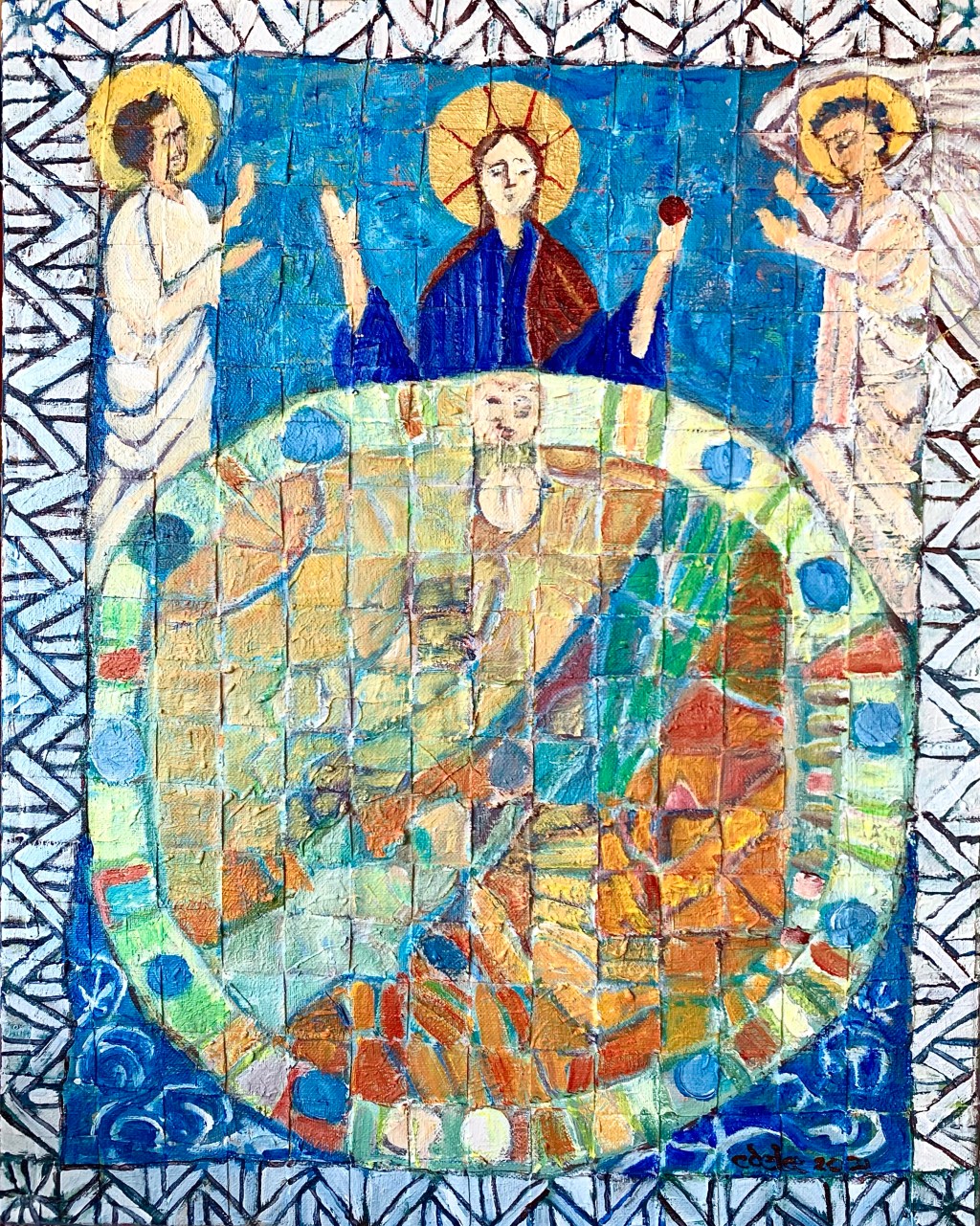
The image shows Christ holding the orb of the world, flanked by two angels. The map itself is highly detailed. Jerusalem is marked in the center, with Rome appearing slightly below it. Major rivers, such as the Ganges and the Danube, are drawn in blue, and the Red Sea is also included. Representations of the so-called ‘Marvels of the East’ line the right-hand side of the painting. The British Isles are found to the lower left.

Hereford Mappa Mundi

The Hereford Mappa Mundi is unique in Britain’s heritage. An outstanding treasure of the medieval world, it records how 13th-century scholars interpreted the world in spiritual as well as geographical terms. The map bears the name of its author, ‘Richard of Haldingham or Lafford’ (Holdingham and Sleaford in Lincolnshire). Recent research suggests a date of about 1300 for the creation of the map. An unknown artist drew the Hereford Mappa Mundi on a single sheet of vellum (calf skin), measuring 64 × 52 inches (1.58 × 1.33 meters), tapering towards the top with a rounded apex.

The geographical material of the map is contained within a circle 52 inches in diameter and reflects the thinking of the medieval Church, which places Jerusalem at the center of the world. Drawings of the history of humankind and the marvels of the natural world are superimposed onto the continents of the world. These 500 or so drawings include around 420 cities and towns; 15 Biblical events; 33 plants, animals, birds, and strange creatures; 32 images of the peoples of the world; and 8 pictures from classical mythology.

We all make maps in our minds, otherwise we’d get lost going from our easy chair to the kitchen to get a snack on a commercial break. This is because our hippocampus is working well. Some of us have a talent for getting lost in a proverbial tea cup, especially when landmarks aren’t visible. When I lived in Colorado, I always knew which way I was headed as long as I could see the mountains. At night, I had no idea, so I could get lost easily.

T shape map, East at top

The ancient western world oriented their maps with east at the top and Jerusalem at the center because the sun rose in the east and faith was primary in their world view. The Chinese, who were the first to invent the compass, often drew maps with South on top because they always thought the compass pointed to South. South was their sacred direction, for in any religious or royal ceremonies the kings faced south. This perception may have come because the northern parts of China were cold and dark.

The Islamic maps of the era also drew the south on top, since the initial Islamic habitations were north of Mecca. Therefore, South-oriented maps would show the followers looking up towards it. Yet, our maps today orient north instead, due to Mercator, the noted mapmaker of the 16th century. By this time, sailors were navigating not only by the North Star, but also with the compass. Their sailing records were complete and detailed. Mercator used these to create the first Mercator Projection map, which was more correct than any map beforehand. After this map, all western maps set North as the top of the map.

Columbus managed to find the Americas in 1492 with the map he had at the time, but he was convinced he’d found islands outlying Japan or Asia because he’d traveled the distance the map had indicated was necessary to find the Asian continent. This is a classic case of cognitive dissonance, for the map Columbus had in his mind and in his hand didn’t correlate with reality. This disconnect can cause us discomfort or cause us to make decisions or conclusions based on a reality that no longer exists or doesn’t fit the facts in hand.

All of us have this problem, to one degree or another. As we grow up, we discover our childhood myths are just stories, and the Tooth Fairy, the Easter Rabbit, and Santa Claus aren’t real, but just our parents acting in secret to bring magic into our childish world. As the oldest child in my family, I recall the Christmas I realized Santa Claus wrote in the same distinctive script for which my father was known. Unlike many doctors, my dad had elegant and legible handwriting. At the tender age of five, I made the choice to keep the secret of Santa Claus safe for my younger brother’s sake. Besides, as long as I believed, I would get presents from both my parents and Santa. Keeping the Santa secret safe had its advantages.

These old maps also remind us how our point of view determines our world view. If we see the world with the eyes of faith, we’ll observe the world through a different lens than the person who looks through a microscope or telescope. A person of faith can look through these tools and see the wonders of God in the smallest or most distant bits of creation, but without faith, these views will be unique, but not inspiring.

In ancient times, while sailors navigated with their eyes fixed on the Northern Star, they also depended on the written records of previous sailors. They depended on the capricious sea gods to protect them and their cargo from harm. Sailing was a dangerous occupation and goods were often lost at sea. The apostle Paul was caught in a storm on the Mediterranean for two weeks, when the crew finally threw the cargo of wheat overboard to lighten the load. Even in the first century, there were supply chain issues in the grocery business (Acts 27). Afterwards, Paul met and healed people on shore and the ship finally got under way with new supplies to replace the old ones.

Today, our settled lives have been upended by a tiny virus that seems to mutate and persist. What we used to know as normal now feels strange. I grew up hand washing dishes at the kitchen sink, but since COVID and the demise of my garbage disposal, I’m back to hand washing them until the plumber can rotorouter my drain and I can put Mr. Dishwasher back to work. I’m not sure my dishes are clean or sanitary. Of course, I obviously made it to a ripe old age without a dishwasher, but the pandemic has changed my worldview. I see germs everywhere now.

“‘Adjusting our expectations to account for unpredictability, uncontrollability, and the fact that our lives may be disrupted on and off, and building that into our expectations, would be good for our mental health,’ said Karestan Koenen, a professor of psychiatric epidemiology at the Harvard T.H. Chan School of Public Health. “As humans, we don’t have as much control as we think we do. The virus has just made it very clear.” Many of us have a world view that puts us in charge of all things, when in truth we aren’t the captains of our fate.

First Stage, Map Icon

The first stage of my icon map followed the original map fairly well, but I let it rest next to my easel for a long time. This was a sure sign I wasn’t happy with it. The old map was a world view which belonged to a different age, but not to me. When I thought of my own world view, Jesus still had priority as Lord and Ruler of creation, but the world over which he reigned wasn’t merely the earth, but all of the known universe.

After a vacation, I decided to repaint it. The central swath of color represents the Milky Way in the night sky, as seen from earth. The warm golds and reds are the energies of all the planets and the stars in our universe, as well as the heat of all the life on earth. If we are all one, and Christ is lord of all, we humans have a particular responsibility to care for life in all its forms. As John 10:10 reminds us, Jesus said:


“I came that they may have life, and have it abundantly.”

Joy and Peace,

Cornelia

Cognitive Map – an overview | ScienceDirect Topics
https://www.sciencedirect.com/topics/neuroscience/cognitive-map

Map Psalter, British Library
https://www.bl.uk/british-library-treasures/articles/maps-and-views

Mappa Mundi | Hereford Cathedral
https://www.herefordcathedral.org/mappa-mundi

No, It’s Not Just You: Why time “speeds up” as we get older – Science in the News
https://sitn.hms.harvard.edu/flash/2019/no-not-just-time-speeds-get-older/

Why maps point North on top? – Geospatial World
https://www.geospatialworld.net/blogs/why-maps-point-north-on-top/

The Washington Post Analysis | This is how America is responding to Omicron
By Olivier Knox and Caroline Anders
https://www.washingtonpost.com/politics/2021/12/03/this-is-how-american-is-responding-omicron/

Autumn Leaf Prints

adult learning, art, autumn leaves, Carl Jung, Christmas, coronavirus, Creativity, Faith, grief, holidays, inspiration, nature, Painting, renewal, shadows, Spirituality, trees, vaccinations, vision

As the days grow shorter, the pile of leaves grows larger. This is Einstein’s equation for autumn. I know “Energy equals Mass times the speed of Light squared” isn’t really congruent with all those bags of leaves accumulating on the edge of the streets of the front yards in your neighborhood. It just seems that way. When I bought my first little stucco, flat roofed house back in my hometown, the former owners reminded me at closing, “Be sure and rake the roof every autumn.”

Of course I forgot about this, until the twenty something major trees around my little flat roofed house dumped all their leaves on my roof. How did I know? When it rained, those leaves blocked the drainage holes, so water came inside the ceiling light fixtures of my kitchen in the back of the house. As soon as the rain quit, I had the ladder out and was filling the big, black garbage bags with soggy leaves. If you only fill them half way, they’ll stay intact when tossing them over the parapet. I was younger then, and trainable. I didn’t forget when autumn came the next year.

Gail’s Leaves floating on Water

I’ve always thought leaves “fell” off the trees or the wind blew them off, but I asked Mr. Google, “Why do leaves fall?” Turns out, the trees cut them off with scissor cells. The leaves are only useful for making food for the tree. They are the seasonal kitchen staff, so the tree lets them go for the winter and brings in a new crew in the spring. The changing light and cooler temperatures triggers a hormone that makes this happen.

The scissor cells are stained red and mark the boundary between the branch (left) and the leaf stalk.
University of Wisconsin Plant Image Teaching Collection

If the leaves stayed on the tree, they’d wake up during a winter warm spell, start their food production work, and then get frozen when the cold inevitably returns. The tree knows the lifespan of the leaf, and this is the natural course of the life cycle. New growth will come in the spring, after a period of rest and recovery.

Lauralei’s Memories of The Leaves that Were

Our holiday season coincides with darkening days and marketing excess. Most of the commercials show happy families with lots of presents in heavily decorated holiday environments. Statistics show 25% of people are estranged from their families, and one out of every 463 Americans alive at the beginning of 2020 has since died of covid-19, the disease caused by the novel coronavirus. About 1 in 8 Americans say that a member of their family died of the virus; another fifth say that they lost a close friend, according to YouGov polling. These are staggering numbers, for in the US alone, 779,293 people have lost their lives as of November 30, 2021. One too many Thanksgiving tables had an empty place setting for a loved one no longer among us, and this will be a blue Christmas for many families.

If this were a war, maybe folks would get all excited and consider good health practices such as mask wearing , hand washing, and vaccinations their patriotic duty. Instead, they throw themselves into the breach of a thousand tiny viruses as if they were seeking the congressional gold medal for valor, and end up leaving their families with nothing but medical bills, grief, and the loss of their presence. Into this weary season comes Omicron, yet another variant, but an expected event due to the lack of worldwide access to vaccines and the virus’s ability to mutate in immunocompromised individuals. The enemy keeps evolving and the battles continue, whether we’re weary of the struggle or not.

“The Falling Leaves,” by Margaret Postgate Cole of England, is one of the first anti-war poems from a woman’s perspective. It was written in November 1915, during the First World War, when from 1914 to 1918, Flanders Fields was a major battle theatre on the Western Front. A million soldiers from more than 50 different countries were wounded, missing or killed in action there. Entire cities and villages were destroyed, their population scattered across Europe and beyond. The tradition of poppies on Veterans Day came from the red flowers given life from the blood spilled on this battlefield. COVID today is exacting it’s own cruel battle toll, with children left orphaned and spouses left without their mates. The adverse affects on this generation may be equal to those who went through the great flu pandemic of 1918 or the Great Depression.

War may be necessary in some instances, but it’s never to be glorified. There’s always a sadness related to the loss of life, regret over the great expense poured out that might have been used to build rather than destroy, and the cruelties that attend actions when we make others into evil enemies and refuse to see them as human as we are. Her poem speaks poignantly to this human loss:

Today, as I rode by,
I saw the brown leaves dropping from their tree
In a still afternoon,
When no wind whirled them whistling to the sky,
But thickly, silently,
They fell, like snowflakes wiping out the noon;
And wandered slowly thence
For thinking of a gallant multitude
Which now all withering lay,
Slain by no wind of age or pestilence,
But in their beauty strewed
Like snowflakes falling on the Flemish clay.

Source: Margaret Postgate’s Poems (1918)

If we want to treat these end of year days as “days of denial” of all that’s grim in the world to focus only on the good and the light, we’s be like people who claim we have no shadow. Carl Jung believed the shadow included everything in the unconscious mind, good or bad. Also, the shadow might include only the part of the personality that you don’t want to identify as self, but still is a part of your unconscious mind. This dark side of your personality contains everything your conscious mind can’t admit about itself.

When we read the birth story of Jesus, we often focus on the angels and the gifts of the magi. We forget these heavenly hosts are God’s armies and the magi came to meet the new king. These were revolutionary acts that caused King Herod to feel insecure and threatened, so he slaughtered the innocent babies born at this time. The Bible never forgets this shadow side of life, for this is why Christ came into our world:

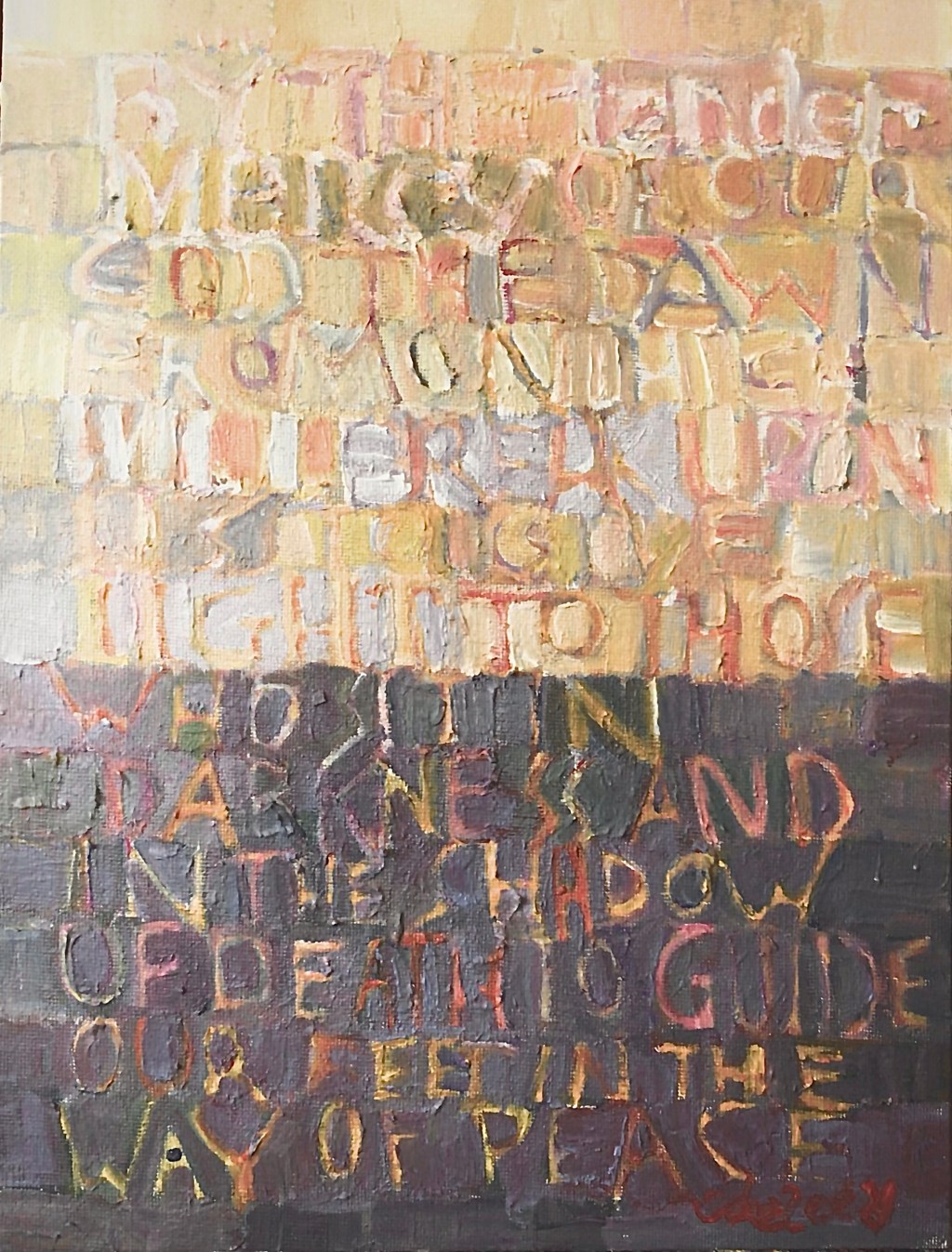
“to give light to those who sit in darkness and in the shadow of death, to guide our feet into the way of peace.” ~ Luke 1:79

Joy and Peace,

Cornelia

Why Leaves Really Fall Off Trees : Krulwich Wonders… : NPR
https://www.npr.org/templates/story/story.php?storyId=114288700

The Depths Of Estrangement: Why Family Rifts Happen And How To Heal
https://www.wbur.org/hereandnow/2020/12/24/family-estrangement-holidays

[The Washington Post] Analysis | A third of Americans say close friends or family have died of covid-19
https://www.washingtonpost.com/politics/2021/10/13/third-americans-say-close-friends-or-family-have-died-covid-19/

Visit Flanders Fields | VISITFLANDERS
https://www.visitflanders.com/en/themes/flanders_fields/

KISS Principle and The Six Degrees of Hydrangeas

adult learning, art, Bartram’s Nursery, brain plasticity, butterflies, Creativity, Faith, flowers, garden, inspiration, Ministry, nature, Painting, purpose, renewal, righteousness, risk, Spirituality, Travel

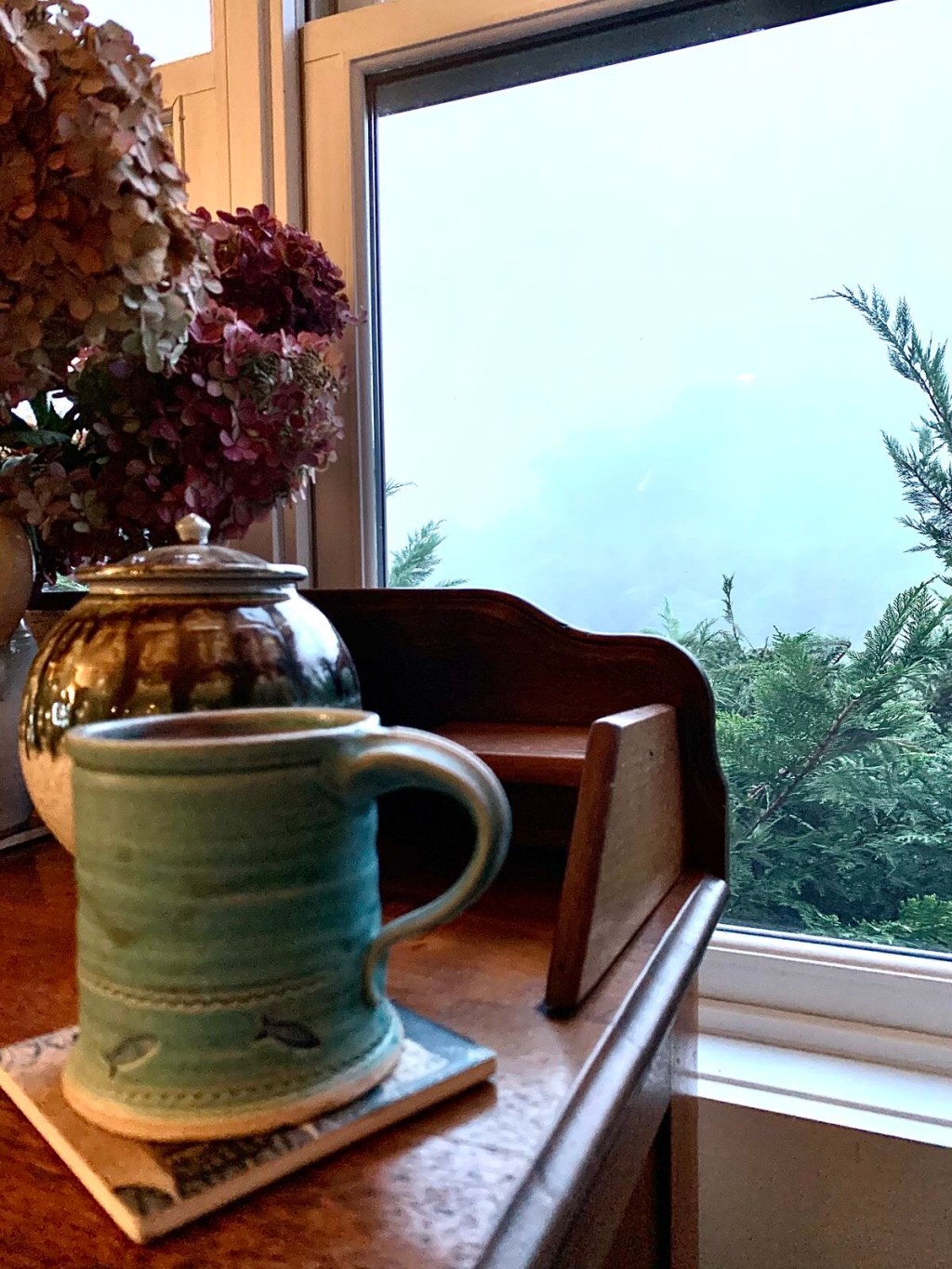
These dried hydrangeas, a gift from North Carolina, traveled home with me from my vacation back east to see my youngest nephew marry the love of his life. My childhood friend cut them from the bushes in front of her beautiful retirement home in the Blue Ridge Mountains near Lake Junaluska, the famed Methodist Retreat Center. Her home is about an hour away from the Biltmore Estate, America’s largest home. I’ve now been to both historic places, known for their hospitality, and enjoyed the hospitality of two friends’ homes, who live not an hour apart. I knew both of these gals growing up back home, and now they know each other through me.

Hydrangeas and Coffee on a Cloudy Carolina Morning

Hydrangeas are native to America. Two well-known hydrangea species, among others, grow wild in North America — the H. aborescens (smooth leaf) and H. quercifolia (oak leaf). Their actual cultivation began in the 1700s. An historic trifecta of our forefathers’ estates is proof: Mount Vernon, Monticello, and Montpelier all cultivated these hydrangeas.

Bartram’s Garden, possibly drawn by a young William Bartram

William Bartram, of Bartram’s Nursery in Philadelphia, provided the seeds and plants for these historic homes. James Madison’s home, Montpelier, in Vermont, still has the creamy white heads of H. arborescens as a border for his garden wall. The Bartram Gardens were a natural history project begun by his father John Bartram and continued through the generations, with William’s love of travel and exploration leading to a four-year collecting trip to the American Southeast and the publishing of an account of his travels in 1791. It became a classic text in the history of American science and literature.

Documents from Mount Vernon record how in 1792, George Washington planted a native hydrangea, H. arborescens, on the bowling green at his home. Nearby, when Thomas Jefferson was designing his gardens and walkways at Monticello, he also included these new shrubs. Today, gardeners can purchase heirloom H. quercifolia seeds from the Thomas Jefferson Center for Historic Plants in Monticello.

The notion everyone is connected by just six stages of separation gained popularity in the early 2000’s based on scientific studies done in the 1960’s. The game Six Stages of Kevin Bacon was based on this idea. Today, due to social media and the internet, some people have only 3 or 4 stages of separation. Our founding fathers ran in the same circles, so their stages of separation were small.

Hydrangeas also come from Japan, where they’re the subject of many brush and ink paintings. The flowers hold a solid role in Japanese culture. The Japanese celebrate the hugely popular Ajisai (hydrangea) festivals in the blooming seasons of late spring and summer. Pink hydrangeas are given on the fourth wedding anniversary. Hydrangea gardens often grace the grounds of sacred Buddhist temples. People enjoy amacha, or tea from heaven, on April 8, Buddha’s birthday. Amacha is brewed from leaves of the Hydrangea serrata.

Steps ascending to Meigetsu-in Temple

While western churches are sited in lawns, as if they were sheepfolds to shelter the sheep within and protect them from the outer world, eastern Buddhist temples incorporate nature into their design and sites. This reminds us everything is one. As Father Richard Rohr reminds us in his book, The Universal Christ, the author of Colossians 1:19-20, puts this idea plainly:

“For in him all the fullness of God was pleased to dwell, and through him God was pleased to reconcile to himself all things, whether on earth or in heaven, by making peace through the blood of his cross.”

A classic example is the Buddhist Meigetsu-in Temple, which was founded in 1160 as a Rinzai Zen temple of the Buddhist Kenchō-ji school. Located in Kamakura, Japan, its nickname is the hydrangea temple, for from the end of May through July, thousands of hydrangeas bloom during the rainy season. The temple is a Japanese national historic site.

When I first brought in the dried flowers to class, the first reactions I heard were, “Wow! You brought those all the way from North Carolina intact?” and “This is gonna be hard!” I’ll let you figure out who said what!

My answer was, “Sure, I’m an old art teacher, and I’m prepared for anything. I had a travel box in my SUV trunk, so they nestled quietly there on the journey home. As for hard to paint, remember what I always tell you, don’t paint the eyelashes before you get the shape of the face. The KISS principle always applies.”

“You mean keep it simple, stupid?”

“Mike, the one who wants to learn and stretch their mind is never stupid. KISS stands for KEEP IT SIMPLE, STUDENTS.”

They all laughed. Most of us can’t see the big forest because we’re looking at all the individual trees. If we step back and get a sense of the whole first, we can see how the parts relate to one another. This helps us put the basic sketch onto the surface of our work. It also gives us a moment to observe the subject before us and catch that moment of interest, which we can then emphasize.

Image Ball in Shadow and Light

As I reminded folks, “This looks difficult, but the basic shape here is a big ball. We’ve already done geometric balls. You thought those were boring, but they had a purpose. You needed that skill to be able to see the same shape in nature and recognize the same pattern of light and dark shadows.”

They nodded their heads. Teaching often is just reminding people what they already know or reinforcing previous skills from a different viewpoint. We went on to the slide show. It helps to see how other artists have handled the subject of the day. I’ve always enjoyed show and tell time, for it gives us inspiration and education both. Every time we learn something new, we have a new wrinkle in our brains. At a certain age, this is the only place we want to get wrinkles!

Inuzuka Taisui: Butterfly and Hydrangea, 1930, Woodblock print

This lovely Japanese woodblock print is from the era when Japan moved from its historic monarchy into the beginning of its new democratic government. The old emperor was confined to the palace due to illness, so the western educated prince regent Hirohito was the default leader. During this time, the people favored western art styles, such as this romanticized Shin-hanga print, instead of the older artists’ works of the floating world, or Ukiyo-e. The Japanese continued to prefer the works of the floating worlds, with the dancers, actors, musicians, and tea houses.

Of course, Taisui and the other artists of the Shin-hanga movement were producing for a distant audience, who may never have set foot upon the island of Japan. What we think we know of a place is one thing, but until we experience it first hand, we won’t know its truth and its power, except by word of mouth. Taisui was active for only a decade, as far as we know, from 1920 to 1930, but he made numerous prints of plants, insects, and birds, which still bring joy to us today.

T. Adams: Hydrangeas and Lilacs, palette knife technique

I found this painting on Pinterest. I pointed out how the artist didn’t paint every single flower petal, but still got the message of “hydrangeas” across. This is a palette knife work, so it builds up the shapes from back to front. An artist can’t just throw paint on the canvas like some piece of spaghetti against the wall and hope it sticks. We always have to put our thinking cap on and build up the shapes from back to front and from dark to light. We also have to pay attention to the direction of the light if we’re doing a realistic image.

Allison Chambers: Yesterday (Hydrangeas), oil on canvas, c. 2017-21

This second rough image by Allison Chambers is another example of not painting all the minute details, but getting the main idea across (KISS). This is why billboards don’t use small print and politicians use sound bites. We’re moving too fast on the highway to read the fine print and our attention spans now are less than a goldfish! Sad but true, a goldfish can focus for nine seconds, but the average human only for eight seconds.

We can blame phones, social media, and our desire to be connected all the time. Once we were content to call once a day, but now we have to check in twice a day or more. Some of us find that much contact interferes with getting things done, but then self starters don’t need anyone checking up on them. These folks tend to think frequent callers need to find another hobby to fill their time. Everyone needs a purpose in life, so those who’re trying to micromanage others might need to spend that energy helping the poor with food distribution or expending that excess energy doing good elsewhere. Then again, maybe those frequent callers are just lonely. They might need to use those dialing fingers for good as part of a community prayer chain. Then they can connect in prayer and feel useful too.

Doris Joa: Hydrangea with Ivy, watercolor on paper, 2015

This last image does have many details. It’s a watercolor built up in thin layers of washes to get the desired result. When working with washes, we have to have time and patience, and channel our inner goldfish, so we can manage our attention spans. Our first inclination is to work wet in wet, over and over, but that just muddies up our colors in that space. We need to let that spot dry, move to a new spot, paint it, and keep painting and moving, until we get the whole first layer done. Then we can come back and lay in darker tones in certain areas, once again moving about the canvas, for if we repaint too soon, we’ll just lift up the underpainting.

This takes focus and intent, as well as the ability to reserve judgement on our work, since it takes time for it to come into being. This isn’t a simple skill, for delayed gratification isn’t practiced often today. Even when we work our plan and execute our technique to the best of our ability, the end result may seem lacking. Yet, we’ve grown, or else we wouldn’t realize our struggle didn’t meet our expectations. When we want more, we can see how far short our efforts fall. This should encourage us to continue the challenge.

As Philippians 3:12-14 reminds us about the spiritual life:

“Not that I have already obtained this or have already reached the goal; but I press on to make it my own, because Christ Jesus has made me his own. Beloved, I do not consider that I have made it my own; but this one thing I do: forgetting what lies behind and straining forward to what lies ahead, I press on toward the goal for the prize of the heavenly call of God in Christ Jesus.”

After show and tell, we sat down to paint. We’d done enough talking and presenting of models. We had enough to chew on for the short time our class meets. If we have two hours, we use the first 15 minutes on presentation and the last 15 minutes on cleanup. This gives us about 90 minutes to paint. We don’t make large works, but sometimes we take an extra day to finish what we started. I’d call most of our work “studies,” since they’re quickly done.

Gail’s Hydrangeas

Gail chose to do color exploration and deeper, more saturated applications of paint, rather than her usual washes. This was a bold experiment for her. Art is a risky business. We can’t always control what the brush will do. Most of us have been trained since childhood to “color within the lines.” Once the paint gets loose, we’re in uncharted waters, sailing out into the deep ocean and out of sight of familiar landmarks. We can either turn back and hug the safe shore, or sail out to discover the unknown land. Taking risks is how we grow.

Mike’s Hydrangeas

Mike’s love of texture is apparent in his painting, as well as a variety of color. While the colors aren’t natural to the subject, he chose the colors which made him feel good. His is an emotional response to the beauty of the flowers. He wasn’t happy with the opening of the vase, but he got so carried away with the flowers, he forgot his perspective principles.

We might need to reteach that lesson once again. Some lessons need reteaching multiple times. This is why Jesus spoke in the gospels about God 264 times and love 44 times. Money rated 24 mentions, riches 2, the neighbor 10, and the poor 25. If we ever wondered what Jesus was focused on, we might look at what he emphasized in his ministry.

Cornelia’s Hydrangeas

I noticed we each gave our flower pots a different look when we painted our canvases. None of us are dedicated copyists. My color scheme tilts toward the red-orange, yellow-green, and blue-violet. This is a secondary triad, rather than a primary triad of red, yellow, and blue. The mixed colors give the flowers their muted look.

Secondary Triad on Cornelia’s Hydrangeas

By adding white to some of the brush strokes, and darker tones to others, I was able to suggest individual flowers as well as shapes. It’s just a quick sketch, a work I would do in preparation for a larger painting. Doing this would help me get some ideas down and help me solve some problems in advance, as if I were training for a competition. I would know if my color scheme was working, or if I needed to change the values or tints. I might want to choose a deeper color, or certainly a larger canvas.

So we come back for another day and another try. We can “see the promised land,” but like Moses, we don’t know if we’ll ever reach it. Artists have to be incurable optimists, for they keep trying again and again, even though we know human perfection in art will always be out of reach. Yet as Paul reminds us in Romans 3:21-24, if perfection in art eludes us, we can still have “Righteousness through Faith:”

“But now, apart from law, the righteousness of God has been disclosed, and is attested by the law and the prophets, the righteousness of God through faith in Jesus Christ for all who believe. For there is no distinction, since all have sinned and fall short of the glory of God; they are now justified by his grace as a gift, through the redemption that is in Christ Jesus.”

May we all go onto perfection, with God’s help—
Joy and Peace,

Cornelia

Hydrangeas: A History
http://thehouseandhomemagazine.com/culture/hyndrangeas-a-history/

Taisho Democracy in Japan: 1912-1926
https://www.facinghistory.org/nanjing-atrocities/nation-building/taisho-democracy-japan-1912-1926

William Bartram – History of Early American Landscape Design
https://heald.nga.gov/mediawiki/index.php/William_Bartram

Kamakura’s Famous Hydrangea Temple: Walk Among Flowers in Japan’s Ancient Capital
https://livejapan.com/en/in-tokyo/in-pref-kanagawa/in-kamakura/article-a0001996/

Science: You Now Have a Shorter Attention Span Than a Goldfish
https://time.com/3858309/attention-spans-goldfish/

The Science Behind Six Degrees
https://hbr.org/2003/02/the-science-behind-six-degrees

The Autumn Colors

adult learning, apples, arkansas, art, autumn leaves, change, Creativity, Faith, inspiration, nature, Painting, perfection, photography, shadows, trees, vision

Robert Frost, in his poem “Nothing Gold Can Stay,” speaks to the transitory nature of fall colors:

Nature’s first green is gold,
Her hardest hue to hold.
Her early leaf’s a flower;
But only so an hour.
Then leaf subsides to leaf.
So Eden sank to grief,
So dawn goes down to day.

Nothing gold can stay.

When I was in North Carolina recently, I was a tad early for the best colors of autumn, but I didn’t miss the Apple Festival in Waynesville, where I bought a half peck of apples fresh from a local orchard. Every time I encounter the word peck, it it brings back memories of my dad and his older brother schooling us children on the tongue twisters they learned in school. Back in the Stone Age, proper elocution was emphasized, along with cursive writing. To this day, l still hear their dulcet duet:

Peter Piper picked a peck of pickled peppers;

A peck of pickled peppers Peter Piper picked;

If Peter Piper picked a peck of pickled peppers,

Where’s the peck of pickled peppers Peter Piper picked?

Don’t get me started on sister Suzy’s seaside seashells or the amount of wood a woodchuck could chuck if a woodchuck could chuck wood. I’d much rather talk about autumn leaves!

Here in Arkansas, our colors up north are about spent, but near and south of the I-40 corridor, peak leaf change generally takes place in early November. The colors usually don’t last long because as soon as the leaves change, strong cold fronts tend to knock off the leaves quickly as we head toward Thanksgiving.

Of course, with climate change, our first frosts are occurring later in the season. In fact, some climate scientists think we could be on the path to two main seasons—winter and summer—with transitional short shoulders of temperate weather we once knew as fall and spring. This will affect not only agriculture’s growing seasons, but also insect populations, flower blooms, and the wildlife dependent upon them, not to mention our utility bills.

Waynesville, NC Trees

After a three week hiatus from art class, I was excited to return. While I was gone, Gail has had many sleepless nights helping with the new grand babies and Mike has been extra busy, as is his normal usual. I was glad to see Erma and catch up with her to give condolences in the passing of her dear husband. COVID has kept us apart and out of touch, so I was late to know this. Others were sick or out of town, so Mike, Gail, and I looked over some art works for inspiration.

Georgia O’Keefe: Leaves, 1925

The Georgia O’Keefe Leaf painting treated these single shapes as unique objects, a radical idea in its day. This allowed her to limit her color palette and focus her design on the positive and negative spaces. A somewhat similar painting is Norman Black’s surrealist Autumn Leaves. It differs in feeling because the individual leaves are isolated, floating in space, rather than being layered one upon the other like cozy coverlets.

Norman Black: Autumn Leaves

One of the aspects in painting we often overlook is the source of light. Light is what gives our work sparkle, just as the light makes the world visible. As we wake to darkness now, we’ll appreciate the light more and more when we come home in the dark, for the days gradually grow shorter. Most artists pick one direction as the source for their light in the painting. This allows them to control the shadows of the objects in their canvases. They prefer the afternoon or morning light, not just because the sun is lower in the sky, but also because these times have distinctive temperatures. The morning has cooler colors, while the afternoon has warmer colors.

Paige Smith-Wyatt: Autumn Sunset

We looked in our cell phones for images of autumn leaves. This is when we discovered our phone search systems aren’t all created equal. While my phone will turn up every single yellow, red, or orange tree or leaf photo, plus a few pumpkins thrown in for good measure, other peoples’ phones list photos by month and date. Technology frustrated us right off the bat. Rather than waste half our class time looking for an image, Gail and I decided on one.

Sometimes the perfect is sacrificed in favor of the good when the time is short. Perfection is a goal, not the necessity to begin the journey. This is why we Methodists say we’re “going onto perfection,” rather than we’ve already arrived.

Gail’s Red Leaves

Mike chose the first one that popped up in his phone. He went straight to work. Gail likes to find the best before she starts. Sometimes we need to accept what is before us and make the best of what we have. The perfect isn’t always available. Also, she was working on too little sleep. Newborn babies will do that to grandmas. We can take a halfway good image from our phone and use it as an inspiration or jumping off point. We don’t have to recreate the image.

Beacon Manor Landscape Photoshopped

When working from a photo, it’s good to crop the image to the same scale as the canvas. This helps you get the proportions of the subject true to form. I also photoshop the colors, sharpness, and contrast. This preparatory work helps the mind sort out the important shapes. Once these decisions are made, drawing the basic shapes on the canvas starts and colors start happening.

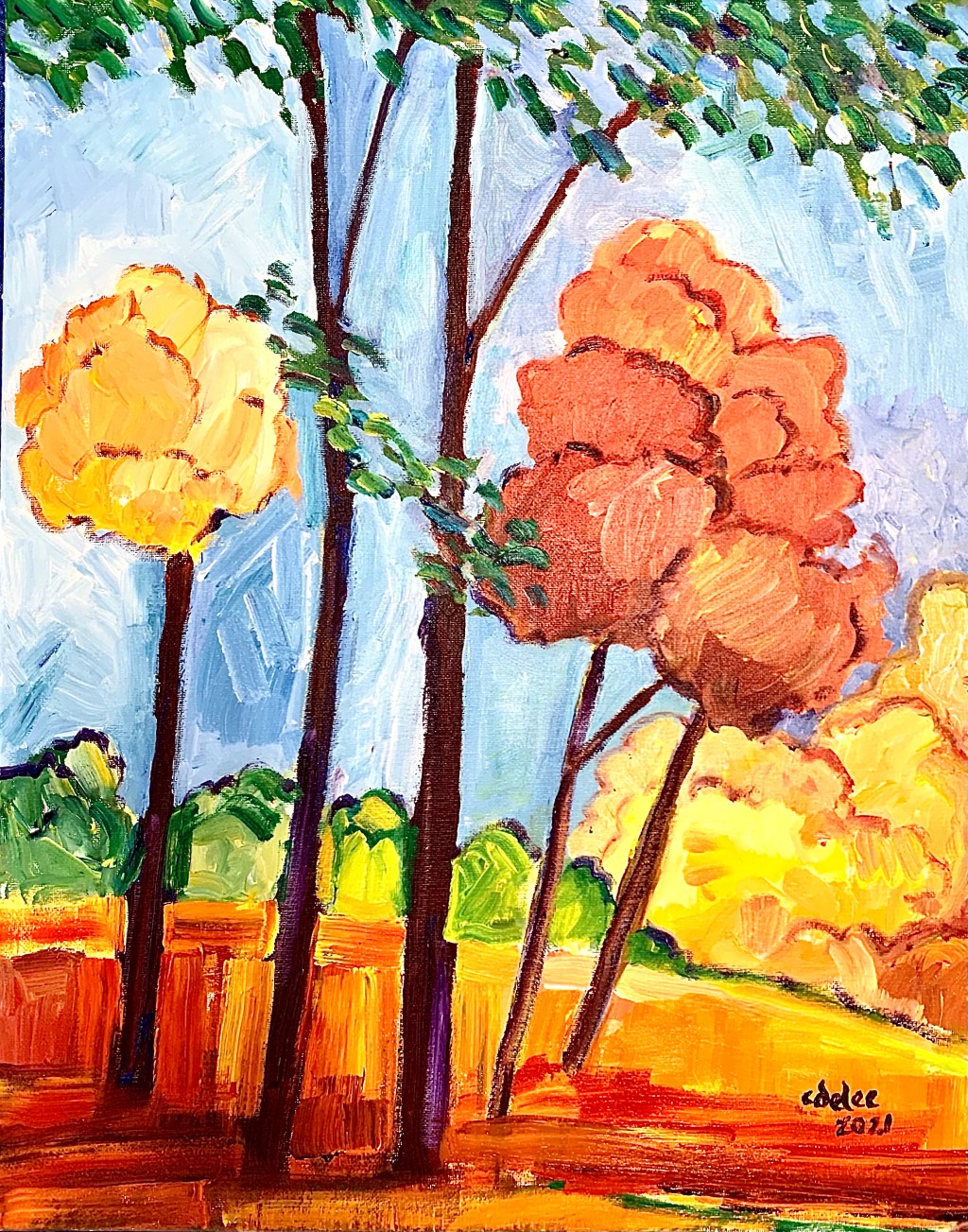
Cornelia’s Autumn Landscape

Mike got out of the class to get back to the office before I could set a photo of his tree, but I recall it was an overall image with multicolored leaves. I worked from an old autumn photo from the grounds of my condo. I’d pushed the colors past realism in my computer software program, so it was already bold. I eliminated much of the extraneous details and painted just the simplest elements of the landscape. This is called “artistic license.” We don’t have to paint every leaf, but we can paint the shape of all the leaves in the mass together.

Artists and poets both seek to strike a chord in the hearts of their audience: one uses colors, light, shape, and form, while the other creates their images and emotions through word and metaphors.

Song for Autumn by Mary Oliver

If we remember nothing about this glorious autumn, let’s remember John 8:12, in which we hear Jesus proclaimed as the Light of the World:

Again Jesus spoke to them, saying, “I am the light of the world. Whoever follows me will never walk in darkness, but will have the light of life.”

Fall Foliage Dates

https://www.5newsonline.com/article/weather/when-is-peak-fall-color-across-the-usa-state-by-state-foliage/527-c4986dff-ffb9-4b27-9335-65ead54a1c10

History of Tongue Twisters

https://www.mentalfloss.com/article/513952/history-behind-famous-tongue-twisters

USGCRP, 2018: Impacts, Risks, and Adaptation in the United States: Fourth National Climate Assessment, Volume II [Reidmiller, D.R., C.W. Avery, D.R. Easterling, K.E. Kunkel, K.L.M. Lewis, T.K. Maycock, and B.C. Stewart (eds.)]. U.S. Global Change Research Program, Washington, DC, USA, 1515 pp. doi: 10.7930/NCA4.2018.

https://nca2018.globalchange.gov/chapter/19/

Portraits in the Style of the Modern Masters

adult learning, art, Creativity, Holy Spirit, Icons, inspiration, Matisse, Ministry, Painting, picasso, risk, Spirituality, vision

“ Good artists copy, great artists steal,” Pablo Picasso once said. If we’re going to learn art, we should learn from the masters, and not from ordinary purveyors of paint. In art school, we often copied the old master paintings and drawings to learn their techniques and develop those traditional styles of execution so we could “break the rules” later on if we so chose.

Learning to paint and draw is a process. In ancient times, young people were apprenticed out to a master. In this workshop, they would learn their trade from the ground up, from cleaning brushes and sweeping the workshop floors, to later mixing colors, and then painting backgrounds. Later on they’d be drawing figures, so when they were competent, they would fill in the lesser people in the painting. By the time they achieved master status and were able to leave and establish a studio of their own, they could paint faces, hands, and the complete figure with appropriately draped clothing. This was about five to ten years of full time work in their master’s workshop and included the journeyman designation by the local guild.

When I taught art in the kindergarten through eighth grades at a private school, I always reminded the high achieving parents, “Your children’s art is an exploratory and experimental exercise. It may not look like a beautiful finished product, although it might have gone through that stage at some point in the process. If it’s a picture of daddy cutting the lawn, but all you see is black circles covering the page, that’s the sound of the lawnmower engine and the smoke it makes as it crisscrossed the yard.” For children that age, the story is more important than the image. For the parents, the image is more important, but parents have to learn where their children are in their development.

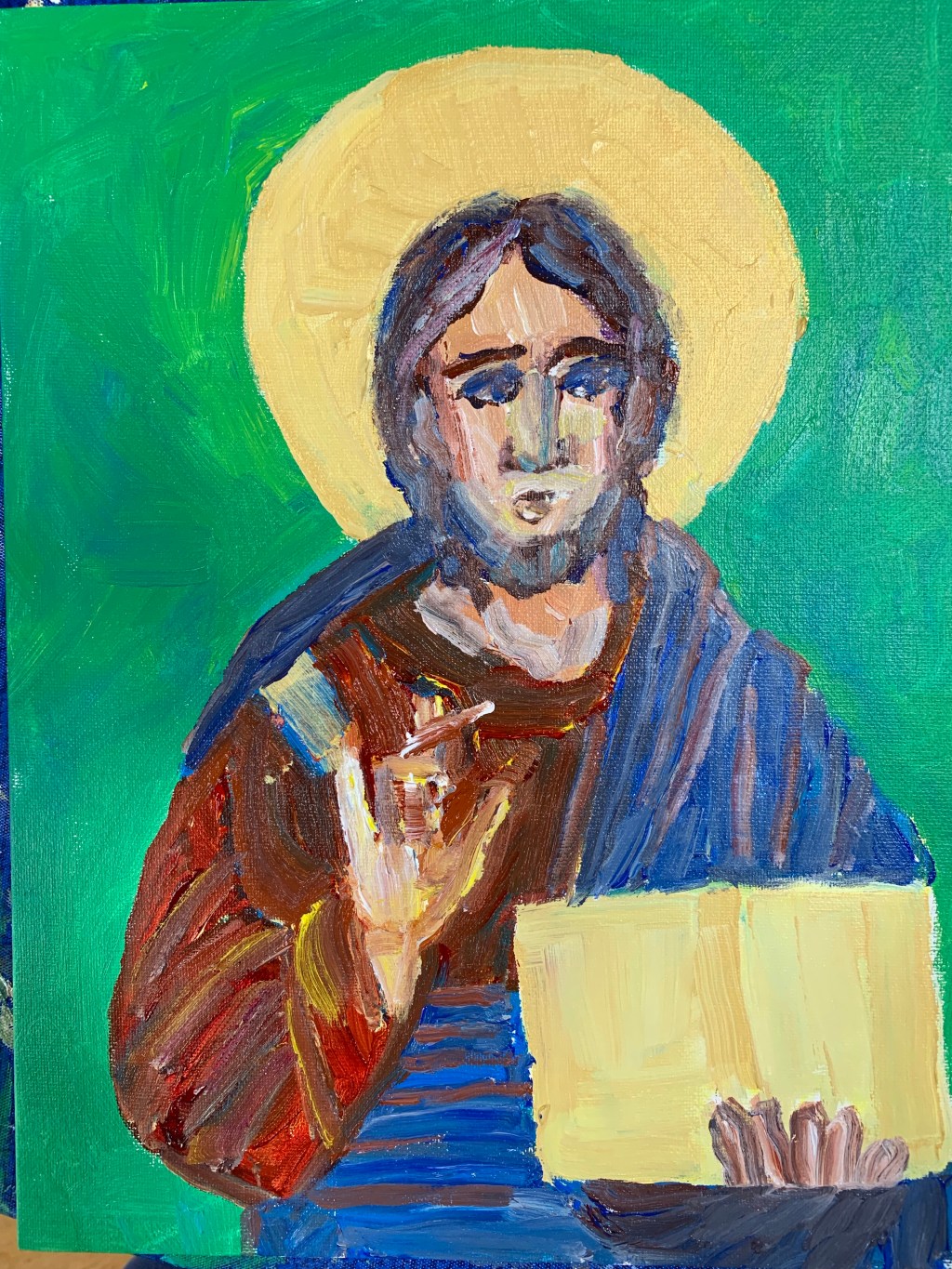
Icon of Christ

We can’t judge a book by its cover, nor can we judge a painting done in a weekly art class the same way we look at a painting in a museum. Still, we look to the better image for our inspiration, rather than to a lesser image, as 2 Corinthians 3:18 reminds us:

And all of us, with unveiled faces, seeing the glory of the Lord as though reflected in a mirror, are being transformed into the same image from one degree of glory to another; for this comes from the Lord, the Spirit.

DeLee: Repainted Icon with fabric and multimedia embellishment

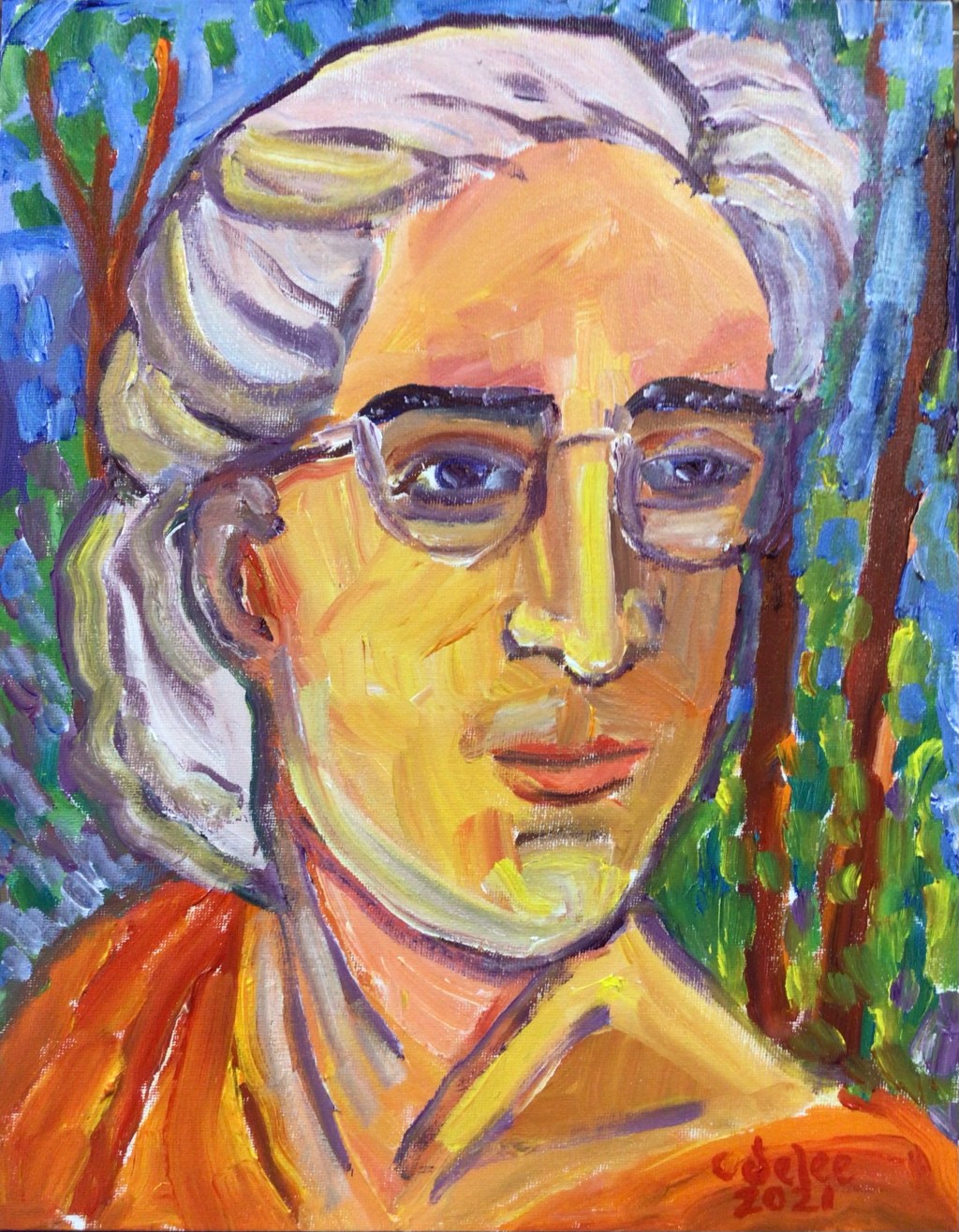
Edgar Degas once said, “Art is not what you see, but what you make others see.” The past two weeks our group has been working with faces and master artists. We looked at Picasso in his multiple styles, along with Matisse and his more decorative style. We also painted portraits from our own photos in the styles of these two masters. Both Picasso and Matisse transitioned through several different styles during their artistic lifetimes, so we weren’t limited in our inspiration.

MATISSE: THE DREAM

“Creativity is allowing yourself to make mistakes. Art is knowing which ones to keep,” said Scott Adams, the American cartoonist who created Dilbert. Or as the late Bob Ross would say, “There’re no mistakes, only happy little accidents.” Most of us can’t bring ourselves to make mistakes, however, even though mistakes are how we learn. Falling off the bicycle is part of learning how to find the proper balance to stay upright. We take tests in school to discover what we need to restudy. Tests aren’t a measure of our worth, but a measure of our learning. This desire to “appear faultless” often keeps us from trying something new, for fear we might not be good right out of the gate. Mature people know life isn’t a horse race, but everyone has their own gifts and graces to hone and embellish. If we don’t try, we might always be a diamond in the rough. We’ll never rise to our best if we don’t extend ourselves beyond our safe places.

Mike: The Indian

Mike took a look at an image and went to work on his painting. He worked mostly from memory, adding designs and colors as he felt moved to place them on the canvas. “Likeness” wasn’t his goal, but the joy of playing with color and shape instead.

MATISSE: WOMAN WITH HAT

Matisse’s portrait of his wife caused a scandal at the 1905 Salon Exhibition. Matisse’s studio colleagues asked the painter, “What kind of hat and what kind of dress were they that this woman had been wearing which were so incredibly loud in color?” Matisse, exasperated, answered, “Black, obviously”.

Cornelia: Green Portrait

“The chief enemy of creativity is ‘good’ sense,” is another Picasso quote. After all, those who always stay within the lines and always color the sky blue won’t be able to imagine sunsets or sunrises. This is why James Whistler said, “An artist is not paid for his labor but for his vision.”

Picasso: Double Face
Gail’s Grandfather

What is vision in the world of art? We’re familiar with visions from God, or the lack thereof in certain times, as when Samuel was called:

Now the boy Samuel was ministering to the LORD under Eli. The word of the LORD was rare in those days; visions were not widespread.
(1 Samuel 3:1)

In God given visions, the prophet is open to God’s word, hears God’s voice, speaks for God, calls God’s people back to God, and reminds people of the consequences of their actions, both good and bad. Like a prophet, an artist needs to be open to the same move of the Spirit in the natural world, for the light calls and the trees speak, and the waters whisper of the deep mysteries of God’s Providence for God’s creation. Perhaps we need still hearts and quiet minds to receive these messages, but thankfully nature has a way of renewing the life of the human soul.

Gail’s Double Face Portrait

As we become more our true selves before God, we begin to find our artistic vision. Cezanne called Monet, who was famous for his Waterlilies, “only an eye, but what an eye!” If the eye is the window into the soul, we also reflect outwards what we are inside. We keep working on both our inner selves and our outer talents, with the thought one day the two might intersect. As Picasso said, “It took me four years to paint like Raphael, but a lifetime to paint like a child.” He could learn all the art techniques in a short time, but to become his true self, without pretense before others, took him a lifetime.

We Methodists should have a good jump on this goal, since we have the spiritual tradition of “going onto perfection.” This is one of our classic grace teachings. Prevenient grace brings us to know the saving grace of God before we’re even aware of God’s working in our lives. Justifying grace is the work that lets us understand Christ’s gift on the cross for our salvation, and Sanctifying grace empowers our works to renew us in the image of God.

Gail’s Matisse Portrait

If God’s grace is available for our spiritual development, it’s also there for our personal development. Is art a frill, or a necessity? Those of us who make art, find our lives are enriched by our creative endeavors. Neuroaesthethics is the emerging field in the science of how art affects the brain. These scientists define creativity as “the generation of something new,” and art as “the most homogenous form of total creativity.” However, we still have no understanding of how the brain generates new ideas, despite a tidal wave of neuroscientific research. This is why my art classes have always had learning environments with projects with no one right answer, but rather multiple possible solutions. All art comes from a true self, not from a stockpile of manufactured and multiplied standardized reproductions.

Cornelia: Yellow Portrait

Recent thinking suggests art should be regarded as a cognitive process in which artists engage the most perplexing issues in their present experience and try to find a way of symbolizing them visually so they can bring coherence to their experience. As a result, the definition of art is constantly changing. Understanding how we symbolize our experience, how we use symbolic form to organize our thinking processes, and what are the neuroanatomical corollaries to these processes will have obvious implications for future learning. Additional neuroscience research supports the idea of enhancing transfer of learning abilities from the arts to other cognitive domains. More importantly, as Yayoi Kusama, the painter of polka dotted pumpkins says, “I followed the thread of art and somehow discovered a path that would allow me to live.”

One of the best reasons to pursue art is for our spiritual and mental health, rather than to make salable products. Improvement is a goal in itself, as is persistence. Also, concentrating on creating an object that has no real purpose, but to allow the artist to express their inner emotions and solve the challenges of a three dimensional world on a two dimensional surface. “Life beats down and crushes the soul, and art reminds you that you have one,” said Stella Adler, the American actress. In the studio, we find our true self, not who others think we are or what we do for a living. We can be children once again and paint because we want to.

In art class we lift up “studio habits of mind” or the skills we teach in painting class. For every painting or project, we always first

  1. Observe—to see with acuity
  2. Envision—to generate mental images and imagine
  3. Express—to find their personal voice
  4. Reflect—to think meta-cognitively about our decisions, make critical and evaluative judgments, and justify them
  5. Engage & persist—to work through frustration
  6. Stretch & explore—to take risks, “muck around,” and profit from mistakes
  7. Develop craft skills and
  8. Understand the history of art.

These are thinking or reasoning skills anyone can apply to any area of their lives, even if they’re improvising or “working in the Spirit.” We all can build resilience for our lives through our experiences in art. For some of my former students I taught in the classroom, art class was the only place they were well behaved, for they didn’t have to come up with one right answer, but had the opportunity to discover their own answer within certain boundaries. Also, they were graded on improvement, as well as their work ethic. “Practice makes perfect, or at least improvement, so keep working.”

Just remember what Salvador Dalí said: “The reason some portraits don’t look true to life is that some people make no effort to resemble their pictures.”

Excellent discussion of Matisse and Cezanne here:
T.J. Clark · Madame Matisse’s Hat: On Matisse · LRB 14 August 2008
https://www.lrb.co.uk/the-paper/v30/n16/t.j.-clark/madame-matisse-s-hat

The Salzburg Global Seminar: The Neuroscience of Art
https://www.salzburgglobal.org/fileadmin/user_upload/Documents/2010-2019/2015/Session_547/SalzburgGlobal_Report_547_FINAL_lo_res.pdf

Art, Creativity and Learning
June 11-13, 2008 National Science Foundation

https://www.nsf.gov/sbe/slc/ACL_Report_Final.pdf

Creativity Challenge

adult learning, art, beauty, coronavirus, Creativity, Faith, Icons, inspiration, Ministry, Painting, Pantocrator, Philosophy, photography, Plato, purpose, Reflection, Spirituality, vision

I was an art major before I attended seminary at Perkins, where I had the great privilege to take Philosophy from Dr. Billy Abraham. Of course this privilege was extended to me because I failed my one and only philosophy class in undergraduate school. I had taken it pass fail, but hit a terrible depression after my art teacher died. I had no energy to even hand in a paper with my name on it, even though the professor offered this as an act of grace to pass me.

“I’ve not done the work, I’m in over my head, and I haven’t understood any of these concepts in this class,” I said. “I don’t deserve to pass.”

“It’s a pass fail class. It doesn’t count toward a grade average, but it can count against you. Just turn in the paper,” he pleaded.

It didn’t seem appropriate to me, or honorable to take this option, but that could have been my depression coloring my decision making process. Still, I wasn’t raised to take credit for haphazard efforts, and providence ensured my F didn’t count against me when I transferred to art school the next semester, so that F didn’t affect my ultimate grade average after all.

Raphael: School of Athens, Vatican City

I speak about this because in seminary, Billy Abraham daily stretched the brains of every one of us first year students. First we heard one Greek philosopher say this was “true and real.” Then the philosopher who was his student came along and directly contradicted his old master, saying, “No, instead, something else is true and real.”

We all were in hair pulling mode, not to mention Dr. Abraham’s favorite description, “getting our underwear tied into knots.” I’ve always heard there’s a Rosetta Stone, which can unlock the meaning of an unknown language for those who have the eyes to see it. Perhaps only the creative ones, those who can see the patterns and the similarities, or what the mathematicians call the “sets” and the biologists call the “modules,” can suddenly see the key in plain sight.

Rosetta Stone

I admit I too was floundering until I had the eye opening realization I already held the key in my hand. I’d met this same question before in my art studio and history classes: “What is beautiful and what is truly art?” This definition had changed over the centuries, so why should the ideas of what is “reality and truth” remain fixed? This is a great example of “transfer of learning,” a well known educational concept, which resulted in my “lightbulb moment.”

Leonardo: Mona Lisa

As I explained to a fellow student, “Think of these as distinct historical ideas, not as your individual truth. It’s like looking at a fashion show from the ancient times to the present: no one expects those clothes to look like what we wear today. Just memorize what each of these styles look like. You don’t have to wear a toga to know what these Greeks thought. We just have to know how these old ideas influence later trends of thought fashions.” This is teaching by analogy, which is familiar to Bible readers as “parables.”

Coffee Bean Madonna

Most people can get over that intellectual hump. Seminary is designed so persons who aren’t agile thinkers will reconsider their educational choices. Philosophy and theology will winnow those who need to be told what to think, rather that learning how to think and understand deeply. Biblical studies will sort out those who aren’t able to interact with more than one voice of biblical interpretation. Then the internships and clinical pastoral settings will further sort those who don’t play well in groups. Finally the supervisory process we all go through toward our ordination into one of the orders of the annual conference is a long period of discernment, for all concerned.

The good news we can all do ministry, for we’re ordained by our baptism into the priesthood of all believers, not only reflect the Christ who lives in us, but to be the Christ in service to our neighbors. As we read 1 Peter 2:9—

But you are a chosen race, a royal priesthood, a holy nation, God’s own people, in order that you may proclaim the mighty acts of him who called you out of darkness into his marvelous light.

Minion Madonna

This is why it’s important we consider such concepts as truth, beauty, and the good. The Greek adjective kalon only approximates English for “beautiful.” Kalon has more of an ethical tone, but doesn’t mean the same thing as agathon or the “good, ” but rather is a special complement to goodness. At times kalon narrowly means “noble,” or “admirable.”

What was true for Plato were the forms, and everything here on earth were mere reflections or imitations of these ultimate truths. The true beauty and the good existed beyond this world, but everything and everyone could aspire to that ideal. Plato thought art and poetry were the arenas of greatest beauty, as Simonides, the Greek poet, drew an explicit analogy: “Painting is silent poetry and poetry is painting that speaks.”

While some say, “Imitation is the sincerest form of flattery,” for Plato imitation is found in the appearance of things, rather than in reality (the forms, which exist in an ideal world elsewhere), so judged on its own terms, the product of imitation has an ignoble pedigree (Republic 603b). Therefore, the imitative arts direct a soul toward appearances and away from proper objects of inquiry, which are the forms. While a mirror reflection might prompt you to turn around and look at the thing being reflected, an imitation keeps your eyes on the copy alone. Imitation has a base cause and baser effects.

Festival Madonna

Plato also believed poets created their works under irrational conditions, with inspiration arriving sometimes spontaneously, as if it were from the gods, a “divine madness,” as it were. Even today, people think creative types are more likely to be mentally ill, but science doesn’t bear out this romantic notion. Illness isn’t a prerequisite for creativity, even though many artists have suffering in their life histories.

Another Coffee Madonna

Creativity of any kind—making a collage, taking photographs, or publishing in a literary magazine—tends to make individuals more open-minded, curious, persistent, positive, energetic, and intrinsically motivated by their activity. Those who score high in everyday creativity also reported feeling a greater sense of well-being and personal growth compared to those who engage less in everyday creative behaviors. Creating can also be therapeutic for those who are already suffering. For instance, research shows that expressive writing increases our immune system functioning, and the emerging field of post traumatic growth is evidence we can turn adversity into growth.

Realism was the primary purpose of painting until the 19th century, when the invention of photography took over this task. This freed painters to engage in the higher search for what is beautiful and what is true, rather than to limit a painting to reproducing a likenesses or the mere imitation of nature. Yet many people still judge a work of art by how close it resembles the natural world. Of course, we also say the say the same about the embalmer’s art as we view the deceased in the casket: “My, doesn’t so and so look natural! So lifelike, as if they were asleep.”

Source

For our first lesson back in art class, we worked on seeing the familiar in a fresh way. This isn’t as easy as it sounds. We’re so used to recognizing faces in the ordinary way, to see them in a different way is a struggle. Take the Mona Lisa, by Leonardo Da Vinci. It’s an icon or representative image of the renaissance portrait. No matter what an artist does to it, we still recognize it as the Mona Lisa. Our goal was to take a photo of of someone we know, and push the limits of the facial expression and shapes so it wasn’t like the image we worked from originally.

Mike’s Painting

Mike copied the cover of the Bad Girls of The Bible, and made a good likeness. In between calls from work, he focused on replicating an image he could see. After several years of sincere efforts to paint what he sees, it’s hard to break this habit and paint something beyond his vision.

We’ll take a shot at this again. I a similar lesson early in the group’s existence and I remember it was distressing to them to draw without seeing. We were feeling the objects inside bags, and they didn’t like not looking. Bring out of control was disconcerting.

Gail’s grandchild isn’t really a zombie

Gail took her grandchild’s photo and stretched it into another dimension by treating the image as if it were a Night of the Living Dead character or the Scream from the German artist Munch. She had the most success of any of us in terms of breaking the norms of “portrait.”

Sally’s painting

Sally, new to our group, began a lyrical study of a woman’s head. I confess I never saw the image from which she drew her inspiration. It’s her first try, and we’re glad she got paint on the canvas. We’ll keep working on it together. All art, as is life, a work in progress.

Russian Icon of the Pantocrator

I worked from an icon of Jesus, which I knew would test me to break the form I saw before me. As it turned out, I too couldn’t break it on this first day. When the Platonic Ideal Form exerts its pull on the mind and hand, the artist keeps making the reflection of that form as a work, which exists as an imitation or a window into the true reality where the Holy is found.

Low Blood Sugar Painting

After a long summer break with all the Covid isolation a person could stand, I quite forgot how much energy teachers expend in explaining new concepts and in the excitement of the first day back. I noticed about 11 am I was struggling for words and not making good choices with my brush, but I ignored it in the thrill of being back with people. After cleaning up, I always check my blood sugar before I drive home. It was 45. I’d never seen it that low, but I was paying attention to other people, not to my body. I ate the crackers I always carry for just such an emergency.

The Wisdom of Solomon (7:26) speaks about God’s Wisdom personified:
“For she is a reflection of eternal light, a spotless mirror of the working of God, and an image of his goodness.”

In Hebrews (1:3), the writer describes The Christ:
“He is the reflection of God’s glory and the exact imprint of God’s very being, and he sustains all things by his powerful word.”

This long discussion on Plato, the true forms elsewhere and the imitations and reflections here help us to realize how much debt Christian spiritually and art history have to Greek thought. Art isn’t just “I know what I like and that’s all that counts.” We can all experience making art and enjoy it on any level. Having the depth of understanding to see how art connects us across the human community will give us a greater appreciation for our common spirit.

I promise I’ll bring a healthy snack to eat during class next Friday! I’ve learned my lesson on this, if nothing else! We’ll work on faces for two more weeks, then we’ll take a short break and come back in October and decorate cookies one week for Day of the Dead and paint an autumn themed subject for the other week.

Joy and Peace,

Cornelia

Simonides on poetry and painting—Plutarch: The Glory of the Athenians 3.1, 346f-347a.

Plato’s Aesthetics (Stanford Encyclopedia of Philosophy)
https://plato.stanford.edu/entries/plato-aesthetics/

Creativity and Rationality on JSTOR
The Journal of Aesthetics and Art Criticism
Vol. 70, No. 3 (SUMMER 2012), pp. 259-270 (12 pages)
https://www.jstor.org/stable/43496511

Mathematical Biology Modules Based on Modern Molecular Biology and Modern Discrete Mathematics
https://www.ncbi.nlm.nih.gov/pmc/articles/PMC2931670/

The Real Link Between Creativity and Mental Illness – Scientific American Blog Network
https://blogs.scientificamerican.com/beautiful-minds/the-real-link-between-creativity-and-mental-illness/

Golden Leaves on a Silver Breeze

arkansas, art, autumnal equinox, beauty, cognitive maps, Creativity, Dreamscape, Faith, flowers, Holy Spirit, hope, Imagination, inspiration, ministry, mystery, nature, Painting, Retirement, Spirituality, Travel

Autumn is just around the corner: I know this in my heart of hearts. My friends, who have lost hope in this endless pandemic, tell me, “It’s heat stress, nothing more.” I persist in my belief the bright yellow leaves scattered among the green canopies and the orange and red tinged foliage are the harbingers of the cool breezes of fall.

When the thermometer kisses 100 F and the heat factors have blown past that number like a NASCAR driver taking a hot lap for the pole position, my body only wants to swill decaf iced tea and stay close to the air conditioning. When I taught art back in Louisiana, my art rooms were in an old wooden shotgun shack. It wasn’t air conditioned because “it’s tradition, so it won’t be air conditioned, no matter how much you ask for it.” Private schools have their “traditions,” some of which aren’t healthy for either the teachers or the students.

Two days into the school year, I fainted from the heat. A visit to the nurse’s station got me glasses of sugary iced tea and cold compresses, plus it was air conditioned. I thought I’d died and gone to heaven. Someone drove me to my dad’s office in the Medical Arts building across from the hospital. I got the once over and was sent home to rest, drink plenty of fluids, and not go outside. My couch never looked so good to me. Mom and dad even kept my little girl so I could rest.

I learned later I had a brush with death. Passing out with other people there allowed me to be helped. People who are alone in the heat aren’t so fortunate. Heat can kill a person. The hurricane Ida is already taking out the utilities in south Louisiana, which means they might not be back for weeks. The hospitals full of Covid patients hope to have ten days of power and food, but that’s just to get them through until relief supplies can roll in.

Dreamscape: Airport

I actually repainted this canvas a second time, since I wasn’t thoroughly pleased with it on the first go round. The Airport image above is the first incarnation of this painting. While I don’t mind the colors in the ground, the overall texture of the work didn’t appeal to my senses and the runway with its numeral stuck out like a sore thumb. It was either going into the trash bin of my work, or I’d leave it alone long enough to find the inspiration to cure it.

Painting is a journey in itself, as the white canvas disappears under the brushstrokes of color. We can think of a pristine sand beach in the early morning, and its well marked surface erased by the high tide under the moonlight, only to be marked again when the sun rises. As Benjamin Disraeli, the British Prime Minister in the 19th century once said:

“Like all great travellers, I have seen more than I remember, and remember more than I have seen.”

Sometimes we can better solve a problem by ignoring it, for the the problem will find its own solution. Trying to impose our solution upon it just leads to more death, but not to life. Letting the painting come into being in its own time is a better choice, for it can’t be born before its time. In the spiritual life, kairos time is God’s time, while chronos is human time. When we work on deadlines or punch a clock, we operate on chronological, human time, but if we wait for the inspiration from the divine energy, we’re operating in the God moment, or the propitious moment for decision or action.

Golden Leaves on a Silver Breeze

Along my life journey, I’ve made some unique handmade preaching stoles. When I decided I no longer had use for them in retirement, I decided to cut them up. This is why some of the pieces are the same rectangular size, such as the gold and silver diamonds pattern with the blue and white diagonal stripe in the upper left corner. Some of the pieces are the backings, and others are deconstructed sections. I incorporated several types of gold: acrylic paint, embroidery thread, and a metallic candy wrapper. I also used multiple textures of lace and fabric, some of which I overpainted. All of these come from recycled fabrics. In life, nothing is wasted.

Perhaps this no longer looks like a map of an airport, but more like a place remembered in a dream, when one wants to travel on the whiff of a breeze, which has brought a half remembered smell of a time in the past or a love long lost. Autumn can bring those memories to mind, as well as our hopes for a more beautiful future, for just as a leaf flutters free from its tree, our thoughts can fly away: golden leaves on silver breezes.

Look for the golden leaves, my friends, and let them call to mind those of fond memory and the dreams of journeys yet to come.

Joy and Peace,

Cornelia

No One is an Island

art, cognitive maps, Creativity, Faith, flowers, Healing, inspiration, Ministry, nature, Painting, Spirituality, vision

If we watch the evening news on television, read a newspaper, or check our Twitter feed, bad news seems to fill the whole of it. Sometimes it gets to be too much, and we turn it all off, for we can’t cope with the next straw; it will break our camel’s back and we won’t be able to go on. Or we may already be broken by all the grief and pain, wounded by the wounds we can’t heal or by those wounded ones who wound others, rather than seek healing. I often thought I spent 50% of my pastoral care on 10% of my congregation, the “broken” ones.

After a while, we can feel like Elijah, who was worn out from doing great things for the LORD, and felt “I alone am left.” God comes to remind him he’s not alone. John Donne was very ill when he wrote this famous meditation. The artists all are from the margins, or made their art during a time of suffering. Yet, what beauty they found in this time. Artists often find their way back into the unity of all things by joining in the creating spirit of God.

Sam Doyle: Untitled (Rambling Rose), paint on metal, Smithsonian Institute.

Sam Doyle, who was on born and died St. Helena Island, SC (1906-1985), was a self taught Gullah artist, who painted the local stories of his community on anything he could find. He covered the walls of his home, as well as scraps of metal and wood with iconic figures of his people. You can read about this richly talented primitive artist at https://www.soulsgrowndeep.org/artist/sam-doyle

Hilda Wilkinson Brown: Third and Rhode Island, Washington DC, oil on canvas, 1930-40, Smithsonian Institute

Hilda Wilkinson Brown was born in Washington, DC 1894 and died there in 1981. She was an African American artist and art educator who brought her love of education and creativity to everything she did. Her work was mostly “under the radar,” except for in her own community. Yet she persisted. As a teacher, she’s best remembered for introducing individual creativity as a goal, rather than having students mimic the teacher’s model. Unfortunately, art education classes are still teaching mimicry.

Myrna Báez: Platanal, acrylic on canvas, 1974, Smithsonian Institute.

Myrna Báez of Puerto Rico (1931-2018), painted this lush field of plantain trees, a crop long wedded to concepts of Puerto Rican identity and sovereignty. She depicted the crop’s large leaves as they reflect the tropical sun and delighted in her manipulation of paint on unprimed canvas. Báez’s belief in Puerto Rican independence manifests in her impulse to look, depict, and therefore possess the island’s landscape on her own terms. Puerto Rico is currently an unincorporated territory of the United, in which the people are American citizens, but have no vote, unless they move to the mainland.

Georgia O’Keeffe: Hibiscus with Plumeria, oil on canvas, 1939, Smithsonian Institute

Georgia O’Keeffe, who was born in Sun Prairie, WI in 1887 and died in Santa Fe, NM in 1986, painted this exquisite “Hibiscus with Plumeria,” (oil on canvas, 1939, Smithsonian Institute). Intrigued by the opportunity to paint tropical flora, O’Keeffe accepted an offer from the Dole Pineapple Company for an all-expenses paid trip to the state of Hawaii to create a painting for the company’s 1939 advertising campaign. It was a perfect escape from the stress of her husband, Alfred Stieglitz’s ongoing affair with Dorothy Norman, the beautiful young wife of an heir to the Sears, Roebuck & Co fortune.

She visited Maui, O’ahu, Hawai’i, and Kaua’i, painting the islands’ dramatic gorges, waterfalls, and tropical flowers, among them Hibiscus with Plumeria. Pink and yellow petals towering against a clear blue sky transform the delicate blossoms into a joyous monumentality. But of the twenty canvases of Hawaii she completed, none showed a pineapple. Only after Dole had one flown to New York did she finally, if reluctantly, paint the desired fruit.

George Bellows: Vine Clad Shore–Monhegan Island, oil on canvas, 1913, Smithsonian Institute

George Bellows was born in Columbus, OH in 1882 and died when his appendix ruptured at the age of 42 in New York City in 1925. He’s best known for his “outsider” subject matter: tenement life, New York street scenes, and boxing subjects. While Bellows was famous for his fight scenes, he recovered his soul in the landscape, such as this Vine Clad Shore on Monhegan Island, Maine.

Frank Wilbert Stokes: The Eighth of March–Island Ice, Greenland, 1894, Peary and Party near 6 p.m., oil on canvas, 1893, Smithsonian Institute.

Frank Wilbert Stokes (born Nashville, TN 1858-died New York City 1955) was the artist member of Robert Edwin Peary’s Greenland Expeditions. He did small works such as this one on site as a record of the journey. Stokes spent eight weeks in the Arctic, the first painter to work on the ice fields, where he had to learn a method as he went, mixing kerosene into his pigments to stop them freezing and sketching outdoors through indistinguishable Arctic days and nights. Based in his studio at Bowdoin Bay, Stokes would spend fourteen months in all working in this extraordinary Arctic environment:

The outside winter temperature was frequently forty degrees below zero Fahrenheit. The lowest temperature experienced was frequently sixty-five degrees below zero. In order to prevent his colours from freezing, [Stokes] mixed them with petrol and poppy oil and kept his colour box in a deerskin bag. Lieutenant Peary’s general orders forbade any member of the party to go more than a quarter of a mile from the main camp. This restriction was relaxed in the case of Mr. Stokes, who frequently went four or five miles in moonlight or starlight, during the polar night, to study effects which he had declared to be indescribable in words, but which are shown by his pictures.

Thomas James Delbridge: Lower Manhattan, oil on canvas, 1934, Smithsonian Institute

Thomas James Delbridge (born Atlanta, GA 1894-died Long Island, NY 1968) painted this view of Lower Manhattan, an oil on canvas, in 1934, which is now in the Smithsonian Institute. It was part of the Federal Work Projects Administration, which gave support to “starving artists” during the Great Depression. Lower Manhattan’s glorious skyscrapers inspired all New Yorkers, including the city’s artists, through the worst hardships of the Great Depression.

Looking from the dock of a harbor island, Thomas Delbridge showed the dark mouths of Manhattan’s ferry terminals; above them ever taller buildings climb out of red shadows into gold and white sunshine. The crisply outlined forms evoke such famous structures as the Woolworth Building to the left and the Singer Building to the right without placing the buildings precisely or describing specific details. The skyscraper at the center suggests the mighty Empire State Building as it had stood incomplete before its triumphant opening on May 1, 1931. Even as the stock market foundered and thousands were thrown out of work, New Yorkers had gathered in excited throngs to watch their tallest tower rise. The Manhattan skyscrapers in the painting appear to be pushing back dark clouds, creating an oasis of brilliant blue around the island. (1934: A New Deal for Artists exhibition label)

DeLee: How Many Times Must Paradise Burn?

Does art come only from the mind, or does it come from the greater depths of our souls and our hearts or guts? If we reduce art to only its analytical forms and colors, we may rob ourselves of the deeper experiences of the art itself. Likewise, if we put on our false face of “I’m fine,” but in fact we’re falling apart inside, pretty soon our facade will crack open too. Then folks will say, “What happened there?” And perhaps we’ll be too ashamed by then to speak of it, for we lied about our truth too long.

My recent canvas is another cognitive map, for it deals with the changing landscape and our changing climate. It uses paper scraps, lace trims, the button row of an old outfit, and old blue jean seams all glued on the canvas in the proximate place of the main roads of the Dixie Fire out in California. I painted flame colors over the surface, but left some greens for where the fire hadn’t yet spread. Then I took out my handy Bic torch lighter to sear some of the cloth additions. Even acrylic paints, if overheated, will combust, as I soon discovered, for I burned two holes in the painting. They look like the black holes of outer space or the dark night of the soul in our spiritual lives.

When I think of all the needless deaths from the coronavirus since we’ve have the introduction of our current safe and effective vaccines, I feel very sad for every life lost. Even with nearly 4.4 million deaths worldwide and almost 639,000 deaths in the USA alone, I’m not so inured to the loss of my brothers and sisters that I can just shrug it off. I know very few of those Covid has taken from us, but the world is a lesser place without those millions.

And so I leave you with this famous meditation. Donne didn’t know if he was on his deathbed or not when he wrote it. I’m pretty sure I won’t leave behind such immortal words when I think my end is near.

No man is an island,
entire of itself;
every man is a piece of the continent,
a part of the main.
If a clod be washed away by the sea,
Europe is the less,
as well as if a promontory were.
as well as if a manor of thy friend’s
or of thine own were.
Any man’s death diminishes me,
because I am involved in mankind;
and therefore never send to know for whom the bell tolls;
it tolls for thee.

~~ John Donne, “Meditation 17,” (1623, transcribed into modern English)

“It was fitting that God, for whom and through whom all things exist, in bringing many children to glory, should make the pioneer of their salvation perfect through sufferings. For the one who sanctifies and those who are sanctified all have one Father. For this reason Jesus is not ashamed to call them brothers and sisters.” —Hebrews 2:10-11 NRSV

About Hilda Rue Wilkinson Brown: African American artist and teacher who lived in Washington, D.C. (1894 – 1981) | Biography, Facts, Career, Wiki, Life
https://peoplepill.com/people/hilda-rue-wilkinson-brown

George Bellows | The Metropolitan Museum of Art
https://www.metmuseum.org/exhibitions/listings/2012/bellows

The Project Gutenberg eBook of My Arctic Journal, by Josephine Diebitsch-peary. https://www.gutenberg.org/files/64549/64549-h/64549-h.htm

Art Inspired by the Covid Blues

art, at risk kids, beauty, cognitive maps, coronavirus, Creativity, Faith, Family, generosity, greek myths, Healing, Holy Spirit, Imagination, Painting, pandemic, picasso, renewal, The Odyssey, vision

After the initial burst of summer excitement, my community is not only sweltering in a heat wave, but we’re also smack dab in the midst of the third wave of this Covid-19 pandemic. We might be more than halfway through 2021, but at the rate my home state of Arkansas is pursuing vaccinations, it’ll be years before we reach the holy grail of herd immunity, estimated to be at 80% immunity. Only 37% of our people are fully immunized, with Alabama and Mississippi pulling up the rear nationally with 35% and the states of Louisiana and Wyoming tied with us at 37%.

@rdaily—Arkansas hospital bed availability. Getting nearly impossible to find an ICU bed again. Many really sick patients being held in ER beds all over the state.

Like the old gal who’s always worn a certain size shoe or dress, my state now tries to fit an increasing number of Covid patients into a fixed set of ICU beds in our state. My days of a size seven shoe or skirt are a dim memory, as are the days of empty medical facilities.

“We have nowhere to send COVID-19 patients within the State of Arkansas. There is limited bed capacity at trauma centers increasing pressure on the time-sensitive healthcare system,” said Jeff Tabor, program director for the COVIDComm system, which helps match covid-19 patients with hospitals.

Tabor said the one COVID ICU bed which is available is located in southern Arkansas. There are five hospitals, also in southern Arkansas, showing limited COVID bed space. Tabor said some COVID-19 patients are so critical at rural Arkansas hospitals that they cannot be transferred to other hospitals because the patient is too critical and because of bed space.

Recently our state legislature adjourned a special session without amending their misguided law mandating no masks ever in public schools or government agencies. Act 1002, by Sen. Trent Garner, R-El Dorado, prohibits state and local governments, including public schools, from requiring people to wear masks. Act 1002 became effective on July 28.

The state’s largest school district, joined by a small district already suffering from Covid quarantine attendance problems in its early opening days, filed suit in court to stop this law from going into effect. The judge issued a temporary restraining order. The reasons for this aren’t political, but are found in the Arkansas constitution.

LRSD and MSD are likely to succeed on the merits. Act 1002 violates the Education Article of the Arkansas Constitution, Article 14, § 1, which requires that “the State shall ever maintain a general, suitable and efficient system of free public schools and shall adopt all suitable means to secure to the people the advantages and opportunities of education.” A suitable and efficient system of public education would not require students to risk their health and their lives to get the education promised to them in the Arkansas Constitution, especially when the State is required to “adopt all suitable means” to provide them “the advantages and opportunities of education”.

An affidavit provided by Dr. Glen Fenter, the superintendent of the Marion School District, said that incentives, including gift certificates, groceries, and even big-screen televisions, didn’t entice many local citizens to take the vaccine. Only one out of every three students in the district has acceptable home internet service, making remote learning difficult; even then, “very few” students who did “participate in the virtual education option last year achieved an acceptable level of academic progress,” the affidavit said.

The Marion superintendent said that his district was forced to “quarantine over 500 students and employees” based on CDC and state health department guidance after the second week of school. The school year in Marion began July 27, 2021. This rural system has only 3,325 students enrolled for the 2021-22 school year. Their math proficiency score averages 22% and reading averages 31%, compared to the statewide averages of 47% and 45%.

The broader lawsuit argues that the Act violates an education clause of the state constitution, the equal protection clause of the state constitution, and that certain federal laws preempt the state from enforcing the Act. It also argues that the Act violates separation of powers principles, conflicts with a subsequent state law, and violates the premise of Jacobson v. Commonwealth of Mass., the 1905 U.S. Supreme court case during the smallpox scourge, which allowed mandatory vaccination policies — and penalties for those who refused to comply — to stand.

On another front, the mayor of Little Rock, Frank Scott, Jr., said the capitol city’s covid-19 task force had recommended to him that “masks be worn again in public spaces for which the city is responsible.” He strongly exhorted businesses to follow suit. Scott made note of the many children who visit city parks and community centers and who will be returning to school later this month, adding that “right now, they don’t have the ability to mask up.”

“The Lotus Eaters” by James Dromgole Linton

In the middle of all this stress, I ponder these questions: “What inspires a work of art? In our search for beauty in this world, do we have to forget our pain and become as the lotus eaters of the ancient myths?”

Edward Marle: The Lotus Eaters, 1970, Glasgow Museum

Worn out from the years of the Trojan war fought in a foreign land and tired from an unending journey full of trials and tribulations on the way home, Odysseus found his men succumbing to the hypnotic lure of the magic flower. When eaten, it caused people to forget both their troubles and also their future plans. In the words of the hippies of yore, they were content to “get high and get by.”

Alfred Lord Tennyson’s poem, The Lotus Eaters, inspired Robert S. Duncanson, an African American landscape painter, prior to the Civil War:

Hateful is the dark-blue sky,

Vaulted o’er the dark-blue sea.

Death is the end of life; ah, why

Should life all labour be?

Let us alone. Time driveth onward fast,

And in a little while our lips are dumb.

Let us alone. What is it that will last?

All things are taken from us, and become

Portions and parcels of the dreadful past.

Let us alone. What pleasure can we have

To war with evil? Is there any peace

In ever climbing up the climbing wave?

All things have rest, and ripen toward the grave

In silence; ripen, fall and cease:

Give us long rest or death, dark death, or dreamful ease.

Robert S. Duncanson, Land of The Lotus Eaters, 1861

Odysseus had to bodily carry his men back to the ship and tie them to their seats to keep them rowing on a straight course for home. Today we’re treated to videos of airline passengers taped to their seats because of their unruly behaviors. Rage flying has taken the place of rage driving. Neither the roads, the post offices, nor the skies are friendly anymore. “Going postal” has almost lost its meaning when no workplace is safe these days.

In the midst of the record deaths of despair, come now the increasing deaths of our most precious inheritance—our children. The number of children contracting Covid-19 has increased fivefold since the end of June, with a “substantial” 84% jump in the last week alone, according to a new report from the American Academy of Pediatrics. This number comes as numerous states report upticks in child hospitalizations amid the ongoing delta surge. In Arkansas, we’ve had three children die from Covid.

Picasso: The Weeping Woman, 1937 (Portrait of Dora Maar)

Some would say this is an “acceptable loss or trade off to allow others to have freedom.” I find this line of reasoning heartless at best and cruel in reality. I wonder what these folks would say if their child had lost their life instead. It seems not too long ago some of these same persons were advocating for the elderly to accept a shortened lifespan, since their productive lifetimes were expended. They seem to value people only for their economic ability, rather than for their humanness or for their lived experience. Allowing the “weak” to die in this part of the pandemic also devalues those who aren’t yet ready to produce economic gain for the big machine. (Yet, they fail to recognize the loss of future gain of these young “production units.”)

I would rage blog at the inhumanity of our legislators, who couldn’t find an giant acorn in the midst of an empty football field, even if they had the scales removed from their eyes, but then there’s always the hope they might learn the lesson of Job, for whom suffering brought new understanding of God. Then they’d call themselves back into session and amend their own misbegotten law so it’s flexible enough to meet our current, extreme circumstances. Who knows, they might even rescind this unconscionable law, for persons who truly have the capacity to lead with courage also have the ability to change their minds. Some say it’ll never happen, but I’ve always been afflicted with incurable optimism.

Google Map of National Park Medical Centet

In the meantime, I paint and pray. Even this dire event can inspire a work of art. One of our local hospitals has already canceled elective surgeries in order to concentrate on Covid care. The other hospital has very limited intensive care unit availability. Right now, no one in our tourist town needs to get sick and we certainly don’t need a mass casualty incident. Of course, I could live in a rural county and my nearest medical facility with a trauma unit could be hours away. I remember my early years of ministry when I reminded people, “If I’m ever unconscious, please just have them stabilize me and send me off to the big hospital in Little Rock or Memphis.”

Photo Sketch on Google Map

Today I blog about another painting based on a Google map of my adopted city, so it’s another “cognitive map.” I used scraps of an old preaching stole. I made the stole from odd pieces of fabric, plus an old pair of overalls, and a garden glove. I deconstructed the stole, since I’m no longer preaching in my retirement years, and added a few worn out face masks, in which I sewed small pleats. I took some of my grandmother’s old crochet and rickrack trim to mark some of the roads, but let the three dimensional shapes mark the other directional lines. My mother made Belgian lace collars for my young daughter’s dresses, so I’d used these for masks.

Layout on Raw Canvas of Primary Fabric Elements

I too wore these masks until I was tired of them. I was hopeful when those who know more than I do believed the virus had subsided and we were safe to shed our face coverings. One day in early July at Kroger I had an hour long conversation with a young man who was also glad to be shed of the mask, just to see people’s smiles. We talked for a while and I learned he was just a few weeks past a suicide attempt. This pandemic has been hard on him. We talked some more, for I’ve been in the dark place before too.

Cognitive Map: Search for Healing

I don’t need a preaching stole anymore, for preaching isn’t what I do best in this season of my life. God sets people in my path who need an encouraging or healing word. The world, in its beauty or its sadness, inspires me to paint a new vision of the world as it could be, for I don’t think I’ve ever painted what was ever “real.”

People ask, “Why don’t you make a painting that looks like real life?”

I answer, “We have cameras today for this. In any event, how do we know this ordinary world we see today is what God intended? This could be the fallen world, and not the original world of colors and joy, which God originally created.”

Perhaps we need to rethink our cognitive maps or how we view our world. If we consider all persons to be made in the image of God, then caring for them becomes important also. We can’t separate the Spirit of God from the body in which it resides. We also have to recognize God works through extraordinary events as well as through ordinary events. If we are to reject the inspiration and special providence of God in the matter of scientific discovery, then we’re going to go back to living in caves for a long time.

Posted on Homes to Warm of Highly Transmissible Disease

I remember when my daddy came home from his medical office with a small vial and a special double pronged needle. The windows were open, so it wasn’t yet the heat of summer. He stood next to the light, as he always did in his office when he worked, and gave us children the smallpox vaccine.

“Let’s put a little light on the subject, shall we?” I laughed as I proffered my left arm. He washed it with a cotton swab and alcohol, in his usual calm way. I went first because I was the oldest. Also, I was a role model for my brothers, but I was used to this because of my birth order. I knew to trust my daddy and to show my brothers the way forward. A few tiny pin pricks later, a bandaid, and I was good to go. My brothers followed suit, and we were all told, “Hands off.” We were restricted from playing with our friends because of our parents’ fear we’d end up with a limp or in an iron lung. Polio was eradicated in the USA in 1979, but it still occurs in war torn and poverty areas worldwide.

Finally, while some will write off as heartless idiots the ones using the tired canard of freedom of choice (the ones who fail to protect our vulnerable children), I remind them we require measles, mumps and rubella vaccines to enter schools because medical professionals deem it important for the children’s health and welfare. Of course this same group throws back to us the name “liberal whackdoodles” in return. Maybe we’d all be better off if we thought less of our own egos and territory, and cared more about the welfare of our future generations.

We could then fulfill the promise of God in Isaiah 57:19—

“Peace, peace, to the far and the near, says the LORD;

and I will heal them.”

God is full of grace and love, given to offering gifts of healing to those who are both close to us—our neighbors—and those who are far from us—the strangers. If only we humans could love one another as God loves us all.

Changing the way we see our world, one map at a time, brings

Joy and Peace,

Cornelia

More Poetry By W. H. Auden: Funeral Blues

https://allpoetry.com/funeral-blues

Stop all the clocks, cut off the telephone,
Prevent the dog from barking with a juicy bone,
Silence the pianos and with muffled drum
Bring out the coffin, let the mourners come.

Let aeroplanes circle moaning overhead
Scribbling on the sky the message ‘He is Dead’.
Put crepe bows round the white necks of the public doves,
Let the traffic policemen wear black cotton gloves.

He was my North, my South, my East and West,
My working week and my Sunday rest,
My noon, my midnight, my talk, my song;
I thought that love would last forever: I was wrong.

The stars are not wanted now; put out every one,
Pack up the moon and dismantle the sun,
Pour away the ocean and sweep up the wood;
For nothing now can ever come to any good.

What Percentage of Arkansas is Vaccinated? | Arkansas Vaccine Tracker | USAFacts

https://usafacts.org/visualizations/covid-vaccine-tracker-states/state/arkansas

UPDATE: ADH announces additional COVID ICU beds after hospitals reached limited availability | KARK
https://www.kark.com/news/health/coronavirus/the-perfect-storm-rural-hospitals-facing-critical-situation-as-covid-icu-beds-fall-to-only-one-available-in-arkansas/

Legislators Who Voted for Act 1002 — Arkansas Citizens First Congress

http://www.citizensfirst.org/act-1002

Little Rock mayor reinstates city mask mandate in defiance of state law

https://www.arkansasonline.com/news/2021/aug/06/little-rock-mayor-reinstates-city-mask-mandate-in/

LINK TO COURT DOCUMENTS HERE:

Arkansas Judge Blocks Statewide Ban on Mask Mandates

https://lawandcrime.com/covid-19-pandemic/arkansas-judge-blocks-statewide-ban-on-mask-mandates-the-law-cannot-be-enforced-in-any-shape-fashion-or-form/

Jacobson v. Massachusetts :: 197 U.S. 11 (1905) :: Justia US Supreme Court Center

https://supreme.justia.com/cases/federal/us/197/11/

Are Vaccine Mandates Constitutional? | The National Constitution Center

https://constitutioncenter.org/interactive-constitution/podcast/are-vaccine-mandates-constitutional

Covid Cases Among Children Jumped 84% Last Week—Here Are The States Where Kid Hospitalizations Are Increasing

https://www.forbes.com/sites/jemimamcevoy/2021/08/04/covid-cases-among-children-jumped-84-last-week-here-are-the-states-where-hospitalizations-are-increasing/

Marion School District 2021 Review

https://www.publicschoolreview.com/arkansas/marion-school-district/509390-school-district


Maps of My World

arkansas, art, at risk kids, brain plasticity, Children, cognitive maps, coronavirus, cosmology, Creativity, Faith, Healing, Health, Historic neighborhood, Icons, Imagination, Israel, Painting, pandemic, renewal, Spirituality, Travel, vision

A cognitive map is a representative expression of an individual’s knowledge about the spatial and environmental relations of geographic space. Everyone has a unique relationship to his or her own environment, so each person’s cognitive map is different. I learned this the hard way back before the advent of GPS. Folks would give me directions to their homes in the days when I would make sales calls or later on when I’d make a pastoral visit. It didn’t help that some gave me landmarks like “go past the barn that used to be green,” or “turn left where the old trailer used to be.” I’d clear my throat and reply, “What color is that barn now and what took the place of the old trailer?” Often they couldn’t say, for their internal map was based on old programming and not the latest update. Some people still use their old flip phones, like Mark Harmon on NCIS, but that’s his quirk. They can get around, but it’s hard to get others to come on board with these old ideas.

DeLee: Hot Springs Downtown Historic District

Everyone’s map is different, for sure, but for some of us, the landmarks can change, but our memories aren’t replaced. Some people are like me, who get lost in a tea cup, so I’m unsure of where I am at any given time. This may be why I give some the impression I’m a tad “spacey.” Others can steer a sure and certain course at any time of the day or night to make their way home, like a carrier pigeon with an important message for those who await their arrival. Once I was riding with the men from the West Helena Church to the Methodist Camp for a meeting. I always liked the Methodist Men’s meetings, for they had steaks and other real food, not dainty salads like the women’s groups. Night was coming on and rural roads in the Arkansas Delta look much like one another in the gloom. Our driver could tell I was uncomfortable.

“What’s the matter, preacher?”
“I’ve only been to the camp in the daytime. This doesn’t feel right to me, somehow.”

“You know we all grew up hunting in these woods and rice fields. We know these places like the back of our hands.”
“I know. I also know I always get lost every time I go somewhere by myself.”

“Well, you don’t have to worry about getting lost tonight! We’ll get you there and back.”
“It’s probably better you’re driving, since we don’t want to miss supper.”

They laughed. They all had a much better cognitive map of their home county than I did, since they had spent their whole lives there and I’d only spent three years. Of course I grew up in my home town and even there I still managed to get confused about places, so I’m not sure my living anywhere longer would have filled out my cognitive map with more details.

Characteristics of Cognitive Maps:

  1. Diverse in nature and purpose. Cognitive mapping is used in a broad range of disciplines for a variety of purposes. Cognitive maps are the most general type of mental-model visualization.
  2. No restrictions on structure or form. Cognitive maps don’t have to adhere to a specific format. Thus, they’re often abstract and have no consistent hierarchy. They’re flexible and can accommodate a wide set of concepts or situations that need to be represented.

I usually get lost in a teacup, and my typical travel technique is to drive in the general direction of my goal and then circle it until I have it surrounded. I once drove to Springfield, Missouri to find the hospital there. Once I saw the blue H sign, I took the highway exit, and drove until I began to see a multitude of fast food shops along with drug stores and medical uniform shops. Once I saw physicians’ offices, I knew I was close. Then the height of the hospital building was unmistakable. I knew it would be located in this area, for my cognitive map of every city told me “this is how a hospital district is arranged.”

Google Satellite Map of Springfield, Missouri

I’m not a direct point to point person, a fact which drives most of my friends crazy. They also insist on driving when we go places, so I guess they don’t like my usual scenic route. I’m well aware most people’s minds aren’t like mine, so I design my sermons so they can be understood by the greatest number, most of whom are logical or literal thinkers, who like one point to build upon another. This has always been a growth area for me, much like navigating directly to a destination. Yet I’ve always arrived (to everyone’s amazement) and somehow I’ve also found a sermon that didn’t put everyone to sleep. (Those who stayed out all night at the drag races sometimes gave me a challenge to preach in between their intermittent snores, but I digress.)

Clippy’s Sermon Prep Service never made it past Beta

For instance, when I used to prepare my sermons, I often put notes on a legal pad throughout the week. Other ideas would percolate up to my consciousness and I would jot those down too. I would write some clarifying remarks out to the side and connect them to an idea already on the page. Sometimes I’d draw a circle around an idea, or enclose it in a box to make sure I’d emphasize it. Later in the week I’d number those ideas as to their prominence or order of presentation. This would go on throughout the week as I blindly drew the cognitive map of my sermon for Sunday from the depths of my heart and mind.

I couldn’t bring it in this form for my congregation, however, so I’d have to sit down to make sense of it. In other words, I needed to produce a map or outline of such clarity, a blind person could find their way to the main point of the sermon with ease. Once I got it in this form, it was a strong enough armament to hang a sermon upon. I could elaborate these points with Bible verses and illustrations from life. Then I’d sometimes chop a few limbs off, just to keep from driving in circles, but this is how I mapped out my sermons every week to get people from point A to point B without getting lost along the way. I never learned this direct method to travel in a car, however.

T and O World Map

One of the earliest extant maps is the T and O map, first created by Isidore of Seville in 600 AD. It was an early attempt to envision the world on paper. The T in the circle represents the Mediterranean Sea, which partitioned the 3 continents Asia, Africa and Europe.

Most of us are more familiar with maps of city streets, state highways and byways, as well as world maps. If we visit the museums, or do a Google search, we can find interesting antique maps of how our ancestors viewed the world. The British Library has some of the oldest maps in its collection These images are surrounded by water, since people hadn’t sailed across the ocean yet. This world map comes from a beautifully illuminated copy of Beatus of Liébana’s ‘Commentary on the Apocalypse of St John’, a religious text from the 8th century held in high esteem by medieval Christians. This copy was made at the Spanish Monastery of San Domingo de Silos in 1106, a time when the monastery’s scriptorium was producing some of its finest work.

Copy of Beatus of Liébana’s ‘Commentary on the Apocalypse of St John’ (1106)

In this old map, Adam and Eve are shown with the serpent against a dark green background representing the verdant Garden of Eden. It’s a picture of a world centered round the Mediterranean Sea virtually unchanged since the 8th century and reflects an even older world-view inherited from Roman times. Beyond the Red Sea is a hint of an undiscovered fourth continent that some ancient thinkers, such as Pliny, the 1st-century Roman author, had suggested must exist in order to balance the known land masses of Europe, Asia and Africa.

DeLee: Sunrise Over Lake Hamilton

In my mixed media cognitive maps, I’ve kept the primary city streets, but selected only the geographic and architectural details which had meaning for me. I’ve used left over fabrics from the Covid masks I’ve made, old needlepoint seat covers from my parent’s garage, and antique crochet my grandmother made that she never sewed onto a pillowcase. I’ve often said, I’m going to “get around to it” and do something with these souvenirs from my ancestors, but this pandemic might not last that long. Also, I have other more pressing and exciting projects to pursue.

Kathryn Clark: Foreclosure Quilt, Washington DC

The pandemic has tossed my well conceived notions of how I live my life right out the window. Confined to my home, I longed to travel and to wander the city streets as I did in the days before Covid. While I had the grounds of my condominium property to explore, it wasn’t enough. When I began to look at the Google maps of the sites I’d painted before, I noticed I liked the patterns of the satellite views. Sketching out colors and shapes on the images saved from my iPad, I started making some preliminary works. Then I found some old paintings that no longer pleased me and began to rework them with maps of places which have meaning for me.

DeLee: Condominium and Boat Docks at Lake Hamilton

Now we’re a year and a half into the Covid emergency, but for some of us, our cognitive maps haven’t yet changed. Goldman Sacs estimates the United States would save $1 trillion in healthcare costs with a nationwide mask mandate, whereas hospitalizations nationwide cost $24 billion. We could save many lives, especially those of our vulnerable, youngest children. We also will need to vaccinate the whole world, for this plague knows no boundaries. Until all are safe, no one is safe.

DeLee: Hot Springs Airport

I don’t have the type of mind that can conceive of a worldview in which I abdicate my responsibilities toward my neighbor. I’m too steeped in the biblical worldview, in which God calls Cain to account for killing his brother Abel, but Cain answers, “Am I my brother’s keeper?” God’s answer is “Absolutely!” The Hebrew ancestors once trusted in their Temple to protect them, rather than God. When the Babylonians took them into exile, they had to get a new vision, or a new cognitive map, of who they were as God’s people, for they had once tied God to the land of Israel only.

Ezekiel had a vision in which God spoke to him in a desert valley of dried bones:

“Prophesy to these bones, and say to them: O dry bones, hear the word of the LORD. Thus says the Lord GOD to these bones: I will cause breath to enter you, and you shall live. I will lay sinews on you, and will cause flesh to come upon you, and cover you with skin, and put breath in you, and you shall live; and you shall know that I am the LORD.” (37:4-6)

DeLee: Old Fairgrounds, Now a Shopping Center

When our world changes, we either have to live in exile and despair or we can live in the power and presence of God. If we have a hope to return to our ancestral home, in our case, “the precovid era,” we have to survive this uncertain time. When this crisis passes, we’ll discover on our return the Temple needs rebuilding, the infrastructure of the city needs repairs, and the houses need care to become homes again. We’ll need communities to care for one another, especially for the weakest and the least of our brothers and sisters who live on the margins of society. Perhaps we shouldn’t go back to how “things used to be,” but use this crisis as an opportunity to create new visions for new maps, the maps which represent a better world for all humanity.

DeLee: Medieval Icon of Christ Blessing the World

Joy and peace,

Cornelia

The New BauHaus
https://youtu.be/Efz67zwDU6k

The Hidden Costs of Covid Hospitalizations
https://www.forbes.com/sites/leahrosenbaum/2020/10/30/the-hidden-costs-of-coronavirus-hospitalizations/

Steven M. Weisberg, Nora S. Newcombe: Cognitive Maps: Some People Make Them, Some People Struggle, 2018
https://journals.sagepub.com/doi/10.1177/0963721417744521