Time and Eternity: Standing Still While the World Rushes By

Dreamscape, epilepsy, Family, Food, Health, Imagination, Love, Mental Illness, Ministry, mystery, New Year, purpose, Secrets, Spirituality, Strength, Travel, Uncategorized, vision, Work

20131221-120631.jpg

Greetings at the transition of the old year and the beginning of the new year. I took a long break from my weekly journal to participate in the National Novel Writing Month, or NaNoWriMo as it’s so fondly called. The goal is 50,000 words in 30 days. I didn’t make it, but I didn’t join until 10/12 and I took off four days for Thanksgiving. Still, I managed 27,000+ words and got 47,000 in by the second deadline of November 8th. I felt pretty good about my first shot at a novel.

So, if you bear with me, you will get a chapter a week in this place I call ARTANDICON. The title is “The Wandering Soul”: a priestess of the god of care and compassion discovers that her epileptic seizures are unique, for they dislocate her in both time and space. She travels to a distant planet, which is earth, and there observes and interacts with the cultures and religions of that world. She comes back in our time, but also in other more ancient times. A very strange dis-ease, but it gives me the opportunity to reflect on life, love, mystery, purpose, meaning, and all the other great themes we wrestle with as we journey through our days.

The Art of Life

Children, Family, Food, Imagination, mystery, purpose, Spirituality, Work

20130830-104141.jpg

Just a little water, a little rest, and a straight edge scraper will clean my palette so that I can begin to work anew. Sometimes we wish we could wash ourselves, rest a bit, or scrape off the remains of our day and start over, try again better, so that even if we don’t come up to our hoped for outcomes, at least we will have failed a little closer to our mark.

It’s that stubbornness that gets us up again before our chosen medium to push it, pull it, noodle it, cajole it, or scream at it until we lock ourselves into the rhythmic dance of call and response, fear and dread, passion and exhaustion that we call art. Yet art isn’t just what we make in our studios, for life itself is art. Art is a skill as a result of learning or practice (Latin), whereas the Greek root means complete, just, or suitable. (http://www.etymonline.com/index.php?term=art)

In the case of one person I know, he lives his art and life by skillfully cutting his daughter’s peanut butter and jelly sandwiches on the old cutting board from his boyhood home (http://lettherebedragons.com/husband-and-father/). In the spiritual life, we call this being present in the moment. If we treat each moment of life with intensity, rather than living on autopilot, we will discover our life and art to be more full and more immediate.

The Shining River

Creativity, Icons, Imagination, Italy, Ministry, mystery, photography, Prayer, Spirituality, Travel, Uncategorized, vision, vision, Work

“Then the angel showed me the river of the water of life, bright as crystal, flowing from the throne of God and of the Lamb through the middle of the street of the city. On either side of the river is the tree of life with its twelve kinds of fruit, producing its fruit each month; and the leaves of the tree are for the healing of the nations.”  ~~ Revelation 22:1-2

I have never visited a more beautiful city than Venice, Italy, with her

The river of God, flowing from the throne of God, with the tree of life bearing fruits in every month & leaves for the healing of the nations.

The river of God, flowing from the throne of God, with the tree of life bearing fruits in every month & leaves for the healing of the nations.

ancient mansions on the canals, her grand piazza opening up to the lovely Basilica of San Marco’s domes, and her delightful bridges, museums, and churches. Most tourists who visit here love to feed the pigeons, while I think they are a public nuisance. Then these birds take flight heavenward and I’m inclined to think of angels’ wings and brushes of glory.

With all these earthly visual delights, my eye still is drawn heavenward to the sky, for the clouds and the atmospheric haze of Venice give this city a unique ambience. If a painter were to lay the colors of the South Italian sky upon the watery bogscape of Venice, the discord would be marked immediately.  At dawn and twilight especially, travelers don’t need a GPS to recognize the location or even a town sign to mark their arrival, for the sky alone says, “Welcome to Venice, weary traveler! Rest your soul!”

Most of us are used to living on a city lot with trees and grass that is bounded by a concrete walkway, a grass “neutral ground,” and a street that separates us from a mirror image of our own property across that same road. Venetians live on canals in multistory buildings that double as homes and warehouses. The lower floors were for work, for the cargo hauling gondolas easily accessed these, while the upper floors were for the family retreat, since they were more private. Everything in Venice moves by some form of floating contraption, since the city was built on marshy land in the middle of a lagoon between several small islands.

Because there aren’t any motorcars, there is a different feeling to the city. On the larger canals, the big boats ferry people on the tourist routes and smaller motorboats act as taxis. The classic gondola with the human powered oarsman is a premium priced experience, much like a carriage ride in downtown Hot Springs or Eureka Springs, Arkansas.  Travelling to the nooks and crannies of this jeweled city is by foot over one of the many bridges and side paths, so it is a sightseer’s paradise.

This slower travel allows a visitor to feel the rhythm of the place, to smell the air, to note the patina on the marble facings of the homes, the worn indentations on the entry steps of the ancient homes, and the variety of colors in the handmade bricks. Walking down the narrow corridor between the homes doesn’t prepare the visitor for the sudden opening into a larger space and the overwhelming, all enveloping softness of lush rose, moist yellow, and puffy crème that make up the clouds of a Venetian sky. Perhaps someone else sees only a cerulean blue sky and a titanium white cloud, but I know what I see. I visited this beautiful city only once, some forty years ago, and I still remember images from those blessed days.

As I think about this crystal clear memory from my past, I wonder how we see our own world today and how we envision the world that is to come. Many of us have a very negative view of this world: the problems, the people, and the pains are all overwhelming. We have divided our world into an “us vs. them” place: rich or poor, black or white, Republican or Democrat, Developed world or Emerging world, Christian or Muslim, and the list of dualisms goes on and on.  Even in the Bible, folks were divided, until Paul set them straight, There is no longer Jew or Greek, there is no longer slave or free, there is no longer male and female; for all of you are one in Christ Jesus” (Gal 3:28).

We aren’t meant to separate ourselves from one another but to find a way to come closer to each other. “If only we were all Christians,” you say, “and everyone belonged to MY church/denomination.” I think that what Paul also means by “one in Christ Jesus” is that all human beings share the image of God, no matter what church they belong to, and no matter what God they call upon. No matter how different they look from you and me, they still hold the divine image and imprint within them. If we are to truly live out our call to be “the living image of God in the world,” just as Jesus Christ was the living image of God in the flesh as the Incarnated Son of God, then we have to take that incarnation in our lives and the recreation of this world seriously.

In the Celtic Tradition, heaven and earth are only three feet apart. The “thin places” where we feel the presence of God are even closer. What if God intended all creation to be a “thin place?” The Garden of Eden seemed to be such a spot, for Adam and Eve not only lived and cared for the land here, but they had daily walks with the LORD in the cool of the evening breezes (Genesis 2-3). Unfortunately, our spiritual forbears decided that equality with God was more desirable than companionship with God, so they lost their daily privilege of the presence (Gen 3:22-24). This is called “The Fall.”

Ever since this Fall, all of human kind has attempted to recover the intimate relationship with God and nature that we once had in the Garden. Today some focus only on their spiritual lives and separate their souls from their flesh. Both Christian and New Age groups will do this: we deny our body sleep, good nutrition, or healthy exercise. We also see it when a proponent of some “spiritual doctrine” proclaims that the body is unimportant, so that it can be treated either well or ill, or can be used by the cult leader for “higher purposes.”  Or we claim that since our bodies don’t matter, we can use them for any purpose we want, for only our soul matters.

Since God created us with both a body and a soul (Gen 2:7), both must be valued by God. Moreover if God sent his Son into the womb of a teenage Virgin, so that he might be born fully human (both body and soul) and fully divine (still the Son, still part of the Holy Trinity), then God distinctly values the human body, both female and male. God sent his Son in human form to the earth, not just to redeem humanity, but to set all creation free (Rom 8:21).

When we spend time in a thin place, most often we are isolated and silent. Most of us need that time away from the hustle and bustle of life to settle our minds so we can hear or feel the presence of God. We need a “Garden of Eden” that is our place to meet God daily until we are able to meet him in the midst of the fallen world in which we live. How can we learn to feel the presence of God while we are within the “maddening crowd?”

I practice times of “tuning out” or letting my mind drift. Some call this daydreaming or a failure to stay on task. Creative people are task slaves until their idea has fully formed well enough to get them excited about working and then you can’t tear them away from their fever until they drop from exhaustion or realize they are about to overwork their piece.  We know our own work habits, and it usually isn’t on anyone else’s time clock. The creative idea is their master, not the schedule, the calendar, or some outside influence.

I will be in the car at a red light and hear a voice in my inner mind prompting me to look up and photograph the sky. I do this for no particular reason, other than I feel impelled.  It’s not an actual voice of a person; it’s more of an intuitive feeling that now is the time to take this photo. Perhaps I’m just bored, or I have better peripheral vision, or I need something to occupy my time so I don’t go silly waiting at the back of this long line. I think of these moments as “intersections of heaven and earth,” for these are windows in which our everyday world opens up into a world in which God is present and touches our world and our space and our time.

The painting which graces the headline is from a photo of the street outside of my condominium, beyond the small creek, looking over into the wooded lot beyond. The old asphalt road has become the River of Life, bright as crystal. There are many trees there and the golden sky tells us that we are in the presence of the glory of God. I go in and out of this gate every day, into a world in which God is ever creating and recreating. I have a much better attitude toward all the ugliness I see out there when I know it is passing away before my very eyes.


Making Sense of Grief

Creativity, Family, home, Imagination, Mental Illness, mystery, purpose, purpose, renewal, salvation, Secrets, Spirituality, Strength, Travel, Uncategorized

“A voice is heard in Ramah, lamentation and bitter weeping. Rachel is weeping for her children; she refuses to be comforted for her children, because they are no more.”~~ Jeremiah 31:15 

Reflections of sky and sun in  a pool of water.

Reflections of sky and sun in a pool of water.

We crossed the Isthmus of Corinth to the Old City to hike among the ruins of Acro-Corinth. Two famous and sacred springs flow there beneath the renowned Doric Temple of Apollo.  Its spare monolithic columns rise above the old city center’s area of commerce and religion. One spring is the Peirene Fountain, the city’s major source of water. It was named for the woman who wept so hard when Artemis accidentally killed her son in a hunting accident that the goddess took pity upon her and turned her into a spring of water. Nearby is a hidden spring of water, sacred to Artemis herself and located underground beneath the ancient Temple of Apollo. Because Artemis was both a protector of youths and the bringer of harm to them, devotion to her cult of “protection” became interwoven with that of the “fates,” mythological beings who controlled the lives and destinies of humankind.

Into this underground shrine and spring, devotes of Artemis would come for protection during childbirth, bring their young children for blessings of protection, and families would come to celebrate the great transitions of life just as we do in our faith communities today: hatching, matching, and dispatching. After invoking the goddess’ blessing, they would sacrifice a living animal. Having appeased the god’s power, the people went off to live their daily lives. A sign in the underground sanctuary said “Do not enter: forbidden—Eight coin fine.” Even today this warning holds true, for we can’t access this tunnel.  It has yet to be excavated. It may have led to the hidden chambers for the priests and priestesses of the Artemis cult, it could have been a passage between the spring and the Temple of Apollo, or it could have been the passageway into the rooms for the initiates into the mystery cult of Artemis.

Artemis as “protector” brought prosperity to fields and crops, herds and wild beasts, as well as long life, peace and health to her human devotes (Callimachus, Hymn 3 to Artemis, 3rd C BC, www.theoi.com/olympios/Artemis.hmtl). However, just as she could protect, so also she could bring down, for she was a hunter and her arrows were swift and true. One never knew if today’s blessings would continue on the morrow. Over the years, the Greeks developed a mythological concept of Fate or Moira to further explain their understanding and meaning of life.

The Fates were illustrated as ancient women: one spun the fiber of our lives, one measured the length of the thread, and the last cut the thread with shears to determine the end of our lives. “Moria/Fate brings good and ill to mortals and the gifts of the immortal gods are inseparable” (Solon, Frag. 13, 6th C BC). They didn’t believe in a person’s freedom of will to choose, for they believed a person’s destiny was set at birth (people who believe in astrology and horoscopes are examples of this type of thinking).  “But mortals are not free to choose prosperity nor stubborn war, nor all destroying civil strife: Aisa (Destiny), giver of all things, moves a cloud over this land, now over that” (Bacchylides, Frag. 24, www.theoi.com.Daimon.moirai.html).

We all deal with death in our lives.  Our own bodies are dying every month: at least our outer layers of skin are, which we shed every thirty-five days. In a sense, we are “new people” about eleven times a year! This loss happens so often that we ignore it until the house needs dusting. However, when we are struck with a great loss, a huge grief, or an inconsolable sorrow, we can become like Peirene weeping and wasting, or Rachel refusing to be comforted.  It doesn’t matter what our loss is: death of a child, loss of a breast, demotion at work, disability, terminal diagnosis, loss of limb, death of a beloved pet, divorce or breakup of a relationship—we are blindsided by this event.  “It isn’t supposed to happen this way! What kind of God lets these kinds of bad things happen to good people?”

At times like these, we forget that God has experienced first hand the suffering of his Son’s agony on the cross. God isn’t unfamiliar or unaware of the cost of pain and the experience of death. Anything that the Son experienced here on earth was also experienced within the Holy Trinity, which never ceased to be Holy or Three in One. Even when we forget this subtle piece of reasoning in our own pain, and all we want to do is kick the shins of the Almighty or put our boot into his hind parts, God knows that we are consumed with our own suffering and agony. Our anger against God is just a reflection against the circumstances in which we find ourselves: bereft, abandoned, hurting, despairing, and worn out by sorrows.

I think of my cousin Tommy Mac: brilliant, good boy, golden child. Not like his older brother Earl Jr., who would barely get through high school due to his good old boy party ways. Tommy had a full scholarship to a big East college and was going to law school and make his parents proud. The summer before law school, he drowned in a tubing accident on a swift running stream.  His parents were in the bedroom to receive visitors, but all they could say was, “Why would God take this one?” I don’t know if Earl Jr. was there also, but if he were, I hope he heard only the grief of his parents speaking. More likely he would have thought, “Have you not reserved a blessing for me?” (Gen 27:36).

I walk into the home of the one who took his own life and left his family devastated.  They didn’t know how troubled he was, for they would have helped, or they may have been reaching out, but nothing they could have done would have been enough.  Wracked with guilt, they ask, “How could he leave us? Will we see him again?” All I know is that sometimes our “real self” is lost to our “dark self.” This darkness convinces us that no hope exists, no one cares, no help is available, and no life is worth living.  The dark self can’t see God, but God can see all things: “Everything exposed by the light becomes visible, for everything that becomes visible is light” (Ephesians 5:13-14). Many believe that suicide puts one’s self outside of the love of God, but scripture affirms that “not anything else in all creation will be able to separate us from the love of God in Christ Jesus our Lord” (Rom 8:39).

How do we get beyond the grief that binds us to it or causes us to waste away until we are mere fountains of tears? Some parents make their child’s room into a shrine. This “guest bedroom” is like visiting Graceland or Neverland Valley Ranch. It pays homage to a “star” but it isn’t meant to host visitors overnight, for it is prepared for the return of the King.  Others grieve inwardly, and move on, but live within a shroud. They expend their energy of grief in giving back to others in their community, just as Peirene did. Her tears became a fountain of life giving water for the city.  Children gathered to play there, women met to share their lives, men gathered to make business deals, and the city thrived. If Peirene couldn’t answer, “Why was my child taken by the goddess?” then the only peace that Artemis could give her was to let her share the gift of life for others in exchange for the stolen death of her son.

Perhaps this is how the ancients came to tell this story to understand how one recovers from a great grief.  To give one’s self for others is the greatest gift:  “No one has greater love than this, to lay down one’s life for one’s friends” (John 15:13). Peirene’s Fountain kept the valley watered, lush and beautiful the year round. Her outpouring of grief gave a blessing of life and beauty to the town. In the hidden and sacred spring, Artemis was worshiped as a protector and savior for the family.

Today we recognize that these waters of life come from one Savior: “Let anyone who is thirsty come to me, and let the one who believes in me drink” (John 7:37-38). Find a mug, cup, glass, or your favorite drink container.  Fill it with your favorite beverage.  Sit down with it and begin a page of memories about the person(s) or situation(s) that fill you with grief. If at first all you can do is write their name or the word identifying them on the page, that is fine.  Sit with this and drink for a while. As the words come up, write them down. Now is not the time for pretty paragraphs, outlines, or perfect punctuation. Organization isn’t necessary. In fact, if you just write in jotted notes all over the page or in boxes, you can “organize it later.” We are looking for FOUNTAIN FLOWING THOUGHTS—automatic writing, if you will.  Let the words flow out of you like the tears of Peirene or Rachel.  Later you can put this catharsis to good use.  This is your spiritual cleansing experience for the week.

Dream, Explore, Go

Creativity, Food, home, Imagination, mystery, photography, purpose, renewal, Travel, Turkey, Uncategorized, vision

Sunlight in the Pines

Sunlight in the Pines

“You shall take possession of the land and settle in it,  for I have given you the land to possess.”  ~~ Numbers 33:53

I overslept this morning, a behavior that seems more common lately. I did make to church yesterday. It was a grand day at Bristol-Baby! Even watching on TV, it had the makings of being there. Wrecks that took out the leaders, who would have expected that? Kyle winning, again. Joey Logano getting into a fight: the older he gets, the more his testosterone kicks in. Everyone will be glad to go to next week!

I am reading an ancient book THE ODD WOMAN, set in the early days of the women’s movement. In early industrial England, women of certain classes had limited choices: marriage, teaching, clerking, governess, or unwholesome occupations. The primary characters either ply these trades or have the economic means to live off the income of their estates. Two are out to change the world by teaching the shop girls how to type so they may move up a class and gain better working conditions.

Then last night I woke up several times with a very dry mouth. In between, I had several dreams, only one of which I even recall a fragment. As I slept, dogs and I spoke together as if we understood each other perfectly. Perhaps I need to write a book, DREAMING WITH DOGS!

As I made my morning ablutions, this verse popped into my mind, “You shall take possession of the land and settle in it, for I have given you the land to possess.” I had been thinking of exploring beyond my memoirs of Turkey and Greece, and what it means to be an explorer who never leaves home. How can one be both a settler and an explorer at the same time?

Settlers and explorers don’t share the same skill sets.  Nor do they share the same callings. If they were sailors, settlers would hug the known shores, while explorers would follow a star until they discovered an unknown land. Explorers want to try the new restaurant in town, while settlers feel secure ordering from a known menu and eating a familiar repast. I suppose this is why when church people move, they look for a place that feels like home and a church that feels their home church. These are settlers. Explorers, however, lead them, for the clergy are always moving into a land “God has given us” by virtue of our appointments. I grew up in a big church, thought I was getting a small church experience in seminary, and learned that there are still even smaller churches out in the world!  Culture shock is the sure sign of being out of your comfort zone, and a pointer that you travel not in the shallow waters anymore. John Wesley identified the explorer DNA of the Methodist clergy when he told them to be ready at a moment’s notice to “pray, preach, move or die.”

Agoraphobia–the fear of open spaces–affects nearly 1.8 million American adults (.8% of the population). Xenophobia–the fear of strangers– affects more of us, sometimes in subtle and unrecognized ways. The “other” is the one we fear because they aren’t like us. The tension this sets up between their settlement and our settlement constructs a “no man’s land” across which neither of us can transit. So we both lob bombs of hate, suspicion and denigration across into each other’s territory. US vs. THEM is our tribal rivalry, our devotions to our pack, and our adherences to our specific creeds.

The other race, immigrants, the poor, the rich, the educated, the ignorant, the churched, the unbelievers, and all other contrasts of our world, such as those that shop at Wal-Mart and those that wouldn’t be caught dead in the parking lot.  All of these are “strangers who live in strange lands.”

Sometimes we artists, creative people, and persons of faith think we must leave home to find the new experience that will open the eye of our imagination and set our creative juices flowing. We believe that only by traveling can we find the novelty that will awaken our senses that have been jaded by the constant bombardment of repetition. What we fail to do is to be explorers at all times, even when we return to the same address and the same bed each night. I have a set of coffee mugs for DST and for CST. I get bored drinking from the same set all year round and begin to miss the spring colored ones. These then are too bright in the fall and winter, so I bring out the deep colors and snow scenes. Monet painted his backyard many times: think Water Lilies!

Sometimes I feel the need to rearrange my 768 square foot condominium: then again, I decide to rehang the artwork to give myself a fresh look on the walls. Buying a new rug in Turkey was my big redecorating project for a while. I will change the cover on my bed according to the season, just to keep the room fresh. I am thinking of redoing the valence in the bedroom. I could still add crown molding and baseboards to the rooms, but I won’t do that until I change the floor covering. These projects are all worthy, but they take away from true creative pursuits. They are just signs that I want to strike out in a new direction, but I am afraid to leave the shore.

“You shall take possession of the land and settle in it, for I have given you the land to possess.” This word is for the explorers who yearn to be settlers also, for the Hebrews had been wandering for a long time in the wilderness when they heard this promise from God. For them, the land would be new, wonderful, exciting, full of surprises, and an explorer’s delight. Only later would they be a settled people, forgetting how God fed them daily in the wilderness, and instead trusting their own labor to wrest a crop from that land. They would forget as they sat at their looms patiently weaving that for 40 years in the wilderness, their clothes never wore out and their saddle leather never failed. As they became settled, they trusted themselves more and depended on God less.

The explorer, however, is always going into the unknown, so trusting God in all things is a highly developed characteristic.  “It is the Lord who goes before you. He will be with you; he will not fail you or forsake you. Do not fear or be dismayed” (Deuteronomy 31:8).  This is what the Hebrews were told crossing into the Promised Land, but within a generation they began to trust themselves and other gods. The explorers still trusted the same God who had been with them in the cloud by day and the pillar of fire by night.

“Where is my next meal coming from” is the same question as “from what source is my next creative idea or expression?”  How can I make ends meet is a question both settlers and explorers ask. Settlers will tie themselves to a plot, whereas explorers will find a way to live off the land. The same God provides for them all. “Look at the birds of the air; they neither sow nor reap nor gather into barns, and yet your heavenly Father feeds them. Are you not of more value than they?” (Matthew 6.26:). I think we would all be improved by trusting God a little more, by risking entry into the unknown land where God resides, and opening our hearts and minds to the other.

Perhaps that is why we travel, to discover amidst the uniqueness in others an essential humanity. I would be sad to think that some folks traveled hoping to discover the unusual, but yearned for only the familiarity of home, but then they would be settlers. People who travel looking for home, who spend time comparing their experience to home, and talk about how glad they will be when they get home have missed the joy of traveling! Why did they spend $4000 on a grand tour of the holy places when they could have stayed home and complained!? They may have just needed a change of scenery or the weather was poor at that time of year. I too can find a growl bear mood, but when this happens, I like to take my iPhone out and wander about to photograph the common scenes of my everyday life.

Taking photos that are interesting and might be useful for a painting requires me to pre-compose or imagine the image through the lens. Then I brighten and/or use one of the Instagram filters before I share it on Facebook or twitter. I will put the camera inside the flowering bush, lie down on the sidewalk to shoot upwards (just because I’m a granny doesn’t mean I can’t get up again!), or bend down to get eye to eye with a low subject. People’s photos often fail because they aren’t close enough, the light is from the wrong direction, the viewpoint is ordinary, and the subject or photo itself lacks contrast. In other words, they are safe, shore hugging pictures. Explore what your camera can do. Take it for a ride out on a big wave out beyond the breakers.  Feel the exhilarating breeze upon your face as your bark rushes over the tops of waves that have yet to break! You are flying! This is art! This is fun! You can bring your ship home anytime you want, but you’ll never be the same again. You are now an EXPLORER.

This quote is often attributed to Mark Twain, but it hasn’t been found in any of his writings. It still speaks the truth to all of us:

“Twenty years from now you will be more disappointed by the things you didn’t do than by the ones you did.  So throw off the bowlines, Sail away from the safe harbor. Catch the trade winds in your sails. Explore. Dream. Discover.”(—attributed in error to Mark Twain, first found in H. Jackson Brown Jr.’s P. S. I Love You (Rutledge Hill Press, 1990). Brown’s book is a collection of quotes and maxims attributed to his mother.)

Doing Battle With The Dragon

Children, Creativity, Fear, Health, Holy Spirit, Icons, Imagination, Mental Illness, mystery, purpose, purpose, renewal, Stress, Travel, Uncategorized, vision, Work

“The horse is made ready for the day of battle, 
but the victory belongs to the Lord.”  ~~ Proverbs 21:31

Mount Erciyes, Cappadocia, Turkey As I journeyed with my group along the Silk Road on the fourth day of our pilgrimage, we saw the twin peaked volcano Mount Erciyes, on which St. George of Cappadocia was said to have slain the dragon. As we made our 400 miles across the sunlit fields with poplar trees into the tufted fairy mountain volcanic formations, I had several conversations about art and artists with my fellow travelers. We had visited the Firca Ceramic Factory in the morning. The artisans there explained their apprentice program and the process of training to become a master potter. Not everyone makes the cut, of course, but they can still be employed at the level of tradesman or tourist ware producer.

For people who have no concept of the time, effort, sensibility or spirit that is necessary to produce a great work of art, this “educational session” went right over their heads. Others had their “consciousness raised,” as we used to say back in the old days. This latter group happily gave a fair price for the extraordinary works of these artists’ hands.  I myself brought home a small plate of colorful fish to remind me that I am always called to “fish and to catch the hearts, souls, minds, and bodies of others for the sake of Christ and his church” (Matt 4:19).

At lunch I visited with one of my new friends. She asked, “Why did it take Michelangelo so long to paint the Sistine Chapel?” Because it was fresco—fresh plaster. He could only work while the plaster was wet. Bodies with clothes and landscapes went quickly, but nudes and faces were painted more slowly. If we could get up close we could tell by the edges and lines how much he did in a sitting. “Oh. Everyone who saw the chapel on our tour was kind of bored with it all. Now I understand why it was so important.”

I realized it’s because not many of us make art anymore, just as most of us don’t can jams or jellies. We also don’t quilt, knit, crochet or embroider. We buy our clothes premade and our foods prepackaged. Cooking from “scratch” is a lost art. We don’t seem to want to dirty our hands any more with the creative process. Instead, we have lost the spirit that calls us to enter into battle with the raw materials. We are a people without faith that God is with us in these fights. It is as if we are afraid to risk losing the battle, so we do not enter the fray.

I have recently been teaching art to prekindergarten children. The first thing I had to teach their classroom teacher was that “failure in art is part of the process of learning how to succeed.” In other words, it’s not the finished product of polished perfection that we seek, but the child’s growth in using the tools correctly and their creative response to the imagination challenge of the day.

The second teaching principle was allowing the child to do his/her own work.  Many of our parents have “taken over” doing for our children so they can have a good outcome. These children will have poor motor skills and will not be self-sufficient when they grow older. They will be less independent and less confident.  However, they can master skills in art class that can give them a sense of self-esteem that comes from accomplishing a task, taking charge of their own work, and creating their own designs from their own fertile imaginations.

The third principle about art is joy, and I usually don’t have to teach this to the children.  They love to play and the colors, materials, textures, and tools are great ways to explore the world in play. For adults, however, art is about the finished product from the get-go, so we worry that our idea will not come across on the canvas or paper.  For the work to come alive, the artist must let go of that original idea and go with the image that begins to come to life on the canvas. Sticking with the old idea is like staying with the old battle plan when the lines of engagement begin to shift. We all know what happened to General Custer at Little Big Horn.  The same death will happen to our creative product if we don’t pay attention to the new information coming t us from the front lines.

Likewise, in our lives, we don’t listen to the battles going on in our hearts, minds and bodies. Some might call this our conscience, or that voice that whispers “this isn’t right for you.” That other voice that whispers so sweetly, “but everyone else is doing it…” is like St. George’s dragon, or the personification of evil. Flip Wilson’s character Geraldine used to say, “The Devil made me do it!”

We can go along with the “demon voice” of “everyone else is doing it” and discover that our moral standards are at the lowest common denominator, and we make decisions not on any ultimate truths or standards, but on conditional and relative criteria. The ground is always shifting under us, like a mountain about to erupt. If we refuse to fight this particular dragon and “go along to get along,” then either our mental health or our physical health will begin to fail us. We may intellectually marshal the arguments of reason for our refusal to do battle against this insidious dragon, but like the fiery beasts of the old tales, they will surely begin to ravish the countryside.  In this case, the country isn’t Cappadocia, but the heart and mind of the one who needs to gird the horse for battle.

Many of our modern illnesses are related to stress, which comes from having to reconcile two discordant tunes in one’s head. Only when we can fine that one tune to hear will we be both well and at peace.  Another image is trying to “spot paint a wall that was painted too many years ago.” Putting fresh paint over dull color will make this one spot stick out like a sore thumb.  One must paint the whole wall, and of course, the other three walls and the ceiling, for the rest will look too sad next to that freshly painted wall. The truth is we can’t just put a new piece of cloth on to an old garment; we must change out the whole thing. This is called a “make over” or a life style change, or the “new life in Christ.”

I myself have had a lifestyle change from the hectic, caring for the lives of others that is the life of a pastor to the new life of caring for myself in these years of being on incapacity leave.  These past four years others from my old life have pushed me to be “more involved and to do more ministry with and for others” in the hope that I will be able to return one day to full or part-time ministerial service.

As I listen to my body, I realize that the stresses of these activities aren’t for me anymore. I can do them on an occasional basis, but not on a weekly basis, and definitely not on a daily basis. I am healthier when I am in the solitude of my studio writing and painting. I need the quiet to stay well and avoid the stress that brings on the seizures. Here I can reflect on the battles between good and evil, the struggles we all have to live the full Christian life.

We all do battle against the dragon.  Some of us want to be at the heart of the action, to receive the affirmations of the people to be there for them and to touch their lives. We think if we can make a difference here, it will atone for our failures to make a difference somewhere else or in some one else. We will be at peace when we understand that while we may gird the horse and swing the sword, “the battle belongs to the LORD.”

As an artwork for spiritual reflection, find an icon of St. George and the Dragon. As you meditate upon it, write out the words of your particular “dragons.” These are the powers and principalities that you struggle against: pride, fear, self-doubt, worry, hopelessness, arrogance, anger, weakness, hate, etc.  You can make the words of any size or shape. Embellish them with wings, give them an elongated tail, scales and an open gaping mouth. Now draw a large sword, gleaming brightly in the light of day. Upon this sword write the words of power that come from scripture: “The battle belongs to the LORD!”

Keep this image near you this week and draw strength from it: God is at your right hand!

For photo & info on the volcano at Mt. Erciyes:  http://volcanocafe.wordpress.com/2012/03/29/cappadocia-upright-volcano-of-turkey/

For Illnesses related to Stress:  http://www.webmd.com/balance/stress-management/features/10-fixable-stress-related-health-problems

We Journey By Stages

Creativity, mystery, purpose, renewal, Spirituality, Uncategorized

Canvasari interior, Sultani. Turkey. Along the Silk Road

Caravansary interior, Sultanhani. Turkey. Along the Silk Road

“And Abram journeyed on by stages towards  the Negeb.”

~~ Genesis 12:9

“A wandering Aramean was my ancestor” (Deut 26:5) is likely the first affirmation of faith in the Bible. It speaks to a people who began their lives with a call from God to journey in faith: “Go to the land that I will show you” (Gen 12:1). I spent two weeks in Turkey and Greece along the Silk Road making a journey of faith with others who were out to visit the sites of the Seven Churches of the Revelation.  We were not just on a journey of faith during this brief time, but this pilgrimage was a microcosm of the experiences of our lifetime faith journeys.

Deciding to set out is the first step of a faith journey! For many of us, counting the cost is too expensive. We say we could save so much money by setting out alone, buying a cheap fare on line, and so on. However, we never do this because we are afraid to go alone. Travel in a foreign country, even one as safe and hospitable to Americans as Turkey, is not as safe as being in the USA for those without connections or knowledge of the language.

I missed the tour bus and had to negotiate my own way out to the suburban location of our hotel in Istanbul.  First I tried the bus, but the driver wouldn’t take me there, so I went to the taxi stand. The driver didn’t speak English, but I had the hotel address and phone.  He called them and got me there before the Tour Bus arrived. If my mother were still alive, she would be in the hospital with a heart attack! But I travel by faith, and believed that God takes care of those who journey with him.

In ancient times folks travelled in groups also. These are the caravans of antiquity: traders travelled together to protect their goods and families journeyed together to protect their herds of animals.  The average daily distance herds or camels could cover was 15 or 20 miles. Along the Silk Road we saw many Caravansaries/Hotels, some of which have been converted into destination resort/hotel accommodations rather like our bed and breakfast lodgings.

The Sultanhani Caravansaray pictured is more like a fortress than a hotel.  Inside are rooms for the people and their goods. These have high and small windows and heavy doors for easy defense.  The open courtyard has water and cooking areas for the common use.  Across the way are covered open porticos for the animals and their handlers.  There are also “accounting rooms” for any trade that was contracted there.

We all need a resting spot on our faith journey. Sometimes we just get tired of “going onto perfection.” We think that we are good enough, or at least better than our neighbor, and that ought to suffice.  But is that our true calling as a people of faith on a journey? In the work place, we always strive to do better. On the athletic field, we always want to leap higher or run faster. In our creative endeavors, we are unsatisfied unless we are constantly improving!

So why is it that people of faith who have set out on the long journey of Christian Perfection come to the decision that “good enough” is their Caravansary or Resting Place, when they have “an ancestor who was a wandering Aramean?”  If we are ever to obtain the image of Christ by faith, continuing the dangerous journey is our calling.

Along the way we’ll not know the language, the bathrooms will be hard to find, and the food won’t be familiar.  If we look only for what “feeds my needs,” we probably aren’t leaving familiar territory. We aren’t going to the Land God is going to show us.  We aren’t journeying by stages to the Negeb, to the desert lands. The heart of the matter is we don’t want to go to the desert as part of our journey, for in the desert everything is stripped clean down to the bare essentials.  The excess of the fat lands, the lush growth of flowers, the sweet smell of success, and the power of regeneration that happens with ease all have a siren call. The arid and dry lands have a still small voice that can only be heard by a heart that is in tune to silence and simplicity.

This is a different journey from the world’s journey. Not everyone will hear it. Not everyone will take it. Some of us will use the Caravansary as a place in which to hide from the world, others will use it as a temporary resting place.  The Silk Road beckons us to continue on our pilgrimage.

Our spiritual and artistic reflection project: Journey Image.  Consider your own journey and your own call (spiritual, vocational, missional, etc.).  Pick a line or image or both that represents the story of that journey to date. You can use a “timeline” format, a collage, layers, a clock face, or a self-portrait with multiple images to represent this journey you are on.  If you want to include your hopes and dreams for the future that is also good!

Joy and Peace, Cornelia


Merry Stressmas Everybody!

Creativity, home, Love, Ministry, mystery, photography, purpose, Spirituality, Uncategorized, vision

“The kiln tests the potter’s vessels…”  ~~ Ecclesiasticus 27:5 

I was baking cookies all day Friday, my oven never going higher than 375

Firca Master at Work

Firca Master at Work

degrees Fahrenheit.  This is a great test for butter, sugar and flour: leave it in that heated box too long and the smoke detector just outside the kitchen door will start its screeching. Pottery however, gets tested at much higher temperatures in the kiln.  When I was in Turkey recently, I visited at the Firca Ceramic Shop in Avanos. The craftsmen there work in a cave that was carved out in the middle ages and have been plying their trade for over two hundred years. They make museum reproduction pieces as well as their own creative work done in the Turkish decorative style. Their artists learn their trade by producing first the trade or tourist goods, and then progress onto the craftsman’s level and then to the artist’s level at which they sign their work.

The quality of the ceramic ware may vary, but all the pieces are subjected to the same testing in the heat of the kiln: very high temperatures to turn the fragile clay into hard and durable pottery.  In fact, the whole process of making a pot or dish is one of pressure and stress upon malleable clay.  First the clay lumps are slammed upon a plaster slab to drive the bubbles of air out.  If these stayed inside the clay during the firing, the air trapped inside would expand and explode the pot as the kiln heated up.  Then the clay is slammed upon a wheel.  The potter dips her hands into water, applies pressure to the sides and the top and begins to raise the cylinder to a certain height. Then holding the sides with one hand and pushing in with a thumb, the potter pulls the clay in a firm and even motion out to the desired width.  Only then does she raise the pot to its final height.  Once the clay dries out, it goes to the oven/kiln for the first firing; this makes it hard enough to work on for the glazing/painting so that it won’t break.  The final firing at the highest temperature (2400 F) sets the glaze.  Even here, the results aren’t predictable: the glazes can slip, they can give off gases that discolor other glazes on other pots, or the kiln can cool too quickly and break the pots when the cold air hits their hot skins. The stress of being made into a beautiful pot is sometimes too much to bear.

As I was baking sugar cookies, I was cutting the next batch into stars, Cornie's Kitchensnowflakes, and bells. I would pull out the cooked batch and let them cool on the pan for a minute. Then as I took them up with a spatula, some of them would break. Since I was giving these away, I was forced to eat the broken ones. It is a rule in Cornie’s Kitchen: “only the best goes out for others.” I know that no one forced me to do this, but someone had to do it, and I wasn’t waiting for volunteers. Even a sweet cookie breaks under the stress of the heat of the oven. “If you can’t stand the heat, get out of the kitchen” is the old saw that gets repeated during times of stress.

I have noticed that this holiday season has been a time of stress for many people. I remember that when I was in active ministry, I used to clear my calendar between Thanksgiving and Christmas because I would be handling a lot more counseling for people having seasonal meltdowns than at any other time of the year.  I have felt the stress in the air even though I don’t have a church of my own now. The Kroger clerk told me how she really felt about the guy in produce who didn’t mark all three of the brands of blueberries that were on sale that week. I have friends that I had to recommend to a “real counselor” because they were using me as a therapist and weren’t ever talking to me about anything else anymore. They no longer were “friends” for I never heard about their lives, but only about their sickness. It was stressing me out to the point that it was impacting my health, for I was starting to have the auras that warn a seizure might be imminent. At least I have an early warning system, and can take counter measures in defense.

But what about the people who are tied into the news 24/7? Their stress levels are off the wall, for every event is part of their immediate pain and suffering. And what of the people who are mentally unstable, who feed off the constant attention given to the intense interest and glorification of the victims of mass shootings? There have been 62 mass shootings in the last three decades, and 24 in the last seven years alone.  Mass shootings are those in which four or more people have died. (http://www.washingtonpost.com/blogs/wonkblog/wp/2012/12/14/why-are-mass-shootings-becoming-more-frequent/)

These people may not be able to set boundaries on their obsessions and then they finally give into them. The fact that they have a gun is what makes the carnage so devastating. The sad thing is most of these mass shootings were done with legal guns. Perhaps the only answer is to have armed guards at every public gathering place, but then we would be living in a police state. I don’t think most Americans want that to happen.

Perhaps I am lucky in having a physical condition such as a seizure disorder that can send the “flashing yellow light” that warns me to slow down. Stress lowers the seizure threshold, so too much of a good thing or too much of a bad thing can cause my brain’s electrons to misfire.  I don’t know what sets off a mass murderer, but I do know what stresses out the average person: things that are out of control. I remind everyone I meet, we are not in control of how anyone else receives our words, our actions, or our intentions. We are only in control of what we do, think, say, act, and intend. We cannot make a silk purse out of a sow’s ear. We can lead a horse to water, but we cannot make it drink.

As someone living with epilepsy, I know that if I smell things that no one else can smell, I need to cut back on anything that causes stress in my life.  In ancient times, folks would have screamed “demon possession!”  Today, we modern people are beyond that, and realize that the kiln of life is just “testing this cracked pot.”  I can either keep on going and ignore the warning signs and explode into a seizure, or I can back away and stay seizure free. I choose the latter.

Our lives “explode” sometimes, though most of us don’t become mass murderers. We have fights, fusses, dramas, and all the other distresses of the human condition. It seems all the worse at Christmas because we have the expectation of an idealized and serene family experiencing a blessed birth.

Most of us don’t realize that the reason “there was no room for them at the inn” was because no one wanted Mary and Joseph and their “inconvenient truth” which was “conceived out of wedlock” to be born at their hotel. People were cruel then too. They stayed in a stable because one innkeeper wasn’t so hardhearted. God gave the message of the Christ child to the shepherds and to the foreigners, but not to the Israelite priests or the middle class merchants, for God’s love for human kind includes the poor outcasts and the aliens. The king and the priests conspired to kill all the baby boys, but the Holy Family had already fled into Egypt.  Does the early life of Jesus sound like a sweet innocent Hallmark or Lifetime movie now? (Luke 2, Matthew 2).

Jesus’ life was more like ours: full of stress and pain, not all sweetness and light. Remember that the baby in the manger doesn’t bring the faith you need to get through the days like these, but the Christ who endures the trials of the kiln, the Savior who tests his love for you on the cross.

As an artwork to process your pain in the midst of darkness, consider Christ as the Light that comes into the World.  Chiaroscuro is the term we use for strong contrasts of light and darkness. Set your subject in a strong light, so that the shadows are equally intense. Have only part of your image appear against the darkness. Use paint, crayon, pastel, pencil or photography. Consider how goodness in this world is sometimes obscured by evil, and how we have to find the silver lining in every cloud.

Meditate upon this verse: “We know that all things work together for good for those who love God, who are called according to his purpose.” ~~ Romans 8:28

Crayola Crayons and the Secret of The Cross

Children, Creativity, Family, Fear, Forgiveness, home, Icons, Imagination, Love, Meditation, Ministry, mystery, Prayer, renewal, salvation, Secrets, Spirituality, Strength, Stress, Uncategorized, Work

“When I came to you, brothers and sisters, I did not come proclaiming the mystery of God to you in lofty words or wisdom. For I decided to know nothing among you except Jesus Christ and him crucified.”                                                    ~~ 1 Corinthians 2:1-2

When I was in kindergarten, I wanted more crayons in my 2012 time icondrawstring bag, so I put my little five year old hands into the darkness of this hidden place, found the larger crayons, and broke them in half.  I did this in secret, to have “more” when I spread them out on our table during coloring time. I didn’t understand that I didn’t have any more “colors,” but only had more pieces of crayons. This “mystery” of “numbers and more” was lost on my undeveloped five-year-old mind.

In the first grade, we had individual desks, so we kept our colors in their original boxes.  This is when I first noticed that while my teacher required us to have the Crayola standard eight color non rolling crayons, these magic colors came in boxes of many more colors! As soon as I was allowed to bring more than a set of eight colors to school, I begged my parents for the biggest box my teachers would allow. The beauty and secret joys of all the mysteries of the universe were there in all these colors as I opened my first large box.  It may have had only twenty-four colors, but I thought I had all the secret knowledge of heavens before me.

There are secrets and then there are mysteries. Secrets are things that can be known and understood, but for some reason we want to keep the information “sub rosa.” Mysteries, however, can’t be understood and are beyond knowing, so they are often hidden, even if they are in plain sight. Such is the mystery of God and the reality of the crucified Christ.  We cannot see the invisible God, but we can see his visible evidence in Christ’s broken body hanging on the cross: God’s abounding love, his radical forgiveness, and his amazing grace in the gift of his son’s life to bring us into a new life and a new relationship with the Father.

Death, especially a hideous and tortuous demise, doesn’t seem the avenue to life. A criminal execution isn’t noble or brave. The people around the cross jeered,  “Save yourself, as you saved others!” (Luke 23:35) But he did not.  This is a mystery to us, for he could have called 10,000 angels down at any time! Surely the heavenly host who filled the skies at his birth would have rescued him from this horrible fate at the last. This is why “the message of the cross is foolishness to those who are perishing, but to us who are being saved, it is the power of God” (1 Corinthians 1:18).

Lately secrets have been much bandied about. Our straight arrow University of Arkansas football coach seems to have had a secret life, one that only came to light after his motorcycle accident with a female passenger on board. This young university employee was in a “previous relationship” with the head coach. My gut tells me that the “previous” became “active” the moment the motorcycle went off the road, for the coach at first failed to mention to the University authorities that he had anyone with him. This lie and the multiple refusals to come clean over a period of time broke the bond of trust between him and his employers and supervisors. He was placed on administrative leave while others decided his fate.

Over the Easter weekend the true colors of our theology began to show. The Facebook page “Save Bobby Petrino” held a rally Easter Sunday. In the spirit of the season they said, “Jesus saved Bobby Petrino, now Jeff Long can save him too.”  Wow! Never thought that our Athletic Director would get elevated to the second person of the Holy Trinity! That’s usually reserved for winning football coaches like Petrino. “Forgive and Forget” for this crowd really means, “Let’s get back to winning games.”

I wonder how they would have reacted if Coach Nutt had been caught—oh wait! There was the text message scandal and the comely media lady.  This was the final straw, as I remember, that caused us to buy out a losing coach’s contract. It seems we treat the indiscretions of losers differently than those of winners.  In a like manner, consider the realm of politics and two men, both of whom “did their wives wrong.” One we continue to faun upon and the other we still love to hate. I speak of Bill Clinton and John Edwards. In truth, the first has redeemed himself and changed his ways, devoting his post presidential life to good works around the world. John Edwards is too fresh in our minds for his cover-up of his relationship with his pregnant mistress and paying hush money to her family while his own wife was battling cancer.

This sort of self-destructive behavior happens to people who rise to great power, have many “yes men” around them, and have pressures from all sides pushing them constantly. They become isolated from their families and from the ordinary world’s give and take. They live in an unreal universe in which they are the sun and everyone else is a mere planet that revolves around their light and glory. It can happen to doctors, lawyers, CEOs, clergy, teachers, managers, principals, or any one in supervision over another person.

What we forget is the “other woman,” the young “planetoid” that gets sucked into the gravitational pull of this bright shiny object. Some would say that she’s an adult and could say “no,” but when the power is unequal, and especially when the person is her boss, “yes” is more often what she will say.  Men of power usually survive, but the “other woman” is marked for life, especially in her home state.  “Why did you leave your last job?” Spin that one, honey. Ask Monica Lewinsky how life has treated her these last seventeen years: no steady job, no home of her own, no love life, people still taking her photo as “that girl,” and she still has the trophy black dress hidden at the back of her closet. She hasn’t exactly moved on and thrived.

We tend to respect power and strength. We want a winner at the helm, whether we are speaking of a football team, a church, a business, a family or a volunteer organization. We want a “messiah” who walks and talks like Tim Tebow and looks like him if possible! If he has the purity, power, and passion of Tim Tebow, that’s even better. What we don’t realize is that his character comes from understanding the mystery of God in Christ: power is found in weakness! Only when we set aside our human strength can the strength of God be brought to bear in the tough times of our lives. When we are standing on our own two feet in when we are at our weakest. When we are driven to our knees, when all our powers have fled, this is when God takes over! “I give up” means “God, take over.”

Any one of us would trade $1 for $10, an act that results in a1,000% no risk return.  Yet every day, people play the lottery in hopes of more payout with a lesser opportunity of result. Giving up our puny power for the power of the Almighty God is a no brainer trade! This is why Paul came knowing only Christ and him crucified. This is why the “tebowing” move is on one’s knees. It is the attitude of a humbled soul, who recognizes that while God’s mysteries may be beyond our understanding, the gift of Christ’s body on the cross, broken for us, is the key to unlocking all the wisdom and knowledge of God.

The ancient Jews practiced the “whole burnt offering” as a gift to God. Nothing was left for them to consume, enjoy or keep. As a practice of self-examination, we need to discern what we have kept hidden in the closets of our minds and in the secret places of our hearts. God already knows these things, but we are keeping them hidden from the world, from our friends, and our families. We don’t need to spill our guts to everyone, but we do need to admit these to ourselves and to God. Write your secret on a piece of paper: anger at (name) who raped me, my substance abuse, workaholism, fear, sadness, perfectionism, my idiot boss, etc.  Find a place on pavement, patio, or rock and set this paper on fire. As you burn this paper up, watch the smoke lift up to the sky above. Know that God is burning this pain from your life.  Pray that God strengthens you to live a new and intentional life, depending upon the love that held Christ to the cross.  When the road gets hard ahead, go down to your knees, and let the power of God hold you close, moment by moment.

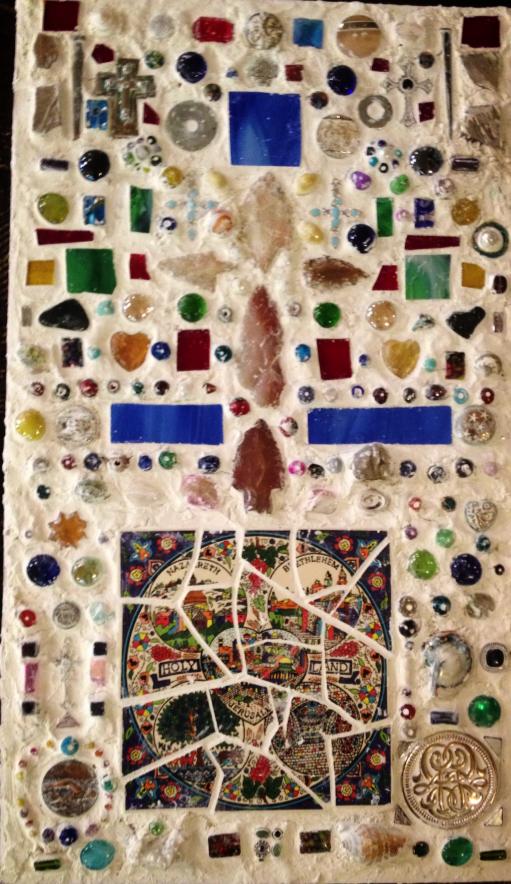
You might have many hidden objects that you can’t get rid of because they have meaning to you. They are in boxes or drawers, tucked in the back of your jewelry box or in your storeroom or garage. One day you’ll get around to it, do something with them, but you just don’t know what yet.  I have many small crosses people have given me, some small pieces of broken jewelry that have lost their mates, and some odd items that I’ve found and for some reason I can’t throw away. I have seashells from the beach vacation I took 20 years ago and old necklaces that are no longer in style. I finally pulled these all out and made an icon of the cross from found objects.200? found object icon

Find an 8 X 10 inch frame at the craft store that you like and get rid of the glass carefully (wrap it in newspaper and throw it away). Cover the backing board with fabric or scrapbook paper. You can also use an 8 X 10 canvas panel painted gold.  Use gorilla glue or a glue gun to attach the objects, beginning from the center outward. Make sure to leave 1/4 inch or more outer margin so that the frame will fit! Do NOT lift the panel up to look at it or the heavy items will fall off! Leave panel flat to dry for 24 hours. Insert it into frame and display.

May your New Life be one of Joy and Peace, Cornelia