A Life of Mystery and Hope

adult learning, arkansas, art, brain plasticity, Creativity, Faith, hope, Icons, Israel, mystery, Painting, Spirituality, suffering, vision

Our weather is changeable. Last week I had the heat turned on, but this weekend I have gone back to ceiling fans and my air conditioner. I was so ready for cooler temperatures, but I am not in charge of the thermostat outside, only the one inside. Of course, while the calendar may say it is autumn and the northern states may get their first snows, we southern folks should know better than to put away all our lightweight clothing just because we have had a first frost. That first frost freeze is just a tease, since an eighty-degree day or two will soon follow.

I talk about the mysteries of our weather because when we try a new art medium for the first time, we sometimes think, “Oh, this has some similarities to a prior experience.” Then we get into it and come to the “unknown land”—the place where we realize we are lost and have no idea which way to turn. We cannot go back, we do not know how to go forward, and we think if we stay in this place, we might starve to death.

We are like Abraham, who heard God’s call to “go to a land I will show you” (Genesis 12:1), but we have no idea how long that journey will take or where we will end up. We go from our safe place as an act of faith, travel in faith, and meet every obstacle and detour with the faith God will bring us through. Every artist is an Abraham in their heart, for they are always on a spiritual journey. Even when we reach the promised land, we always are moving spiritually “from Dan to Beersheba” as we hone our craft, just as Abraham and his family followed their flocks to the seasonal pastures. Like the ancient Jews, we too can confess:

“A wandering Aramean was my ancestor…” (Deuteronomy 26:5).

If we wander, we need a guide. Beginning artists have always sought more experienced artists as their guides and teachers. For the basics, we more experienced persons act as teachers by giving instruction and directions. Some teachers give their students works to copy so each person produces an approximation of the teacher’s image. Since this method does not encourage creativity or intense attention, I have always taught people to use their own eyes to see the image, rather than have me prescribe and define it for them. That would take the greater part of the “seeing and imagining” work away from the students. This would build my neurons but not do all that much for theirs. The more difficult task challenges us and keeps our brains from becoming numb from disuse. Art is one of the best exercises for stimulating the brain.

Marie Woods: Seeking Serendipity II, Mixed media on birch panel, 12″ x 12″, 13″ x 13″ overall, Framed in a tray frame

To start the class, I showed some multi-media art works using words and found objects. Because everyone has a different learning style, I find showing images for visual learners helps those who learn through sight, while talking about these examples helps those who are auditory or hearing learners. I sometimes need to take the tools in hand to show the haptic or hands on learners. No style is “better” or more “advanced” than another, but our unique style of learning has to do with the design of our brains. We can train our brains to work in a different fashion, but our preference will always be easier.

I had begun working on a piece the week before when Mike and Gail were in class. Mike had to go away to handle a work emergency and Gail wanted to finish a pumpkin painting. Since they had known what we would work on, and we had a week off, they were ready with a fleshed-out idea. These two also have experimented with other media in the past also. Gail’s granddaughter brought a variety of materials to work with and already had an idea. Marilyn had a promising idea, but needed technical help to bring it to life.

This is where we become those who say, “we walk by faith, not by sight” (2 Corinthians 5:7). We might look at our canvas, the paint we have put on it, the gauze we tied to it, and say to ourselves: “Well, this is a fine mess I’ve gotten myself into!” This is when a call for help, the lack of activity, or the smoking of a brain working overtime makes me look up from my own work and ask, “You need some help?”

I do not read minds, but my old schoolteacher skills never really die. If the room gets too quiet, someone is either in trouble or fixing to cause trouble. In our Friday art class, we do not have the latter. When I went to help Marilyn, she was at a decision point over what to do with her image without the netting. To begin with, she had tied it on tightly and did not have scissors on hand. In our class, we are willing to share, so no one has any need. As the writer of Hebrews 13:16 reminds us,

“Do not neglect to do good and to share what you have, for such sacrifices are pleasing to God.”

My scissors broke when one of our group tried to cut a cork, so I borrowed Gail’s X-acto knife. Plan A was not available so we moved to Plan B. First the blade fell out, but I put it back in. Marilyn may have been wondering if we ever were going to find a working tool to cut away her netting. She had tied it very securely on the canvas board. Once we got it off, we could look at the paint texture on her board. There was always plan C—arm wrestle the netting off the canvas by sheer force of will, but Plan D would have been better: use the shears in the kitchen. Nothing stops us when we are going to make art. We will find a way.

Marilyn: Continental Drift

“Talk to me about your goals here,” I said.

“I was trying to get some green here, like a green ground.”

“You have plenty of green colors on your palette. Do you want solid greens or washes, like transparent greens?”

“More like transparent greens.”

“So, use your big brush and water.”

“I did not bring my big brushes. Just my small ones.”

“You can borrow mine.”

This is how the art studio life goes. We chat things out for a bit until we get over a hump, and then we let a person explore on their own some more. Some things they will discover for themselves. The more water you put into a color, the thinner it is on the canvas. The more paint put on your brush, the more opaque it is. If you want transparency, you thin your paint with a medium or water, but if you want to cover an area, you paint straight out of the tube. Keeping your brushes clean by changing the water often is also important. Otherwise, you are dragging colored water into your other colors. None of your other colors will be true colors, but will take on the color of your water.


Jimmie Durham: “Still Life with Spirit and Xitle”, car being crushed by a volcanic boulder with a comical smiley face painted on it.

When we journey, we sometimes need to take a detour along our well-planned route because a boulder has rolled down into the middle of the road or a recent flood has washed out the bridge. My map reading skills before GPS were so suspect, my daughter was frightened whenever I announced, “I’ve found a shortcut to save us some time.”

“Oh, no! Not the long cut!” She would wail. Unfortunately, she was usually correct. The shortcut might have been true, but my map reading skills always turned these short trips into long journeys. I do get to see the “unknown lands” off the beaten path of the scenic tours of whatever place I visit. “Oh, the places I have been!”

Dr. Seuss is a prophet

Learning how to paint, create art, make pottery, play a musical instrument, or any other creative activity does require attention, practice, critiquing, and patience. We must be pilgrims on a journey, knowing the long walk is part of the spiritual process of becoming the person we want to be. Our works will reflect our inner journey as we get closer to our destination. An artist never quits learning, so the artist’s journey never ends until they can no longer create physical works here on earth. As Anselm Kiefer, a modern German multimedia artist says,

“Art is longing. You never arrive, but you keep going in the hope that you will.”

Anselm Kiefer: Feld (Field), 2019-20, Emulsion, oil, and acrylic on canvas, 110¼x149% inches (280 x 380 cm)

Gail tried laying her paint on with a painter’s spackling knife. Normally she thins her paint out with water and treats it like a watercolor painting. She will build up layers to add depth and color. She also has a good clean edge to these works. She brought none of that vision to this painting, but laid on the three primary colors so thickly, they glistened. She tried printing the words with a rubbery shelf paper, but they did not stand out enough. I asked, “Do you think those words would read better in a different color?”

Gail: Elusive Peace

Her reply, “Peace is elusive these days. It is hard to find.”

“Form follows function” is a design principle, so Gail must be on to the metaphor of her theme word.

My Heart is on the Sea

Harper came to visit and made an ocean with sea foam bubble wrap and a heart floating on the water. She also brought her latest fancy bead bracelets.

Michael’s Cross and Crown

Mike was making up for missing art. He sat down with all his materials and worked his background in paint. After listening to my intro, he returned to cut up his purple cloth, arrange it on the canvas, and set the two pieces of scrap wood into a cross shape. Then he used spray fixative to hold the lot together. I saw him trying to get the wood to stick, so I suggested putting spray on both surfaces. This way the two would bond together. That piece of information was a technical revelation.

“I just need it to stick together long enough to get it home,” he said, “and then I can glue it for real.”

Aurora Across Arkansas 11/11/25

I noted his background colors reflected the unusual auroras which graced our evening skies this past week.

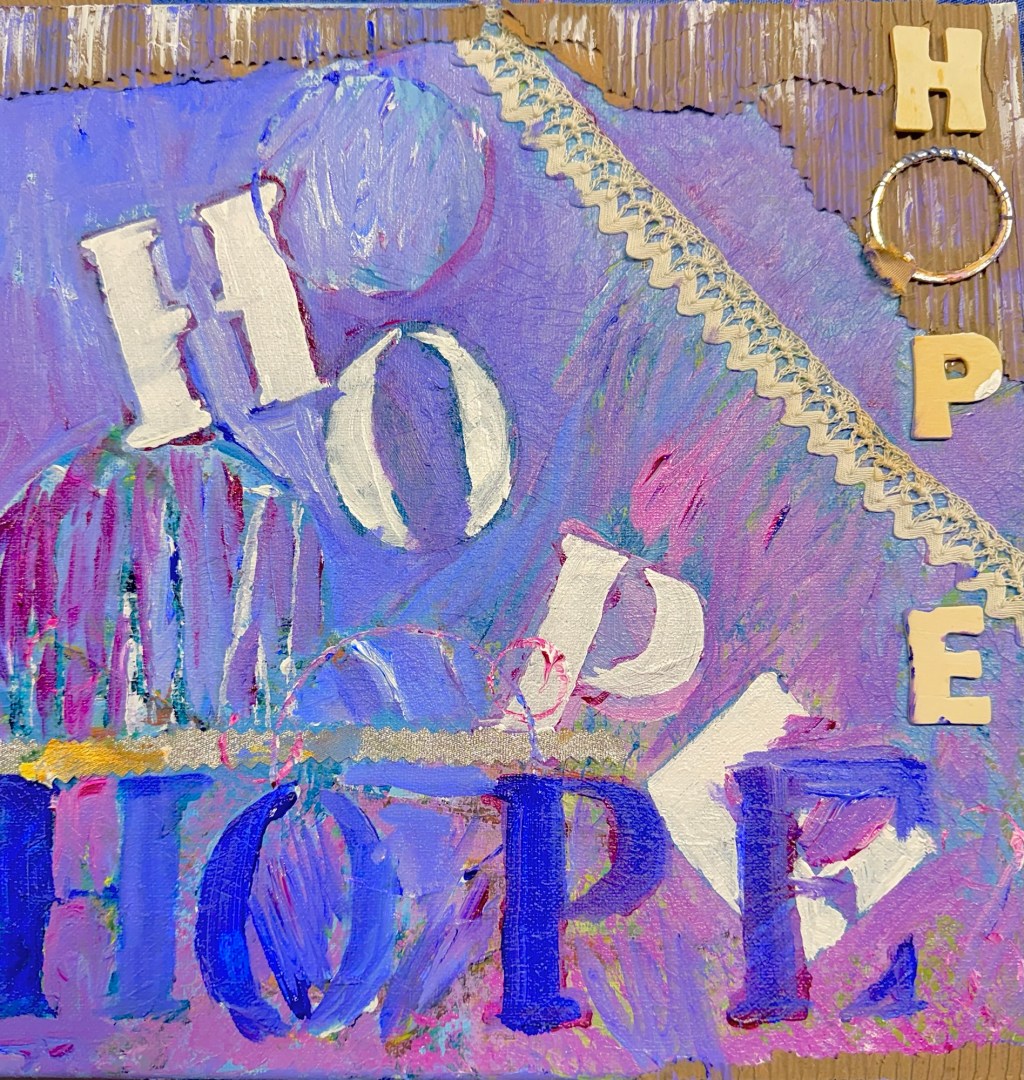
Eternal Hope

I had started my small canvas the week before when I was half sick. My hand, heart, and mind never feel quite connected when I feel bad, but I still work anyway. The beauty of acrylics is I can paint over them later. In fact, this is a repurposed canvas. If a work does not “speak to me” after a few months, I either cut it up to reweave it or paint it over entirely. I always think I will find hope for it in another form, but it may need to take its own journey to find its best self.

Jeremiah once said to the Jewish exiles in Babylon,

“For surely I know the plans I have for you, says the LORD, plans for your welfare and not for harm, to give you a future with hope.” (29:11)

When we have forgotten what our home looks like, God still remembers where we once lived. When we have lost our memories of the ancient Temple practices, God still knows the rituals. God will remind God’s faithful of our service. If we have lost our knowledge of how to walk with God, God will send us teachers once more. God always provides us with what we need.

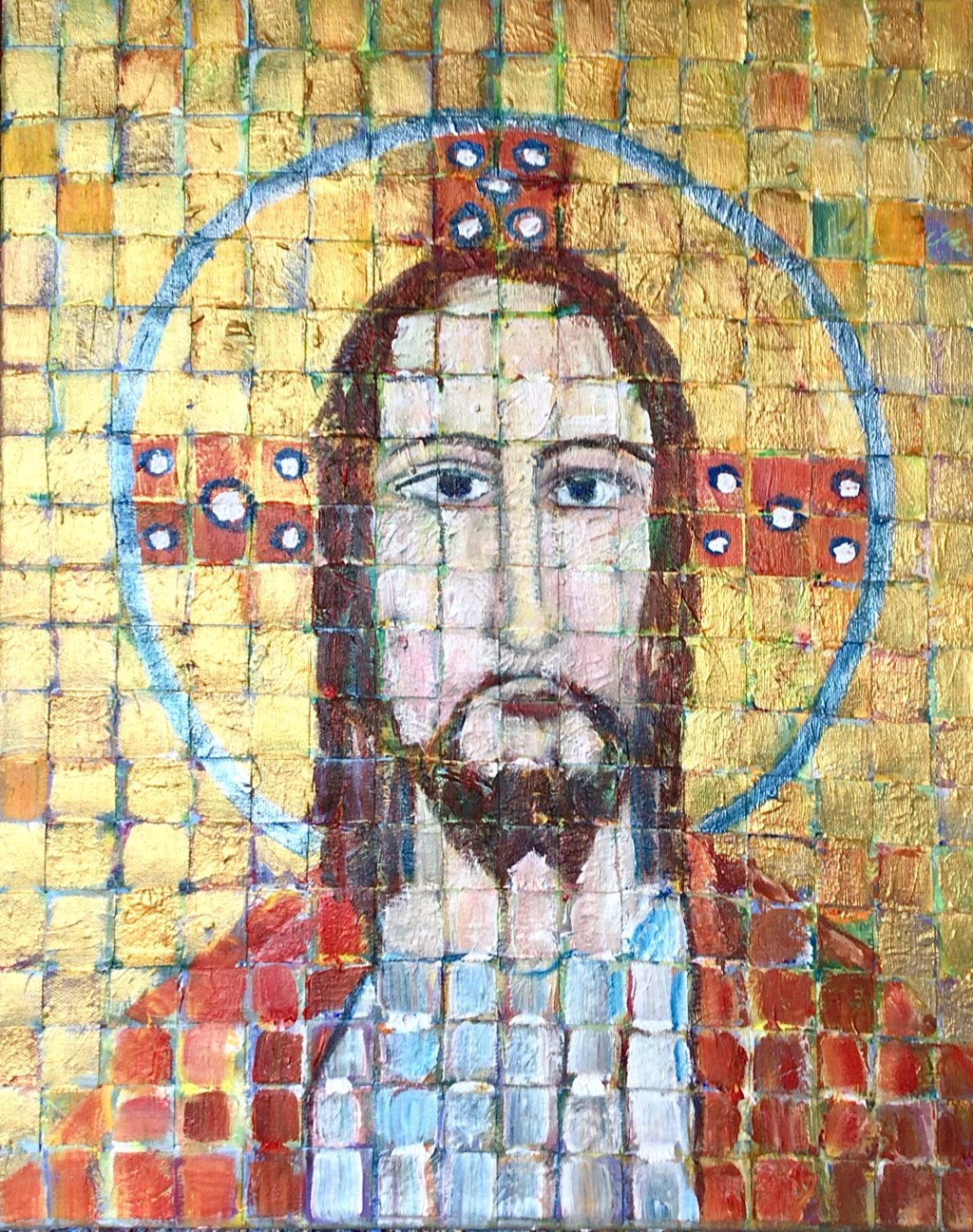
Christ the Redeemer, 16th CE, Gallery of Art, Skopje.

Hope is part of our GrecoRoman heritage also. “Dum spiro spero” is Latin for “While I breathe, I hope.” Some form of this saying has been around since the 3rd century BCE. My grandmother sewed her antique crochet trim onto pillowcases for wedding gifts. This is a scrap I found in her sewing kit. I stenciled the letters HOPE and glued down the wooden letters H, P, and E. I used an old metal circle for the O. Torn corrugated paper added a touch of texture, as did a few string prints. Sometimes hope appears to slide away or seems raw and unvarnished. The colors are blue and violet because Advent is the great season of Hope. Matthew quotes the Servant Song from Isaiah in 12:18-21—

“Here is my servant, whom I have chosen,

my beloved, with whom my soul is well pleased.

I will put my Spirit upon him,

and he will proclaim justice to the Gentiles.

He will not wrangle or cry aloud,

nor will anyone hear his voice in the streets.

He will not break a bruised reed

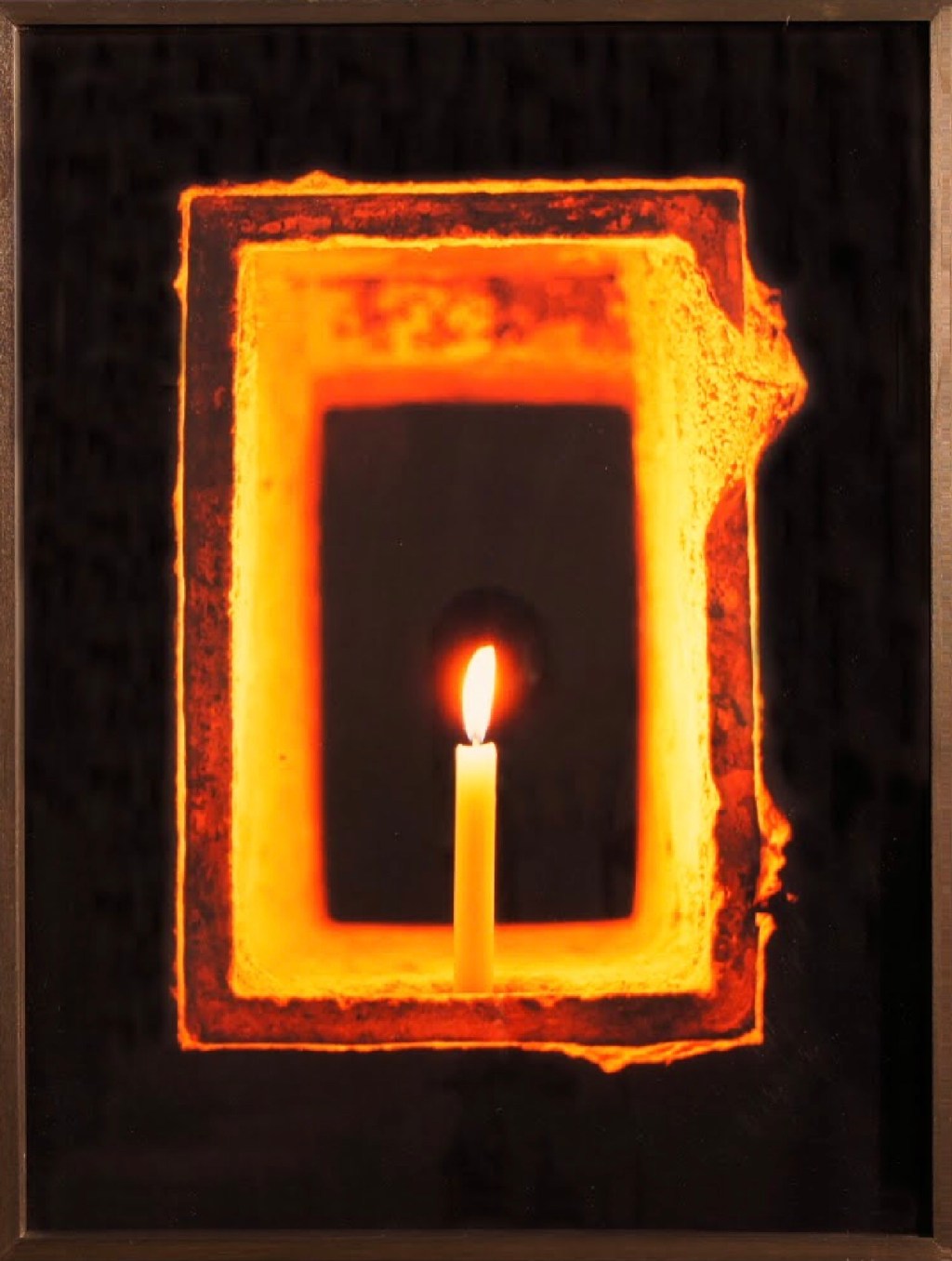
or quench a smoldering wick

until he brings justice to victory.

And in his name the Gentiles will hope.”

This is the Messiah of Hope of Israel and the Anointed Christ in whom we hope today. We can best share the hope of this Christ to our suffering world by serving the suffering, the grieving, the hungry, and the overlooked.

Joy, peace, and hope,

Cornelia


Learning, Growing and Thriving

adult learning, art, Athanasius, brain plasticity, Christmas, Civil War, cognitive decline, Creativity, crucifixion, Faith, Imagination, incarnation, john wesley, Love, mystery, nature, renewal, Spirituality, St. Athanasius, United Methodist Church, Valentine’s Day, Valentine’s Day

In most adults, learning and thinking plateaus and then begins to decline after age 30 or 40. The old adage, “Don’t trust anyone over thirty” takes on new meaning in regards  to creativity. People after this age start to perform worse in tests of cognitive abilities such as processing speed, the rate at which someone does a mental task. The slide becomes even steeper after 60 years of age. We also notice a similar learning decline in children after summer vacation, which results in the fall semester becoming a “reteaching opportunity.”

As one who is also “growing long in tooth,” I have passed this yardstick by a mile. I notice I have a “slower processing speed” in my creative writing. I don’t consider it a reason to quit, but a reason to better organize my other time-wasting behaviors (social media, newsletters, newspapers, etc.). I can always ignore cleaning the condominium! Creativity before housework, is my motto.

Housecleaning Meme

We often think older adults are on a downward slope with unrecoverable loss. “Use it or lose it,” the saying goes. Recent research suggests we need to apply a more hopeful mindset and vocabulary when discussing older people—much like that used for childhood or early adulthood. Decline, as we so often see it, may not be inevitable. In fact, learning a new skill and practicing it for three months has shown benefits beyond the the practice time.

Adults often have limited time or resources, so if we encourage learning a new skill, this may help them step out of their comfort zones. In people’s later years, many personal and societal changes—such as moving out of state to be closer to family members, switching jobs or coping with physical distance from loved ones—make learning new skills necessary to adapt and succeed.

For example, taking a class to improve technological skills could aid seniors’ success in an increasingly digital world, such as helping them use Telehealth or online banking platforms. Learning new skills in an art class allows a person to express their feelings and solve problems in creative ways. Each person can find their own path to success in artistic practice.

Potholder Loom, just like the one I had back in the day.

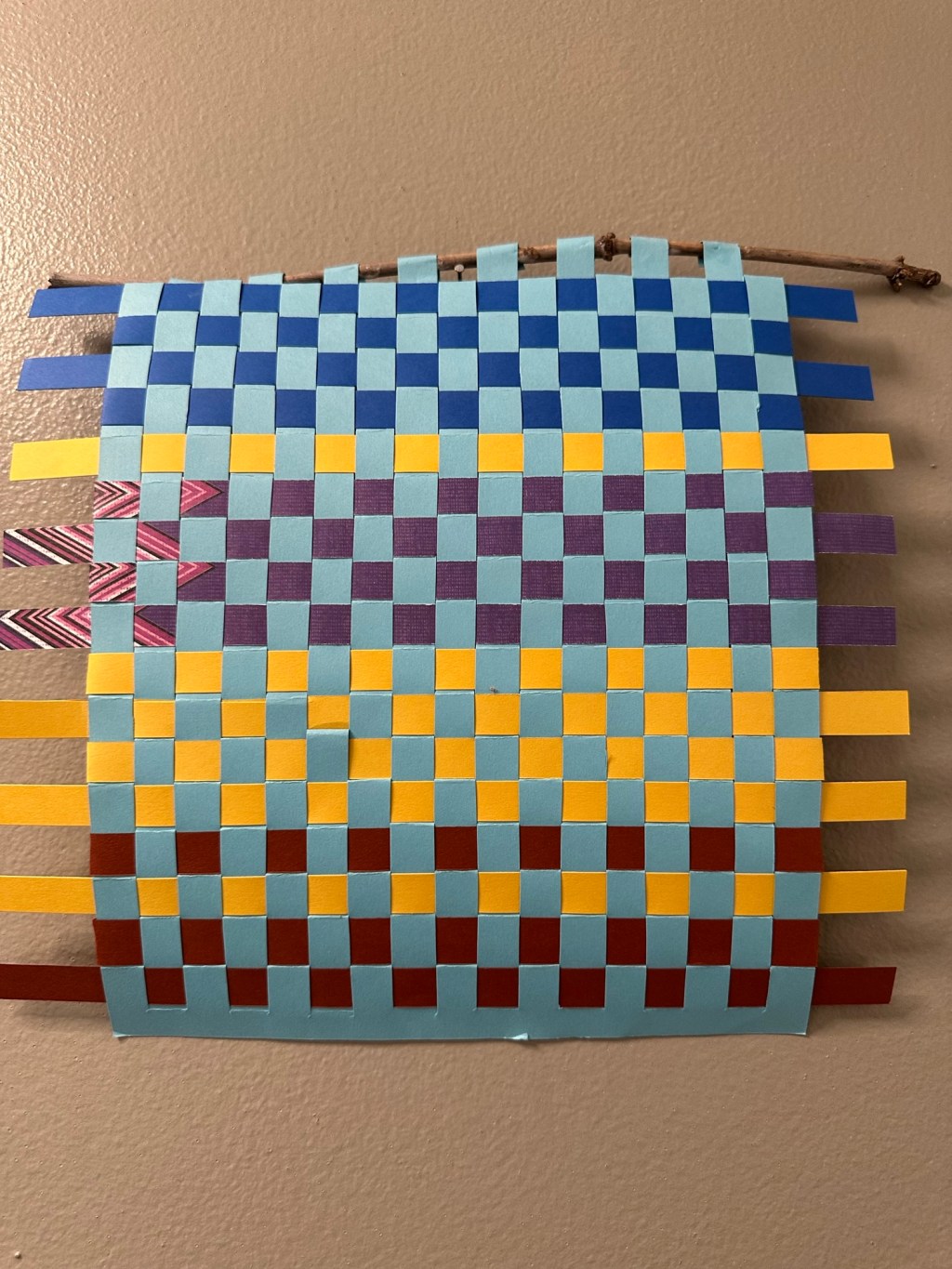
Our art class is trying a new thing: weaving. We have been painting for quite a while, so this is really a hands-on project. Some of us had the benefit of making woven potholders as children, or weaving newspaper “sit-upons” at summer camp. The technique isn’t unknown, but making a creative design interpretation is how we take our basic skill forward into a stimulating and creative brain challenge.

DeLee: Woven Paper on a Stick (Earth and Sky)

We could just repeat what we already know, but this doesn’t build us new neurons in our brains. If we keep the same old paths and don’t create new ones, we aren’t flexible when we meet new situations. Since we live in a rapidly changing world, building a brain capable of rapidly adapting is important to live independently and vibrantly for as long as possible.

I remember how my Daddy could only use the old tv remote to change the channel for the original non cable stations. When “Murder, She Wrote” came on the cable channel, my Mother had to use the cable remote to change the station for him. His Alzheimer’s disease prevented him from learning new skills, but he remembered all of his previous medical training and could diagnose his condition and boss the emergency room doctors when he was admitted to the hospital for a fall. Our brains are a mystery indeed.

Mike jumped the gun on Valentine’s Day and created a woven heart. These were big in the Danish and German communities and very popular in the 19th century in America. During the Civil War, soldiers made many of these in elaborate forms to send to their loved ones back home.

Unknown Artist: Affirmation Weaving

The brain is a fantastic and mysterious organ. If we make a habit of learning something new every day, of whatever interests us, we have the opportunity to keep our lucidity for a longer time. We also we meet the quickening changes of modern life with a steadfast heart and mind. We stress less when we know we can adapt and change in our own lives. We don’t have to be the people who say, “You can’t teach an old dog new tricks.” We can teach and we can learn, but we might need to be more patient with the old dog. In some corners, we call that “grace.”

I watched my Granddaughter’s Daddy Daughter Dance

Our group was in and out during the several weeks devoted to this project. One of us was sick, one was grieving the death of a beloved pet, another had pressing work issues, and the teacher went to Florida to see her granddaughter get married. Amazingly, life goes on. People dropped in for spiritual support, which is a side benefit of the community of art class. I managed to get mine mostly done, and Gail S. finished hers completely. Sometimes life interrupts our best intentions and we move on. We will learn new lessons on the next project.

Gail S’s “Eye of God” weaving

 Gail S’s “Eye of God” weaving incorporates yarns from two different mop heads, some sticks, and a bird feather. Gail almost always keeps a realist focus in her works, so her eye of God has a bird feather to mark the pupil. The upper field of grey and white mop yarns represent the cloudy sky, while the blue yarn stands for the water and the brown for the land. God watches over all of God’s creation. Gail S’s love of the outdoors and all of nature is evident in all her work.

Cornelia’s Cross on a Hill (unfinished)

I also recycled some old paintings and cords which I’d used in the preparatory work of other paintings. In addition, I used some recycled strips of Amazon shipping parcels as well as a wire shape which once belonged to a butterfly wing. In repurposing these items into the weaving along with two old brushes bound together with a God’s eye, I invoke the renewal of life after death.

We people of faith have two opportunities for a renewal of life after death. The first is by our profession of faith in Christ and his life, death, and resurrection on our behalf for our salvation. This gives us a living faith in this world. The second renewal is for the resurrection from death itself. This gives us a life beyond this world. Our faith is worthless if it doesn’t change us for our walk upon this world. If we don’t have the heart and mind of Christ within us, and if we aren’t earnestly seeking to be made perfect in the love of Christ daily, our United Methodist heritage tells us we’ve not yet been converted.

Yet Christ desires to save all, as John records in 12:32,  Jesus tells the crowd,

“And I, when I am lifted up from the earth, will draw all people to myself.”

Not just some people, or only the best, or even just us United Methodists, but ALL people. Most of us aren’t able to understand such a wide ranging love, for we live in a world of tribal loyalties. If we look at creation, which is God’s first work, God loves that which God created. God loves everything God created. We humans are the ones who choose sides and introduce boundaries and hate into God’s singular creation. The world or Kosmos is the creation first and then the people in it.

Today we tend to ascribe “world” to the “culture,” or secular society in general, but its plain meaning is creation and the human presence, for good or ill. The ancient Greeks and Romans divided the world into the material (bad) and the spiritual or mind (good), but the Jewish theology conceived the unity of both as part of God’s gift to humankind.

In the fifty-fourth chapter of On the Incarnation, St. Athanasius of Alexandria wrote a sentence that has echoed down through the centuries even into our own time as a brilliant summary of the Gospel. He wrote this: “God became man so that man might become god” (54:3).

This doctrine is called theosis or acquiring the whole nature of God. We United Methodists call this state Christian Perfection, or “a heart so full of love of God and neighbor that nothing else exists.” Our Wesleyan heritage was influenced by the Wesley brothers’ deep love for the Greek Orthodox fathers of the early church. To focus only on fallen nature is to deny the power of God to redeem us and all creation and to make all things new. We humans and nature aren’t more powerful than God!

If we cut off part of our God given self, we deny the incarnation of Christ, who became human for us that we might become divine. We need to remember what John 3:16 so succinctly states:

“For God so loved the world that he gave his only Son, so that everyone who believes in him may not perish but may have eternal life.”

Art is a way to open our eyes and hearts to a new way of seeing spiritual truths. Art is also reflective of the artist’s soul and spirit. A sensitive viewer can read the tale of trauma or the struggle for survival in an artist’s body of work. More than this, we can listen for their voices straining to be heard. Most people have been silenced and conformed to the “cause no trouble, don’t get out of step” mantra of the public school system training our youth for the workplace.

In art class, we can lose our fear of being different because being different gets rewarded! Being original gets an attaboy or attagirl.  I find such joy helping people find new courage and creativity they didn’t know existed within themselves. My students keep me young too. I feel blessed beyond measure.

Joy and peace,

Cornelia


To Stay Sharp as You Age, Learn New Skills | Scientific American

https://www.scientificamerican.com/article/to-stay-sharp-as-you-age-learn-new-skills/

That Man Might Become God — Fr. Andrew Stephen Damick
https://blogs.ancientfaith.com/asd/2015/01/22/man-might-become-god/

Light Overcomes the Darkness

art, Bethlehem, Christmas, Faith, Hanukkah, hope, Israel, Light of the World, mystery, Nativity, suffering, Ten Commandments

“The light shines in the darkness, and the darkness did not overcome it.” —John 1:5.

Work in progress: Light Shines in the Darkness

Some of us can hear these words with hope, two thousand years after John’s gospel was first written. These words come as a ray of hope, like a flashlight’s beam bursting into a collapsed mine to let imprisoned workers know help and life-giving oxygen is on the way. For the people in the first century who lived under the Pax Romana—the peace of Rome—not everyone had the same rights and privileges as the citizens of Rome. The conquered lands, including the nation of Israel, were under military occupation and suffered brutal taxation and unfair application of the laws.

More importantly, obedience to the emperor and the empire was required, which for the Jewish people meant making a sacrifice in honor of the emperor. Because this act would acknowledge a human being as a god, the Jews were between a rock and a hard place. If they denied the emperor, they were unpatriotic. If they sacrificed to him, they committed blasphemy against their God. After all, we find one of the great commandments in Exodus 20:2-3:

“I am the LORD your God, who brought you out of the land of Egypt, out of the house of slavery; you shall have no other gods before me.”

We take religious freedom and expression as a given here in the United States, since the first European settlers to these shores came here with the express purpose of worshipping God in their own way. Unfortunately, they also persecuted the next groups who arrived and who worshipped differently. After gaining independence from England, America has been one of the few nations of the world in that one of its core values is to honor every faith tradition and allow each person to worship freely (or not) God as they want.

Insisting on the priority or preference for one religion isn’t historical or grounded in our constitution. We find this in both Article VI of our Constitution, which prohibited religious tests for federal office holders, and in Article I of the Bill of Rights:

“Congress shall make no law respecting an establishment of religion, or prohibiting the free exercise thereof; or abridging the freedom of speech, or of the press; or the right of the people peaceably to assemble, and to petition the Government for a redress of grievances.”

In this present time, when certain groups of Christians (Christian Nationalists) want to claim an alternative history of our national origin and our national destiny, they also are trying to rewrite our history to make it fit their purposes. This elevates their religious group above others and gives them preference over other Christian denominations as well as other faiths and nonbelievers. When these other groups become persecuted or marginalized, the whole suffers, while a few prosper.

The situation was much the same back in the first century CE, when tax farming was a corrupt practice in the Roman provinces. A family bought the rights to a tax area, collected whatever they wanted, and gave the due to Rome. The rest they kept as profit. No wonder folks hated the local tax collectors: they were not only greedy, but they colluded with the occupation. The priests in the temple made sure they never rocked the boat, so they could keep up their rituals and practices of the law, both scriptural and secular.

Therefore the people yearned for a savior, a messiah. In every age, in the stillness of the night, in the darkness of despair, when hope was flickering to an ember, a voice of a prophet would arise. These prophetic voices weren’t often heard, but occasionally one voice would pierce the gloom like a bright light in a dark cave. When a prophet speaks a true word from God, people recognize it as true because it speaks the truth of God, reminds people they belong to God, calls the people back to God, and tells them the consequences of their resulting behavior. Prophecy isn’t just about fortune telling.

Poets are often the prophets of their age. The first stanza of William Butter Yeats’ Ode speaks both toward that first century past and to the second coming:

“Turning and turning in the widening gyre
The falcon cannot hear the falconer;
Things fall apart; the centre cannot hold;
Mere anarchy is loosed upon the world,
The blood-dimmed tide is loosed, and everywhere
The ceremony of innocence is drowned;
The best lack all conviction, while the worst
Are full of passionate intensity.”


Final State: The Light Shines in the Darkness

If we lose hope, if we give up on the hope of redeeming our world and ourselves, we will fall into despair and nihilism. These emotions are not good. We won’t listen for the still small voice of God in the dark and quiet spaces anymore. We won’t hear the voice of God in the weed growing in the crack in the pavement of the sidewalk as we go about our daily tasks. We will fail to hear the promises of new hope and new strength when the crocuses pop through the snow next spring.

Art and poetry keep us connected to the magic and mystery of the Spirit of God. A steady diet of news and television is a soul killer. If you find your attitude going south, I recommend you limit your news consumption to two hours or less per day. Replace those other hours with sunlight, exercise, cooking, a new hobby, fiction reading, journaling, or whatever. If you keep getting drawn back into the distressing activity, remember to let go, and return to a better activity. Optimism and a sense of hope will carry us further than negativity will. As Isaiah 6:13 says,

“Even if a tenth part remain in it, it will be burned again, like a terebinth or an oak whose stump remains standing when it is felled. The holy seed is its stump.”

Or as my daddy always said, “Don’t let the bad guys grind you down.” Of course, this sentiment had some bad medical school Latin he and his friends translated when the going got tough and the sleep got short in his younger days. “While I breathe, I hope,” is “Dum spiro spero,” in Latin. It’s been one of my favorite sayings. Night doesn’t last forever, and morning will come. Dawn will break! There will be a new day and a fresh opportunity to do at least one thing better. To make a difference in one person’s life, to make a difference for the good for someone, somewhere. I may be just baking cookies to bring to overworked volunteers somewhere, who are doing good for others, but I can bring a bright light to someone’s day today. I don’t have to save the entire world.

If I can be a ray of light for someone today, I might give them hope. Hope is a gift. We should share it freely. Then hope would grow and “The people who walked in darkness have seen a great light; those who lived in a land of deep darkness—on them light has shined.” (Isaiah 9:2).


Joy, peace, and light,

Cornelia

Faith of Our Forefathers (May 1998) – Library of Congress Information Bulletin

https://www.loc.gov/loc/lcib/9805/religion.html

The Second Coming | The Poetry Foundation

https://www.poetryfoundation.org/poems/43290/the-second-coming


Total Eclipse of the Heart

adult learning, arkansas, art, Astrology, cosmology, Creativity, Faith, Great American Eclipse, Imagination, inspiration, Light of the World, Love, mystery, nature, Painting, photography, shadows, Spirituality, Travel, Uncategorized, vision

In the Bonnie Tyler song, “Total Eclipse of the Heart,” her rock and roll soul pines for a young man as she sings:

“Every now and then

I know there’s no one in the universe

As magical and wondrous as you.”

Love struck teen heart ballads tend to elevate the beloved to a high pedestal, while hymns lift the praises of God to the highest heavens. If we look at John Wesley’s Notes on the New Testament, one of the doctrinal standards of the United Methodist Church, his commentary on 2 Corinthians 4:6 (KJV) is instructive:

“For God, who commanded the light to shine out of darkness, hath shined in our hearts, to give the light of the knowledge of the glory of God in the face of Jesus Christ.”

We might be more familiar with this verse in the NRSV, a more modern translation, which wasn’t available in the middle of the 18th century:

For it is the God who said, “Let light shine out of darkness,” who has shone in our hearts to give the light of the knowledge of the glory of God in the face of Jesus Christ.

Bailey’s Ring, from an earlier total eclipse over the South Pacific Ocean

Wesley’s commentary in his Notes on this text is succinct:

  1. For God hath shined in our hearts—The hearts of all those whom the God of this world no longer blinds.
  2. God who is himself our light; not only the author of light, but also the fountain of it.
  3. To enlighten us with the knowledge of the glory of God—Of his glorious love, and of his glorious image.
  4. In the face of Jesus Christ—Which reflects his glory in another manner than the face of Moses did.

What do the Total Eclipse of the Heart and Paul’s words to the Corinthian community have to do with art and faith? We’ve just experienced, what was for most of us, was a once in a lifetime experience. The last time a total solar eclipse was visible across the entire continent was in June 1918, when a total solar eclipse was visible from Washington to Florida, according to the US parks service. Nearly 100 years passed until this present Great American Eclipse.

At the 1878 total eclipse, Maria Mitchell led the Vassar College eclipse party, an all-female expedition from that pioneering women’s institution, which came to Denver in an era when science was a male bastion. Even higher education was deemed risky for the “fairer sex.” In 1873, the prominent Boston physician Edward H. Clarke had warned in an incendiary book titled “Sex in Education,” that the recent push for female colleges and coeducation could undermine women’s health by taxing their brains and causing their reproductive organs to atrophy — leading to “a dropping out of maternal instincts, and an appearance of Amazonian coarseness and force.” Nearly 150 years later some men still concern themselves with outmoded and 19th century views on women’s health concerns.

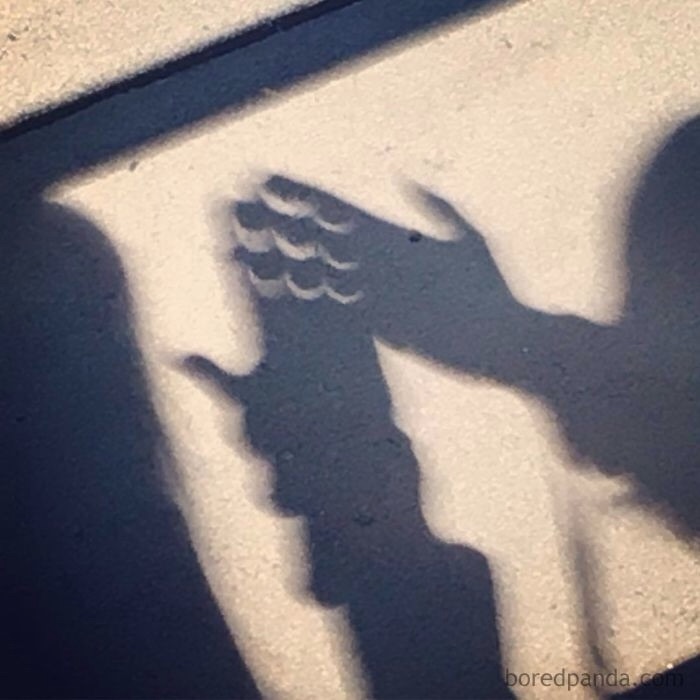
Eclipse as seen through the hands

I drove over four hundred miles to Kentucky in 2017 for the prior Great American Eclipse and got to stay home to see this second Great American Eclipse in my own front yard. Some folks couldn’t have been bothered about this current grand event, while others were convinced God was informing America of her impending doom. Moreover, multiple conspiracy theories abounded, none of which came true, of course. For instance, the world didn’t come to an end and our cell phones still work. Even the electric grid held up, even though the sun didn’t shine for all of a few minutes as the shadow traveled at over 1,600 miles per hour as it raced along the path of totality. This wasn’t even Y2K, which we all remember was a nonstarter at least and a dud at best.

Eclipse over Niagara Falls, 2024

In art class Friday Tim and I talked about the experience of this celestial event. We humans often elevate our own importance when we measure ourselves against one another and the works of our hands. When we go out into nature, we’re faced with the grandeur of God’s creation, especially when we visit the Grand Canyon or Niagara Falls. In Psalms 19:1, we read:

The heavens are telling the glory of God; and the firmament proclaims his handiwork.”

We see the beauty of nature and feel a warmth in our hearts. Our spirits soar. This intimacy with nature is one of the reasons we send our children to our United Methodist Church Camps, not just because they’ll have a great Christian experience, but because they’ll have that faith experience in nature with trusted leaders. I still remember my adventures and experiences in nature at those camps as part of my spiritual journey.

Towering Cumulus Clouds

Even in seminary, when I was having difficulty with some of my courses, I could go for a walk on the campus under the tree lined walks and search the skies for hopeful signs. Sometimes I saw the towering cumulus clouds in the Texas sky as a sign God was with me “in the cloud by day.” In those times of difficulty, even the cloistered realm of preparation seemed like a wilderness journey, but I was glad for a guide.

Bill Maxey, from Nebraska, taken at Hot Springs, AR.

When I was actively serving as a pastor, sometimes I just had to get away. I’d drive until I found some nature, a national park, national forest, or some fields outside of town. If it was a hot summer, I looked for some deep woods and cool shade to shelter me. In the cool spring, I drove until I found flowers. Maybe this is why I retired to a lake in a national park. I don’t need a big house, since I’d rather go out into nature instead.

Totality on Lake Hamilton, with sunset in the west, outside the path of totality

It was the heat of summer in 2017, so you’d think I’d remember the temperature drop right before the eclipse was halfway through. This year I was on Lake Hamilton, and the breeze off the lake combined with the cooler air was decidedly noticeable. When we entered totality, the lights on the Highway 70 bridge and at Bubba Brews automatically came on. The distant sky in the southwest, outside the path of totality, looked like a summer sunset. My neighbors and our visitors from afar were cheering.

Bill Maxey: multiple exposure of the Great American Eclipse, 2024

Not everyone can make an artwork that expresses their emotions as well as the shapes of the image. We can learn the rules of perspective and color, but then we have to learn to let our heart rule our head. This is what I call an “artistic leap of faith.” When we were young, we accepted the basic ideas of Christianity. As we got older, life happened, and we might have begun to struggle with our childhood beliefs not being equal to our adult needs. If we keep our childlike faith, we risk losing our faith. If we are able to wrestle with our faith and find a new and more mature faith, we can handle the major challenges of later life. As Paul says in 1 Corinthians 13:11-12—

“When I was a child, I spoke like a child, I thought like a child, I reasoned like a child; when I became an adult, I put an end to childish ways. For now we see in a mirror, dimly, but then we will see face to face. Now I know only in part; then I will know fully, even as I have been fully known.”

Tim’s Partial Eclipse painting using red, blue and brown to build the sky

Tim experimented with mixing colors to get richer depth. Using the Prang watercolor palette, he mixed the red, blue, and brown to get the black sky of the eclipse event. The red orange of the sun has some brown in it too. He layered the colors with multiple strokes, with a nod to Van Gogh. He worked from a photograph I brought. I pulled many of them off the internet, and many of my friends sent me some too.

Cornelia: Total Eclipse of the Sun

I worked on an image I’d taken from my iPhone. I had placed one of my eclipse glasses over the lens and was wearing another pair. It wasn’t that easy to get the sun lined up with all that blocking! My image looked a lot like a fried egg or an eyeball. I used several jar lids to get the circles painted cleanly. My dark sky is red, blue, and violet. The shape of the corona was not distinct, due to the quality of my camera. NASA has a very high-resolution image, which breath taking. Our tax dollars at work are bringing great scientific research and development to benefit us in everyday life, such as solar panels and heart implants.

NASA: High Resolution Image of the Total Eclipse

Thomas Merton, in No Man is an Island, in a chapter called “Being and Doing,” wrote—

“We cannot be happy if we expect to live all the time at the highest peak of intensity. Happiness is not a matter of intensity but of balance and order and rhythm and harmony. Music is pleasing not only because of the sound but because of the silence that is in it: without the alternation of sound and silence there would be no rhythm.”

I was a bit exhausted after all the excitement of this big event. I’d met new people from three different states, visited around our patio, and been gifted crystals that had been dug from Mt. Ida and “energized by the eclipse.” I’m not a crystal person, but I understand from those that are these crystals are “special.” I was feeling every bit of my new age as the calendar flipped over for another year.

Bourbon Codex: Aztec priestly document recording astronomical observations: eclipse

But today is another day, I had a night to sleep, and we had fun in art class. As long as we find joy in life, we know we’re alive. Our joys aren’t just collections of peak experiences, but some are the joy of the assurance of God’s enduring presence in our later lives when our youthful vigor has left us. We need to remember just as the moon eclipses the sun, once it passes, it also reveals the sun’s glory. One day this Bible verse from Philippians 3:21 will be true for each one of us, who has a heart full of love for God and neighbor:

“He will transform our humble bodies that they may be conformed to his glorious body, by the power that also enables him to make all things subject to himself.”

Joy and peace,

Cornelia


Bonnie Tyler – Total Eclipse Of The Heart Lyrics | AZLyrics.com

https://www.azlyrics.com/lyrics/bonnietyler/totaleclipseoftheheart.html

John Wesley: Explanatory Notes on the New Testament (With Active Table of Contents) [Kindle Edition], first published 1757

John Wesley: Wesley’s Notes on the Bible – Christian Classics Ethereal Library—online free edition of this book

https://ccel.org/ccel/wesley/notes/notes.toc.html

The Solar Eclipse Is the Super Bowl for Conspiracists | WIRED

https://www.wired.com/story/solar-eclipse-conspiracies/

Solar Eclipse 2017: Sun and moon put on celestial performance – CBS News

https://www.cbsnews.com/news/2017-eclipse-dazzles-million-watch-celestial-performance-sun-moon/

Thomas Merton—“No Man is an Island” in a chapter called “Being and Doing” [TMHI]: 1955

 A Woman in Eclipse: Maria Mitchell and the Great Solar Expedition of 1878

https://undark.org/2017/08/17/wilo-maria-mitchell-astronomer-eclipse/

NASA: Benefits Stemming from Space Exploration

https://www.nasa.gov/wp-content/uploads/2015/01/benefits-stemming-from-space-exploration-2013-tagged.pdf?emrc=ca90d1#:~:text=Overcoming%20the%20challenges%20of%20working,information%20technology%2C%20and%20industrial%20productivity


Eclipse T-Shirts

adult learning, art, Children, cosmology, Creativity, Faith, Good Friday, Great American Eclipse, Habits, Icons, Imagination, incarnation, inspiration, mystery, nature, Painting, Philosophy, Spirituality, vision

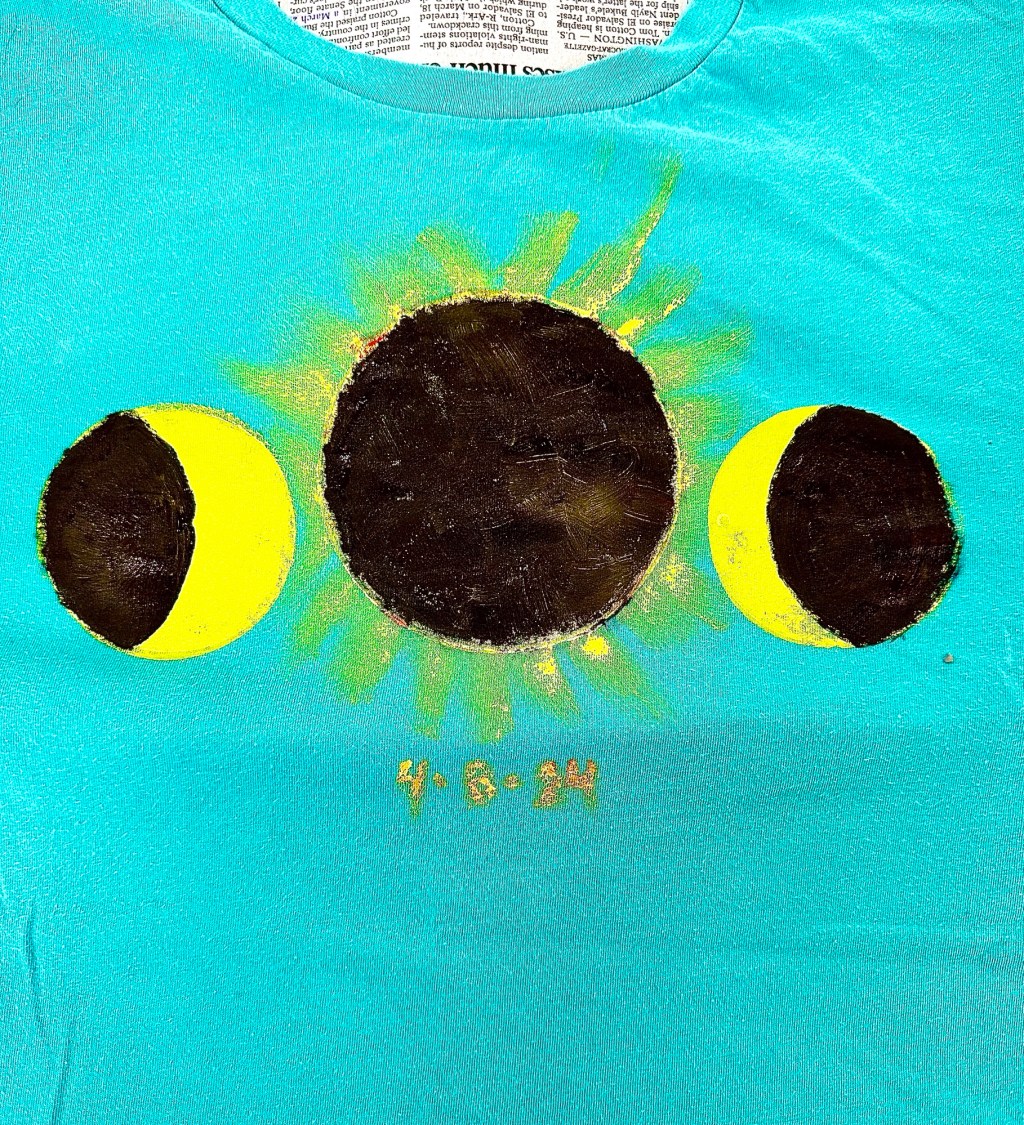
Friday in art class we painted our own unique designs on t-shirts for Monday’s Total Eclipse of the Sun. Anticipation of an event is characteristic of young children, while adults often feel over saturated with the early build up of attention given to an important event. By the time it gets here, we go, “Wow, what a letdown.” Children, who have fewer years of experience and anticipation comparison, can still marvel at the alternate reality of the total eclipse.

In the sixth century BCE, Anaximandros believed “the moon has a false light and is illuminated by the sun, and the sun isn’t smaller than the earth and it is pure fire.” The Greeks in 290 BCE knew the moon was unlike the sun. Anaximenes wrote it “didn’t shine with its own light, but with the reflected light of the sun,” as Eudimos wrote in his book History of Astronomy.  The Chinese also studied the skies and stars. They used bones heated in fires to divine messages from their deceased ancestors as early as the 12th century BCE.

Chinese oracle bone depicting lunar eclipse of 12/27-28/1192 BCS.

The Death of Jesus in the Synoptic Gospels has the record of an eclipse occurring during the time of the crucifixion. John’s Gospel, which comes from a different source, doesn’t mention this time of darkness.

Egon Schiele, Crucifixion with Darkened Sun, Oil on Canvas, 1907.

When it was noon, darkness came over the whole land until three in the afternoon. ~~ Mark 15:33

From noon on, darkness came over the whole land until three in the afternoon. ~~ Matthew 27:45

It was now about noon, and darkness came over the whole land until three in the afternoon, while the sun’s light failed; and the curtain of the temple was torn in two. ~~ Luke 23:44-45

When Jesus had received the wine, he said, “It is finished.” Then he bowed his head and gave up his spirit. ~~ John 19:30

Yet the Gospel of John tells us more about the miracles of Christ and his dual nature (both human and divine), so that we might believe and have everlasting life through him. New Testament scholar Ernst Käsemann is correct when he says of the Fourth Gospel: “Judged by the modern concept of reality, our Gospel is more fantastic than any other writing of the New Testament.”

Bruce Metzger, noted New Testament scholar and lead translator of the NRSV said, “The more often you have copies (of biblical texts) that agree with each other, especially if they emerge from different geographical areas, the more you can cross-check them to figure out what the original document was like. The only way they’d agree would be where they went back genealogically in a family tree that represents the descent of the manuscripts.[104]

Tim’s Eclipse T-shirt: very simple due to his rehab from arm surgery. He uses his arm until it hurts and then he rests. We do what we can, not what we can’t.

We modern folks are used to looking at the world through the eyes of science and education. We look for repeatable patterns and consistent evidence. We have “grown up minds” with calendars, schedules, to do lists, and multiple people who make demands on our time. Often, we are thinking about our next meeting or chore before we even finish the one we’re currently working on at the moment.

We aren’t practicing Brother Lawrence’s admonition to “Practice the present moment.” Our constantly chiming cell phones don’t help us be present, even though we could set our notifications to silent. Indeed, we’re never present or still enough to know the peace of the God whose name means “I AM.”

Lauralei’s Eclipse T-shirt: experimenting with fabric paint

What is “reality?” How can we know the present moment and come closer to God? With the advent of photography people began to think super realism in painting was preferred to some degree of emotional expression. Today, with the introduction of Artificial Intelligence, we can make computer generated photos and paintings that go beyond our wildest dreams! This means our new generations may likely begin using tactile materials and hand-built techniques to create future art works. Instead of fantastic other worlds, they might find their inspiration in the environment or in social justice concerns.

Gail W’s Eclipse T-shirt: first stage in class. She came with a design in mind and brought her sewing chalk also.
Gail W’s Eclipse T-shirt: the finished product.
Some of our inspirations are too grand to be completed in a few hours. We need to have the desire to carry the effort forward to meet our goal.

As with the icon, the artwork is only a reflection of the image which is painted. The icon isn’t holy, but the person depicted is holy. As the writer of Hebrews 1:3-4 says:

“He is the reflection of God’s glory and the exact imprint of God’s very being, and he sustains all things by his powerful word. When he had made purification for sins, he sat down at the right hand of the Majesty on high, having become as much superior to angels as the name he has inherited is more excellent than theirs.”

I didn’t get a photo of Mike’s “Crawford Law Eclipse T-shirt.” Work called and he had cats to herd. He was generous as usual to bring fabric paints for the group to share. We used old newspapers inside our T-shirts to keep the paint from bleeding through to the backside. We had an opportunity to share stories and eat my birthday doughnuts which Tim blessed me with.

Cornelia’s Eclipse T-shirt: I collapsed all the moments of occlusion into three, so I could finish in one sitting.

If we take time to practice our art, we may realize our own works may be only a reflection of the glory of what we saw, but we we can continue to practice our skills in prayer, for God will bring us ever closer to perfection if we commit our work to God’s glory.

Leonardo da Vinci: Study of the technique for observing solar eclipse, Codex Trivulzianus, 1487–1490

Also, Marilyn, who was working with some other ladies of the church on the potato bar posters, had brought the warm-gooecrescent roll-cream cheese-vanilla-cinnamon-sugar dessert. If you ever have a chance to put this into your mouth, you will be transported into an alternate reality. This is the stuff from which dreams and visions arise! If you eat it, and you merely remark, “Good,” my thought is you’re dead to this world or you’ve lost your sense of taste. The child in me screamed for MORE!! The adult in me will see if I can reduce the calories with no depreciation in taste.

Paul Nash: Eclipse of the Sunflower, 1945

I hope we get a break from the clouds on the Great American Eclipse Day. The last one I traveled to in 2017 was very impressive and worth the journey. Watch it on television if you can’t be outside. Only look at the sun with certified eclipse glasses. Some experiences are such that we can only say “Awe!” And we may want to stop time forever, but time will march on, for we can’t move the sun either forward or backwards. No matter how important we are, we aren’t gods, and we aren’t even Time Lords. If we manage to grasp only a portion of the holiness and beauty of God’s creation in this one event, we will better experience the joy of the passing glory of our God:

“When I look at your heavens, the work of your fingers, the moon and the stars, that you have established, what are human beings that you are mindful of them, mortals that you care for them?” ~~ Psalm 8:3,4 (NRSV)

View of the Great American Eclipse 2017 at
Lake Barkley through a pinhole

Joy and peace,

Cornelia


Eclipses and the Ancient Greek Philosophers

By H. Rovithis-Livaniou and P. Rovithis

https://articles.adsabs.harvard.edu/cgi-bin/nph-iarticle_query?bibcode=2007ASPC..370..115R&db_key=AST&page_ind=0&data_type=GIF&type=SCREEN_VIEW&classic=YES

How Ancient Humans Studied—And Predicted—Solar Eclipses | Scientific American

https://www.scientificamerican.com/article/how-ancient-humans-studied-and-predicted-solar-eclipses/

Historical Reliability of the Gospels, Encyclopedia MDPI

https://encyclopedia.pub/entry/29465

https://handwiki.org/wiki/Religion:Historical_reliability_of_the_Gospels

104. Strobel, Lee. “The Case for Christ”. 1998. Chapter three, when quoting biblical scholar Bruce Metzger

In Memoriam: Bruce M. Metzger (1914-2007) | Bible.org

https://bible.org/article/memoriam-bruce-m-metzger-1914-2007

Bruce Metzger was the master of several ancient and modern languages and ended up teaching at Princeton for 46 years after he received his PhD there. As one of the editors of the standard Greek New Testament used today and the senior editor of the NRSV, his scholarship has proved to be almost impeccable. His specialty was New Testament textual criticism, the field whose primary goal is to ascertain the wording of the original text. Many considered him the finest NT textual critic of the 20th century. His death in 2007 left giant footprints for the next generation to come. 

Paul Nash, British Military artist, died in 1946 of complications from asthma. He didn’t see the total eclipse, but knew of it and was very connected to nature.

Read about him in A landscape of mortality | Tate

https://www.tate.org.uk/art/artists/paul-nash-1690/landscape-mortality

Map of the 1945 eclipse: SE1945Jul09T.gif 1,121×1,452 pixels


Nativities Then and Now

Altars, Apocalypse, beauty, Bethlehem, Christmas, Creativity, Faith, Holy Spirit, Icons, Imagination, incarnation, inspiration, Israel, mystery, Nativity, righteousness, Savonarola, vision

Every Christmas, my family would put up a beautiful tree and decorate it to the nines. My dad would always tie this living sculpture to the nearest window frame so the tree wouldn’t topple over. He was well aware at least one of his three curious and rambunctious children would no doubt be crawling under the lowest branches to reach the brightly wrapped presents hidden far back in the corner under the tree.

We kids most desired and sought after these hidden gifts, while those near the front always got a cursory glance and shake. If it were hidden, it had to be desired! Package shaking in the hidden, tight quarters could cause a tree to collapse and that would be more drama than our frazzled mother wanted at this time of year. My dad was wise enough, or trained by experience, to know messing with “Mother Nature” wasn’t a great idea.

Mother’s Nativity with other additions from family and friends

Under this tinsel draped tree, with its 1950’s glowing bubble lights, we always had a nativity scene. In our early childhood, it was solid and childproof, but as we aged, and got too large to crawl under the tree, a better quality nativity came to live under the tree. By my college years, my brothers were also grown enough for mom to exercise her creative genius. She hand-painted her own ceramic nativity group. This masterpiece also got its own special display site. Up until this time, we children had no idea our mother had any artistic talent, for she’d spent her days transporting us to our multiple after school activities. Between my brothers’ sports teams and my hobbies, it’s a wonder she found time to do anything else in the afternoon hours.

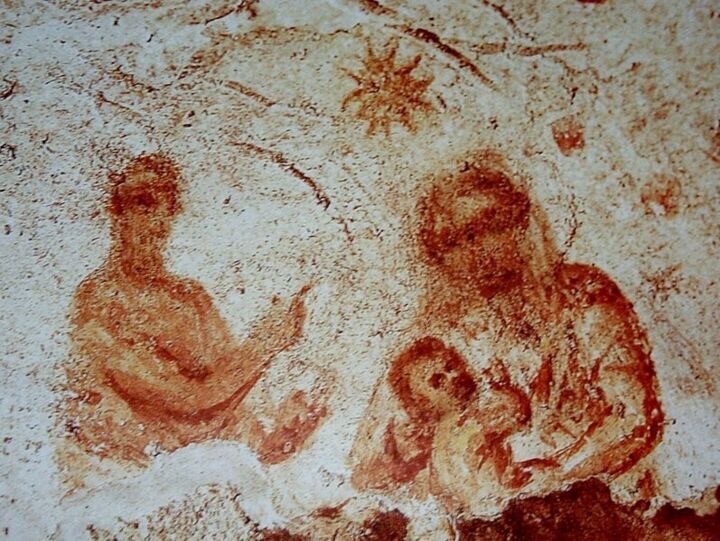
Nativity, Adoration of the Magi, 3rd century. Fresco, Rome: catacombs of Priscilla, 3rd Century CE

The 3rd century fresco shows the scene of Adoration of the Magi on the the arch dividing the room in the Greek Chapel in the Catacombs of Priscilla, Rome. In depictions of ancient Greek and Roman gift-giving practices, the act and choice of gift were important. They furnish information about both giver and recipient. The wise men adopt the same postures used in Roman imperial ceremony for the worship of an Emperor or other ruler. Roman art has always provided a pictorial model for the representation of the Magi. By identifying with or recognizing such an outward act of homage, the viewer could enter into the Nativity story through the wise visitors, worshipping the God manifest on earth in the Child.

This is why the earliest Christian art is found in the catacombs of Rome, in the hidden places, since worshipping Jesus wasn’t an approved religious practice in the Empire. Only the Divine Emperor alone was worthy of reverence and worship, not some dying and rising god of a far-off province. Today in America we sometimes forget we’re a nation founded on the principle of freedom to practice our religion as we see fit, or not to practice a religion at all, as the case may be. No government can compel the privilege of one religion above another or set one as the official religion.

Tympanum of the right side of the cast of so-called Sarcophagus of Stilicho, sculpted around 385 AD (the original piece of art is in Sant’Ambrogio basilica in Milan, Italy), Detail Nativity scene, Museo della civiltà romana a Roma (Eur), Room 15 (Christianity).

Another early depiction of the nativity isn’t in a Christmas context, but is found on a late 4th C Roman sarcophagus for a high ranking military official and his wife. The unknown artisan rendered the Christ child, wrapped in binding clothes, and lying in a manger, between the ox and the ass, to fulfill the prophecy of Isaiah 1:3—

“The ox knows its owner, and the donkey its master’s crib;
but Israel does not know, my people do not understand.”

As accustomed as we are today to manger scenes with all kinds of animals present, the scriptures don’t name them. These are left up to our imaginations. Even the elements derived directly from the gospel narratives of Matthew and Luke were slow to appear in visual renderings. Between those early scriptural accounts and the formation of even a basic manger scene lie some centuries during which Christian devotion and depiction developed. Likewise, the celebration of Christmas was slow to develop, but by the 4th century it was well along.

Nativity Fresco in Santa Maria Foris Portas, Castelseprio, Italy, 9th CE

In the ninth century, after the iconoclastic period, when the images of holy persons were forbidden and destroyed, a fresh wave of religious activity began in the arts. In Italy. In the church dedicated to Mary Outside the Gates in Castelprio, Italy, an entire series of paintings covered the interior walls. The church was located on an important trade route and the site was once a Roman fort. The theme honored Mary as the Bride of Christ, thus making her the spiritual equivalent of the Church, which is the Bride of Christ in scripture. In every tableau, Mary is the largest or most significant figure. Over the centuries, the area lost its importance, these paintings were whitewashed over, but after many years and much restoration, they’re now protected as a UNESCO World Heritage Site.

Today Protestant believers have a Christo-centric faith, often ignoring the other persons of the Holy Trinity. When we focus on the nativity, we forget God’s plan was to use humanity to save the fallen creation. This includes Mary and Joseph both, as well as God’s own Son, as Paul so well reminds us in Philippians 2:5-8—

Let the same mind be in you that was in Christ Jesus,
who, though he was in the form of God,
did not regard equality with God
as something to be exploited,
but emptied himself,
taking the form of a slave,
being born in human likeness.
And being found in human form,
he humbled himself
and became obedient to the point of death—
even death on a cross.

Giotto di Bodone, Nativity of Jesus, 1303-1305. Fresco, 200 x 185 cm. Padua: Scrovegni Chapel

Giotto’s frescos in the Padua Chapel are some of the most important works of art because he brought the Holy Family into ordinary human life. The blue skies replace the gold of the traditional icons, which stood for the infinite and eternal spiritual world. In Giotto’s painting, people hunger and thirst, while in the world of the icons, all suffering is transformed and any passion is disciplined.

Duccio di Buoninsegna, Nativity between the prophets Isaiah and Ezekiel, 1308-1311. Tempera on panel, 43.8 × 111 cm. Washington: National Gallery of Art

Duccio painted in his studio all the individual sections of the great altarpiece of the church in Sienna, Italy. On completion in 1311, the townspeople held a grand parade as they carried the paintings to the cathedral. They were installed in a magnificent framework with some of the works facing the congregation and the rest facing the church officials. The altarpiece remained intact until until 1506 when it was partially dismantled, relegated to side chapels and replaced by a 15th-century bronze tabernacle.

In 1771, the church fathers hired a carpenter to saw up the old wooden altarpiece into seven vertical pieces, and then saw each of those pieces in half laterally to separate the front scenes from the back. He then reassembled the different pieces to form new scenes. Most of the individual paintings stayed together, but others were sold to private collectors or museums. This Nativity between the prophets Isaiah and Ezekiel was purchased by the Museum Kaiser Wilhelm Friedrich in Berlin and remained on display there until 1938. At that time, a Nazi-appointed Museum director purged most non-Teutonic art from the collection. Through a trade, this Nativity came to our National Gallery of Art in Washington, D. C.

Duccio: Maesta Reconstructed Altarpiece. Front (L) and Back (R)

When we think about hidden meanings in art works, sometimes the journey a work takes to its exhibition home is part of its meaning. The Nazi purge of non-Teutonic art from the collection was based on their idea of a pure race for their homeland, with which they shared a special mystical bond. It meant they would purge or purify all who didn’t meet this white supremacist ideal. I personally am glad America is an open society, which welcomes all kinds of art and artists. When we think of the journey of the Holy Family, they made an arduous trip to Bethlehem while Mary was about to give birth and then had to head out on the lam because king Herod was out to kill all the boy babies. When we look at beautiful nativity scenes, we forget Jesus was born into a troubled world. Indeed, these beautiful works make us forget our own troubles.

Sandro Botticelli, Mystical Nativity, 1501. Tempera on canvas, 108.5 × 75 cm. London: National Gallery.

One of the most unusual nativity paintings is the Mystical Nativity by Botticelli. Painted with egg tempera on canvas, the artist writes in the upper section how he painted this “at the end of the year 1500, in the troubles of Italy…in the half after the time, during the fulfillment of the eleventh chapter of St. John in the second woe of the apocalypse…”

The monk Savonarola was actively preaching at this time, and scholars believe he influenced Botticelli. During the time of the Medici rule, Florence prospered with trade and the city’s alliance with France made for a time of peace. Lorenzo d’Medici died in 1492, relations with France broke off, and the French army ran amuck in the Italian countryside. Florence lost her former glory, trade dried up, and a political vacuum allowed for new voices to rise. Savonarola preached repentance and austerity, even going so far to burn luxurious items and artworks. He burned all kinds of vanities: cosmetics, mirrors, veils, and books.

People followed him because he was charismatic, and his words seemed to match their circumstances. Florence under his rule was an example of theocracy, the government of a state by immediate divine guidance or by officials who are regarded as divinely guided. Under this system, the people prosper if they care for one another and live godly lives, but they fail to thrive if they cheat the poor so the rich can live in luxury.

Prosperity religion teaches the good thrive and the sinners suffer. It’s not a new idea: retribution and reward appeal to people, but sometimes the good suffer and the evil prosper. The book of Job is a counter argument to this worldview. The life of Christ also shows the best of us will be sacrificed on a cross by those who don’t know what they’re doing. From birth to death, Jesus and his family were under duress from the powers of state and religion. He was a new voice of love and acceptance, of grace and forgiveness, of a righteousness by faith, not works. This new voice would upend the world as people knew it then.

Douce Apocalypse – Bodleian Ms180 – p.042 Woman Clothed in the Sun, Oxford University, London, c. 1265-70

The Mystic Nativity is a combination of the Nativity and the Last Judgment. On top, the angels hold hands in a circle, the center is the birth of Christ on earth, and the lower third is the vanquishing devils due to the Christian’s reunification with God. The number twelve represents the twelve gates of the new Jerusalem, the City of God. Twelve are also the number of stars in the crown of the woman in the apocalypse linked to the Virgin Mary. Other symbols also occur, but the overall meaning is Botticelli painted to deal with his fears about the end of the world.

Sometimes we make a cursory glance or reading of a painting, only to see its surface meaning. If we were to take this path with Botticelli’s Mystical Nativity, we might only see pretty angels and lovely ribbons. It looks like a homecoming at a sorority weekend with all the hugging and kissing. But Botticelli was painting during a time when the theological ideas of the monk Savonarola were in ascendance. He believed, “The more creatures approach and participate in the beauty of God, the more are they themselves beautiful, just as the beauty of the body is in proportion to the beauty of the soul.”

Virtuvian Man by Leonardo da Vinci, 1490, pen, brown ink, and watercolor on paper, Gallerie dell’Accademia, Venice, Italy.

As an interesting aside, about contemporary with Botticelli’s work in Florence, while Leonardo da Vinci was in Milan in 1490, he drew his Virtuvian Man, considered one of the greatest scientific and humanist works of the early Renaissance. Da Vinci used Vitruvius’ classical treatise on architecture as the source for his drawing. Notes from his translation are written in his famed mirror script below the image. This artwork is now so fragile, it never travels and only copies are shown.

While his outer world may be falling apart, and prosperity has left his vicinity, Botticelli still had hope for a better world. His faith was grounded in the birth of the savior, the son of God, who came in flesh to make all flesh divine. We forget this crucial message of the nativity, which is to make holy all flesh. More often we focus on the magi’s gifts brought to the child: riches fit for a king, or the gifts of presence, from the poor shepherds. The true gift is the one in the manger, for Christ is God’s gift to us. He came to make us all At-One with God, the very best atonement possible. At the Last Judgment, all who are at one with God’s purposes will be separated from the rest.

Banksy, “The Scar of Bethlehem” (2019) (courtesy Bisher Qassis), located in The Walled in Hotel in Bethlehem, closed since 12/12/23, due to fighting against Hamas

How can we practice seeing past the surface of everyday life? Sometimes we have to be shocked. Modern nativities bring us again and again to confront the same world of challenges and discord into which the young Christ child was born. If we wrap ourselves in warm swaddling clothes so we too won’t cry over the lack of a Christmas in Bethlehem this year, we lose sight of the common humanity of all God’s people. The extremists will take retribution on everyone, but those who take the middle path punish only those who did wrongs. Is there hope for those who take the “my way or the highway?” Or do we need to join the Holy Family and become refugees to avoid King Herod’s slaughter of the innocents?

Vatican City public nativity

This 2020 nativity was created as a public art project by ceramics students in Castelli, Abruzzo, Italy, a region known for its ceramics. It had nineteen figures including an astronaut and a Darth Vader figure, whose creation predated the Star-Wars series and represented a generic “sinner” figure. In modern nativity scenes, artists often integrate characters not mentioned in the gospel accounts, in order to bring the interests of contemporary audiences into the biblical story. As you can imagine, it created quite a buzz. Some said it lacked “beauty,” while others thought it was a joke. Some thought it disrespectful to the honor of the Holy See, the Church, and to the good Lord himself. It’s a truism “beauty is in the eye of the beholder.” Also, “we’ve never done it that way” still has a strong hold on people’s hearts and minds.

Sinner and Astronaut: Large Ceramic Nativity at the Vatican, 2020

Seeing deeper meanings in art or scripture is no more complicated than seeing a deeper understanding of a literary experience, such as a book or poem. In art, we do have the hurdle of acquiring some visual background and “visual language.” Just as we can’t understand a foreign language without learning some phrases, we need to know some art history and styles. We can only understand in part at first, but later we’ll understand as if we were old friends. No one is a savant right away. If we pause as we read a scripture, let the words sink into our deeper minds, and let the Holy Spirit open up new insights into God’s word, we can do the same with art works.

Bread Nativity

After all, bread is just bread: ordinary flour, yeast, oil, and water. Once we bless the bread and invite the Holy Spirit to transform it, we understand these same ordinary materials to be signs of the extraordinary presence of the Body of Christ, as recorded in Luke 22:19 at the Last Supper—

Then he took a loaf of bread, and when he had given thanks, he broke it and gave it to them, saying, “This is my body, which is given for you. Do this in remembrance of me.”

Baby Jesus Bread Rolls

We’re always surrounded by the mysteries of hidden meanings, if only we have eyes to see and ears to hear. May you know God more deeply in the days and years to come.

The Christ Child in the Rubble, Nativity in Bethlehem, Palestine, West Bank, 2023

Joy and peace,

Cornelia.

Featured image—Nativity, 3rd century. Stucco, Rome: catacombs of Priscilla.

Category: Sarcophagus of Stilicho in Sant’Ambrogio (Milan) – Wikimedia Commons
https://commons.wikimedia.org/wiki/Category:Sarcophagus_of_Stilicho_in_Sant%27Ambrogio_(Milan)

Duccio, The Nativity with the Prophets Isaiah and Ezekiel, 1308-1311
https://www.nga.gov/collection/highlights/duccio-the-nativity-with-the-prophets-isaiah-and-ezekiel.html

Botticelli’s’ Mystic Nativity: Symbolism, Savonarola and a Reflection of an Era | Renee Farina – Academia.edu
https://www.academia.edu/1262474/Botticellis_Mystic_Nativity_Symbolism_Savonarola_and_a_Reflection_of_an_Era

Leveto, Paula D. “The Marian Theme of the Frescoes in S. Maria at Castelseprio.” The Art Bulletin, vol. 72, no. 3, 1990, pp. 393–413. JSTOR. Free account to access. https://doi.org/10.2307/3045748. Accessed 24 Dec. 2023.

Katarína Šimová: The Fresco Cycle of Santa Maria foris portas, MASARYK UNIVERSITY! FACULTY OF ARTS, DEPARTMENT OF ART HISTORY, 2021. Open source
https://is.muni.cz/th/ufv2u/castelseprio_frescoes.pdf

Significance of Leonardo da Vinci’s Famous ‘Vitruvian Man’ Drawing
https://mymodernmet.com/leonardo-da-vinci-vitruvian-man/

Baby Jesus Bread Buns · How To Bake A Roll Or Bun · Baking on Cut Out + Keep
https://www.cutoutandkeep.net/projects/baby-jesus-bread-buns

The Adoration of the Magi: Mosaic in S. Maria Maggiore https://www.christianiconography.info/staMariaMaggiore/epiphanyArch.html

The Magi and the Manger: Imaging Christmas in Ancient Art and Ritual – The Yale ISM Review https://www.ismreview.yale.edu/volume-3-1-fall-2016/the-magi-and-the-manger-imaging-christmas-in-ancient-art-and-ritual

The Persistence of Effort

adult learning, Altars, art, Attitudes, beauty, brain plasticity, Children, cognitive decline, Creativity, exercise, Food, Habits, Health, Holy Spirit, inspiration, knitting, Love, Ministry, mystery, nature, Painting, Prayer, pumpkins, purpose, rabbits, renewal, Right Brain, sleep, Van Gogh, vision

These shoes are made for walking

I was reading an article in the New York Times the other day. In “How I Learned to Love Finishing Last,” the author wrote about her slow pace as a runner. As one who regularly finishes last in my age group in the annual Spa 5K Walk each November, I’m optimistic one day I might get old enough to be in a nonagenarian age group all on my own. Perhaps if I’m 90 and still doing a 5K, they’ll give me a ribbon just for participating! “The last will be first and the first will be last,” especially if there’s only one of us in the race!

“When we compare ourselves to others,” said Dr. Justin Ross, a clinical psychologist in Denver who specializes in athlete mental health and performance, “we set ourselves up to suffer. Instead, the real psychological benefits come from enjoying what your body can do.”

Portrait of Yayoi Kusama in costume in front of pumpkin painting, photo: Noriko Takasugi

Suffering physically isn’t what art class is about, although we may suffer indignities to our egos, but this shouldn’t hold us back from doing our art works. The case of the Japanese artist Yayoi Kusama is evidence even hallucinations of voices and images can’t keep an artist from creating. If our daily efforts don’t measure up to what we imagined in our mind, it’s merely because our inner eye sees better than our hands can execute our vision. Sometimes our eye forgets what it once learned, for we haven’t used our skill of looking in a while. A runner doesn’t leap off the couch and immediately run a marathon or even a 5K. The smart athlete takes the time to train progressively for the distance beforehand. Also, they get new shoes.

Kroger Run: Two ghost pumpkins and a small pie pumpkin

Sometimes the coach has slept over the summer also. Just as students in school need a time to relearn last year’s lessons, as a coach in art class I sometimes forget the lessons, which are second nature to me because they’ve been inculcated by multiple teachers since I was eight years old, aren’t as ingrained to my own students. I also forget I’m always observing everything around me: cloud patterns, changing colors on trees, sunlight dappling on tree branches, shadows on the ground, and reflections in windows. I think about these patterns rather than about what I need to do next or next week. My calendar will remind me of these things in due time. I’ll be wrapping this up soon so I can work on my monthly Rabbit blog.

Rabbit playing “Hide the Pumpkin.”

A National Institute on Aging study found five healthy lifestyle factors — physical activity, not smoking, not drinking heavily, following the Mediterranean-style diet, and engaging in mentally stimulating activities — can have important benefits. People who engaged in four or five of these behaviors had a 60% lower risk of developing Alzheimer’s compared to those who only followed one or none. People who followed two or three of the activities had a 37% lower risk. This is your free wellness plan from Dr. Cornie, who has no medical degree, but did stay in a Holiday Inn once.

Debunking the Myth of the Split Brain Theory

Although we commonly think art is a “right brained” activity, in 2013 a group of researchers at the University of Utah discovered people actually use both sides of their brains equally. Back in the 1970’s when I was seeking employment after graduate school, the “Art is a right brain myth” ruled the creative work world. I once suggested I’d be a good candidate for a museum position because I understood both the artistic and the logical mind. I was not hired. Intuitive understanding of the brain a half century ahead of time doesn’t exactly open the doors to a fancy job.

As I recall, I got a checker’s job in a grocery store and ended up counting the teller trays and preparing the bank deposits for that store. The good news is creating works of art is a multi-process activity, one that depends on several brain regions and on redundancy of art-related functional representation rather than on a single cerebral hemisphere, region or pathway. This means even when we lose our ability to form words (typically a left hemisphere activity) our ability to create art still exists. We can still express our inner feelings and thoughts. This is good news for the aging and those who love them.

Yayoi Kusama – Pumpkin, 2014, installation view, Donum Estate, California, photo: Robert Berg

One one the great sadnesses in my ministry is being with young people who desperately want to have their old one’s memories recorded, but waited too late to ask them or were too busy with their own lives to sit and listen to these stories of the olden days. Once their old person has a stroke and loses the ability to form words, the opportunity has passed. Those stories will be locked in their minds due to aphasia, and no one or no amount of time will pull them out. We always tell young parents their babies need to be enjoyed while they’re still young, but we should also tell families to get the stories of their elders while they still can. “Strike while the iron is still hot” will take on a new meaning one day.

We needed bigger pumpkins

Gail and I were the only ones in class today. Lauralei showed up to gift us chocolate cake and keep us company. Tim and Mike were out of town. Gail and I both repainted old canvases. I showed some of the unusual ways pumpkins have been decorated by various artists, but none of them sparked any interest. We got down to work by covering our old canvas with a base of titanium white paint. Then I located all three of the pumpkins with circles and drew a baseline for the object on which they sat. I didn’t look over at Gail’s work for a while, but then I noticed she’d almost completely finished one pumpkin without roughing in the shapes of the others.

Gail had a big canvas today.

“Did you plan on finishing that one pumpkin before drawing the other two?” I asked.

Gail gave me a “needs more caffeine” stare.

“That’s what I thought. Maybe next time draw in the rough shapes so you get everything located in space relevant to each other.”

Pumpkin Spice Latte Time

We kept on painting until clean up time. I often say “I’ve slept since then.” It’s my all purpose excuse for forgetfulness or just plain airheadedness. Sometimes I have my mind on other things and I’m not focused on what’s in front of me. I forget about the wisdom of Brother Lawrence, who said “many do not advance in the Christian progress because they stick in penances and particular exercises while they neglect the love of God which is the end. This appeared plainly by their works and was the reason why we see so little solid virtue.” He also said, “there needed neither art nor science for going to God, but only a heart resolutely determined to apply itself to nothing but Him and to love Him only.”

Cornelia’s small painting of pumpkins

We know Brother Lawrence from the classic text, The Practice of the Presence of God. Although it dates from the late 17th century, his lessons on living life in joy in the present moment, all for the love of God are invaluable for us modern folks who tend to live for our 15 minutes of personal fame, social media clicks, or self interest. We aren’t used to the monastic life today, or to the discipline of that lifestyle. We live in a Burger King world, in which each individual gets his or her own way to every extent possible. Unfortunately, the Christian lifestyle is one of discipline, but not harsh punishment:

“Now, discipline always seems painful rather than pleasant at the time, but later it yields the peaceful fruit of righteousness to those who have been trained by it.” ~~ Hebrews 12:11

In art class we focus on the disciplines, just as the guild artists taught the apprentices back in the day. These disciplines are not only for safety, for some of our art tools are dangerous, but also some of our techniques are proven to yield better results than others. This is why carpenters measure twice and cut once. They also cut on the outside of the line, rather than the inside. They can shave down a piece easier than adding to it. Murphy’s Law recognizes this: “A wire cut to length will be too short.”

Zen Tangle drawing of pumpkins: exercise in texture

Art class has no mysteries, but we can forget the “secret gnostic knowledge passed down by word of mouth” from our previous classes. I often use the excuse “I’ve slept since then.” Another good excuse is “My mind has gone to Pluto.” I share these with you all, for they’ve always worked for me. Of course it helps to be a natural blonde. Then again, I’m very organized, but I’m also very active, so sometimes my calendar gets overwhelmed, and I pull out the “OOPS! Card.” Even in retirement I’m still creating and sharing my faith through art and writing. It’s my way of exercising those brain cells to keep them from dying off. We old folks can still learn new things, even if it takes longer. This is what we call the persistence of effort. Those who keep using their skills won’t be losing those skills.

The same goes for learning a new skill. It’s all a matter of repetition. We can’t get frustrated if we don’t get it on the first try. We won’t be a good role model for the young if we have that attitude. We need to lower our expectations. I used to think I couldn’t knit, but only crochet. After my mom, who was a stellar knitter passed on, a friend taught me to knit in an afternoon! Where this sudden bilateral coordination came from I have no idea, but it was so welcome. Perhaps I needed to be in the right frame of mind, or I wanted to be able to carry on my mom’s memory, but I was definitely receptive to her teaching.

Letter to Theo Van Gogh, September 18, 1888

It’s never too late to learn and we’re never too old to start learning. Art isn’t just good for the brain, but it’s good for the soul. Art is our attempt to represent truth, beauty, and nature in media that can be accessible to others. By doing this, we bear witness to the creation and the Creator. We only need give our best efforts, and let God’s Spirit guide our growth.

Joy, peace, and perseverance,

Cornelia

We have pumpkins galore on the autumn altar.

How I Learned to Love Finishing Last


How the Aging Brain Affects Thinking | National Institute on Aging

https://www.nia.nih.gov/health/how-aging-brain-affects-thinking

The creative-right vs analytical-left brain myth: debunked! – Dr Sarah McKay https://drsarahmckay.com/left-brain-right-brain-myth/

Art and brain: insights from neuropsychology, biology and evolution – PMC

https://www.ncbi.nlm.nih.gov/pmc/articles/PMC2815940/

The Project Gutenberg eBook of The Practice of the Presence of God, by Brother of the Resurrection Lawrence (free ebook)

https://www.gutenberg.org/cache/epub/5657/pg5657.html

Perspective: How We See

adult learning, art, Attitudes, Creativity, inspiration, Leonardo da Vinci, Ministry, mystery, Painting, perfection, perspective, Philosophy, risk, salvation

Perspective is both a mental outlook on life and our ability to view things in their true relations or relative importance. In art class, we use the tools of perspective to make a two dimensional surface appear three dimensional. One of the techniques is drawing parallel lines as converging in order to give the illusion of depth and distance. An untrained eye doesn’t see this at first, but once the illusion is pointed out to them, they never can unsee it. We worked last year with one vanishing point—railway tracks—and two vanishing points—buildings seen on the corners.

Two Point Perspective

There are mysteries in this world which we don’t understand, but those of us who have been taught by others with this “secret hidden wisdom” can share it with others. The Ancient Greek mystery religions kept their knowledge for only the select few, who learned it by word of mouth in secret ceremonies. The early Gospel, however, was proclaimed openly to all who would receive it. Yet even in Corinth, some believers wanted to be more special or spiritual than others. Paul wrote them, saying they needed  to know “Nothing beyond what is written,” for the scriptures contained within enough for their salvation (1 Corinthians 4:6). As an apostle, he was a steward of the “Mysteries of God,” and even if he were to understand “all mysteries and all knowledge, and…have all faith, so as to remove mountains, but… not have love…(he’d be) nothing.” (1 Cor 13:2)

Cornelia: Art Room Door

As a teacher, I can provide students with learning opportunities for every skill in art. Thanks to  Oaklawn UMC, and the generosity of my clergy pals over the years, I have a space in which to teach. I don’t charge for the lessons, since I consider this my ministry in retirement. I’ve taught every age from kindergarten through adulthood. There’s no age I don’t relate to. As Dale Chihuly says about art: “Most of art is the work. Not every piece is a success. We learn from our mistakes more than from our successes. If we don’t show up to work, we never have a chance to do well.” (It’s not an exact quote—I watched the film last night).

Gail: stage 1

As I tell folks, we may be saved by grace, but progress in art is by works. We can’t have our egos invested in the product. Right now Tim is in recovery from carpal tunnel surgery. Doing light exercises with pencil is good for his wrist muscles. Art class is a form of physical therapy. He wanted to draw a pumpkin because it had some shapes he’s struggled with over time. He noticed if he moved forward or backward by mere inches, the image he saw was different. This too is a matter of perspective. What is our view point: is it fixed or variable?

Gail: stage 2

Gail and I worked on painting an interior scene. I freehanded my painting, while Gail used her ruler and pencil to draw in the door shapes. I still wasn’t totally recovered from my colonoscopy—my age is catching up on me. My brain felt foggy, but I was trying. We came back for a second week to work on this project.

Gail: stage 3—extended floors

When we leave our work, we have an opportunity to clear our minds and reflect on other things. On returning to our canvas, we then look at our image with fresh eyes. My engineer friends call this the “saturation principle.” Just as the land can only absorb so much water before it runs off, our minds will get clogged up and we just can’t seem to make progress. Getting up for a drink or a walk about is a good thing. Sometimes the paint won’t dry fast enough for us either! That’s an indication to work in another area, even if we don’t want to. We must listen to what our work is telling us.

I often let my paintings rest overnight while I get a good night’s sleep also. In the morning, I’ll see if it still holds up, or if I need to keep painting. Sometimes I’ll take a “finished” painting down after a few months and repaint it. If it won’t last three months under my eye, it doesn’t leave the house. But I’ve learned from the experience. If we ever quit learning, we are dead. I don’t plan on being dead any time soon.

ABC—Positive and Negative Choices

Learning how to see in art is the most important lesson in art. Most of us won’t be Michaelangelo or Leonardo, but we can be the best of who we are. Our outlook on life in art means accepting our imperfections and our weaknesses. Some people can’t accept the learning curve necessary to make acceptable looking products. The point of art class isn’t the product. It’s the process of doing. With the doing, the “product” will come around eventually. We just need to have a positive attitude. Besides, our salvation isn’t dependent upon our accomplishments in art, but our faith in Christ and our love for Christ spread abroad into God’s world.

A Gift from my Mom

Perspective is also our attitude towards life. As Bob Ross, the great philosopher of happy trees and the joy of painting once said,

“If you have light on light, you have nothing. If you have dark on dark, you have nothing. It’s like in life. You gotta have a little sadness once in a while, so you know when the good times are coming. I’m waiting on the good times now.”

He said this in a PBS episode filmed shortly after his wife had passed away. Art class is also therapy for the soul, for we paint our emotions on the canvas, whether we realize it or not. We don’t have to talk about our feelings, but art helps us express them.

When I taught art back in the dark ages, I told my students if they learned only one thing from me, they would never forget it. A positive attitude leads to positive behavior and positive behavior leads to positive consequences. A negative attitude leads to negative behavior and negative behavior leads to negative consequences. That’s the simple ABC’s of life in the art room. Try it. You’ll like it. This is how we teach “Perspective.”


Joy and peace,


Cornelia

Master of Glass: The Art of Dale Chihuly

https://www.imdb.com/title/tt24862190/?ref_=ext_shr_lnk


Feeling Down? Here Are the Best Bob Ross Pep Talks


I See the Icon—The Icon Sees Me

art, beauty, Faith, Holy Spirit, Icons, Imagination, incarnation, inspiration, Love, Mandylion, mystery, Painting, Pantocrator, Plato, renewal, salvation, St. Athanasius, vision

The icons of Christ radiate a sense of calm, a spiritual experience created countless times by various artists over the ages. Each one channels the spiritual force which lies outside of language, mystery, and mysticism. Over the years, we’ve come to understand the icon serves as a window into the world beyond our own. In this world we think of dualities: good and evil, winning and losing, ours and theirs. In the world beyond ours, everything belongs to God, we are all one, and no one lacks for anything. The heavenly banquet table is a never ending feast for everyone and no one is reduced to begging for the crumbs that fall from it. No one hungers or thirsts in this land of the unclouded sky.

Jesus is the Bread of Life

The icon represents to us the world we yearn to be. In this respect, it’s a “wormhole” from the fully perfected world to this world, which is still going onto perfection. The New Heaven and the New Earth promised in Revelation 21:1-4 speaks to this very event:

Then I saw a new heaven and a new earth; for the first heaven and the first earth had passed away, and the sea was no more. And I saw the holy city, the new Jerusalem, coming down out of heaven from God, prepared as a bride adorned for her husband. And I heard a loud voice from the throne saying, “See, the home of God is among mortals. He will dwell with them; they will be his peoples, and God himself will be with them; he will wipe every tear from their eyes. Death will be no more; mourning and crying and pain will be no more, for the first things have passed away.”

The Good Shepherd

Until that time comes, we have the icons gazing upon us to remind us of this promise, as well as of our calling to be coworkers with God in bringing this world into fruition. If we see with spiritual eyes, we’ll be able to look beyond the paint and canvas, beyond the image and likeness, and beyond material truth to see the spiritual truth of the icon before us.

To understand the icon better,we ought to take a trip in the WayBack machine to Ancient Greece to visit Plato and study up on his philosophy. This is important because whether they know it or not, artists of every stripe and measure participate in this “not yet, but yearning for a better world” as they make their art. In the 4th C BCE, Plato believed the true reality was in the ideal forms which existed in a world outside of this one which we daily experience. Every form we see on earth is merely a copy of the ideal form, but not the “truth.” Plato’s truth existed in this realm of ideas, rather than in the senses. This is the opposite of how most modern people look for “truth,” especially scientific or observational evidence based truths.

Christ Enthroned

For Plato, the ideals of good and truth had to exist as a form in the eternal world so we could recognize them in our transitory world. All things, even virtue, justice, love, and beauty, must have an ideal form in this realm beyond our sensibilities. Where we get into trouble is believing this world’s representations of the ideal forms must follow the pattern exactly. The examples we consider beautiful can change over the centuries, but the idea of beauty as the highest ideal of loveliness never changes. This is why we don’t keep repeating Greek and Roman Classical themes for our public buildings in the modern era.

James 1:17 says of God: “Every generous act of giving, with every perfect gift, is from above, coming down from the Father of lights, with whom there is no variation or shadow due to change.”

The Golden Christ

When we say “God doesn’t change,” we mean God never quits loving us, always wants to save us, and always wants to work for good for those who love the Lord and are called according to God’s purposes. God does change God’s mind when we give up our wayward ways and return to godly ways. The Old Testament is full of times God had a change of heart. Maybe some of these events were the people having a heart change and coming back to God. God does seem absent when we turn away, while God seems near when we turn towards God.

Coptic Jewel Icon

But I digress, and I plead the hot weather. Plato’s perfect forms are the subject, especially the form of the Good. For Plato, only the soul or the mind can know the true forms, while the sensible body is suspect. Plato’s philosophy is a form of dualism, which elevates the spiritual over the physical. This is an important concept for early Christianity, since they had to hash out an understanding of the incarnation of Christ. For some, Jesus was purely divine, while for others he was purely human.

Variation on the Christ Not Made by Hands Icon

The traditional interpretation of Jesus Christ is he is both fully human and fully divine, as Athanasius so succinctly said in his treatise On the Incarnation: “for God became man so that man might become god” (54:3). This theology of theosis, or perfection in love, always boggles the mind of those of us who are used to 1 + 1 = 2, or the sensible and mathematic physical reality of this world. One of the rallying cries back in those days was “There never was a time when the Son wasn’t the Son.” People marched in the streets to proclaim this belief: the Son of God never gave up his divinity even when he became human for the sake of our salvation. It was necessary for him to become human to save all of us and only if he were completely God would he be able to save us entirely.

Christ Pantocrator

For the icon painters, Athanasius also is informative when he writes about the Incarnation: “and He manifested Himself by a body that we might receive the idea of the unseen Father; and He endured the insolence of men that we might inherit immortality.”

As Jesus says in John 14:7, “If you know me, you will know my Father also. From now on you do know him and have seen him.” Like Phillip, we can only believe in what we’ve seen. Many of us are doubting Thomases, who need to touch and hold onto physical proof before we can be convinced. The icons remind us that Jesus is

“the image of the invisible God, the firstborn of all creation; for in him all things in heaven and on earth were created, things visible and invisible, whether thrones or dominions or rulers or powers—all things have been created through him and for him” (Colossians 1:15-16).

What image is the Christ icon? That depends on the time and place where the icon was created, but all images share certain qualities. The eyes are prominent, the mouth is small, the forehead is broad, and the lower jaw is small. Most of the icons of Christ look like a philosopher, rather than a warrior king, which was the original meaning of the Jewish messiah. All icons have at least one ear visible to hear the prayers of the faithful.

These letters form the present participle, ὤν, of the Greek verb to be, with a masculine singular definite article, ὁ. A literal translation of Ὁ ὬΝ would be “the being one,” which does not mean much. “He who is” is a better translation

The backgrounds are gold and represent a timeless, eternal spiritual space. Today, yesterday, and tomorrow are all the same for God, who is known by the name I AM. In John 8:58, Jesus got into an argument with some of the Pharisees over who were the true children of Abraham. When he told them, “Very truly, I tell you, before Abraham was, I am,” they were ready to stone him  for claiming to be god. Moreover, as the author of Hebrews reminds us, “Jesus Christ is the same yesterday and today and forever” (13:8).

Roman Icon, 12th CE, oil on wood panel, Vatican Museum

The icon itself isn’t holy, but the image it represents is holy. This is why icons are venerated , while Christ is worshipped. The image isn’t holy, but the person represented is holy. In this sense, every icon points to the ideal form of Christ in the spiritual world beyond us and the icon acts as a window or a wormhole opening so that spiritual world can enter into our sensible and material world here. The more we live with an icon, the more our hearts and minds are tuned to the silent harmonics of the hymns of joy, peace, love, beauty, generosity, and compassion. This is because we become open to the truth of Christ in a mystical way which supersedes our own personal beliefs and experiences. We lose our attachment to the world of dualisms and enter into the world of union with the divine. We are undergoing theosis. Theosis is more than just salvation and divine pardon, but is  rather the process of spiritual transformation that culminates in mystical union with God. It is a cooperative work of the Holy Spirit and the believer that results in this union.

After 12th Century Vatican Icon

Art has a way of affecting the energies of a human being. It’s well known how certain colors affect mood, so designers use these techniques to create appropriate spaces in buildings. Public art adds to the charm of a city and likewise, destroying green spaces can render a city to grimness. Having art in one’s home or office elevates it above the ordinary.

Even artists who aren’t painting icons, but are making landscapes or abstractions can be said to be seeking a platonic form, one which only they may see in their own mind’s eye. We keep looking for the next challenge, the creation which comes closest to our imagination. We artists keep on going, however, for each new work not only refines our imagination, but it also moves us closer to our desired goal. We’re like long distance runners who always seek a new personal best!

Resurrection Christ

The icon makes a claim on our lives as we return its gaze. In the silence, Christ asks, “Are you going onto perfection in the love of God and neighbor?” We take a silent stock of our lives and our interactions in prayer. Most days we agree with the apostle Paul in his letter to the Philippians (3:12):

“Not that I have already attained this—that is, I have not already been perfected— but I strive to lay hold of that for which Christ Jesus also laid hold of me (NET).”

Joy and peace,

Cornelia

Plato
https://www.webpages.uidaho.edu/engl257/classical/platonic%20idealism.htm

Early Christian Heresies
http://webspace.ship.edu/cgboer/heresies.html

CHURCH FATHERS: On the Incarnation of the Word (Athanasius) 54:3. https://www.newadvent.org/fathers/2802.htm


From the Shadows to the Light

architecture, art, Carl Jung, change, Faith, Family, Fear, Food, greek myths, hope, inspiration, mystery, nature, New Year, purpose, rabbits, renewal, Roman Forum, shadows, Spirituality, Temple of Janus, Zeitgeist

Rabbit! Rabbit! Welcome to 2023! This old bunny may not see the clock strike midnight, but I’m recovering from a bad cold. Rest is more important than ringing in the New Year. Every year has its own character.

Live with Optimism, even when the nights are long.

Zeitgeist is a word that comes straight from German — zeit means “time” and geist means spirit, so the “spirit of the time” is what’s going on culturally, religiously, or intellectually during a certain period. When it comes to the turn of the New Year, we bunnies wonder if our new broom will sweep clean or if the old broom will leave the same mess as always in our cozy rabbit dens.

Always use a New Broom on the New Year for Good Luck.

Are we filled with hope or with foreboding? Do these dark days and deep nights of winter fill us with a gloomy spirit? Or do the imperceptibly lengthening minutes of daytime give hope to the shadows the cold of winter has left in the depths of our souls? Or have the coastal grandmother bunnies among us learned to ignore all this stum and drang by blending their afternoon tea time into early evening wine tasting?

Everything a culture considers taboo, evil, or immoral typically ends up being proscribed or “consigned to the outer darkness.” From there it ends up inside us in what Carl Jung called “the Shadow,” or our inner “Satan,” as it were. Repressed and inhibited, it festers and rages in the darkness of our “unconscious.” Even in extreme cases, it takes on a quasi-autonomous existence of its own, occasionally intruding as the famous “voices in the head” or even as a multiple personality.

Dr. Jeckyll and Mr. Hyde is a famous light and dark shadow character from fiction, but too often in real life we rabbits point out our own dark shadows in the lives of those we so easily demonize. As my wise old granddaddy rabbit would reprimand me, “When you point out the faults of others, you have three fingers pointing back at you.”

Luke 6:41
“Why do you see the speck in your neighbor’s eye, but do not notice the log in your own eye?”

I always find life more refreshing on the first day of the year, perhaps because I don’t over indulge in strong drink as I once did in my wayward bunny youth. We bunnies all have a wayward youth, for how else would we know what the immature among us are getting into? My old daddy rabbit believed, “Experience was the greatest teacher of all time, as well as its most costly tutor.” Indeed, we remember the costliest lessons best of all. The young ones today say, “Go big or go home.” My grannie would say, “If you’re in for a penny, you might as well be in for a pound.” After all, everyone who participated, either in a small or large way, would be held accountable.

Janus: Bloodstone intaglio of Roman god of transition, passages, and new beginnings.

As I look back on old 2022, grizzled and worn out by conflicts both at home and abroad, I can understand why the ancients thought of Janus, for whom January’s named, as a two faced god. One face, which looked backwards, was lined, bearded, and craggy featured, while the forward looking face of the new year was youthful, smooth, and clean shaven. Every new year is fresh and clean as a beardless youth’s face, as well as untroubled by any recollection of pains or past memories. Most of us bunnies also have short memories, for we tend to repeat the same mistakes over and over. Rabbits have short term memories of around 4 minutes, but can remember bad experiences for longer periods, just as humans can.

Unknown Roman Artisan: Soldier’s Brooch in the Form of a Rabbit, 100–300 CE, Copper alloy with champlevé enamel, found in Britain, Metropolitan Museum of Art, NYC.

In Ancient Rome, as the poets Ovid and Horace recount, Janus was the god of war and peace. They differ as to whether the Temple of Janus was a prison for peace or war, but they both agree the prison was meant to maintain PAX ROMANA, or the great Roman Peace. If peace were impounded, peace would be guaranteed to the nation. If war were imprisoned, it wouldn’t rampage about to destroy the countryside. Just as Janus had two faces, Roman religion was open to multiple interpretations and meanings. Perhaps today, they’d be known as “freethinkers,” as opposed to “literalists” or “strict constructionists” in their interpretation of their ancient stories.

Seeing the Night Skies through Bunny Eyes

Maybe in 2023 we bunnies might want to look at different ways of thinking, instead of one fixed way. There’s a difference between a straight and narrow path and a rut. On the path we can still see other twists and turns, which might change the outcome of our experience and existence. In a rut we’re stuck for life, with no where out, until it becomes our grave. If the world is changing more quickly than is comfortable for us, I give the example of my old granddaddy again. He pushed a button to turn on one of the first electric lights in his home town and lived to see men walk on the moon. Be resilient, be adaptable, and embrace change. After all, we’re always changing, so the option of never changing is death.

Ancient Greek Black Figure Vase, Wasps Attacking Men Robbing Zeus’ Bee Hives for Honey, c. 540 BCE, British Museum, London.

Romans would celebrate January 1 by giving offerings to Janus in the hope of gaining good fortune for the new year. They believed their acts set the stage for the coming year, so it was a common practice to make a positive start to the year. Not only did they exchange well wishes and sweet gifts of figs and honey with one another, but according to the poet Ovid, most Romans also chose to work for at least part of New Year’s Day because they saw idleness as a bad omen for the rest of the year. If 1st century Romans were to drop into some of our 21st century celebrations by means of Dr. Who’s traveling blue Police Box, they would wonder how the barbarians, who sacked Rome in 455 CE, had managed to take over our modern New Year.

Some days I need to be in two places at once.

We toga wearing bunnies, who are long of tooth, know from experience the barbarians are always at the gate of our safe little gardens. Sometimes they’re even inside the gardens of delight, as Peter Rabbit and his Cottontail friends perpetually discover when Mr. McGregror chases them with a rake. If we cast a look back on 2022 with our rheumy eyes, we saw Russia attack Ukraine, an outrageous act which sent millions of people to emigrate from their the destroyed cities and ravaged countryside, with the hope of finding safe haven in another European country.

Mr. McGregor thinks Peter is a Barbarian, who has slipped through his impenetrable garden gate.

Across the pond, on our southern border, thousands of migrants have fled disaster and violence in their homelands, but even though the US economy is hurting for workers in our entry level jobs, they have difficulty getting in. Are these people actually “barbarians at the gate?” Or have we projected our Shadow Fears upon them because they are foreigners? We did this with the Japanese, who m we placed into Internment Camps in World War II, much to our disgrace. This bunny asks us to search our hearts in 2023 to see if our three fingers are pointing back at our own selves.

Think about how Woodstock symbolized the 1960s: Woodstock was part of the Zeitgeist of the 1960s. Whatever seems particular to or symbolic of a certain time is likely part of its Zeitgeist. I came home from college one Christmas wearing a necklace of tiny black and white seed beads, only to be greeted by my old fashioned daddy, “Are you a hippy now?” For him, any one thing represented the whole, for he grew up with the ancient bunny wisdom, “One bad apple spoils the bushel.” We were only reconciled when he realized I hadn’t lost my fondness for his beloved Cowboys football team.

If we can find one common interest in this strange and fraught world with those with whom we would be at war, then we might be able to come to peace with them. If we insist on all or nothing, no bunny will get anything. We all want to have endless days of peace and joy, but the life of a bunny also has days of struggle and sorrow.

Earth as seen from Space

Carl Jung, the great psychologist once said, “There are as many nights as days, and the one is just as long as the other in the year’s course. Even a happy life cannot be without a measure of darkness, and the word ‘happy’ would lose its meaning if it were not balanced by sadness.”

We also have this promise from 1 Corinthians 10:13—

“No testing has overtaken you that is not common to everyone. God is faithful, and he will not let you be tested beyond your strength, but with the testing he will also provide the way out so that you may be able to endure it.”

Many of my southern bunny kinfolks will eat a variety of this New Year’s Day meal: black eyed peas, ham, greens, and cornbread. We think every pea consumed equals another day of good luck. Of course, we’re not the only superstitious clan.

Our cousins in Japan, celebrating Ōmisoka, or New Year’s Eve, gather together to eat long noodles to cross over from one year to the next. At midnight, many visit shrines or temples for Hatsumōde. Shinto shrines prepare amazake, a sweet low alcohol drink, to pass out to crowds and most Buddhist temples have large cast bells that are struck once for each of the 108 earthly desires believed to cause human suffering.

Year of the Rabbit

I found some interesting New Year’s good luck traditions, which are practiced around the world. In Greece, folks hang onions outside on their front doors to ward off evil. On New Year’s Eve, Colombian households have a tradition, called agüero, of placing three potatoes under each family member’s bed—one peeled, one not, and the last one only partially. At midnight each person, with eyes closed, grabs for one. Depending on the potato they select, they can either expect a year of good fortune, financial struggle, or a mix of both.

Ruined House (suspected fruitcake damage)

In Ireland, people bang Christmas bread against the walls of their house for good luck. If any of you bunnies have a Christmas fruitcake still lying around, please choose another loaf to prevent damage to your walls. Good contractors are backed up and hard to find, especially around the holidays.

The Danes chunk plates at their friends’ doorsteps for good luck on New Year’s Eve. Perhaps all that darkness from the winter solstice makes my northern relatives harebrained, but we love them just the same. I suppose every bunny has some weird relatives.

New Year’s Eve Weather Predictions

Old bunny weather lore says, “The first 12 days of January foretell the weather for each month of the year.” Another way to forecast the weather for the coming year depends on the wind. The old bunnies are at odds as to when this poem should be recited, with some advocating for sunset on New Year’s Eve and others at the break of dawn on New Year’s Day. This bunny notes the poem mentions New Year’s Eve, and since none of our ancient bunnies had time traveling abilities, I’d think we are safe to practice this on the Eve at sunset, then go out to do our responsible reveling.

If New Year’s Eve the wind blows south
It betokens warmth and growth.
If west, much milk and fish in the sea.
If north, cold and storms there will be.
If east, the trees will bear much fruit.
If north east, then flee it, man and brute. Then throw your new year wishes to the wind!

GOOD HEALTH AND JOY FOR EVERY BUNNY

My New Year’s wish for 2023 is for each and every one of my bunny friends to have a better year than last year. And especially to know deep in your hearts, each of you are God’s own beloved children. Remember this good word from Romans 8:28—

“We know that all things work together for good for those who love God, who are called according to his purpose.”

Joy, peace, and love each and every day in 2023,

CORNELIA

Multiple Interpretation of the Opening and Closing of the Temple of Janus:
A Misunderstanding of Ovid “Fasti” by S.J. Green, 1.281 on JSTOR
https://www.jstor.org/stable/4433099

5 Ancient New Year’s Celebrations – HISTORY
https://www.history.com/news/5-ancient-new-years-celebrations

15 New Year’s Traditions From Around the World | Glamour
https://www.glamour.com/story/new-years-eve-day-traditions

New Year’s Weather Folklore: Predicting Weather in the New Year | The Old Farmer’s Almanac
https://www.almanac.com/new-years-day-weather-folklore

The Zeitgeist and the Shadow | The Chrysalis https://longsworde.wordpress.com/2018/07/20/the-zeitgeist-and-the-shadow/