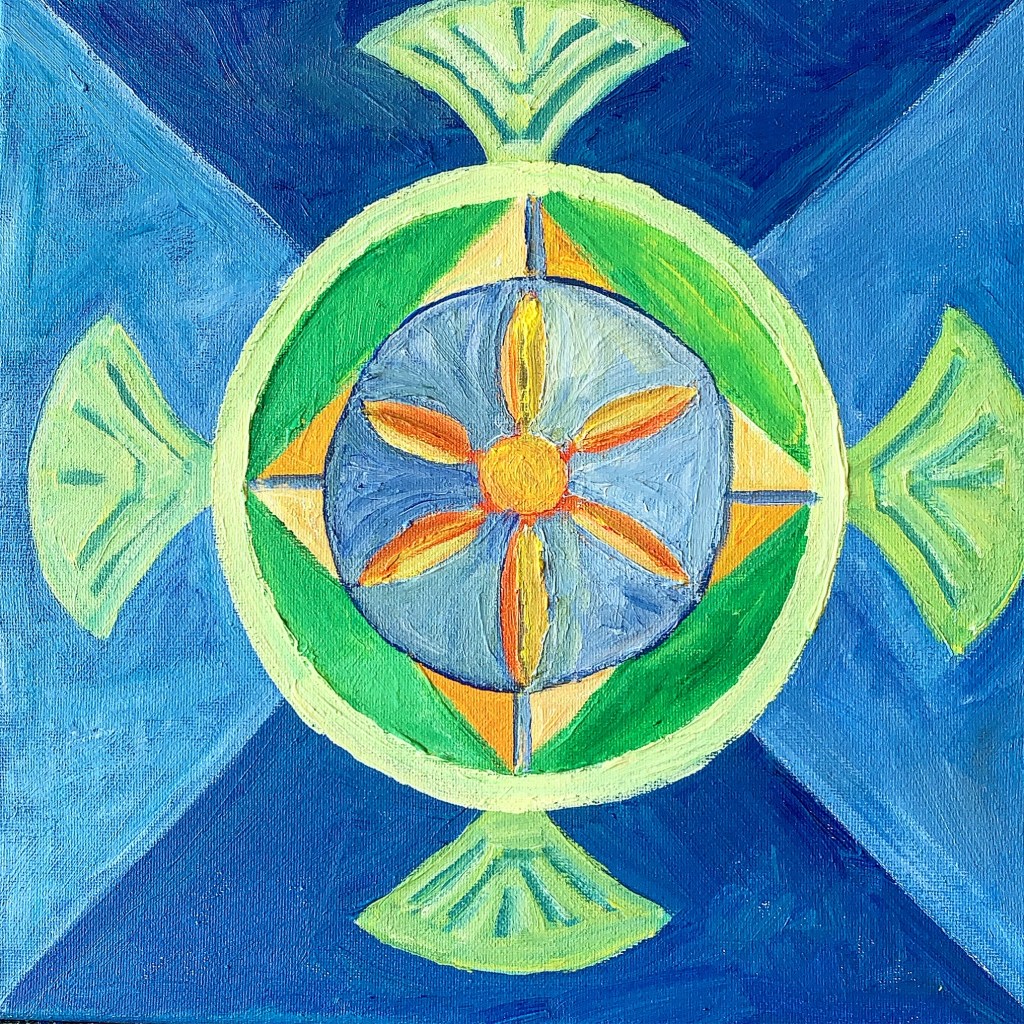
Energies of the Labyrinth

art, change, Chartres Cathredral, coronavirus, Creativity, Faith, garden, greek myths, Imagination, labryinth, Meditation, pandemic, Reflection, Spirituality, Travel, vision

The word labyrinth comes from the Greek labyrinthos and describes any maze-like structure with a single path through it. It’s different from an actual maze, which may have multiple paths intricately linked. Etymologically the word is linked to the Minoan labrys or ‘double axe’, which is the symbol of the Minoan mother goddess of Crete. The actual word is Lydian in origin and most likely came to Crete from Anatolia (Asia Minor) through trade. Labyrinths and labyrinthine symbols have been dated to the Neolithic Age in regions as diverse as modern-day Turkey, Ireland, Greece, and India among others.

Labyrinths or mazes may have served to help the ones who walked them to find their spiritual path by purposefully removing them from their common understanding of linear time and direction between two points. As one traveled through the labyrinth, one would become increasingly lost in reference to the world outside and, in doing so, might unexpectedly discover one’s true path in life.

On New Year’s Day, I was reading my Twitter feed and came across this image of a seaside labyrinth. The comment was, “My #oneword for 2021 is downwind. After walking the labyrinth today with turns both against & with strong wind, I realized how limitless 2021 can be with the help of those who push me forward and not the wind pushing against me. This year, I’ll ride the momentum downwind.”

Twitter photo—My #oneword for 2021 is downwind

The theme of the labyrinth leading to one’s destiny is intricately linked to the Greek myth of Theseus and the Minotaur. The Minotaur lived at the heart of the labyrinth on the island of Crete, whose king required the people of Athens to send a tribute of fourteen youths annually. Once they entered the Minotaur ‘s labyrinth, they never returned. Theseus defeats the beast and saves his people, but loses his father to suicide because he fails to remember to change the color of his sails on his return trip as a sign of his victory. There’s even more dysfunctional family relationships, but that’s a story for another day. Suffice it to say, the ancient gods were wont to interfere with the lives of arrogant humans who failed to defer to the gods and instead acted as if they were masters of their own destiny.

Theseus and the Minotaur: Attributed to the Tleson Painter, ca 550 B.C., Attic Black Figure Kylix, Toledo Museum of Art, Toledo

Greek tragedy deals with the sweeping themes of love, loss, pride, the abuse of power and the fraught relationships between humanity and the gods. Typically the main protagonist of a tragedy committed some terrible crime without realizing how foolish and arrogant she or he had been. After slowly realizing the error, the world crumbles around the hero. The tragic hero must be essentially admirable and good. The fall of a scoundrel or villain evokes applause rather than pity. Audiences cheer when the bad guy goes down. We feel compassion for someone we admire when that character is in a difficult situation. The nobler and more admirable the person is, the greater our anxiety or grief at his or her downfall.

This idea survives to this day in the proverb, “The bigger they come, the harder they fall.” In the 5th C BCE, in the founding work of history known as the Histories of Herodotus, we find the statement: “It is the gods’ custom to bring low all things of surpassing greatness.” An earlier expression, “Pride goes before destruction, and a haughty spirit before a fall,” is found in the Proverbs (16:18). These date from 700 BCE to the fourth century BCE (1:1-9:18).

In a true tragedy, the hero’s demise must come as a result of some personal error or decision. The tragic or fatal error, or fatal flaw of the protagonist that eventually leads to the final catastrophe is known as hamartia, or missing the mark. It’s a metaphor from archery, and literally refers to a shot that misses the bullseye. There’s no such thing as an innocent victim in a tragedy, nor can a genuinely tragic downfall ever be purely a matter of blind accident or bad luck. The tragic hero must always bear at least some responsibility for his or her own doom. In Greek tragedy, the gods may interfere, but they don’t determine our destiny. Likewise, human events and actors may put detours across our path, but though the gods may intervene on our behalf, we can still snatch defeat from the jaws of victory in a true Greek tragedy.

Theseus killing the Minotaur of the Cretan labyrinth. Ariadne, possibly, looks on from the right. Attic black figure vase, Late 6th, early 5th century BCE. (Archaeological Museum, Milan).

The labyrinth is a symbol for change, for it’s the place of transformation. In the myth, Theseus must enter a maze no one knows how to navigate, slay a flesh eating monster, and return to the world above. Theseus accomplishes this, but still retains his youthful flaws until he is changed by his father’s death and he’s forced to grow up and assume adult responsibility. His experience in the labyrinth offered him an opportunity to change and grow but, like many people, Theseus resisted until change was forced upon him.

The medieval labyrinth is a unicursal labyrinth, with a single, circuitous but clearly delineated path. It’s an image encompassing both shared and individual experience, for we don’t walk the path alone, but we share it with fellow travelers. The unicursal labyrinth is distinguished from a multicursal labyrinth (or maze) by having only a single (though winding) path to its center. While a maze may have little or no symmetry and may not even have a center, a medieval labyrinth usually has both. The great medieval labyrinth on the floor of France’s Chartres Cathedral is one of the most famous unicursal labyrinths.

Chartres Cathedral Labyrinth from Above

Carl Jung, the famous Swiss psychologist, saw the similarity between medieval, Christ-centered mandalas in manuscripts and rose windows, the mandalas of his patients, and the mandalas he created. Jung believed his own mandalas “helped him maintain his psychic equilibrium” and believed “everything points toward the center,”so that he found “stability” and “inner peace” even during the war era.

Jung: Mandela

Medieval labyrinths, and all their variations, including the classical design of which the medieval style is an outgrowth, now appear across the United States in settings ranging from churches and parks to hospitals and museums; they may be painted, tiled, paved, woven into a carpet, constructed of canvas, or cut into a lawn. They’re usually designed to be walked on. Over the last quarter century, the medieval labyrinth has entered public consciousness as a “blueprint for transformation” rather than “an oddity,” as it was at one time. I can remember at least one of my fellow clergy asking if “this wasn’t so kind of new age hooey I was getting into.” Moreover, labyrinths aren’t limited to meditative and ritual use; they also appear in secular and recreational settings and are often noteworthy for their ornamental or artistic value.

Lavender Garden Labyrinth

While each one of us walks the same path, no one has the same experience on the labyrinth. We’re all on the same journey, but we’re traveling on a different part of the path. We entered at a different time, or we came to the labyrinthine journey at a different period of our spiritual journey. Some of us will move slowly, while others will hustle along the way. If we came with troubles and worries, we may have been looking for THE ANSWER. The labyrinth isn’t a one armed bandit. We don’t put our money in, pull the handle, and get a payout. The walking is instead an opportunity for reflection, a time to give our selves to the service of God, and set aside our pride.

We enter into the community of faith on the path

I’ve walked on the labyrinth on different occasions and had different experiences, since I’ve been “residing in different inns along my spiritual journey” during the years as I make my rounds about the sun while I live on this planet earth. I’ve been to the holy land twice, and been to Greece and Turkey to walk in the footsteps of Paul to see the churches he planted across the Mediterranean. I spent a summer in Italy during art school, while living in a small town and taking field trips to see the historic sites nearby. I took an interterm during graduate school to visit London and visit all the museums I could devour in that short time, along with some excursions to the seaside. Still, I’ve yet to see Stonehenge, and I’ve not seen Paris.

The question is, do we walk the labyrinth as a tourist going to a destination, expecting to stamp our passports, bring back photos, and buy souvenirs, or do we go expecting to meet Christ along the way? On the tour groups, folks sort themselves fairly soon into subgroups. The ones who want to go quickly to the site, give it a once over, take a few photos, and hit the souvenir shops before they have a coffee or a drink, will find each other and share their daily haul as they relax and wait for the stragglers to roll in. The stragglers come in two groups: the ones who took their time, and the ones who took the wrong turn and got lost. Thankfully, I didn’t get lost as I often do here at home! My notorious ability to take the wrong turn and my poor map reading skills are legend. The virtue of group travel is we leave no one behind.

While each person enters the labyrinth alone, others may also be on the path also. When we meet another, we perform a silent dance of giving way, first one to another, then the other to the one. Two can’t be in the same lane at the same time, but we can “dosie do” to let one another pass on by. This is life in community, where we share the spaces and the journey. When we walk the path of the Labyrinth, we enter a space/time/continuum. This is where up/down, left/right, and forward/backward all exist in one time dimension. Time passes differently inside the Labyrinth, for the twisting path appears to take us first directly toward the center, but just as we approach it, we are forced to follow the path directly away from the center instead. Then we wander around the outer edges of the labyrinth until suddenly, we arrive at the center. If we think we’ll never reach the promised land, we’ll find ourselves suddenly cast upon its shores as a Jonah spewed from the belly of a big fish. What seems like three days of darkness in a labyrinth may only be thirty minutes. Clock time gives way to God time on the journey.

Energies of the Labyrinth

Thus we enter into the timeless paths of all the pilgrims walking before us, those who never made their way to the holy land, but found the holy in the land in which they lived. The labyrinth has a way of uniting all the time of the past, the future, and the now into one dimension. In this way, when we walk the labyrinth, we enter into the kairos time of God, as opposed to the chronos time of humanity. No longer are “on the clock,” but we walk in the appointed and opportune time for us to experience the holy.

If we’re surprised, and emotionally disconcerted as we walk these twisting paths, it’s because we discovered we had no control over how soon we could get to our destination. We can stay in the center and be humbled by this awareness, but often we act like tourists instead. We get our passports stamped after an appropriate rest, and head back home. As heroes who’ve been to the center, we journey back to the outer world as changed people, ready to bring new truths and understanding back to the world. If we are like the Greek heroes of old, however, our tragic flaw will be living for ourselves only and forgetting to do good to all.

The energies of the labyrinth aren’t self-contained to the paths or to those who walk it. It is a holy space, so like the energies of space time, in which space and time are relative, observations depend on the viewer’s speed. If we rush through the labyrinth, we don’t have the same opportunity to meet Christ on the road to Damascus, as Paul did, and have an opportunity to change our lives. We need to drag our feet a bit, as the grieving disciples did on the road to Emmaus, so we might have the privilege of recognizing Christ in the central act of blessing the bread when they invited him to stay with them at the end of the journey.

The hurried life isn’t for the contemplative person, so even those whose lives are given over to getting many things done can benefit from a quiet time now and then. Otherwise, we can become the heroic Theseus who depends upon his own power, rather than giving credit to the powers of the gods, for all his great deeds. This is why his arrogance and pride is his undoing, even though he had a transformative experience in the labyrinth. Not until much later did he process this experience and grow from it.

When I began my painting, I started out with the actual forms, in homage to the many walks I’d participated in over the years. Soon I thought of burying the image, and uncovering parts of it, as if it were an archeological dig in process, but I only buried the outer edges. Then the idea of energies of the innumerable pilgrim walks percolated up into my consciousness and I began to paint the intersecting colored arcs. While I lost the paths, I was painting my emotional experience of the walking. I’ve been on quite a journey this past year, even though I’ve gone nowhere, due to the covid pandemic. Confined to home, I’ve longed to journey elsewhere, but the labyrinth is a journey anyone can take safely without fear of a monster who devours human tributes. I’m looking forward to the new year and new works, and perhaps some actual journeys. God bless everyone. Thanks for reading this.

Joy and Peace,

Cornelia

Labyrinth – Ancient History Encyclopedia by Joshua J. Mark
https://www.ancient.eu/Labyrinth/

Elements of greek tragedy and the tragic hero
https://www.slideshare.net/cafeharmon/elements-of-greek-tragedy-and-the-tragic-hero

Mary Hackworth—“The One and the Many: The Significance of the Labyrinth in Contemporary America,” Journal of Jungian Scholarly Studies Vol. 9, No. 3, 2014
https://jungianjournal.ca/index.php/jjss/article/download/44/37/74

The Labyrinth Society: The Labyrinth Society: Directions to Make a Labyrinth
https://labyrinthsociety.org/make-a-labyrinth

How to Make a Canvas Labyrinth for $200
https://pinkpaganpriestess.wordpress.com/2012/11/30/how-to-make-a-canvas-labyrinth-for-200/

Histories of Herodotus
https://www.gutenberg.org/files/2707/2707-h/2707-h.htm

What is Space Time?
https://www.livescience.com/space-time.html

What Makes a Real Christmas?

art, Children, Christmas, coronavirus, Creativity, Faith, Family, Food, grief, holidays, Icons, Imagination, Love, mystery, pandemic, poverty, Spirituality

I was cleaning up my condo Sunday afternoon because the Pandemic restrictions have caused my housekeeping to need some intensive care. Between all the various projects I’ve done and my new paintings, plus the seasonal change requiring my closet revamp, I realized I haven’t seen the top of my table in months. Since I’m not receiving visitors, I really don’t have to worry about this, but even I can only live with so much disorder and clutter.

When I was in seminary, my roommate and I would make a pact: no cleaning during exam week and ice cream runs every night. Amazingly, some compacts are easily kept, and studying for finals was less stressful because of our sweet rewards. A little chaos for a short period of time isn’t a problem, but months or years of confusion and neglect can bring about disaster.

I realize chaos is the norm for many people during the holidays, even if we’re not attending parties at work, or visiting with relatives or friends. We still have other rituals to indulge, especially if we have children. One year I stopped to list out all the experiences I remember which make up an ideal Christmas. I never imagined the list would be so long, or that my parents worked so hard to make the season wonderful for us children. As you read this list, feel free to add your own traditions to the list.

Natchitoches Christmas Lights
  1. Writing Santa a letter
  2. Traveling to Natchitoches to see the Christmas lights
  3. Pizza and Car trip to see the Christmas lights in town
  4. Hanging Christmas lights on the house
  5. Finding the perfect Christmas tree
  6. Decorating the Christmas tree
  7. Making Christmas decorations
  8. Making popcorn and cranberry strings for the tree
  9. Family ornaments
  10. Watching the bubble lights
  11. Hanging the Christmas stockings
  12. The brass Angel chimes
  13. Finding a thorn bush for a gumdrop tree
  14. Eating ribbon candy from the jar at my nanny’s home
  15. Candy lifesavers in a book
  16. Special foods, such as Ham and yam, and the green bean thing
  17. Christmas breakfast of biscuits and strawberry jam
  18. Drinking from the Santa mug
  19. Christmas plates and mugs
  20. Making fruitcake cookies and cakes
  21. Wrapping and hiding presents
  22. Dreaming while reading the Sears catalog
  23. Holiday visits
  24. Visit to Santa Claus
  25. Gifts from Santa, rather than from the parents
  26. Christmas candlelight service at church
  27. Children’s Christmas pageant and choir concert
  28. Special music
  29. Nativity scenes
  30. Staying up late to assemble toys
  31. Never enough batteries
  32. Stocking stuffers
  33. New red robe or pajamas
  34. Christmas letters from all our friends
  35. A vain hope for snow
  36. Wreath on the door
  37. Wrapping paper everywhere
  38. Handing out presents
  39. Opening presents
  40. Teacher gifts
  41. Making a Christmas list
  42. Dropping hints
  43. Candles in the window to guide the wise men
  44. Advent wreath candles
  45. Advent calendars
  46. Pine cones
  47. Caroling from house to house, mostly off key
  48. Parties
  49. Christmas clothes and Sox
  50. Garish Christmas sweaters

At this rate, I’d have to accomplish 1.7 per day to get all 50 done in between Thanksgiving and Christmas Eve. Like any big project, no one does it all at once. We always divided it up into smaller, achievable experiences, some of which extended over the whole season, and others we did once a week. How we managed to cram a dozen of these into each one of the four weeks before Christmas is beyond me. These days my work ethic is on furlough and if it ever returns, I’ll probably send it on vacation rather than let it clock back into work. I do lead a simpler life now.

My Christmas Tree Today

Any month of 30 days can be converted to one of these units:

  • 2,592,000 seconds
  • 43,200 minutes
  • 720 hours
  • 4 weeks and 2 days or
  • 8.20% of a standard year

These past nine months of COVID, with its quarantines, terrible toilet paper, and bad haircuts have been exacerbated by the illnesses and deaths of friends and family we’ve known and loved. With over 3,000 Americans dying from this disease daily, celebrating a real Christmas as we once did, seems unconscionable. Those of us who’ve lost a loved one look for any light in these dark days. Like Frodo, we might say, “I wish it need not have happened in my time.”

“So do I,” said Gandalf, “and so do all who live to see such times. But that is not for them to decide. All we have to decide is what to do with the time that is given us.” (J.R.R. Tolkien, The Fellowship of the Ring).

When I think of my life of seven decades plus, I remember when I was a child, every one of those two and a half million seconds before Christmas seemed to stretch out to eternity. Just as the three months of summer flew by like an icicle on a hot stovetop, the one month between Thanksgiving and Christmas moved slowly, as if I were watching a stalactite grow imperceptibly across the centuries. Maybe this is why my parents organized this magnificent list of projects to keep us children from whining over and over, “Is it Christmas yet?”

Christmas tree skirt from the 1950’s

I’ve never understood how they managed to teach us deferred gratification. After all, every single day in the month prior to Christmas had some sort of activity, and some of those projects extended over the whole season. One year mother decided to bead a skirt for the tree. She bought a “Twelve Days of Christmas” kit, which contained the white felt skirt, a green fringe, and multi colored felt squares imprinted with the patterns. As we worked each night, we filled each design with brightly colored sequins. Some of these early days were so heavy they had no fabric showing. As Christmas came closer and our project was as yet unfinished, we began to limit our decorating. We also were running out of colored beads and sequins by this time.

Handmade Stockings on an Antique Sideboard

Another year mother made new stockings for us kids, with our names on them. She also sewed a small bell on these so our early arising would wake her up. For the first grandchild, she had more time on her hands. That stocking was fully embroidered and had no warning bell. Of course, it hung at my home, so mother and daddy didn’t have to worry about any early bird interrupting their beauty sleep.

My parents did have a rule that we kids needed to wait until the crack of dawn before we entered the room where the tree was. If we got up earlier, and we almost always did, we took our pillows and covers into the dining room. Our old house had French doors separating the dining room from the living room. We’d pile our bedding down close to these doors and look through the bottom window into the magic darkness of the corner where the Christmas tree stood guard over mysterious packages wrapped in seasonal colors.

“What do you think that big one is?” My brother would whisper.
“It’s probably clothes,” I’d reply, “you know those rectangular packages are usually pajamas or pants.”
“Gross!”
I’d giggle and he’d elbow me in the ribs.

All three of us would strain and crain to see the indistinct shapes back under the lower branches of the fir tree. Until the first light came into the window beside the tree, we could only imagine the treasure hidden there. In our eager efforts and earnest desire to meet the rising sun, we often fell back asleep dreaming of Christmas morning. We’d awaken when our parents began their morning coffee ritual, which usually happened in bed, but on Christmas, they drank their caffeine on the couch and watched our joy, as we unwrapped the presents from Santa Claus.

None of us children were ever hungry on Christmas morning, at least not until we’d discovered the answer to all the questions we’d asked in the dark of night. Once those were revealed and our curiosity satisfied, we could turn our appetites to breakfast. Someone always gave daddy a good jam and biscuit gift in a wooden tub, so it was our go to meal for breakfast. We didn’t eat biscuits often, so they were a treat with huge dripping globs of melting butter. We’d go to one of the grandparents’ homes for lunch soon afterwards, so we didn’t need a big meal.

As I think back on these 1950’s Christmas memories, I was too young to know about the hunger and poverty of others. I do remember the poliovirus and the vaccine in my arm. There was the nuclear threat of the Cold War era and I lived in the time of the McCarthy Hearings and the John Birch Society. This is also the time of Brown vs. Board of Education and the Civil Rights Movement. My parents may have instituted all these seasonal home grown activities not only for us children, but also for themselves. If they were busy with “Christmas,” then they were focused on a spiritual journey and not on the chaos of the world.

Icon of The Creation of the Stars

When my daughter was small, I began buying her Christmas in August, because that’s when I got my first paycheck as a schoolteacher. I bought one little thing at a time, and put aside a little more money on a couple of larger gifts in layaway. I wasn’t going to buy anything for myself, but the choir at my church gave me a ham and a little love offering so I could have a bright red blouse for Christmas. I recalled the year after my marriage, my husband gave away some of our wedding gifts as Christmas presents “to keep up appearances.” We shouldn’t have to lie to the ones we love, especially at Christmas, but not everyone can live with the truth. Christmas isn’t about the gifts we give to one another, but about the gift God gave to humankind.

Creation of Light

Sometimes it seems like our world has gone mad, and folks can’t tell a truth from a lie. My daddy used to say there were folks who’d say the sun was shining even when it was pitch black outside. I’d shake my head in disbelief, but I hadn’t been out in the world as much as he had. Even if we now live in a world gone crazy, we can take comfort in these true words from the gospel of John (1:1-5)—

In the beginning was the Word, and the Word was with God, and the Word was God. He was in the beginning with God. All things came into being through him, and without him not one thing came into being. What has come into being in him was life, and the life was the light of all people. The light shines in the darkness, and the darkness did not overcome it.

Icon of the Nativity with Visit of the Magi

Charlie Brown Clay Stars

adult learning, arkansas, art, Astrology, CharlieBrown, coronavirus, cosmology, Creativity, Faith, Family, grief, Healing, holidays, Imagination, Israel, Ministry, ministry, nature, pandemic, Spirituality

“Close Encounters of the Third Kind” might best describe my and Gail’s latest adventure at the Oaklawn art class. Pinterest Fail is another synonym for our latest escapade. If my daddy were to describe the result, he’d say, “Close, but no cigar.” That’s a quintessential American expression, which is little used elsewhere in the English-speaking world. The first recorded use of “close, but no cigar” in print was in Sayre and Twist’s publishing of the script of the 1935 film version of Annie Oakley: “Close, Colonel, but no cigar!” I’m very fond of these ancient phrases, which are daily passing from the common parlance, even as new words are invented. These were our first attempts at this craft, so our learning curve resembled the same disastrous, steep ascent of the daily Covid infection chart.

The 1977 movie title “Close Encounters “ was derived from a classification of close encounters with aliens as set forth by the American UFO researcher J. Allen Hynek. Close Encounters of the First Kind refer to the sighting of a UFO. Physical evidence of a UFO are classed as Close Encounters of the Second Kind. Actual contact with an alien is a Close Encounter of the Third Kind. Therefore, our air dried cornstarch, salt, and baking soda clay objects, which should have looked neat, crisp, and clean, instead came out more like visitors from another planet, whose embodied boundaries were disintegrating in an inhospitable atmosphere.

Yes, I blame the recipes, which said “warm water,” rather than naming an actual temperature. Just as science projects and recipes for bread need accurate measurements and temperatures for success, so does cornstarch clay. Gail mentioned her clay began to heat up under her hands as she worked it. Mine never did, but I had to add rock salt to my mix because I ran out of table salt. Don’t do this! The salt crystals won’t melt and I had chunks in my finished pieces. The proportions of the recipe I used are equal amounts of each ingredient, so if you have just a limited amount of one, measure it and give the others to the main bowl in the same amount.

Bowl with Ingredients

Once the dough looks like mashed potatoes, don’t eat it. Instead, turn it out on parchment or waxed paper and knead it a bit. Then use a rolling pin to get the dough about ¼ inch thick. Use cookie cutters to get your shapes. Put them on a clean, flat surface, such as the back of a sheet pan. Take a plastic straw to put a hole in the upper part of the cutout. This works best if the shape is a touch dry, since the damp dough will close up. The hole is for the string hanger. The rolling pin might need flouring with corn starch if it sticks to the clay.

I also took some leaves and twigs from the bushes on the church property to use as embossing. I put these down on the cutouts, gave them a rolling pin once over or twice, maybe three, and made sure not to over flatten the shape. You could also use a decorative rolling pin as the last roll to make an all over pattern if you like that idea. A patterned doily or a scrap of lace would make a good pattern also.

Natural Decorations

When class was over, we cleaned our mess up with hot water and paper towels. I let the water run in the sink to make sure any small remains were washed far down the pipes. All the big scraps should be thrown in the trash. When I got home, I wasn’t in the mood to let these air dry for days and days. They already looked like they belonged on Charlie Brown’s Christmas tree, so I put them in the oven at 200F.

Water boils at 212F, so at 200F these shapes would be slowly drying out. I baked them on a cookie sheet for 30 minutes on each side. I did notice a bit of toasting in places, but I planned on painting these, so I don’t think it matters. I did lose the points off a few stars, but in this year of the Pandemic, perhaps some of us may be able to identify with the brokenness and vulnerability of these imperfect objects. We may want everything and everyone to be perfectly normal, but standard operating procedure isn’t on the menu for this year’s Thanksgiving or Christmas. We’re all suffering in one way or another, just like these ornaments.

Broken Stars

I didn’t preheat the oven, for the clay objects don’t need to be shocked into a different temperature. We don’t preheat a kiln before we fire clay pottery, but raise the whole to the same temperature at one time. Of course, if you’re making a recipe with flour, yeast, or eggs, and you need your concoction to rise, you do need a preheated oven. Otherwise, just put the food into a cold oven and let your nose tell you when it’s done. Preheating is a waste of energy if you don’t need it for the recipe. These clay pieces will be hot when you remove them from the oven. Let them cool until you can pick them up without dropping them like a hot potato (a metaphor from the 1800’s).

Painted Star and Bells

I did take a sharp paring knife to the edges to smooth them out. Yes, I didn’t like the raggedy look. You can’t do this cleanup roughly or with big whacks. This is the fine tuning of your shape. I used to help a porcelain doll maker back in my home town. I would sand the final shape of the doll baby’s faces, hands, and feet for her to paint. She appreciated my work because I would keep the anatomical details correct and give the little faces individual personalities. Portraits in porcelain aren’t that easy, but I wouldn’t rush to finish. If we’re always on to the next task, we might miss the opportunity to meet God in the work we’re doing in the moment.

Right now in this current crisis, most of us are limiting our time out and about. If we go to the grocery store, we find our goods and get out. I do the self check out or scan and go wherever I am so I don’t have to stand in lines. I do miss the interaction and chats I used to have with folks. I decided recently even if I were masked, I would begin to speak to others. So far on each outing, at least one person has shared their feelings of grief or loss, which are a result of this pandemic. Because we are forced to limit our contacts, we’ve also lost our opportunities to share our daily joys and our challenges. If we don’t use our words, we’ll lose them. We need time to share our lives and be a community for one another, since we’re all in this together. These are God moments in which we can be a blessing to others, as well as to receive a blessing from them.

This loss of conversation will be even grimmer if our loved ones pass on during this pandemic, for their memories will cease to be available to the younger generation, and their stories will no longer be shared. As these old ones age, and their frailties become like the imperfect points on my Charlie Brown stars, we realize we won’t have them much longer. Even more so, we’ve come to realize this pandemic spares neither the young nor the full of life, as more and more of our friends are struck by this disease. Any one of us could become a Charlie Brown Christmas star at any moment. I have family members who’ve had it, friends who’ve died from it, and my heart goes out to all who suffer with it, especially those who have lost their incomes because of it.

Those who now deal with the persisting side effects of this disease don’t get near the encouragement or assistance they need in their recovery, since the rest of us are too worn down from self care and from caring for those who’re newly ill. Even the health care workers, first responders, and essential workers who have to keep the rest of us safe, well fed, and secure are struggling under the long term stressors of this pandemic. We have a responsibility to care for them so they can keep going under duress. All these folks need a sign from us that they aren’t forgotten.

Christmas Tree Star

Unique stars have always been a herald or sign of unusual events to follow. The gospel of Matthew (2:1-2) records the visit of the magi, astrologers from the east, to King Herod:

In the time of King Herod, after Jesus was born in Bethlehem of Judea, wise men from the East came to Jerusalem, asking, “Where is the child who has been born king of the Jews? For we observed his star at its rising, and have come to pay him homage.”

These foreigners recognized the sea change about to happen in the world, for soon earthly kingdoms would recede in importance, and the powerful would lose their sway. If they could see this sign in the sky, we have to wonder why no one in Israel was considering what the star’s arrival signified. Perhaps the learned priests knew, but didn’t want to tell King Herod the bad news:

Thus says the LORD,
who gives the sun for light by day
and the fixed order of the moon and the stars for light by night,
who stirs up the sea so that its waves roar—
the LORD of hosts is his name:
If this fixed order were ever to cease
from my presence, says the LORD,
then also the offspring of Israel would cease
to be a nation before me forever.
(Jeremiah 31:35-36)

Of course, today most of us no longer believe the stars and planets affect our daily lives, nor are we “born under a bad sign,” as the blues players sing. Once we clean up the Thanksgiving meal, many of us will turn our thoughts to the holiday season. I’ll remove the last of the autumnal gourds and bring out a few winter seasonal objects every week until New Year’s. As the seasons change, we note the changes in our world. If the days are growing shorter and darker, we ourselves can still be lights in the world, as Paul wrote to the Philippians (2:14-15):

Do all things without murmuring and arguing, so that you may be blameless and innocent, children of God without blemish in the midst of a crooked. and perverse generation, in which you shine like stars in the world.

Multiple Layers of Gold and Silver Acrylic Paint on the Ornaments

Even if we’re Charlie Brown stars, our lights will be a beacon of hope for all the world to see.

Joy and Peace,
Cornelia

Air Dry Clay Recipe Using More Baking Soda (better recipe)
https://mamapapabubba.com/2016/02/16/homemade-air-dry-modelling-clay-aka-baking-soda-clay/

Reasons to Preheat the Oven
https://www.epicurious.com/expert-advice/do-i-really-need-to-preheat-the-oven-article

Lifelong Learning

art, bottles, brain plasticity, Children, Creativity, flowers, Imagination, mystery, nature, Painting, renewal, vision

Leonardo da Vinci is the ideal Renaissance man: a supremely gifted painter, scientist, inventor and polymath. Da Vinci has been widely regarded as one of the world’s greatest minds, whose extraordinary talents included painting, mathematics, architecture, engineering, botany, sculpture, and human biology. He once said,

There are three classes of people:
Those who see.
Those who see when they are shown.
Those who do not see.

When small children draw, they first make experiments with whatever medium they have in hand. They’ll put their whole body into it, cover the entire page, and sometimes even eat the materials. Even though they’ve been given a limited arena to explore, such as a sheet of paper, if you turn your back, kids will want to see how the crayons or paint work on a wall, on their bodies, or on the family pet. Parents think of this as more cleanup work, but it’s just another learning experience for the children. The pandemic may have brought this lesson home to roost in more than one home.

Family and House

Later on, children make symbols for the objects in their world. This is why all early grammar school art looks very similar: the blue line across the paper’s top represents the sky, the yellow sun blazes in an upper corner, a house has exactly one door and two windows, and the ground is green grass. Once a child is 9 to 11 years old, they begin to draw realistically, and over the next few years a child will develop their eye for accurate color and detail.

Sometimes children get the idea they have no artistic ability, and develop a bad case of the “I can’t do this-itis.” When I taught art, I had kindergartners cry when they couldn’t cut out a snowman perfectly on the fold. “Oh, sweetie, no one cuts it perfect the very first time! The first time is just for practice. Let’s see what you were doing that got you two pieces instead of one.”

I knew they were holding the cut side, rather than the folded side, when they made made their cut, but they needed hands on instructions to get the lesson. “Oh, look, you need to hold the fold in your hand, and cut on the flappy sides. That’ll give you the whole piece. Try that while I watch.”

It’s just amazing what happens when the scales fall off their little eyes! In the book of Acts (9:17-18), Ananias laid his hands on Saul and said, “Brother Saul, the Lord Jesus, who appeared to you on your way here, has sent me so that you may regain your sight and be filled with the Holy Spirit.” And immediately something like scales fell from his eyes, and his sight was restored. When we find the magic key to unlock the storehouse of hidden knowledge, all the possibilities of the world beyond us seem to be close at hand. It only takes a few successes to gain confidence.

Once young people get up to middle school age, they begin to sort themselves into “groups.” Those who think they’re Michelangelo’s and Leonardo’s heir apparents often think they only need to do a minimum of work, since their native abilities exceed the best efforts of the less talented students. In mandatory art classes, everyone needs to work under the same grading system. Otherwise systemic structures would always prefer and rank higher those students who had the benefit of prior training, cultural experiences, and native talent.

I always leveled the playing field by grading on heavily on the work ethic, the amount of improvement, and then gave the finished product only 25% of the overall total. This meant if Michelangelo goofed off, but dashed off a winning project, he’d most likely fail the first grading period. His parents would get his mind straight and then his art works would begin to improve by leaps and bounds.

Jasper Johns: Order and Disorder.

Likewise, the students who never had a chance at succeeding in art class could give their best efforts, seek to solve the assignments, and discover they could improve! It was as easy as A—B—C—Attitude, Behavior, and Consequences. If we began with a positive attitude, we made positive actions, and got good grades and improving art works. Plus we began to feel good about ourselves. If we kept a negative attitude, we wouldn’t try, we’d goof off, be slow to improve, and get a bad grade. Why feel bad about yourself when everyone else was having a good time in art?

The fancy name for this process is brain plasticity. Our brains can form new information and structures, not only when we’re young, but also as we age. The brain is a muscle, which we can exercise. If we stop exercising our mental skills, we don’t just forget them: the brain map space for those skills is turned over to the skills we practice instead. You might ask, “How often must I practice tennis, guitar, or math to keep on top of it?” This is the question about brain plasticity, since you’re asking how frequently you must practice an activity to make sure its brain map space is not lost to another. The simple word for this is “Use it or lose it.”

Today we live in a world in which many children don’t get to explore a wide variety of interests. Some of this is because our schools have focused on teaching just the basics, so art and music get shuffled off to the outermost edges, or dropped if finances get tight. We live in a more structured world than fifty years ago, so children don’t often interact with their environment unless they’re camping or on a field trip. Many don’t play sports because teams are competitive, time consuming, and don’t allow children to have outside interests. I’m not sure why we want children to become professionals too early in life, when they could be exploring the world in all its vast wonder instead.

Maybe this is why as adults we come back to discover our true selves and take up a hobby we never thought we’d ever try. We have to drop our preconceived notion that our abilities and success in one area of our lives will mean we’ll quickly progress in a new field. Some have said we need 10,000 hours of practice to attain excellence, but others say it depends on the field. Deliberate practice is only a predictor of success in fields that have super stable structures. In tennis, chess, and classical music, the rules never change, so you can study up to become the best. If we were to start up a brand new business , we might need to break some of the rules.

Leonardo da Vinci wrote in his notebook,
“Shadows which you see with difficulty, and whose boundaries you cannot define… these you should not represent as finished or sharply defined, for the result would be that your work would seem wooden.”

We sometimes see with difficulty, and our hand isn’t yet fully connected to our eye, so the boundaries of our shapes don’t match what we see, but we find joy in the act of painting. We keep looking ever more closely, increasing our powers of observation, and training our hand to follow our eye. Some of this is keeping a memory in our mind long enough to put the image on the surface, and the other part is to still the mind of extraneous thoughts so we can hold that thought for the few seconds it takes to make the line.

Leonardo was a lifetime learner.

We do this for our mental health, to keep our neurons fresh and our brains challenged by the problems of representing color, shadows, light, and space. We approach our art work as if we’re little children eager to discover a new way to describe our world. Each time we set brush to canvas, we grow, if only in humility.

Gail brought us some beauty berry bushes. Unlike nearly every other fruiting shrub in North America, beauty berry flowers and fruits in clusters along its stem at the leaf joints, rather than on a separate fruiting stem. Flowers are clustered sprays of pinkish-white tiny blossoms that appear in mid to late summer. Berries are a bright, intense purple, tightly packed in balls of fruit along the stem. The berries are edible when they’re deep purple, but they require lemon juice and sugar to make a good jelly.

The leaves can be used in nearly every way to fight insects: you can crush them and rub them on yourself for a quick fix, you can make an infusion and dip your clothes in it, you can distill out the essential oils and combine them with other plants to make a bug spray… it all works. And it’s not just folklore, either. In 2006, scientists at the USDA’s Agricultural Research Service working at the University of Mississippi isolated three chemical compounds from beauty berry leaves— callicarpenal, intermedeol and spathulenol. All three proved highly effective as repellents for mosquitoes, biting flies, ticks, fleas, and other pests. Later studies confirmed their findings, and actually proved callicarpenal to be more effective than DEET at repelling insects, without the harsh side effects. The last hurdle is making the process financially feasible.

Very nice Beauty Berries

I brought another of my antique 1930’s glass vases from my grandmother’s house. Filled with water, the stems appear distorted underwater and don’t line up with the stems above water. This proved more difficult to paint, so I suggested to Gail a way to simplify the leaves. If the basic yellow shape were filled in first, then the shades of green could go next, leaving thin streaks of yellow for the veins. This is easier than painting a thin yellow line. A thin red edge could highlight certain areas to get the shadow. This takes a steady hand and controlled breathing. Hurrying to get somewhere fast won’t get it done. She paid close attention to the berries and their highlights.

Mike had an errand of mercy to attend to, so he made an appearance and left to help someone who was in trouble. Trouble is just another word for the opportunity to be the hands of Christ in the world. Anytime I had interruptions in my daily plans, I always knew God’s plans were superseding my well planned calendar.

Sunlight on an Antique Vase of Beauty Berries

My little still-life has all the autumn colors. Gail brought in a variety of branches and a red sumac also. We only have about 90 minutes to paint after I show some examples and have time to cleanup afterwards. Therefore, I choose to simplify the subject before me. I decide what is most important and necessary to convey the image, to set it into the space, to give it a mood, and to let it speak. If there’s an air of sadness about it, it’s because I painted it on the anniversary of my daughter’s death. If there’s a mood of mystery within it, the changing season is one of harvest and celebration. The earth gives forth its bounty, then goes into a form of rest, until it rebirths itself in the springtime.

If we’re going to paint not only the subject before us, but also share our true selves in the finished work, we need to become as little children who put their whole selves into their work. Although I’d hope we would have learned by now not to eat the paint.

Next Friday we’re going to make decorations for the harvest season. Mike is bringing in leaves, branches, and spray paint. I’m bringing a drill, glue guns, wire cutters, and wire. If you’re coming to make a wreath or mantle piece, bring your “autumn stuff,” as well as a wreath or log. Please wear a mask.

Until next time, Joy and Peace,
Cornelia

Children’s Art Stages
https://www.d.umn.edu/artedu/Lowenf.html

Edible Beauty Berries
https://www.sarcraft.com/news/american-beautyberry

The Brain That Changes Itself—brain plasticity
Stories of Personal Triumph from the Frontiers of Brain Science NORMAN DOIDGE, M.D. https://www.brainmaster.com/software/pubs/brain/contrib/The%20Brain%20That%20Changes%20Itself.pdf

Rabbit! Rabbit! Welcome to October

All Saints Day, art, Children, coronavirus, Creativity, Faith, Family, Fear, grief, Halloween, Healing, holidays, Imagination, Israel, pandemic, rabbits

The Pandemic killed Halloween Then and Now

Nearly a century ago, no one had “Pandemic Shuts Down Halloween “ on their bingo card. The Great Influenza Pandemic griped the nation back in 1918, so most Halloween celebrations were cancelled due to quarantines. At least 195,000 people had died of this novel disease in America by October, 1918. The CDC estimates about 500 million people—or a third of the world’s population—had come down with this killer virus. By the1920’s, at the end of the Pandemic, at least 50 million people died, with 675,000 victims in the United States alone.

USA Red Cross volunteers in 1918 flu epidemic
APIC / Getty Images

At the time, we had no vaccines to protect against influenza and no antibiotics to treat secondary bacterial infections. Many doctors and nurses were serving in World War I, so the civilian medical professionals around the world tried to control infections with nonpharmaceutical interventions such as isolation, quarantine, good personal hygiene, masks, use of disinfectants and limitations of public gatherings. An interesting side note is all the flu pandemics which have happened since — 1957, 1968, 2009 — are derivatives of the 1918 flu, according to scientists at the National Institutes of Health.

The world back then was falling apart on two fronts from the first world war and disease. People at home were dropping like flies. Bodies were stacking up like cordwood and were placed in mass graves. Then, as now, we rabbits, like people, can only take so much stress before we need to release it. Many of us are pots with tight fitting lids: as soon as we reach the boiling point, our lid begins to rattle and clatter. If the cook doesn’t remove the lid and stir down the goo inside, we’ll be an over flowing volcanic mess, much like my morning oatmeal I’ve neglected when I’ve had too little coffee. Then Halloween, with its ghouls, goblins, witches, and other demons of the dark, arrives like Washington Irving’s ghost of the Headless Horseman, which we meet in The Legend of Sleepy Hollow, written in 1820.

The Headless Horseman Pursuing Ichabod Crane (1858) by John Quidor

Flu Pandemic Inspired Fiction

H. P. Lovecraft was one of the great horror writers, famous for his zombies, which may have been inspired by the grisly experiences of the influenza pandemic. Providence, Rhode Island, Lovecraft’s hometown, wasn’t spared the pandemic’s ghastly atmosphere.

As one local witness remembered, “all around me people were dying… [and] funeral directors worked with fear… . Many graves were fashioned by long trenches, bodies were placed side by side.” The pandemic, the witness laments, was “leaving in its wake countless dead, and the living stunned at their loss” (letter by Russell Booth; Collier Archives, Imperial War Museum, London).

White Zombie: First Zombie Movie, 1932

Lovecraft channeled this existential horror into his stories of the period, producing corpse-filled tales with infectious atmospheres from which sprang lurching, flesh-eating invaders who left bloody corpses in their wake.

In his 1922 story “Herbert West: Reanimator,” Lovecraft created a ghoulish doctor intent on reanimating newly dead corpses. A pandemic arrives that offers him fresh specimens. This echoes the flu scenes of mass graves, overworked doctors and piles of bodies. When the head doctor of the hospital dies in the outbreak, Dr. West reanimates him, producing a proto-zombie figure that escapes to wreak havoc on the town. The living dead doctor lurches from house to house, ravaging bodies and spreading destruction, a monstrous, visible version of what the flu virus had done worldwide. Lovecraft wrote about a zombie super-spreader even before we knew such a thing existed. Who says “life sometimes doesn’t imitate art?”

Thriller: Zombie Dancers backing up Michael Jackson, 1983

Infection, Prejudice and the Viral Zombies

In other episodes and stories, Lovecraft’s proto-zombies suggest an additional thread of prejudice that runs through the zombie tradition, one fueled by widespread fears of contagion during the pandemic. Even before the outbreak, Lovecraft believed that foreign hordes were infecting the Aryan race generally, weakening the bloodlines. These xenophobic anxieties weave their way into his stories, as contagion and pandemic-soaked atmospheres blend into racist fears of immigrants and nonwhite invaders. We hear these same themes repeated today in our pandemic times by white supremacists and far right groups who want a sovereign nation within the land of the free.

Indeed, many of Lovecraft’s stories are unwitting templates for how prejudicial fears may be problematically amplified at moments of crisis. Such fears are evoked and often critiqued in later depictions of viral zombie hordes, such as the infectious monsters of Romero’s 1968 movie, “Night of the Living Dead” and the film’s subtle commentary on race, as when the white police force mistakes the main African American character for a viral zombie. Amazing how systemic racism persists in making “walking while black equate to viral zombie” even today.

Small Rabbits Fear Large Monsters

Lovecraft’s proto-zombies also provided a strange compensation for some of the pandemic’s worst memories. Like the covid-19 virus of today and the flu of the last century, these monsters consumed the flesh of the living, spread blood and violence, and acted without cause or explanation. Lovecraft assures his readers that these monsters are far worse than anything they saw in World War I or in the pandemic, the twin defining tragedies of his era. Unlike the virus, though, these literary monsters could be seen, stopped, killed, and reburied. Every decade seems to need its own monster or zombie, and Lovecraft offered his readers a version that spoke deeply to the anxieties of his moment.

Modern Fears Birth Modern Monsters

Our modern monsters are more in tune with the unimaginable horrors of our present world. In the 1950’s we had nuclear terrors, so our monsters were Godzilla and the Creature From The Black Lagoon. In the 1990’s, cloning was a scientific advance we knew could go amiss, so we had dinosaurs run amuck in Jurassic Park. Aliens have always been the most foreign of foreigners, so whether it’s the Thing from Outer Space or Invasion of the Body Snatchers, we can scream into our popcorn all afternoon long. If we don’t scream, everyone will know we’re one of the “pod people.” Even before cinema took over entertainment, Orson Welles’s radio broadcast of the H.G. Wells novel War of the Worlds caused mass panic among listeners who believed Earth really had been invaded by Martians on October 30, 1938.

Image Invasion of the Body Snatchers, 1956

Dangers of Dualistic Thinking

Maybe this is why we rabbits need structured experiences which bring us up to the edge of fear, but in a safe environment. We need to learn to deal with our feelings and emotions as they threaten to overwhelm us. We need reassurance we can handle the frightening experience. We don’t need to be thrown off a cliff, but tested appropriately. If we don’t deal with our inner fears, we’ll see a ghoul in every dark shadow. This is why movies today have ratings for age groups.

When I was young, I was certain monsters lived under my bed and in my closet. I couldn’t sleep unless my closet door was shut. I was in art school before I could leave that door open. Something clicked in my mind, or I realized I was now at the age of responsibility. If this were so, I needed to give up this childish fear of invisible monsters. It was time for me to be the monster slayer in real life.

My daddy had a fear of monsters all his life—he called them communists. As a member of the now discredited John Birch Society, he claimed there was a “commie in every breadbox.” We’re no different today, for we rabbits seem to need our own monsters in the world beyond us. If we can’t deal with the brokenness or fears within us, we’ll project it outward onto an outside “other” group. Just as we too often put certain rabbits on a pedestal and are shocked when they fall, we also put some rabbits in a pit and wonder why they can’t get out of it. We tell ourselves “they don’t try hard enough” or “they aren’t worthy enough,” but neither of these statements are true. People are individuals, so we can’t make conclusions about them as a group.

Mischief Abounds All Night

By the 1920s, Halloween in America had become synonymous with mischief, which young people used as an excuse to break windows or damage property. Mischief comes from the Middle English word meschief, or “misfortune,” which itself derives from the Old French meschever, “to end up badly.” In the U.S., mischief has a legal definition: “Criminal mischief” includes true vandalism, such as the defacement or destruction of property, but also includes fully reversible pranks, like toilet-papering a house. In some states, it covers even vanishingly minor annoyances, like ding-dong-ditch, or ringing the doorbell and running off before the homeowner can answer the door. In 1923, the police chief commissioner in Omaha, Nebraska, went so far as to designate the “city’s worst boys” as junior police officers on October 31 and relied on them to report criminal behavior in an attempt to curb vandalism.

The first known printed reference to “trick-or-treat” appeared in the Alberta Canada Herald on Nov. 4, 1927, according to the Smithsonian.

Modern Mischief Makers

I met two of my young students dressed in black garbage bags as my daughter and I returned from trick or treating one Halloween night. Their too guilty grins as they said hello and hid their hands underneath their costumes was a dead giveaway they were the likely culprits for the artistically draped toilet paper on my giant live oak tree. I let them pass on by and got my car keys to go visit their home, which was just up the street. After a drink and a chat with the parents, we agreed the boys would clean up my tree. My parents also were visited with this “sign of endearment” more than they liked when I was young. I imagine it’s still going on today.

Image of Other Outstanding Mischievous Vandals and Toilet Paper Trees

Reflections on a Non Traditional Halloween

While we grownup rabbits think our little bunnies are going to miss Halloween traditions, the smallest ones don’t know what is tradition yet and the older ones can understand why this year will be different. Trick or treating began in the USA after WWII, as a way to discourage mischief, for if the kids get candy, they’ll be less likely to wreck havoc. As far as long term memories go, I’ve stretched mine, and can remember only one neighborhood walk about. I was slowed by my Carmine Miranda costume, while my brothers ran two houses ahead. I was delayed by holding my fruited headdress on my head.

Another Halloween we had a party at home with apple bobbing, snack making, and games. This was probably due to a fear of poison or pins in candy bars. This fear comes around every year, but it seems to be an urban legend. I also remember attending a school haunted house and walking through the dark and spooky cloakroom. There I touched all sorts of icky, gooey substances purporting to be “brains, eyeballs, and assorted body parts.” I do remember I did everything I could to not be banished to that same cloakroom for bad behavior the rest of year. No sense tempting fate, for sure, my eight year old mind reasoned.

If this holiday is for four year olds to twelve year olds, I can only remember one third of the years. In the short run it seems important, but in the long life of a person, only a few extraordinary moments will rise to peak memory. If this isn’t a year for house to house galavanting, or trunk to trunk acquisitions of treasure, then we’ll use our creativity to make it special, for that’s what we do.

Carmen Miranda Fruit Hat

This Is Not the Apocalypse

We rabbits live in a world of apocalyptic scenarios, yet we have safer, healthier, and longer lives than people in any other point in history. Still we constantly imagine our whole world could all fall apart in a heartbeat. We take our worries and translate a lot of our anxiety into fears about our children. If we listen to the new or hang out on social media, we might get caught up in “doom scrolling.” This is the internet version of rubbernecking at a gory traffic accident. Halloween began as the dark and terrifying compliment to the following bright and glorious All Saints Day celebration of November 1st, when the faithful remembered the saints, martyrs, and ordinary believers who have touched the lives of all the living.

The World of the Living and the Dead Meet

In both these festivals, the world of the living and the dead is permeable and fluid. These two days help us meet our fears about death, the uncertainty of our world, and our inability to control the seeming chaos of a world spinning out of control. We look to fallible individuals today for the change we seek, forgetting that we ourselves need to become the change we want to happen. Moreover, we forget the power of faith and the purpose of our combined faith communities called to work for a just and better world, which reflects the heavenly world to come.

The prophet Isaiah (65:17-18) speaks of God’s glorious new creation:

For I am about to create new heavens
and a new earth;
the former things shall not be remembered
or come to mind.
But be glad and rejoice forever
in what I am creating;
for I am about to create Jerusalem as a joy,
and its people as a delight.

The promises for the Hebrew people in exile belong also to us today, for we find ourselves living in “exile from the life we once knew.” If we live in the past, we’ll always live in exile from the present. Perhaps we should choose to live in hope for a better future and spend our time in this now making that promise come true.

Carve a Bunny Pumpkin for Halloween

Pumpkin Dance
https://www.youtube.com/watch?v=v4IC7qaNr7I&app=desktop

Herbert West: Reanimator
https://www.hplovecraft.com/writings/texts/fiction/hwr.aspx

Vintage Halloween – What Halloween Was Like the Year You Were Born
https://www.countryliving.com/entertaining/g460/vintage-halloween/

The Sinister History of Halloween Pranks
https://www.theatlantic.com/national/archive/2012/10/a-sinister-history-of-halloween-pranks/264127/

American College of Emergency Physicians// 1918 Influenza Pandemic: A United States Timeline
https://www.acep.org/how-we-serve/sections/disaster-medicine/news/april-2018/1918-influenza-pandemic-a-united-states-timeline/

The Myth of Poisoned Halloween Candy
https://www.vox.com/science-and-health/2018/10/31/18047794/halloween-candy-poisoned-needles-pins-razors

‘The 1918 flu is still with us’: The deadliest pandemic ever is still causing problems today
The pandemic ended in the early 1920s, but the virus left its mark for the next 100 years.
By Teddy Amenabar
https://www.washingtonpost.com/history/2020/09/01/1918-flu-pandemic-end/

Your Halloween zombie costume may have its roots in the 1918 flu that killed 20,000 Philadelphians
https://www.inquirer.com/health/zombies-1918-flu-pandemic-philadelphia-20191030.html

The American Influenza Epidemic of 1918: A Digital Encyclopedia – Browse newspaper clippings
https://quod.lib.umich.edu/f/flu/browse/titles/h.html

Open Air Police Court, San Francisco, California, 1918 Flu Pandemic
https://www.cdc.gov/flu/pandemic-resources/1918-commemoration/historical-images.htm

Listening to Flowers

adult learning, art, coronavirus, Creativity, Faith, flowers, grief, Healing, Holy Spirit, Imagination, Painting, pandemic, Reflection, Stress, vision

Listening to God is one of the hardest tasks most of us will ever undertake. How can we hear God’s voice, which has been described as the sound of sheer silence, when we live in the midst of the furious cacophony of our frantic world? If we do take time to be still, our own thoughts jump around inside our skull as if they were so many monkeys in a tree. We also find obstacles to our being still enough to listen to this silence, for there’s people who need us, work to be done, cattle to rustle, and snakes to kill. Even in the midst of a pandemic, life goes on.

Listen to the Flowers

The pandemic has also added extra levels of pain to our lives, for we’ve not only lost the support of our communal practices and our social experiences, but many of us have lost a friend or loved one to the coronavirus. We grieve for the life we used to live before social distancing and we grieve for the lives we’ve lost to the disease itself. Then there’s doom scrolling, the unfortunate habit too many of us find ourselves drawn to when we can’t draw ourselves away from the latest post on social media or update on breaking news about the latest indignity or harm this virus has done to humanity. All this wearies us and as we grow more tired, we lose our sensitivity to the small and quiet things.

It’s alright to admit we’re struggling, for then we can truly live out the verse,

“But God chose what is foolish in the world to shame the wise;
God chose what is low and despised in the world,
things that are not, to reduce to nothing things that are,
so that no one might boast in the presence of God”

(1 Corinthians 1:27-29).

As I’ve continued my painting in my own studio, I recognize I have ebbs and flows of energies. This is normal in every creative person’s life and work. We work through the rough times so if inspiration happens to fall upon us from on high, we’ll be there to receive it. If this doesn’t happen, the canvas can get painted over, cut up and rewoven, or eventually destroyed altogether. It’s a painting, an object from which to learn and to listen as we gain skill in our craft.

When I was younger, however, I treated my works as if they were precious and alive, like a child. Perhaps I hadn’t made enough of them, and I also hadn’t had my own flesh and blood child. Once I had a child, I learned I couldn’t do what I thought was best for her, but I needed to listen to her and figure out what she needed. Since babies cry and don’t talk right away, this took some doing. But there were signs, of course: if I’d just fed her, she might need burping or a diaper change. If she woke up from a nap, nursing and rocking was a good choice. Later as she got older, I had more to learn, but it was a while before she said words.

Our paintings never speak out loud, yet we need to listen to what they tell us, just as our subject matter never communicates a word to us, but we hear it calling to us, “Paint me!” In class this week, Tatiana brought flowers from her gardens for us to paint. She focused on the tiger Lilly and got a good rendering of it. She had some new paints, so she laid the color down thick. It would have to dry before she could straighten up any details.

Tiger Lily

Gail was finishing up the carrot flowers. She had roughed in the shapes with lights and darks last week. This week, getting the lacy details of the flower heads needed a plan. We looked at Seurat, the French pointillist painter, who set dots one beside another to make the shapes and to mix the colors. This was a new technique that she modified for her own.

Carrot Flowers

Glen was painting a violet flower, and had a tender rendering in pink. It was quite well drawn, with good highlighting. I suggested he put a light blue wash on it. He must have enjoyed the blue, for he painted out his beautiful flower. I’ve done this myself. I keep going until lose it, and then I regret it. When an artist is learning a new technique, he or she will often over do it until the painting feels dead. This happens to me when my blood sugar dips and not enough energy gets to my brain. I can even feel it coming on and I have to stop myself before I begin to lose my fresh hand.

Blue Violet Flower

This is why an artist always has to be listening to the flower, if that’s the subject matter of the day, and also to the artist’s own self, as well as the painting. I think of this as a lesser trinity. Just as the Father, the Son, and the Holy Spirit all listen and commune together, so the artist, the subject, and the art work need to listen and communicate together. If we would quiet ourselves so we could hear the voice of the flower speaking to us or our art work telling us what it needed, we might be more likely to hear the still, small voice of the God, who is Three in One.

Flowers in Vases
adult learning, art, Creativity, Family, grief, Imagination, Meditation, Ministry, Painting, pandemic, renewal, Retirement, shadows, Stress, vision

Metaphors make the world go round, or at least make it spin with interest. Our conversation would be boring if we stuck with flat, non descriptive words to share our thoughts and feelings. Likewise, our artworks die on the wall without emotional inspiration or contrasts in shape, color, value, or dimension.

This Pandemic has stripped many of us of our support structures and social experiences, so we may have become anxious, either because of loneliness or from fear of contracting COVID 19. Others are essential workers on the front lines, who daily risk their health and lives to care for the rest of us. People have taken on tutoring their children or grandchildren. I can remember working with my daughter years ago on fractions, using the “old math.” It was a traumatic experience for both of us. She could have used a paper bag to breathe into to help her calm down instead of hyperventilating. I’ve been on some rough airplane flights for which the paper bag was a comforter.

Paper Bag Color

I have fond memories of the pre Covid days when I could visit the bakery. Entering the front door was a joy, for the mixed smells of hot coffee, fried dough, and sugared toppings could transport me to a happy place just by inhaling those aromas. My anticipation only increased as I hovered before the glass display case, for I was waiting to hear which sweet treat would call my name. Usually it was both the bear claw and the chocolate éclair, but those were the days when I was indulging in over nutrition.

Now comes the Pandemic, and while we can still get our food in a takeout paper bag, we don’t get the opportunity to smell or see the foods. We also miss the interpersonal contact with the workers and with the friends we used to meet for lunch. That same paper bag takes on different meanings depending on its context.

Art Class Room

Our first art class back in person was Friday, 130 days since Arkansas entered the Covid Emergency, which was declared on March 11, 2020. That’s about four months, but it seemed longer. Some of my friends have said one day now seems just like another, just like a white paper bag seems to have nothing to distinguish it from the next bag in the package. I’ve set my own personal schedule so I do something different every day. It gives me a reason to look forward to the day, and I don’t get bored.

I have great memories of long, hot summers as a child when I’d make the grave mistake of telling my mother, “I’m bored.” She’d pause her stirring at the stove, look down at me from her grownup height, and reply. “If you’ve got nothing to do, you could dust those shelves full of knickknacks you collect.” Her suggestions were actually directions, but that was how I was raised. After dusting all morning, I’d be glad to entertain myself for weeks without bothering her. My mother might have been the source of my creativity.

If we only see an object or a person for its outward or most functional use, and never dig deeper to know it better or consider it in another environment, we miss its complexity and its richness. If we paint only the outward visage of a portrait, but miss the inner spirit of the person, we’ve done just half the work. If we need practice in this skill, I recommend lying on your back and watching the clouds in the sky above. As the winds above blow, they’ll change shapes. Notice these shapes, call them to memory, associate these shapes with past experiences or make up new stories.

Paper Bag

Each person got their own paper bag, so they could hold it, touch it, crumple it, blow it up, fold it, pose it, or whatever they wanted. Because it’s all white, they could choose to paint it in grays, colors, tints, or a monochromatic value scheme. This bag is also a basic perspective lesson also, depending on the point of view. How each person solves it depends on how it speaks to them. Some of us have our art ears plugged up, for listening to the silence of objects is an acquired skill.

Tatiana Work

Remembering white comes forward and dark recedes is helpful. Sometimes our eye fools us and we paint the opposite of what we see. We get the shape down, but then don’t look again to see where the values are. We just lay on paint. Then we wonder why our image doesn’t match up with our model. Learning to look, paint, look, paint, look, and paint some more is important. We need to be in a continual conversation with the object and our painting.

Glen Work

Glen used to do mechanical and perspective drawings, so he knows how to do this work, but he hasn’t yet found the hidden key to unlock what he already knows from his career so he can apply it to this new activity. This “transfer of learning” means he has skills, but he needs encouragement to use them. I believe he’ll find the key, which is most likely in plain sight.

Gail Work

Gail crumpled her bag and worked quietly in blues to render the various surfaces. We didn’t spend a lot of time talking about our paintings, but hers seemed to be either a stormy sea or a rugged mountain. Life in the Pandemic has given all of us new challenges.

Cornelia Work

After a lifetime of five different careers caring for other people and working sixty plus hours per week, I’m glad for retirement and the slow lane. I enjoy the quiet and isolation, for I feel like I’m on a long term spiritual retreat. This is a time of joy and creative production, so if my paper bag glows with rainbow tones, this is my pandemic experience.

I’ve always told my students, “Each of you are unique. You look at the world through different eyes. You should make your work as special as you are. Don’t copy anybody else. Be your very best. After all, if our fingerprints are unique and our DNA is singular, why wouldn’t our art work be individual also?”

While the pandemic has given us masks and spread us out for the class sessions, it can’t damage our enthusiasm. I’m looking forward to painting flowers next week.

Coronavirus Quilt

Ancestry, art, Children, Christmas, coronavirus, Creativity, Faith, Family, Fear, grief, Healing, Holy Spirit, Imagination, Ministry, purpose, quilting, renewal, Spirituality, vision

My family has a tradition of handcrafts and needle working skills, passed down from generation to generation, as do many Southern families. I admit I didn’t care much for the sitting still part when I was young, but I really liked the bright sequins and beads of the tree skirts we embellished with the symbols of the Twelve Days of Christmas. The first six days were overloaded, while the last few had only a sprinkle of sparkle stitched to the colored felt, but then we were coming in under the wire by Christmas eve and Santa wouldn’t visit our house if we didn’t get into bed as soon as possible. We just barely made it.

Antique Child’s Sewing Machine

Most of our projects didn’t have such a time limit, however. I remember learning to make doll clothes on a toy sewing machine before my mother trusted me on the electric machine. I made tiny tucks across the bodice of these outfits from the scraps of the materials my mother used to make my school clothes. My Nannie had an old foot powered sewing machine on her back porch. It was often hidden under piles of newspapers or canning jars resting on their journey to the garage out back. From her I learned to sew straight seams, unbeknownst to my mom. My small foot wasn’t able to power the treadle of the old machine very fast and I’d been warned within an inch of my life to keep my fingers a good distance from the needle. I was doing this sub rosa, and that added to my excitement, but my mother probably knew. I only thought I was doing something forbidden.

First Lesson

Soon after this, my mother decided I needed to learn to make simple clothes from a pattern. Not that I would do it unsupervised, but she did have a degree in home economics and a lifetime teaching certificate. I made one of those easy patterns with only a front, a back and a neck binding. Of course, I was too young to need to worry about darts yet, so this wasn’t the most difficult project in the sewing room. I did learn how to pin, cut, and sew with the right sides together so the seam would be on the inside.

Later I’d learn to hem my clothes. My mom always thought I sewed backwards. I suppose since she sewed in the opposite direction, I was backwards. I’ll blame this on my being a breech birth, for if I came into the world backwards, I can do things in an opposite manner if I want to. Sometimes it takes a person who sees the world from a different viewpoint than everyone else to help others make sense of the world, especially when the world isn’t in the order we’ve come to expect it to be.

July is the season of the year when active Methodist clergy move to new churches. I’d hear my friends say, “I’m going to hit the ground running and show them I’m ready!”

I’d nod my head, and reply, “I’m going to take my time, get to know folks, find out where they are, and what they need. Then we’ll figure out where we need to go together.” I was past the age of running anywhere, since ministry was my fifth career.

This pandemic has changed many of our rituals and routines. Gone are our potlucks and coffees, our get togethers and small group sessions. We now meet from afar and we’ve learned to like it, or else we live in isolation, and we’ve learned to endure it. I told a friend, “I’m blessed to be single, because if I get on my nerves, I’ve got no one to blame but me! If I get that upset with myself, I go down to the exercise room for a walk.”

As this pandemic has stretched out, I’ve come to realize treating it like a new appointment might be the best practice. Ministry is more of a marathon than a sprint, for we need to keep a steady pace for a long distance, rather than run fast for a short initial spurt. Throwing all our energies at it in the first few months, especially now when everyone is socially distanced, isn’t going to be the most effective use of our potency.

Antique Wedding Ring Quilt
Made by My Grandmother

This is where quilt making comes into play. Quilts can have a structured pattern or they can be various strips of cloth sewn together until they make a square or an entire top. Right now, we’re in crazy quilt land, while we wish we were in structured pattern quilt land. We have to make do with the materials we have at hand and make the most beautiful work with what we have. This is the creative work of the Holy Spirit, which binds the people together, no mater how separated and isolated the community is.

I pulled out some fabric from one of my boxes to make a patchwork pillow. I had no plan, for mostly I was distressed at the brokenness and sickness of our world. I thought if I stitched some strips of fabric together, I would find some order, and perhaps some beauty. Of course, I kept stitching and realized I had more than enough for a pillow, but not enough for another project. I looked at my plain jean jacket and thought it could be improved. I kept stitching, so soon I had enough for the jacket and yet another pillow! This is enough. I’m going to put up my machine and go back to my easel for a while.

Patchwork Pillow with Hand Stitching

I know I miss my friends and family, for they’re like the strips of cloth I’ve sewn together. I try to connect with them by writing my blogs and sharing my spiritual pages, so I can give a voice to the emotions others perhaps are feeling. I write because I’ve never been accused of saying too little, but more often of not knowing when to quit. That’s ok, for someone needs to put into words the feelings this pandemic is putting many of us through.

I hope you’re finding some creative project to do during this pandemic time. I suggest a journal, to write out your memories of your life before this strange time. We don’t know what our future will bring us, and the generations who follow us will wonder what an ordinary life was like back in the day. If we write about the pandemic itself, we may fail to touch the grief of what we’ve lost, and only write about our grievances of today. If we can find an opportunity to note the small blessings of each day, perhaps we can access our memories of our past lives also.

My granddaddy hung his dress jacket in the old wood chifforobe on that back porch where the antique sewing machine resided. The cabinet retained the aroma of his favorite chewing gum, even when he was gone from the house. I can still smell today the juicy fruit chewing gum my granddaddy always carried in his coat pocket.

I hope you’re finding moments of joy and peace amidst this time of pandemic and uncertainty. I’ve attached a poem at the end I think you might enjoy.

Cornelia

Patchwork Jean Jacket with Button and Antique Crochet Embezzlements

Memories are worthy treasures, as this poem reminds us. This is a true story, for the author finished the quilt in 2017. Her husband’s mother had started it and was about a third done with the quilting when she passed away in 1986.

Thirty Years
By Ruth Poteet

My closet’s free of a strange parolee,
coldly imprisoned for thirty long years;
gone with the rest of my walk-in’s debris,
I’d marked it “Goodwill” with cynical cheers.

Rescuing the box, my mind shifted gears.
And ready to face fair verdict instead,
a quilt, yet unquilted, moved me to tears.
At seventy-three I finished this spread.

It took just three weeks, while my fingers bled,
now “thirty years” rests proudly on my bed.

Ruth Poteet: Thirty Years

https://allpoetry.com/poem/12799690-Thirty-Years-by-Reason

Rabbit! Rabbit! Welcome to May!

arkansas, art, coronavirus, Faith, Family, flowers, grief, Healing, Health, holidays, Holy Spirit, Icons, Imagination, Ministry, ministry, nature, poverty, rabbits, renewal, Spirituality, Spring Equinox, Travel

Mother Bunny comforts Benjamin Bunny

April showers bring May flowers and Coronavirus containment orders. Everything we once knew about our worlds has been upended by the advent of this novel virus. Once we were proud of our abilities to master our planet and to wrest its unruly ways to our wills. Now we meet an invisible, but infinitely small agent that can weigh lay us from some hidden corner or passing person. I have friends who say they don’t want to go to the grocery store without their spouse or partner, for they don’t feel safe anymore. Then there’s the folks who run pell mell into the jaws of death, daring the virus to take them on.

Dr. Bunny Rabbit, MD

From my rabbit hole, I wonder if the virus doesn’t affect the nervous system and cause some of us to act more fearful and others to act more foolhardy. I think the stress of looking at our four walls of our various hutches, being cooped up with our rabbit families, and dealing with teaching our bunny children their lessons is getting to us all. Maybe raises for those teachers are due in the next go round, now that we understand what they go through every day. The stress is getting to all of us, and even to this rabbit, who’s used to organizing my own time.

People laughed at me back in my seminary days when I brought my appointment book to school, but I blocked off all my classes, set aside time for study, time for meals, and I only worked a half day on Saturday. Sunday I did church and watched the Cowboys, back when they really were America’s Team. I’m retired now, but I still keep a calendar of projects. Since my two art shows got cancelled, I started making masks for those who’ll be opening up shop again soon. I keep up on my pages, my sci-fi spiritual blog, and I started a new painting series, “Postcards from the Pandemic.” I’m down to working about 30 hours a week now, but I’m almost as old as the dinosaurs. The young rabbits can work the long hours and they’re welcome to them.

The world is topsy turvy these days

This May won’t be like any May we’ve ever had before. Whatever model or image you have of the “merry month of May,” you should toss it out the window and let it smash to smithereens like a precious crystal vase dropped from the top of the Leaning Tower of Pisa. We won’t be traveling there any time soon, but if you can find a high up window, your fantasies about May will crash with a resounding clash. Then you can have a good cry about it or a stiff drink, whatever suits your fancy.

Just get your rabbit mind wrapped around this idea: San Antonio has cancelled its Cinco de Mayo celebrations and the Kentucky Derby won’t run on May 4, but has deferred this premier horse race to September 5, 2020. The Indianapolis 500, a Memorial Day tradition for 104 years, has been rescheduled for Sunday, Aug. 23. These events haven’t been cancelled forevermore. They’ve merely been postponed to a future date. We can bury the small grief of our delayed gratification, and look forward to a better time in the future.

NASCAR will be the first major sport to return to television, but without fans in the stands. NASCAR will resume its season without fans starting May 17, at Darlington Raceway in South Carolina with the premier Cup Series racing four times in an 11-day span. The revised schedule for now will only race at tracks within driving distance of the Charlotte-based race teams and in states that have started reopening.

Drivers, start your engines!

Charlotte Motor Speedway will then host the Coca-Cola 600 on May 24 to mark 60 consecutive years of the longest race on the NASCAR schedule being held on Memorial Day weekend. The track in Concord, outside NASCAR’s home base of Charlotte, will then host a Wednesday race three days later. The teams won’t travel far, they won’t practice, they won’t qualify, they’ll wear face masks, practice social distancing, and the rules might be adjusted for pit stops, but when the green flag drops, those drivers will forget about these minor things because they have a race to win. Racing rabbits always go for the trophy, as in “Wreckers or Checkers! Baby, I’m using the chrome horn if you don’t get out of my way!”

Some holidays and celebrations won’t change, and we rabbits can be glad for this. I’ve often listed all the commercial holidays ginned up to advertise some food stuff or group, but not this May. My bunny nose sniffs a different wind in the air. In the interest of not working too hard, I’ve picked five good holidays and celebrations for May:

May 1—May Day—love and hope
May 4—Star Wars Day—May the force be with you
May 10—Mother’s Day—remember your mama!
May 25—Memorial Day—honor those who died serving the USA
May 25—Carry a Towel Day—homage to Douglas Adams’ Hitchhiker’s Guide to the Galaxy

May pole celebrations

Our age is seeking a new spring of life. May Day once marked the halfway point between darkness and light. It’s half way between the spring equinox and the summer solstice. In Ireland, the pre-Christian Celtic peoples divided the year into two main seasons: Winter and the beginning of the year, which fell on November 1, and the Midyear/Summer, which began on May 1. These two junctures were thought to be critical periods when the bounds between the human and supernatural worlds were temporarily erased.

Many of us have experienced thin times, when we feel the presence of God’s spirit with us more deeply than on other occasions. For me, this is more often when I’m in nature. The great dome of the sky, the clouds lit with the glow of the sun, and the liquid light overflowing and casting its glow on the land below. I can get lost in these thin moments and forget what I’m doing and where I am. If you meet a rabbit stopped for speeding on the highway, perhaps they were in a thin moment and not really a jerk.

There are also thin places, which are places of energy, or a place where the veil between this world and the eternal world is thin. A thin place is where one can walk in two worlds—the worlds are fused together, knitted loosely where the differences can be discerned or tightly where the two worlds become one. These are places which have been recognized over the ages as connected with the spiritual world. Often overlaid with the most recent god of the newest inhabitants, the place retains its spiritual energy. Many temples in the ancient world were built on the sites of even more ancient holy places, only to have churches built over them even later still.

In this era of Coronavirus, we might not be using our frequent travelers miles, so we could seek an alternative thin space. The holy icons are perfect for this, for since they’re a “window into heaven,” they’re by definition a “thin place.” They usually are given a designated place in the home, called the Red Corner, for the Russian word for red and beautiful are the same. Of course, we don’t pray to the icon, and the object isn’t worshipped, for that would be idolatry. We pray to the God of the saint represented, or to the Son of God, but not to the icon itself, which is merely an outward and visible reminder of the inward and invisible spirit which connects us all to what is good and holy and communal in our socially distancing world.

May the Fourth be with you!

On May 4th, we can say, “May the Fourth be with you,” and remember the “Force is always with us,” for every time and place can be a thin place if only we rabbits would become aware the greater power beyond us is also operating within us, for
“we have this treasure in jars of clay, to show that the surpassing power belongs to God and not to us” (2 Corinthians 4:7).

We all have Mothers, who gave birth to us. Some of us also have adopted mothers, mothers who raised us, mothers who formed us in the faith, or mothers who took us under their wing and taught us how to get along in the world. Mothers today don’t have to be women, but they do have to nurture and shelter. The church has been a great mother for centuries, nurturing the poor and the marginalized through the ministries of outreach to the neighborhood and the world. These ministries haven’t stopped just because of the coronavirus, but are increasing because of job losses, homelessness, and hunger. If you have the means to share with your local food pantry, please do. Hungry rabbits depend on us.

Memorial Day weekend was for a long time a pause to honor the nation’s war dead. Then it became a three day weekend for backyard barbecues and sporting events. As the toll from the novel coronavirus pandemic in America marches past the total of Americans killed in the Vietnam War, our holidays may take on a more somber nature. For other rabbits, who have an overripe case of cabin fever, a need to break loose in a wild debacle may override their common sense. I know my rabbit friends have good sense, so even if your state flings the doors wide open to “life as usual,” common sense and expert wisdom will prevail instead. Let others test the waters on this idea, and let them be the guinea pigs to see if the curve has actually flattened.

A cotton towel for a cotton tail would be best.

May 25 is also Carry a Towel Day, so if we have a towel, we won’t panic. As explained in the Hitchhiker’s Guide to the Galaxy, towels are “the most massively useful thing an interstellar hitchhiker can have.” A towel has both practical value, since it can be used for warmth, shelter, a weapon, and also strangely to dry one’s body. It also had psychological value, for if a non-Hitchhiker sees you with a towel, they’ll assume you’re fully stocked with other necessities as well. The lesson I take from this is while life is serious, I shouldn’t take myself too seriously. Humor will get a rabbit through the thickets and briars of this world better than struggling against the thorns and weeds. After all, angels fly because they take themselves lightly.

I will see you next month, when the June bugs fly. Until then,

Love, Joy and Peace,

Cornie

Recipe for CLASSIC MINT JULEP for a delayed Kentucky Derby, best consumed while wearing a fancy hat or elegant jacket. This recipe is adapted from “The 12 Bottle Bar,” a fun, informative cocktail recipe book by David Solmonson and Lesley Jacobs Solmonson. To make simple syrup, pour one cup of granulated sugar or Splenda into one cup of water and slowly heat on the stove, stirring until the sugar/Splenda is dissolved. Plus a Handful of fresh mint leaves,
1 oz. simple syrup (2 tablespoons), and 2 oz. bourbon or rye, your choice (1/4 cup or 4 tablespoons).

Put the mint in a cup, preferably one made out of silver or some other metal that will keep things nice and cold, and muddle it by pressing it gently against the sides and bottom of the cup for a few seconds (use that muddler you got as a wedding present or the handle of a wooden spoon). This rabbit would use a spoon.

DO NOT MASH THE MINT. You just need to release the mint’s oils, which does not require a strenuous effort. Over-muddling will result in an overly bitter drink. Add the simple syrup. Fill the cup with crushed ice and add the bourbon. Stir gently for 30 seconds or so, until frost forms on the side of the drink. Add more ice if needed and garnish with another sprig of mint. If you don’t have metal cups, make it in any cup cup you have. The metal is traditional, however.

This is a stay at home beverage, or a split between two persons, since it exceeds the recommended one ounce per day consumption of alcoholic beverages. Enjoy responsibly.

For more information on some of the subjects mentioned above:

Midsummer
https://www.britannica.com/topic/Beltane

Kentucky Derby: September 5, 2020
https://www.kentuckyderby.com/derbyweek

Thin Places
https://thinplacestour.com/what-are-thin-places/

Icons and The Red Corner
https://remstroybutik.ru/en/where-there-should-be-a-red-corner-in-the-apartment-red-corner-of-the-house/

Alone in the Woods

art, Attitudes, Children, coronavirus, Creativity, Faith, Family, Garvan Woodlands Garden, Health, Imagination, incarnation, nature, Painting, renewal, Spirituality, stewardship, Stress, texas, Travel, trees, Uncategorized, vision

“Turn Around,” I heard the voice whisper.

Life for extroverts in the Age of Social Distancing is difficult. They need people to bounce their ideas off of, friends to hear their tales of daily struggles or victories, and most of all, the transfer of energy between the parties to feel alive. For introverts, most of whom need space and quiet to restore their energies, the “stay at home unless absolutely necessary” directives are more welcome than not. A good book, some quiet music, and a calming drink of herbal tea is a balm for the body and the soul.

Of course, if you have children, activity is your middle name, no matter where you fall on the spectrum of extroversion or introversion. Taking walks in the neighborhood of your city is an opportunity to learn about architecture. How is it built, what are the forms called, and how many styles can you identify as you walk about? You can make an art project from this walk about, by building a shoebox city, a collage from magazines or scrap paper, or making a map.

Fantasy Forest

When my daughter was young, we lived in south Texas, so our walks meant we might stumble upon a limestone fossil creature. She was always amazed some animal from the prehistoric times would find its way into our modern age, even if it were a lifeless stone. To find a treasure from 100,000,000 years ago always added excitement to our jaunts about the home place.

If you live in the countryside, you might have access to the woods or a forest, or you can go there. We haven’t decided to lock down everyone in their home yet. However, it’s my “Dr. Cornie” opinion we all should limit our goings and doings to the utmost necessities of grocery, health, and essential services. While I’m not a “real doctor,” those of us who are “Coronavirus Cathys and Chucks” can spread this disease to others, even if we don’t feel sick or have symptoms.

In this Age of Coronavirus, staying put at home means we “flatten the curve” of the spread of the disease. While many will have a mild disease, too many will have a difficult outcome, especially when they face a lack of hospital beds and equipment to treat them. Let’s think of these others, and not just of ourselves alone.

Autumn Sunlight at Poverty Point, Louisiana

With this admonition in mind, I invite you to travel virtually in solitude to the woods. Many of my paintings are of nature, for I feel close to God in nature. My parents may have been getting a vacation from me when I went to summer church camp at the old Works Project Administration site at Caney Lake, but I connected with the God who meets us in nature while I was there.

The Germans have a constructed word Waldeinsamkeit, which roughly translates to “the feeling of being alone in the woods.” The structure of the word says it all: “wald” means woods/forest, and “einsamkeit” means loneliness or solitude. The Grimm Brothers wrote many fairy tales, which were also set in the famed German Black Forest: Hansel and Gretel, Rumpelstiltskin, Snow White, and Little Red Riding Hood to name a few.

I don’t know if children read these stories today, since they’re a tad scary, but my parents grew up in the Great Depression and fought the Great War in Europe against the Nazis. They helped us through the imaginary, scary events so we could take on the actual, distressing situations. Practicing the easy operations in a safe space helped us confront our fears in real life.

Creek Side Reflections

Sometimes I’ll walk in the woods and hear a voice calling me to turn around. It’s not an audible voice, as if an outside agent were speaking to me. It’s also not my own inner sense, as “I should turn around.” Instead, I perceive a stillness from beyond, and the word I hear is “Turn around and look.”

If nature speaks to us, it’s because “Ever since the creation of the world God’s eternal power and divine nature, invisible though they are, have been understood and seen through the things God has made.” (Romans 1:20). Does this mean all persons see God’s hand in creation? Of course not, for some can’t even see the image of God in their own faces when they look in the mirror as they brush their teeth in the morning. Perhaps this is why the city streets are littered, the country roads are trashed, and violence to humanity is a sad trouble in every zip code. If we are God’s people, we’ll care for one another and for God’s world.

Even in the Age of Coronavirus, when our solid underpinnings have been cut down from under us and we have crashed to the ground with the noise of a giant sequoia tearing through its smaller companions, we don’t lose hope and we don’t lose heart. “Even though our outer nature is wasting away, our inner nature is being renewed day by day.” (2 Corinthians 4:16)

Walk in the woods, in silence, and renew your soul, with Ralph Waldo Emerson:

Waldeinsamkeit
I do not count the hours I spend
In wandering by the sea;
The forest is my loyal friend,
Like God it useth me.

In plains that room for shadows make
Of skirting hills to lie,
Bound in by streams which give and take
Their colors from the sky;

Or on the mountain-crest sublime,
Or down the oaken glade,
O what have I to do with time?
For this the day was made.

Cities of mortals woe-begone
Fantastic care derides,
But in the serious landscape lone
Stern benefit abides.

Sheen will tarnish, honey cloy,
And merry is only a mask of sad,
But, sober on a fund of joy,
The woods at heart are glad.

There the great Planter plants
Of fruitful worlds the grain,
And with a million spells enchants
The souls that walk in pain.

Still on the seeds of all he made
The rose of beauty burns;
Through times that wear and forms that fade,
Immortal youth returns.

The black ducks mounting from the lake,
The pigeon in the pines,
The bittern’s boom, a desert make
Which no false art refines.

Down in yon watery nook,
Where bearded mists divide,
The gray old gods whom Chaos knew,
The sires of Nature, hide.

Aloft, in secret veins of air,
Blows the sweet breath of song,
O, few to scale those uplands dare,
Though they to all belong!

See thou bring not to field or stone
The fancies found in books;
Leave authors’ eyes, and fetch your own,
To brave the landscape’s looks.

Oblivion here thy wisdom is,
Thy thrift, the sleep of cares;
For a proud idleness like this
Crowns all thy mean affairs.

Grimm’s Fairy Tales, Project Gutenberg Free PDF
https://www.gutenberg.org/files/2591/old/grimm10.pdf

Internet Encyclopedia of Philosophy https://www.iep.utm.edu/theo-nat/