Year End Art Class Notes

adult learning, Arches National Park, arkansas, art, Christmas, color Wheel, Creativity, Faith, holidays, Imagination, inspiration, Ministry, nature, Painting, photography, shadows

While some are counting the days until Christmas, some of us are are counting the remaining days left in the old year of 2022. Somehow I always get a cleaning burst of energy around the end of the year. Maybe I hear my mother’s voice urging me, “Let’s get the house straightened up, so Santa will find it neat and clean. There’s no way the jolly old man can find the tree when the house is in this much mess!”

My mother’s idea of a mess was a line not perpendicular to its base, or a fragment of paper left on the table. She mostly cleaned to the grooves while my grandmother was alive, for she slacked off after Nannie passed on. The Christmas tree was ensconced in the NONO ROOM, also known as the living room. It acquired the NONO nickname because our parents never let us into it, for we weren’t allowed to touch anything inside it. We lived in the den, like the pack of wild animals we were. We weren’t raised by wolves, but our parents were never able to wring the wolf out of their brood.

I confess I still organize my large spices by size on one shelf and the smaller ones alphabetically on another shelf. I can’t understand anyone who sets their spices on the shelf willy nilly, so they have to search for them every time. Then again, I sort my paints by color and temperature. Organization is one thing I did learn from my folks, even if I didn’t inherit an obsession for daily cleaning.

However, with less than two weeks before Santa comes to visit and Christmas Eve services will bring the birth of Christ to mind once more., my inner mother began to notice strange flecks of dust on the high cabinet doors, as well as dust bunnies rolling out from behind the sofa. Some people have visits from the Ghosts of Christmas Past. My mother comes to visit me. At least I can still climb ladders.

While I’m cleaning up the house, I should catch up on some art works our Oakland UMC art class has been doing. I took off for a month to visit California, came down with a couch bug that made me so congested I couldn’t think, paint, or do doodly. For some reason, Mike moved faster than I could get my camera out, so I don’t have all his photos. Also, sometimes he was tied up in court doing good for others. I promise to do better in the New Year.

Delaunay: View of Paris, Eiffel Tower

The following three paintings began with the idea of circles and lines. As usual, I showed a few different examples from well known artists whose work hangs in museums. This quality inspiration helps students come up with better ideas.

Gail’s Circles

Gail combined her lines with her change of colors. Those boundary lines set up a line which carried through the subtle colors of the background. Limiting her color scheme helps to define these lines. She likes to plan her ideas out in her head first, imagine how they will look, and then paint.

Mike’s circles and lines in the image below reflect his more exuberant personality. Using both the compass and the ruler, he came up with a variety of circles and lines. Mike paints as the spirit moves him. Whatever feels good, that’s where he goes next. He’ll adjust as he goes.

Mike’s Circles

Either of these methods are fine. If one doesn’t get you down the road to the place you want to go, then maybe it’s time try a different route. I never force anyone down a particular fork in the road. I let them explore in one direction until they learn all they can or hit a dead end. Then they can follow the “road not taken.” Everyone gets to try both roads eventually, and learn the ancient wisdom, “All roads lead to Rome.”

This Road May Lead To Rome Eventually

In the art world, “Rome is the fullest experience of both order and emotion.” Some of us prefer one over the other, just as I prefer order in my spice rack, but I’m willing to throw the spices into the soup by sight and not by measuring spoons. We can get too organized or too exuberant, as the Greeks were fond of saying, “The middle path is safest and best.”

Klee: In the Beginning

During this time, the Russian attack on the largest nuclear power plant in Europe was ongoing. Not only was the electricity at the plant cut, an act which blacked out Ukraine and much of Eastern Europe, but it also threatened the stability of the nuclear reactors there. The Ukrainian engineers at the plant were prisoners of foreign soldiers, who knew nothing about the dangers of their stronghold. The world held its breath as fighting broke out around this sensitive target.

Cornelia’s Ukrainian Power-plant Under Attack

Thanks to satellite imagery, today we can see via the internet, what we waited to see in newsreels at the theater, the last time we fought on European soil. We had to wait until the evening news to see film from Vietnam. Now cable news breaks every half hour with the same old news and we might get an update if we’re lucky. Not all can afford to send reporters to distant lands anymore.

By the grace of God, that power plant still stands. However, Europe and Ukraine will have a cold and costly winter. We should not complain if our prices rise, for it’s a small price to pay for democracy and freedom. There are still nations who would oppress smaller countries, just as the Roman Empire did back in the time of Christ’s birth. As we remember in Matthew’s story of The Visit of the Wise Men (2:1-2):

In the time of King Herod, after Jesus was born in Bethlehem of Judea, wise men from the East came to Jerusalem, asking, “Where is the child who has been born king of the Jews? For we observed his star at its rising, and have come to pay him homage.”

This information led Herod to kill all the innocents, the children under two years old in and around the town of Bethlehem (Matthew 2:16-18). Brutality and mass executions aren’t a recent invention of despots desperate to retain power at any cost. The ethical term is utilitarianism, where one uses others as means to gain their own ends. The test question for this type of ethics is “Does the end justify the means?” At what point can you excuse bad or corrupt behavior to get good results?” A moral person answers, “I prefer good means for good ends and will use those unless I’m in a life or death situation.”

I returned, no worse for wear, from my vacation and texted the group to bring a vacation landscape photo to work from. Of course, Gail brought her latest vacation dream destination and Mike brought several island maps to combine into one image. It was the same island where he and his wife had vacationed, but one had tourist attractions, another was history, and the other natural beauty. He has a flair for combining things. Unfortunately, his busy life gets in the way of keeping all his art supplies in one place, so between his work chaos and organizing chaos, plus my slow phone draw, I failed to get his interesting map. It was a good idea.

Gail’s Mars Elevation

The new Mars rover has been sending back some awesome images. The folks at NASA must be over the moon, without a rocket. Gail worked on this elevation image for two weeks, with colors representing different heights in the landscape. It’s a good copy of the image. In the new year we need to go back to three dimensional work again, but we have had fun with color mixing and texture.

Cornelia’s Western Landscape

While out west, I visited as many national parks as I could manage. I did see many volcanoes and convened in a cave, plus I visited Roswell, NM, but wasn’t abducted by aliens. I was impressed with Arches National Park, and hiked about it most of a day. It’s a stark place, with strong rock formations jutting into a brilliant blue sky. The bright sunshine makes strong patterns of light and dark across the landscape. Most of what grows out in the desert is short grasses or a scrub brush, but on occasion, I would find a gnarled tree in dark shade.

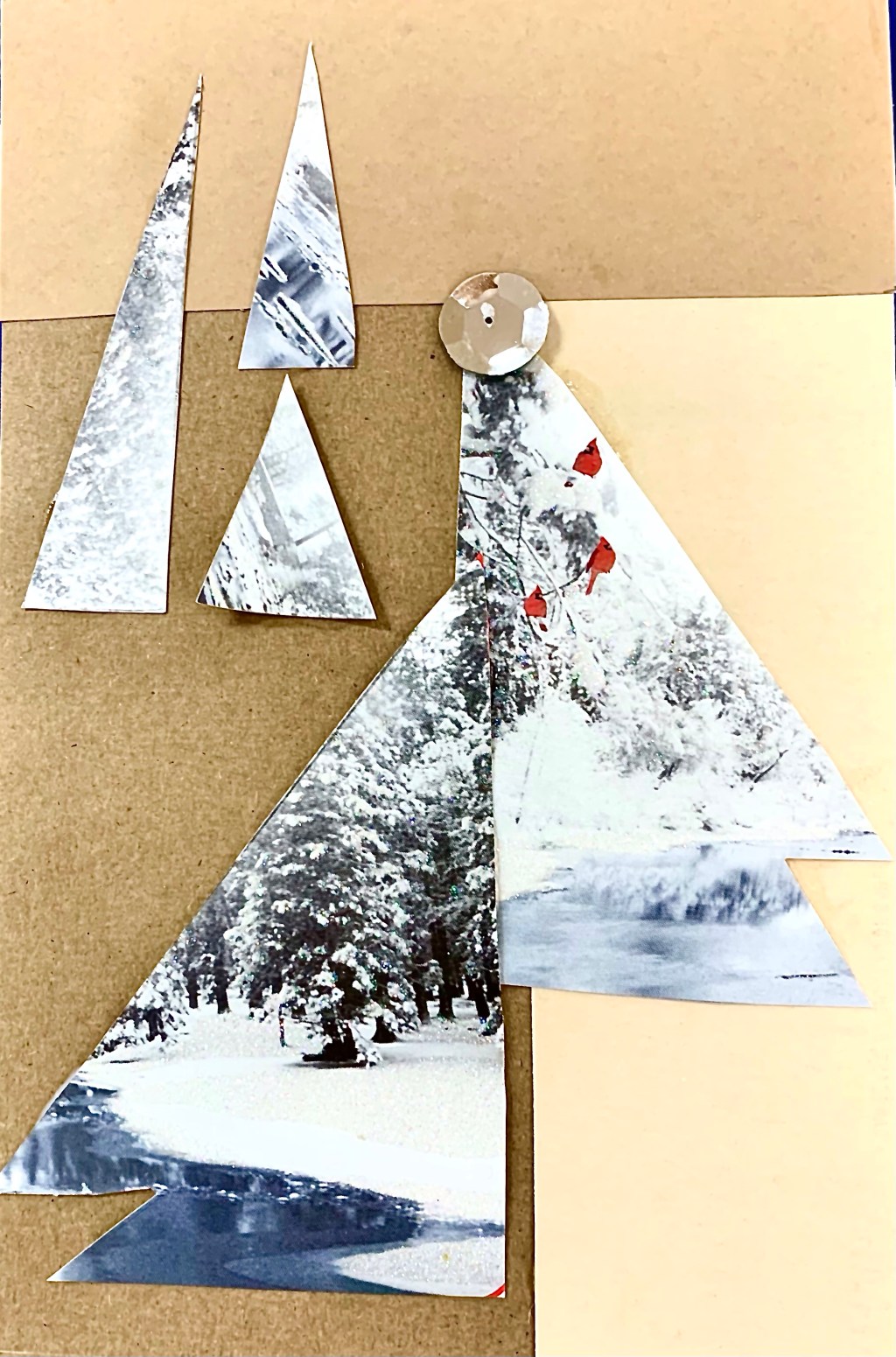
Gail’s Christmas Tree

At Mike’s request, we made Christmas cards, but he had to work that day. Probably helping someone with legal matters, because that’s his calling. Gail and I had fun working on the cut paper cards. I was thankful she brought me a coffee. Whatever bug I had took a while to clear my system. Caffeine helped. She rearranged these triangles several different ways on a horizontal plane and never felt satisfied with the way they looked. Because she was wise enough not to glue them down first, she could see her ideas weren’t hitting her happy place.

Then she turned everything straight up, and organized the design on a perpendicular. Now her tree has its happy red birds, a sequin star, and little trees in the background.

Cornelia’s Card

I brought one of my many boxes of colored paper from my scrapbook stash. I know the Christmas colors are red and green, but I made an Advent Tree. This is why it’s violet and pink and blue. Anyway, we don’t have to follow the rules for Christmas trees. If we want a pale purple tree, we can have one. It’s our tree. Santa will still put a present under it, and the color of our tree doesn’t impair our salvation. A nativity set looks just fine under any color tree.

I know we have at least one more class in December on the 16th. Depending on if my plumber is coming over on the 23rd, we might not meet that day. He said he’s behind, so I don’t know. I’ll be on vacation on the 30th, so we’ll see each other in the New Year of 2023!

I always say, “if I ever get totally organized, the world is coming to an end.” Maybe it’s the providence of God that I always bite off more than I can chew, because I’m never totally organized! But I am going on to organization.

Joy, peace, and a better filing system,

Cornelia

Holiday Gifts and Traditions

art, Creativity, Family, Hanukkah, Imagination, inspiration, knitting, purpose, Thanksgiving, Travel


In my family, we didn’t break out the seasonal decorations or fashions until Thanksgiving Day. My mother put her knitting hobby to good use one year and made Christmas sweaters for all of us. She practiced on mine, so I got the baggy sleeves and an oversized middle. At least she got her stitch gauge down pat on my “ugly sweater.”

I wore it every Thanksgiving, while she still lived, just for her, for without my mother I wouldn’t be the person I am today. If there were a sweater made for her, it would be this one I found at my local Wally World: “Gonna Lay Under The Tree To Remind My Family I Am A Gift.”

I Am A Gift

We all have holiday traditions, whether these belong to Kwanzaa, Hanukkah, or Christmas. These bind us together, as a family and as a community. This year I decided to buy my holiday stamps with Kwanzaa illustrations on them. I admit, my cataracts are bad enough now I thought I was looking at a black Angel with lighted candles. I wondered why the postal clerk was questioning my choice. Why can’t I have Kwanzaa stamps? Maybe I need to go back in and buy the blue and silver stamps also.

Kwanzaa Forever Stamp

This might be a year to make some new traditions, especially if during the past few years some of us have lost someone near and dear to us. Also, the economy has had a big impact, so focusing on togetherness rather than on materialism is a good choice. In the Great Depression, my dad asked only for a book for himself and his brother, and a fresh orange, if possible.

My mother, crafty lady that she was, made me this cross stitch one year for my birthday. All of us are gifted, even if not all of us have the same gifts or in the same amount. What we do with our gifts is the more important matter. A very gifted person who wastes their gift will benefit the world less than an average gifted person who works hard and has good people skills. Sometimes these are called under achievers and over achievers. As a former teacher, I don’t believe in the concept of “over achieving.” I do believe most of us underperform because we are afraid to fail.

Menorah

Failing is how we discover what doesn’t work. Unless we’re playing with dynamite, failure won’t kill us. In sales, every time someone says NO to a presentation, the salesperson is another step closer to a YES. We think we’re too young, too old, or too something else to do what we really want to do in life. Sometimes the people around us tell us we can’t do the greater things we dream about. That was not my mother, or my dad. Daddy might have had reservations, but mother always said, “Honey, you should go for it.”

I drove alone to California last month without an advance plan for where I’d spend each night. I made reservations around lunchtime when I knew how far I’d journey that day. I have all the apps, just like the young people. I hiked in national parks, saw volcanoes, got caught in a snow storm, and paid through the nose for gasoline in the Nevada desert. I saw sea otters in the Pacific Ocean, hugged my grand kids, and learned I can do this. Yes, I wanted to go now, for driving nearly 7,000 miles is hard on the body. Full disclosure: I took a week to recuperate! Or maybe it was getting a month’s worth laundry done which finally did me in. I was glad to do it, and especially glad I didn’t let anyone talk me out of it.

The Gift

I hope you choose to be a gift to others. If you don’t have a parent who encourages you to be more than others think you are, I offer my mother as a gift to you. I can share her with the world, for I keep sharing her wisdom here and there. Whatever you choose, l hope you choose to be a gift that gives to others.

Joy and peace,

Cornelia

Reflections on America

Arches National Park, art, beauty, elections, Grand Canyon, Imagination, inspiration, nature, photography, renewal, Travel, US Constitution, vision, Walt Whitman

Today marks one week since our most recent election. Many races have been decided, while some are due for an automatic recount due to the close vote. At least one senate race will have a runoff between the top two candidates (Georgia), as some races haven’t been decided at all, since the vote counters took Veteran’s Day and Sunday off. Then we have all the legal, but late arriving mail-in ballots from the military and overseas residents. These too need counting. We’ll know the final, final results sometime after December 6th, when Georgia results are in.

Grand Canyon

Pundits on the left and right can give you commentary ad nauseam for the duration with breaking news alerts or standing up for what’s right(wing). They’ll talk demographics, policies, and statistics, but you won’t get that commentary here. I’m more interested in the deep derivations of the arcana of the day. Arcana is that mysterious or specialized knowledge, language, or information accessible or possessed only by the initiate —usually used in plural. The singular arcanus, is from the Latin, arca, chest. It was first used in the 15th century.

El Capitan, Yosemite National Park

Of course, the conspiracy mongers among us are busy weaving tales of hanky panky. As an aside, my spell check wants to make this phrase “hanky pancakes.” I’ll check in with Cornie’s Kitchen to see if there’s any special ingredient for making hanky panky pancakes. Hanky pank once referred to any of the various carnival games in which contestants might win small prizes for the exercise of simple skills (such as dart throwing). State Fair enthusiasts who succumbed to the barkers of carnival games might, if they were lucky, grab a few of these prizes, but as in casino betting, the wise player remembers the house usually wins. It’s an old word, dating from the 1840’s, maybe related to Hokey Pokey. Both these words referred to trouble making bordering on the illegal, if not out right against the law.

This is why your parents warned you not to run away and join a traveling circus or side show, as “There’s hanky panky going on there, child, and you’ll come to no good!” Not that I ever tied a peanut butter sandwich up in a bandana and walked away from home, or at least I got as far as that sandwich took me, which was to the end of the city block. Hot summer days can change a child’s mind about running away from home.

Big Oak Road, Yosemite National Park

Those trading in false tales were known as mongers, from which we get the word “costermongers,” or apple sellers. In the 1510s, “itinerant apple-seller” was formed from coster (a type of apple ) + monger (“to traffic in, deal in,” often implying a petty or disagreeable traffic, by 1897). The sense extended from “apple-seller” to “hawker of fruits and vegetables,” to any salesman who plied his wares from a street-cart. Contemptuous use is as old as Shakespeare: “Virtue is of so little regard in these coster-monger times, that true valour is turn’d bear-herd” (2 Henry IV), but the reason for it is unclear.

Arches National Park

But I come not to bury America, but to praise her, especially the American democratic project, which so far has earned the distinction of having the world’s longest surviving written charter of government. It was written in 1787, ratified in 1788, and has been in operation since 1789. We’ve celebrated 233 years of our unique brand of representational democracy. We aren’t ruled by mobs/anarchy, nor by a wealthy few/oligarchy, or even by one/autocracy, but by all who vote/democracy. As Whitman writes, we must be careful to distinguish between the “chosen” and the “act of choosing.” It’s not the winning candidate which represents the “heart”of our democratic achievement, but rather the “quadriennial choosing” itself.

Arches National Park

If you follow my musings, you’ve probably guessed Whitman is a favorite poet, and the varied landscape is a renewing and inspiring source of reconnecting with a creator God. I recently took a vacation to California and photographed some of our great national parks in the month I took off to see America. On my journey, I met generous, kind, and decent people everywhere I went. May God bless America and use her bounty and her people to bring peace and prosperity to the nations of the world. I hope my images do justice to Whitman’s words.

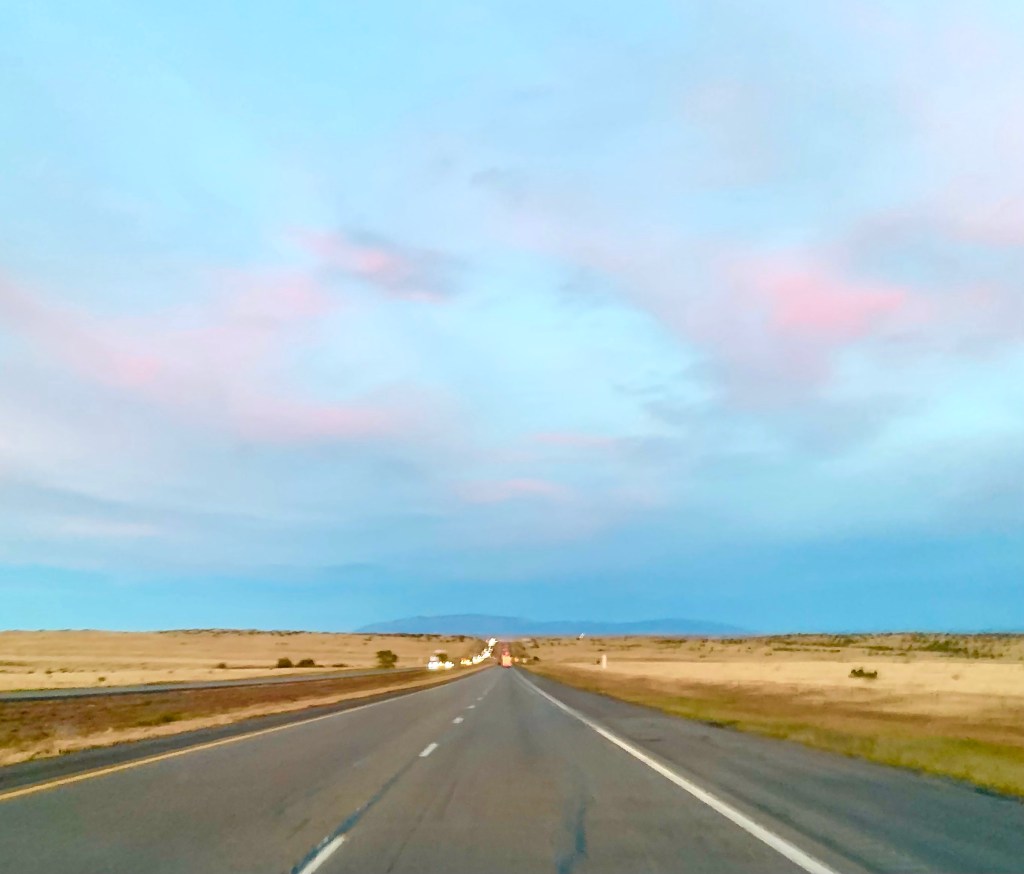
Headed to Albuquerque

Election Day, November, 1884
By Walt Whitman

If I should need to name, O Western World, your powerfulest scene and show,
‘Twould not be you, Niagara—nor you, ye limitless prairies—nor your huge rifts of canyons, Colorado,
Nor you, Yosemite—nor Yellowstone, with all its spasmic geyser-loops ascending to the skies, appearing and disappearing,
Nor Oregon’s white cones—nor Huron’s belt of mighty lakes—nor Mississippi’s stream:
—This seething hemisphere’s humanity, as now, I’d name—the still small voice vibrating—America’s choosing day,
(The heart of it not in the chosen—the act itself the main, the quadriennial choosing,)
The stretch of North and South arous’d—sea-board and inland—Texas to Maine—the Prairie States—Vermont, Virginia, California,
The final ballot-shower from East to West—the paradox and conflict,
The countless snow-flakes falling—(a swordless conflict,
Yet more than all Rome’s wars of old, or modern Napoleon’s:) the peaceful choice of all,
Or good or ill humanity—welcoming the darker odds, the dross:
—Foams and ferments the wine? it serves to purify—. while the heart pants, life glows:
These stormy gusts and winds waft precious ships,
Swell’d Washington’s, Jefferson’s, Lincoln’s sails.

Joy and Peace,

Cornelia

Walt Whitman: Election Day November 1884
https://poets.org/poem/election-day-november-1884

What does Hanky Panky mean?
https://writingexplained.org/idiom-dictionary/hanky-panky

Words related to monger
https://www.etymonline.com/word/monger/related

Shakespeare: Julius Caesar Speech, spoken by Marc Antony
https://www.poetryfoundation.org/poems/56968/speech-friends-romans-countrymen-lend-me-your-ears

NOTES: Whitman’s Election Day, 1884 https://pubs.lib.uiowa.edu/wwqr/article/26076/galley/134444/view/

Rabbit! Rabbit!

art, Attitudes, autumn leaves, autumnal equinox, brain plasticity, cognitive decline, Faith, Imagination, ministry, nature, Painting, perfection, poverty, pumpkins, rabbits, renewal, Rosh Hoshanah

Welcome to September

On September 5, we celebrate Labor Day, and our kids are already back in school. We’re once again slowing down in school zones in the morning and afternoon, and setting an extra plate at the kitchen table for our absent college freshman. We might even see the first fall colors when the Fall Equinox comes around at the end of the month.

Edwardian Summer Gown, 1905

September is when we set aside our summer white clothes and shoes to change our closet over for darker colors and longer lengths. My dear mother had a rule of never wearing white past Labor Day. This quaint fashion principle dates from before Memorial Day, which was instituted in 1868 after the Civil War. This rule helped to separate the old money families, who summered in the country and at the seashore, from those who stayed to struggle on in the grimy cities, which were polluted by coal fired engines. These urban families usually wore dark clothes year round, as the rich did when they returned to their city residence.

Air conditioning has changed this now, but wearing starched, white cotton still reminds people you either have money to send your clothes to the cleaners or hire laborers to do it for you. Or, you might just work extra hard to look like one of the first two. This bunny has reached the age of dripping dry all those cotton clothes. I actually do more ironing when I do a craft project, such as quilting, since those seams need to be pressed open to make a good square. As this bunny has aged, I’ve changed my mind about what I think is important enough to worry about.

Rabbit Ironing

September is also a time to reassess the three core myths which animate much of American life. These myths are we can give 100% to our work, 100% to our family, and 100% to our personal health. I don’t know about you, but I’ve never been able to do this type of higher math without going bananas or feeling significant amounts of guilt that I’m not doing enough in one of those areas. Eventually I learned I was only Wonder Woman in my fantasies, but not in real life. I also realized other people who managed better than I hired help for the housework to free themselves up for family time.

My Wonder Woman Fantasy

Somewhere along the line we’ve bought into the myth of the “ideal worker,” who “has no competing obligations that might get in the way of total devotion to the workplace.” The second myth is the “perfect parent,” who “always puts family first.” The last myth is the “ultimate body,” which is cultivated through diligent dieting and exercise, and doesn’t deteriorate with age.

The authors of Dreams of the Overworked, note in the digital age, when people can post curated images of their best lives, “Achieving even one of these myths would be impossible, but achieving all three is ludicrous.” If your daily stress has increased and you feel like everything you do isn’t enough, I suggest deep breathing with your eyes closed (unless you’re driving a vehicle!). Once you get some extra oxygen to your brain, you’re in a position to calmly reconsider your situation. Not all situations are hair on fire, unless you’re a two year old with separation anxiety. Most of us beyond this age have experience and memories which can guide our future behaviors. An ancient proverb is “Experience is the mother of wisdom,” or as my folks used to say, “The school of hard knocks is the most expensive degree you’ll ever pay for.” Live and learn. With age comes wisdom.

Now that you’re calmer, you can decide, “Do I have options? Do I have a support system with people who can help me discern my way? Can I lay down my false self image of competence so I can ask for help? Can I triage my priorities to say NO to the less important ones, even if it means not pleasing everyone in my social circle?”

Google it, Ask friends for recommendations, and Breathe!

Speaking of options, women are primarily responsible for housework and childcare, not only in America, but also across the pond. About 91% of women with children spend at least an hour per day on housework, compared with 30 % of men with children. The latest available data shows that employed women spend about 2.3 hours daily on housework; for employed men, this figure is 1.6 hours. Gender gaps in housework participation are the largest among couples with children, at 62 p.p., demonstrating an enduring imbalance in unpaid care responsibilities within families. This leads to women taking lower and slower career paths.

Animated Map of 2022 Fall Color Change

September 22 is the Fall Equinox. We’re already seeing signs of seasonal leaf color changes, due to heat stress and drought. Some call this “False Fall,” but I call it a sign of hope. Trees will drop their leaves in order to survive in extreme conditions. Although some claim plants are sentient, they don’t have a brain or consciousness that we can recognize. They do interact and react to their environments. Their first priority is survival.  Photosynthesis and the subsequent leaf abscission after changing color is part of this process. I always look for the change of light which precedes this event. One morning last week, I noted the color of the morning light had turned cooler, and wasn’t the warm yellow of summer. I also had a spark of energy I hadn’t had before. I look forward to more daylight.

This bunny is very fond of September, since I’ve always been eager to start fresh and new. I always got new pencils and a new manilla paper writing pad when I started elementary school. Later on, as I progressed up in grades, ink pens with cartridges were a special treat. Even to this day, I keep my journals with hand written ink in good paper books. I love the feel of these materials in my hands. I probably would have stayed in school my whole life if possible. The day our brains quit learning something new is the day our minds begin to die.

School Bunnies and Friends

That leads me to remind my bunny friends that Alzheimer’s disease is the 7th leading cause of death in the USA and it’s the most common cause of dementia in persons over 65. While most of you may not be baby boomers, you young bunnies have grandparents or parents of that age. Today, about 6.5 million Americans have Alzheimer’s disease, but that number is expected to almost double to 12.7 million by 2050. Perhaps beginning September with World Alzheimer’s Day is a good reminder for all of us to be proactive about our health choices, so we can live independently as long as possible into our senior years.

Talk Like a Pirate

I also like Positive Thinking Day, since reframing negative thoughts into positive ones changes our attitude, our behaviors, and then we get better outcomes as a result. If you don’t feel like being Batman on the 17th, you can ARRRGUH yourself about, MATEY, as you Talk Like a Pirate on the 19th. Bonus points if you wear an eye patch, earring, and tricorne hat or bandana on your head.

The Jewish New Year of Rosh Hashanah begins at sunset on the 25th. It’s one of the four “new year” celebrations in their religious calendar. This one recalls God’s creation of humanity, as well as the legal new year. On this one night in September, when the faithful eat apples dipped in honey or other sweet sauces, they remember how God originally created humans in a sinless state and wish each other a good year to come.

Magic Bacon Carpet Ride

Did I forget International Bacon Day? How can any rabbit forget bacon? Someone will cut my carrot rations for the future, I fear. But if I remember to keep the coffee pot full, I’ll probably get out of the rabbit hoosegow before National Coffee Day on the 29th.

Some interesting holidays we can celebrate this month are: Better Breakfast Month (I suggest bacon, eggs, and pancakes on the weekend and old fashioned oatmeal during the week). There’s also Hispanic Heritage Month and National Sewing Month. Finally, every year on September 30th is National Love People Day. The purpose of the day is to show love to everyone—no exceptions. National Love People Day offers us the opportunity to show unconditional love, which many have never experienced. When we genuinely love our neighbors and express it with kind words and thoughtful deeds, we make our world a better place. This the true meaning of “love your neighbor as yourself.”

Maybe one meaning of loving your neighbor is offering a meal to them. Food insecurity is increasing once again, this time due to increased rents and costs of transportation. Consider a weekly meal service from your church building or organization’s meeting place. It doesn’t need to be fancy, but calories and nutrition would help hungry people have the strength to move on from their current situations. Joining with other groups to cover all the days of the week would be a bonus to your community, not only for the hungry, but also for the smaller groups who could team up to share in the blessing of loving their neighbors.

Until the spice is on the pumpkin, I wish all my bunny friends

Joy, peace, and Bacon,

Cornelia

America’s Ideal of Working Parents Has Become Unattainable – The Atlantic
https://www.theatlantic.com/family/archive/2020/06/working-parents-impossible/613429/

Beckman and Mazmanian: Dreams of the Overworked: Living, Working, and Parenting in the Digital Age

Gender differences on household chores entrenched from childhood | European Institute for Gender Equality https://eige.europa.eu/publications/gender-equality-index-2021-report/gender-differences-household-chores

Debunking a myth: plant consciousness | SpringerLink. https://link.springer.com/article/10.1007/s00709-020-01579-w

September Monthly Observances – National Day Calendar
INTERNATIONAL CHOCOLATE DAY – September 13, 2022 – National Today

Home – National Love People Day – National Love People Day

Alzheimer’s Facts and Figures Report | Alzheimer’s Association
https://www.alz.org/alzheimers-dementia/facts-figures


OAKLAWN FRIDAY ART CLASS

adult learning, art, Attitudes, brain plasticity, cognitive decline, Creativity, Faith, Imagination, inspiration, john wesley, Ministry, Painting, perfection, purpose, Retirement, United Methodist Church, vision

WE’RE BACK!!!

Ready or not, the creative juices must be stirred. If the brain has lain fallow all summer, or it’s been overworked keeping the youngsters occupied, now you can find your own groove again. Yes, it’s time for Adult Art Class at Oaklawn UMC.

Our first meeting will be Friday, September 9, at 10 am in the old fellowship hall. Bring your own acrylic paints, brushes, and a canvas or canvas panel to paint on. We begin with a short visual inspiration from some great art works, I’ll give some direction on the skill we’ll work on in the session, and then everyone is free to bring their own unique expression to their paintings. We don’t copy my work and judge how well a person can match it. We learn from the great masters and stretch our own skills to create something new.

Walter Nowatka: Abstract Ferris Wheel

Of course, making great art isn’t our first purpose. As we age, we will lose our ability to learn new skills until we lose our memory of what we just ate for breakfast. Challenging our brains is one of the best ways to keep our brain cells firing and “chatting with one another.” Our brains have the immensely powerful ability to remodel themselves because each of us have 1,000 trillion synapses, which are constantly being modified every second of every day. Socialization and encouragement also helps to keep our brains young.

Frank Lloyd Wright: March of Balloons

Of course, we have to give up our desire to be perfect. Perfection comes from practice, or working at it. Every baby stumbles and falls when they learn to walk, but dotting adults encourage every trembling step. This is what art teachers also do. I’ve always had a rule in my classes, especially when I taught in middle school: No Negative Talking about People or Art. This included a student’s own art works. They always had to give at least three positive comments about their work before they spoke about the negative. “My work needs improvement” became the replacement phrase for “My work stinks!”

De Fem. Titel saknas, 1908. HAK 1274. Kat. 12. 52,5 x 62,8 cm

Of course, we’ve all grown up and worked in environments where negativity is the rule. Art class is a place of grace because this is how life should be. If we can transform a blank canvas into a field of color, why can’t we transform our communities and our world into fields of hope, joy, and love? Perhaps because we try to make everyone copy/fit into our idea of the proper end product, rather than allow everyone discover their own creative response to the given subject of the day. The museums of our world are richer and more vibrant because artists have listened to the Spirit of the Creating God. We might do well to realize God’s creative energies are varied and vibrant also, just as Isaiah wrote about his vision of God’s Glorious New Creation:

“For I am about to create new heavens and a new earth;
the former things shall not be remembered or come to mind.
But be glad and rejoice forever in what I am creating;
for I am about to create Jerusalem as a joy, and its people as a delight.” (65:17-18)

James Wyper: City of Dreams

I hope to see you there. I don’t charge for the class sessions, since this is one of my ministries as a retired elder in the United Methodist Church. As John Wesley once said, “The World is my Parish.”

Joy and Peace,

Pastor Cornelia

Wes Ely: How long covid reshapes the brain — and how we might treat it

https://www.washingtonpost.com/outlook/2022/08/25/long-covid-brain-science-fog-recovery/

My Summer Vacation

adult learning, art, Creativity, crucifixion, Faith, Family, Forgiveness, holidays, Imagination, inspiration, mandala, Ministry, Painting, purpose, Spirituality, summer vacation

Friday Night Food Fight

The last day of our art class we had a “free for all.” Not exactly a “food fight” or “slug fest” free for all, but a finish up or start a personal project type of day. Our class never disappoints me. Mike brought in his patio parrots, some of which have seen better days. These are papier-mâché sculptures that have been brightly painted and covered with shellac. He hopes to paint over them and repair them so they will look respectable once again in the poolside area. If that’s not possible, I see a vacation south of the border in his future.

A Typical Parrot by the Pool

Gail brought an icon she didn’t quite finish to add gold outlining to the figures. This detail gave her work an extra embellishment to bring it to life. Before, she’d left an edge of white canvas between the background and the figures. This had the same effect, but also gave her work an unfinished appearance.

Gail’s Icon

I’ve been working on a series of Creation Icons from the first chapter of Genesis. Actually, they’re mandalas, but they serve the same purpose as an icon: to focus the viewer’s sight into the window of the world beyond this one and to contemplate the universal mysteries of the universe and the God who created it. The Creation inspired me because I’ve seen old icons with this theme painted both in figurative and abstract styles.

This one represents Day three and is from The Nuremberg Chronicles (1493). Written by Hartmann Schedel and illustrated with woodcuts by Michael Wolgemut, it represents a monumental place in the history of the printed page. One of the most beautifully illustrated texts of all time, the approximately 600 pages, in-folio, contain 1,804 woodcuts intended to communicate to the public a schedule of events predetermined by God, beginning with the Creation, and ending with the end of time.

Creation of Plants by Wolgemut

My icon is a stylized flower against a blue sky with a cross in the center to remind us, as John 1:1-3 says,

“In the beginning was the Word, and the Word was with God,
and the Word was God. He was in the beginning with God.
All things came into being through him,
and without him not one thing came into being.”

Third Day Of Creation Icon

I chose a sunflower as my representative plant, for the young plants constantly track the sun’s transit across the sky each day. The older plants don’t make use of this mechanism of heliotropism, but always face east to wait for the sunrise. The ancient wisdom says when Christ comes in his final glory, he’ll first appear in the east at the Beautiful Gate in Jerusalem. However, the Bible says in Revelation 1:7,

“Look! He is coming with the clouds;
every eye will see him,
even those who pierced him;
and on his account all the tribes of the earth will wail.
So it is to be. Amen.”

I think it best to be ready, day or night, for like the servants whose master has gone off on a trip, we don’t know when he’s coming back. We should be always ready, always eager to serve. We’re never too young or too old to be a servant for Christ. As we grow older, one of our best gifts is mentoring the next generation for leadership. Perhaps they’ll make mistakes, or maybe they’ll do things differently than we did, but mission and ministry will happen.

Most mistakes don’t matter in the great scheme of life, unless they’re breaking a moral or legal law. If they’re just doing a task in a different order, like my arrangement of the dishes in the dishwasher at my mother’s house, we should probably leave that alone. I went and sat in the den and let my mother load the next evening’s dirty dishes because “If you’re going to rearrange everything, you might as well put them in yourself.” She did that one night and sat in the den the next night. Training is everything. My mom spent years training me, so I learned from the best. When it’s time to let go, you step aside and let them do it on their own. Learning from mistakes is part of leadership.

In art class we also learn from our mistakes. Sometimes we find out our palettes are too small to mix up all the different colors we want. This can limit our color schemes, muddy our colors, or tempt us into putting more color over the old color in the same tiny space for mixing. Then we look at our painting and wonder why it’s grey and dull, but fail to notice how dark our glass of brush water is. When the water gets dark, we need to pour it out and get clean water, or we carry that wash water full of pigments into our painting with our brush. In a like manner, if we hold our grudges or anger over time, these soil and blemish our souls. Washing them clean through prayer to God makes a difference in our countenance and joy. We’re brighter people when we rid ourselves of these burdens.

I’m taking the summer off from teaching. I have an art show planned for August to September at the Garland County Library, so I’ll be finishing up some work for that event. I also have a couple of chores around my condo planned, and more of my SOULJOURNIES blog to put into shape. I’m excited about these creative renewal projects. I’ll see y’all on the flip side.

Joy, peace, and sunshine,

Cornelia

The Science Behind Why Sunflowers Move
https://spectrumlocalnews.com/nys/buffalo/weather/2020/08/29/the-science-behind-why-some-sunflowers-move

The Chair

adult learning, art, Creativity, Forgiveness, Holy Spirit, hope, Imagination, incarnation, inspiration, john wesley, ministry, Painting, perfection, photography, picasso, purpose

The everyday objects around us are like so much white noise: we know they’re present, but after a while, we tend to ignore them. A running joke among the clergy is “Never move anything at the new appointment for six months because you don’t know what objects are the sacred cows.” I learned this the hard way in my first full time appointment when I suggested we rid ourselves of an aging, olive green, velvet curtain hanging on the back wall of the fellowship hall stage, since “It was just hanging there for no purpose.” Oh, the outcries of rage! Little did I know this was the one and only curtain to survive the fire which destroyed the old church building. The people saw this ragged banner as a symbol of hope for the church they were rebuilding for the future. They had invested spiritual meaning into this curtain, even though it no longer served a spiritual purpose.

Picasso: The Chair, 1946

In the same way, we treat our Bibles as holy objects because they contain the inspired writings handed down over the centuries. We recognize they tell us important truths about God, humanity, and our relationship with the God whose steadfast love for God’s creation never wavers. In worship, we often say after reading from scripture, “The word of God for the people of God.” When many read John 1:1—

“In the beginning was the Word, and the Word was with God, and the Word was God.”

These same readers connect the “word of God” with the ”Word and the Word (who) was with God, and the Word was God.” The English translation of LOGOS to WORD derives from the Greek principle of Logos, or divine reason and creative order, which is identified in the Gospel of John with the second person of the Trinity incarnate in Jesus Christ. This is how the early Christian writers argued for the preexistence of Christ and for the existence of the Holy Trinity. When we refer to the Logos/Word of God, we are speaking of Christ. If we read the Old Testament, we’re speaking of the one God who has spoken through the ages, but only revealed God’s Son to humanity during the New Testament era. The Spirit has been active always.

This reminds us to honor the Bible for revealing the Incarnate Christ through inspired words, but not to idolize the Bible as a object greater than the God it reveals. After all, over the centuries, the Bible has been interpreted differently by various schools of thought. This brings up the question of how do we know what we know. There’s a whole body of philosophy dedicated to how we know what we know, called epistemology. There are various kinds of knowing:

  1. Sensory perception or observation of facts
  2. Reason or logic
  3. Authority of tradition or common wisdom
  4. Intuition, revelation, or inspiration

Some of us use one way more than others, but each has both good and bad points. In the case of the authority of tradition or common wisdom, for instance, some have been time tested across the ages, but deference to authority without critical thinking can be a mark of intellectual laziness on our part.

Wesleyan Quadrilateral

John Wesley’s famous understanding of what we now call the Quadrilateral comes from Albert Cook Outler’s discussion on how Wesley understood authority. When challenged for Wesley’s authority on any question, Wesley’s first appeal was to the Holy Bible. Even so, he was well aware that Scripture alone had rarely settled any controversial point of doctrine. Thus, though never as a substitute or corrective, he would also appeal to ‘the primitive church’ and to the Christian Tradition at large as competent, complementary witnesses to ‘the meaning’ of this Scripture or that.

However, Scripture and Tradition would not suffice without the good offices (positive and negative) of critical Reason. Thus, he insisted on logical coherence and as an authorized referee in any contest between contrary positions or arguments. And yet, this was never enough. It was, as he knew for himself, the vital Christian Experience of the assurance of one’s sins forgiven that clinched the matter.

Anglican Meme

In reality, Wesley’s diagram for how we know is really a triangle— consisting of Scripture, Tradition, and Reason—which leads to the Christian Experience of being a Child of God, forgiven for our sins. It’s based on the Anglican tripod of the faith: scripture, reason, and tradition. Wesley took the tripod and added the firm “seat of experience” of God’s loving mercy to forgive all our sins. This insight came out of Wesley’s life changing Aldersgate experience, which he recorded in his journal on May 24, 1738.

“In the evening, I went very unwillingly to a society in Aldersgate Street, where one was reading Luther’s preface to the Epistle to the Romans. About a quarter before nine, while he was describing the change which God works in the heart through faith in Christ, I felt my heart strangely warmed. I felt I did trust in Christ, Christ alone for salvation, and an assurance was given me that he had taken away my sins, even mine, and saved me from the law of sin and death.”

Wesley understood he could spend his whole life learning about God, reading about God, and even serving God to the best of his ability, but he was in his words, an “almost Christian” because he didn’t have the faith of a son or daughter who served God out of love, but had instead the faith of a slave or a servant, who served only from fear of punishment. One of Wesley’s Standard Sermons is the “Almost Christian,” which you can read in its 18th century glorious English at the link below. Most of us would be glad to be accounted in the “almost” category, but Wesley asks, why don’t we go farther and become “altogether Christian?”

In Methodist terms, this is “entire sanctification,” or “going on to perfection.” We don’t talk much about this any more, but it’s the purpose of our Christian life to be conformed to the image of God. We aren’t trying to be like Beyoncé, JayZ, Taylor Swift, or Jake Owen. Instead we have the promise in Romans 8:29—

“For those whom he foreknew he also predestined to be conformed to the image of his Son, in order that he might be the firstborn within a large family.”

David Hockney: Walking Past Two Chairs

We don’t do this on our own, but with the assistance of the Holy Spirit. That’s why the Spirit is called a helper, for it’s a coworker in the process of perfection or sanctification. This epistemology for knowing is useful for art classes also. Some of us believe we need to be perfect from the get go and can’t accept our raggedy messes we produce as we learn the techniques of color mixing and shading, much less the fine motor coordination required to connect our thoughts with our hand movements. If we aren’t able to endure the rough edges of imperfection as we “go on to perfection,” we won’t last long in art class. Just learning how to see the three dimensional world and translate it onto a two dimensional surface is a Mount Everest accomplishment in itself. Some days we have no energy to cope, and that’s when we need to come for support and encouragement.

Last Friday we painted chairs. Every artist’s work we viewed for inspiration had a different take on the chair. We no longer have to make a photographic rendering of an object because we have cameras for this purpose. We can use the chair as a reason to break up the picture plane and organize the spaces. I found a funny little poem called “The Chair,” by Theodore Roethke:

A Funny Thing about a Chair:
You Hardly Ever Think it’s There.
To Know a Chair is Really It,
You Sometimes have to Go and Sit.

Sally’s Chair

As the class went on, Sally decided she wanted to copy one of the inspiration images. She’s new, so she was practicing color mixing with her limited palette. When she couldn’t get the bright turquoise color, I brought my manganese blue over and mixed it with her titanium white. The color she wanted came popping out, much to her delight. “I’m going to buy me some of that color.” Sometimes all we need is the right materials.

Lauralei’s Shower Chair

Lauralei’s humor takes the cake with her shower chair. She can imagine the model chairs in a new environment. She doesn’t let the reality limit her options.

Gail’s Chairs

Gail divided up the canvas into various planes of colors, which sing for joy. I think she had fun. As the only one of our group who took the challenge of the entire scene, Mike took a bird’s eye view of the table and chairs. I hear he may be traveling again, or at least yearning to fly away from the day to day grind of full time work to something closer to retirement.

Mike’s Chairs and Table

I can understand that feeling. After years of teaching school, I look forward to summer vacation. We’ll have art class on the last two Fridays of May, and then take the summer off. Our current plan is to return on September 9, the first Friday after Labor Day. In the meantime, if you want to know how God really is,

“Be still, and know that I am God!” ~~ Psalms 46:10

A fun summertime activity is building a chair fort or a chair cave. All you have to do is turn over a couple of chairs on the floor and throw a sheet or blanket over them. This provides a quiet place for a child of any age to have a “time out” alone during a long summer. I recommend a quiet place for children of all ages, even those who’re long of tooth.

Cornelia’s Chairs

Joy, peace, and a quiet place,

Cornelia

Experience in the so-called “Wesleyan Quadrilateral” | Kevin M. Watson
https://kevinmwatson.com/2013/05/13/experience-in-the-so-called-wesleyan-quadrilateral/

The Wesleyan Theological Heritage: Essays of Albert C. Outler: Albert Cook Outler, Thomas C. Oden, Leicester R. Longden: 9780310754718: Books
https://www.amazon.com/gp/product/0310754712/ref=as_li_ss_tl?ie=UTF8&camp=1789&creative=390957&creativeASIN=0310754712&linkCode=as2&tag=deeplcommi-20

Sermon—The Almost Christian by John Wesley via Words Of Wesley Quotes
http://www.wordsofwesley.com/libtext.cfm?srm=2&

Great Blog by Adam Hamilton on biblical authority and how we read the Bible in different eras
https://www.adamhamilton.com/blog/the-bible-homosexuality-and-the-umc-part-one/

Icons for Holy Week

art, butterflies, Creativity, Easter, Faith, holidays, Icons, Imagination, inspiration, Mandylion, Ministry, nature, Painting, renewal

As we approach the days of Holy Week, life can get busy for people of faith. For those in leadership roles, you likely don’t have time to read. That’s OK. This is a time for you to use your meditation and prayer time to rest in the presence of God’s Spirit. Palm Sunday, April 10, begins the mad dash of multiple planned worship experiences in most churches, and the week usually gets more complicated by the human conflicts that also arrive during the high holy days when more is expected than than can be accomplished by Easter Sunday.

Some of these disasters will be small, such as the child who goes out to make a violet ink from new irises growing by the back porch and messes up her pretty Easter dress. Others will be actual chaos, involving runaway ex-spouses with the non-custodial child. Yes, the holidays can get crazy for families, ordinary and church families both.

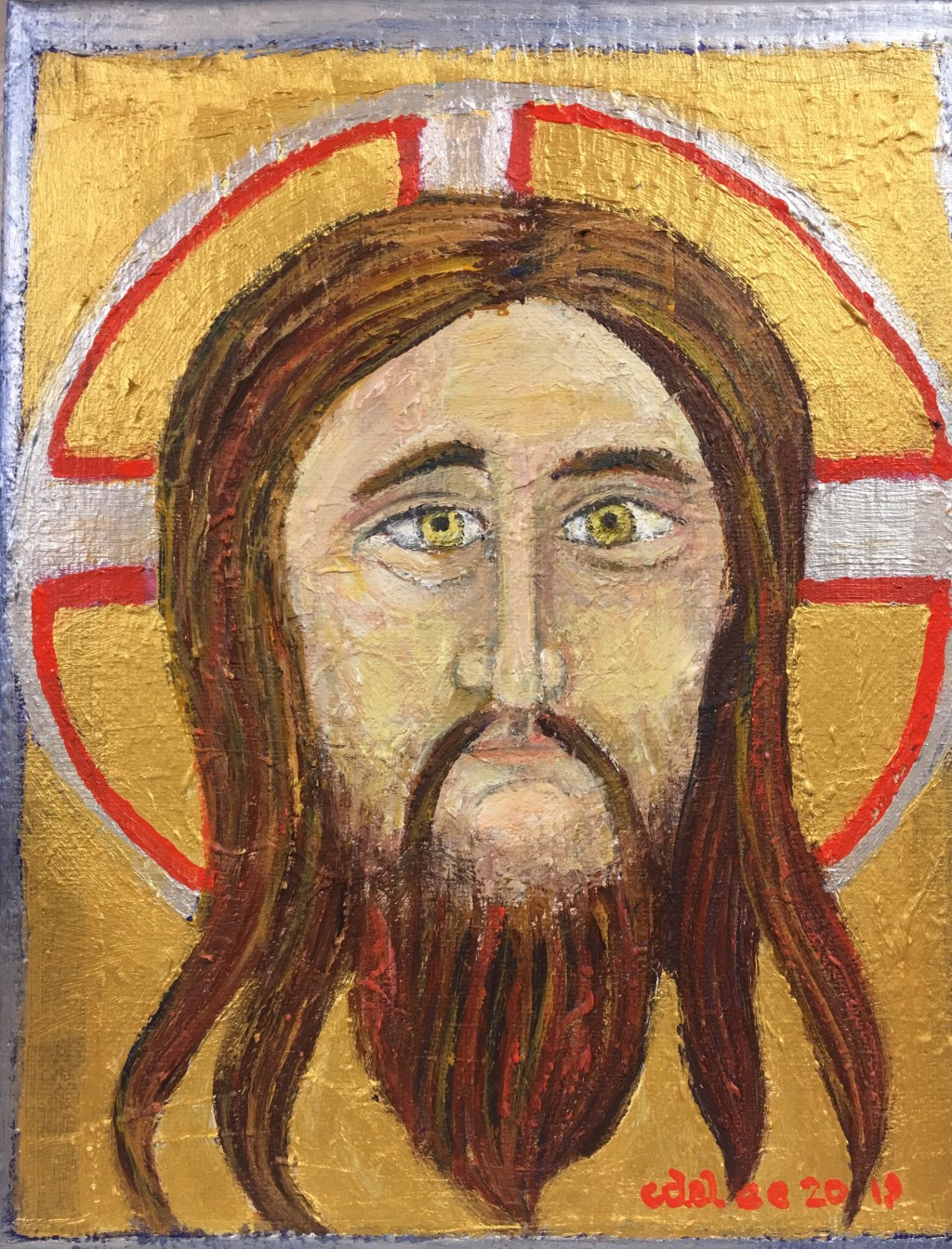
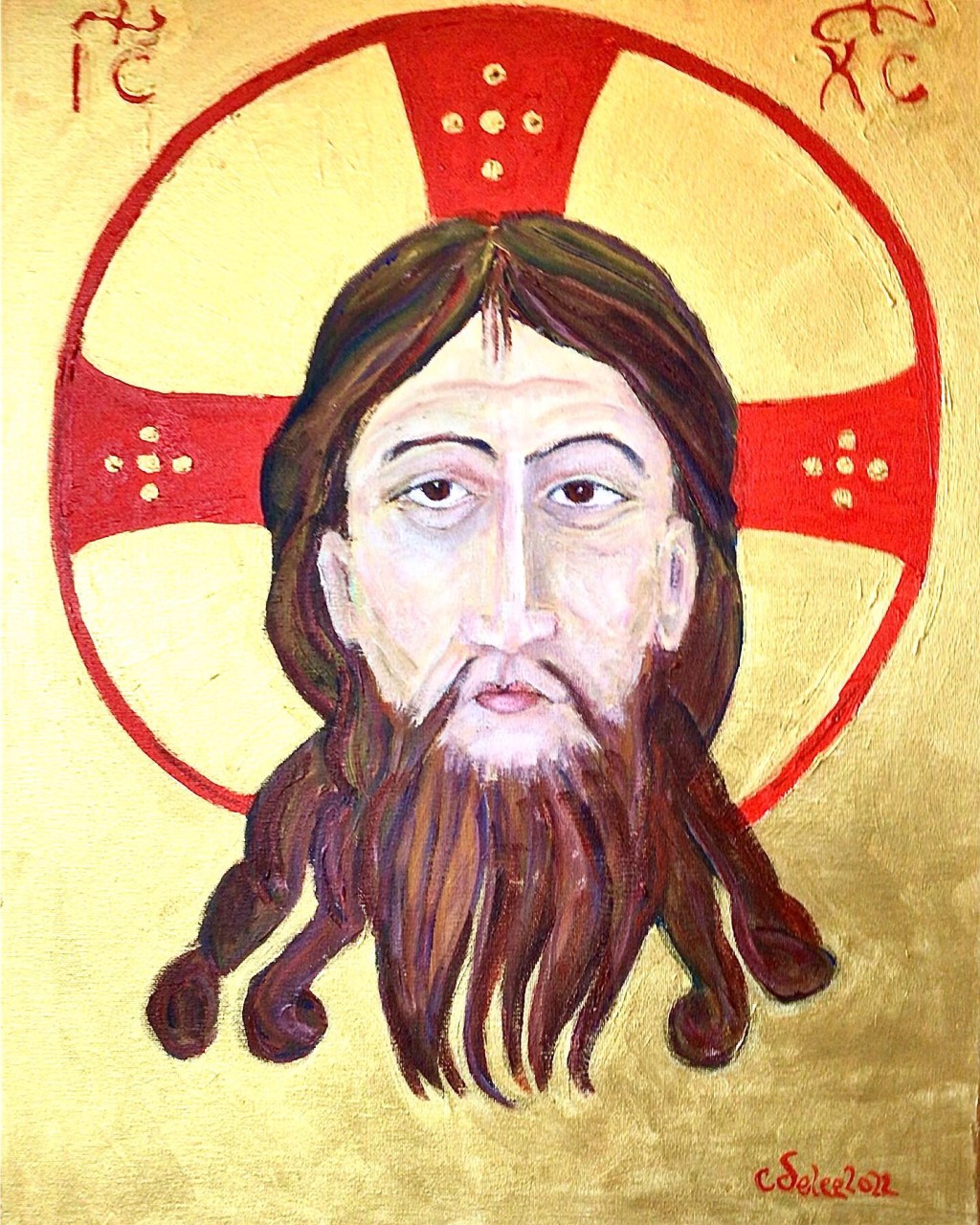
The tradition of the icon says these images are “windows into the heavenly spaces.” I offer seven of my interpretations of these windows: Mandylion, or the Image Not Made By Human Hands, Resurrection of Christ, Christ is Lord, The Good Shepherd, and the Mandylion of the Ecological Christ, who proclaims, “All creation shall be renewed.”

Mandylion Icon
Mandylion Icon
Mandylion Icon
Resurrection Icon
Resurrection and Baptism into New Life
The Good Shepherd
Ecology Mandylion: All Creation Shall Be Renewed

Joy, peace and be still in the presence of God,

Cornelia

Sunflowers and Shadows

adult learning, Alexander the Great, art, Carl Jung, Creativity, Faith, grief, Holy Spirit, Imagination, inspiration, Ministry, Painting, perfection, Plato, Prayer, Socrates, Stress, Ukraine

DeLee 2019, Drying Sunflowers

A sunflower follows the sun. Actually, only young sunflowers track the sun across the sky, while mature sunflowers face east. Why is this? Why do we care? As sunflowers fill our Facebook feeds and social media posts, most of us are looking at flowers so we can ignore the awful consequences of this unprovoked war. Right now, many of us are heartbroken because of the humanitarian crisis unfolding in Ukraine. I had only a passing knowledge of this country because of its well known naïve artist, Maria Primachenko and her paintings of fantastic imaginative animals in gardens. They have always been a delight to my soul and a joy to my spirit. Many of her works include the sunflower, Ukraine’s national flower. Sunflowers have been grown in Ukraine since the mid 1800’s, and are not only an important export crop, but also a symbol of peace. When Ukraine gave up its nuclear weapons in 1994, people planted sunflowers as a symbol of the peace they hoped would follow.

Maria Primachenko
A Dove Has Spread Her Wings And Asks For Peace (1982)

Sunflowers, when young, follow the sun on a 24 hour circadian cycle, just as our bodies have a similar cycle keyed to the light and dark. When the flowers are growing, they maximize their time facing the sun, but once they’re mature, they set their face toward the east, since this gives the head maximum warmth. Bees love warmth, so keeping the buzzing crowds near is in the sunflowers’ best interest for pollination and reproduction.

Heat map of sunflowers at different times of the day

Most of us prefer the sunny days. Clouds, storms, and distress aren’t our first choices. After the last few years of pandemic stresses, we’re unprepared for yet another crisis, even if it seems to be on a distant continent. Our own supply chain for reserves of caring and concern have been stretched thin by the nearly million deaths from COVID in our nation alone, not to mention the worldwide death toll of over 6 million. On Friday in Sam’s Club, I met a lady who complimented me on my flowered pants, which I was wearing in honor of the Ukrainian folk painter, whose museum had been bombed by the Russian army.

“I can’t bear to even listen to the news any more. It’s all so awful,” she said.

I should wear this shirt on Friday at Sam’s Club.

“I know. It reminds me too much of domestic violence cases, where the man decides he’ll punish the ex by killing all the children and taking himself out also.”

My blood sugar usually drops low on Friday after art class, before I eat lunch, so I don’t have my usual, civilized filter on my mouth. The look of awareness on her face was the sudden recognition of a truth she had refused to see before. Sometimes we need to face our fears and deal with them. This is the hero journey. None of us can travel it alone, but far too many fail to ever set out on it at all, even with a spiritual companion or guide. My failure to snack at art class upset her comfortable apple cart and caused her distress. She ran out of Sam’s in a heartbeat. I was able to chat with a baby and her mom later on, who was amazed her child wasn’t at all afraid of this stranger. Food is a medicine for my mood and a bridle for my mouth.

Morandi: Still Life of Bottles with Strange Shadow

On a sunny day, we can see our shadow. Most of us are afraid of our own flickering shadows. We don’t want to see the darkness within us, even though we’re ever ready to see the sinister images of others. Like a sunflower, we’ll turn instead to the light and only see the good, the beautiful, and the true.

A story I remember from my classical art studies regards Alexander the Great and the shadows. His father Phillip II, the ancient king of Macedon, had a difficult, high strung horse, which no one had been able to ride. In fact, it was downright vicious and unmanageable, which made it less of a “gift” to the ruler. Alexander, even though a youth, noticed the handsome horse was disturbed by his own shadow, so he turned the animal’s head into the sun, attached the bridle, and was able to mount him. Alexander rode Bucephalus until the horse’s death at the Battle of the Hydaspes in 326 B.C.E. In his honor, Alexander named a local city, Bucephala (sometimes identified with the modern Jhelum, in the Punjab province of Pakistan), after him.

Mosaic of Alexander the Great and Darius in Battle from the House of The Faun, Pompeii, 3rd century BCE

“Who looks outside, dreams; who looks inside, awakes,” Carl Jung wrote to one Fanny Bowditch, on the eve of his entry into military service during the First World War. Jung believed as long as you looked at other people and projected your own psychology into them, you could never reach harmony with yourself. Jung taught all persons had a shadow side to their personality, or those aspects of ourselves which we’ve repressed. These may be both bad or good aspects, for some of us have yet to realize our own brutal natures, as well as the heroic figures which we’ve also buried inside.

DeLee: Endless Nights of Pain, Ireland, 1973

My old granddaddy was fond of saying, “When you point out another’s failings, you have three fingers pointing back at yourself.” I came to learn I couldn’t recognize the fault in others unless I could claim it also in my own self. This keeps one humble for sure, but it also keeps a person from thinking he or she has any godlike or dictator qualities.

This brings me to another famous shadow story involving Alexander the Great. After his father’s death, he visited Corinth, where Diogenes the Cynic lived in 326 BCE. Diogenes was famous for carrying a lamp in the middle of the day in his “search for an honest man.” In the most famous exchange of this meeting, Alexander asked Diogenes whether there was anything he could do for him. Diogenes, who was enjoying the warmth of the autumn sun, answered, “Stand aside to stop blocking the sun.”

Statue of Diogenes and Alexander

This abrupt response, showing Diogenes’ utter contempt for the power and prestige craved by Alexander, inspired many artists over the years. Although Alexander’s attendants took offense at Diogenes’ rudeness to their king, Alexander himself wasn’t displeased. Leaving, Alexander was said to reply, “If I were not Alexander, I would want to be Diogenes.”

When I brought these delightful images from Maria Primachenko to class, Gail and Mike were amazed at how bright, flat, and clean her designs were. Partly this is due to her use of gouache, an opaque water based color paint. She also uses repeated motifs, symmetry, and clean lines with sharp color contrasts to make her images “pop,” as the decorators say. Mike, who favors textures, was thrilled to see another artist who paints like he does. Gail was glad to process the distressing news through flowers and the yellow and blue of the national flag of Ukraine.

Gail’s Unfinished Painting

Often we don’t feel “safe” speaking about dark or upsetting experiences, preferring instead to bury them deep inside. This is maybe the worst decision we can make, for like a poison or an infection, what we refuse to bring to the light will fester and grow. Then it further sickens the body or the mind until it becomes unrecognizable and unhealthy. Perhaps this is when we move from being rational to irrational. As I always tell folks, “Just because you think the world operates on reason and order, doesn’t make it so.” By this I mean, we live in a world with accidents, change, disease, sociopaths, and greed. In biblical terms, we live in a broken and fallen world, one in which even those of us who are “saved by the blood of Christ” from the wages of sin are “not yet perfected in the love of God and neighbor.”

This is what it means as a Christian to carry the Jungian shadow within us. If we believe keeping a law is the best evidence of our faithfulness, we can overlook the moral quality of the law itself and find ourselves carrying out harm, rather than doing good. As the writer of Hebrews explains in the platonic argument of Christ’s Sacrifice Once for All:

“Since the law has only a shadow of the good things to come and not the true form of these realities, it can never, by the same sacrifices that are continually offered year after year, make perfect those who approach.” (10:1)

Mike’s unfinished painting

If we want to be law keepers, we can’t be picking and choosing which laws we want to keep, as if the law were a cafeteria or buffet table. Jesus certainly knew what potholes lay ahead of him after his baptism in the Jordan River. A forty day fast in the wilderness is great for getting your head together and dealing with our human nature’s dark side of desire for security, power, and equality with god.

Maria Primachenko
Don’t Feast Your Eye’s On Other People’s Bread (1983)

I post my Artandicon blog on LinkedIn as well as on my various spiritual formation Facebook pages which I manage. I sometimes get a message from folks there. One was from a friend, who mentioned she really wanted to get back into her art, “for it brings her peace.” I tell people, “the process of making art brings satisfaction, but we’re not ever satisfied with the work itself.” If we were ever to be satisfied with the work, if we thought we could reach no higher, or if we thought so highly of ourselves that we’d made the last best artwork for all times, then we’d have to quit and make pancakes, until we’d perfected those. And then we’d find a new obsession.

Cornelia’s Painting with Nuclear Monster Destroying a Church

My favorite monsters are those from the Japanese nuclear monster movies of the 1950’s. They are both kitschy and scary. The sunflowers destroyed by these monsters of war will fall to earth and be reborn once again in ever increasing numbers. If hope is the last to die, it’s also the first to rise again. As long as one has breath, one can hope. As Paul wrote to the believers in Rome long ago,

“May the God of hope fill you with all joy and peace in believing, so that you may abound in hope by the power of the Holy Spirit.” (15:13)

Making art is a metaphor for the hero’s journey. Jung believed art was important because often the hands will solve a mystery that the intellect has struggled with in vain. We don’t know what battle or monster awaits, but we also don’t know what divine spirit will come to our aid. Along the fantastic inward journey, we’ll meet the very same creatures who are outside of us. They arise in our dreams, but they were planted in our awakening moments. We may have been turning our faces towards the sun, like the baby sunflowers or the horse Bucephalus, but soon enough we’ll trust the one who guides us and we’ll go wherever it’s necessary.

The journey toward Christian perfection in love is a heroic journey, one which we can only undertake with the help of the Holy Spirit. Along the way, we also travel with others on same road: mystics, saints, and holy persons from yesterday and today. As the old camp song refrain goes,

“And they’ll know we’re Christians by our love, by our love,
They’ll know we’re Christians by our love.”

Maria Primachenko:
May I Give This Ukrainian Bread To All People In This Big Wide World (1982)

The following prayer, Psalm 23, has comforted people for thousands of years in times of trouble and grief. Here in the English Standard Version, if you have fears, trepidations, or trembles, it might help you to calm your spirit. As you speak it aloud to the rhythm of your inhalation and exhalation of breath, remember those who have given up their lives rather than reject their faith: Christian martyrs in the Roman coliseum, Jewish martyrs in the holocaust, and democratic freedom fighters around the world. Let your voice be heard, even as their voice is being silenced:

The LORD is my shepherd; I shall not want.
He makes me lie down in green pastures.
He leads me beside still waters.
He restores my soul.
He leads me in paths of righteousness
for his name’s sake.
Even though I walk through the valley of the shadow of death,
I will fear no evil,
for you are with me;
your rod and your staff,
they comfort me.
You prepare a table before me
in the presence of my enemies;
you anoint my head with oil;
my cup overflows.
Surely goodness and mercy shall follow me
all the days of my life,
and I shall dwell in the house of the LORD
forever.

Joy, peace, and sunflowers,

Cornelia

The Mystery Of Why Sunflowers Turn To Follow The Sun — Solved : The Two-Way : NPR
https://www.npr.org/sections/thetwo-way/2016/08/05/488891151/the-mystery-of-why-sunflowers-turn-to-follow-the-sun-solved

Alexander and Bucephalus | Department of Classics | University of Colorado Boulder
https://www.colorado.edu/classics/2018/06/19/alexander-and-bucephalus

Putin’s Invasion of Ukraine Is a Sin All Russians Will Bear
https://www.bloomberg.com/opinion/articles/2022-02-24/putin-s-invasion-of-ukraine-is-a-terrible-sin-that-all-russians-will-bear

Carl Jung: “Who looks outside dreams; who looks inside awakes.” – Carl Jung Depth Psychology
https://carljungdepthpsychologysite.blog/2020/02/08/carl-jung-i-am-afraid-that-the-mere-fact-of-my-presence-takes-you-away-from-yourself/

Carl Jung – Archetypes – Shadow
https://www.carl-jung.net/shadow.html

Carl Jung: “Often the hands will solve a mystery that the intellect has struggled with in vain.” – Jung Currents
https://jungcurrents.com/jung-hands-intellect-mystery

They’ll Know Are Christians by Our Love
https://www.hymnlyrics.org/newlyrics_t/theyll_know_we_are_christians_by_our_love.php

This is the Way

adult learning, art, beauty, change, Children, Creativity, Faith, Holy Spirit, Imagination, inspiration, ministry, mystery, nature, Painting, purpose, Reflection, risk, shadows, Socrates, Spirituality, vision

Are we our works? Are we valued by our works? Is work a noun or a verb? The child in me asks these questions until the parent in me wants to answer, “I don’t know. Go ask Alexa!”

Alexa Meme

We’ve all been there with the rug rats of our families and kinfolks. Children are curious and for this we’re grateful. This incessant questioning is their way of learning about the world. It’s altogether better than a puppy’s chewing on every new object it comes across. If families are to encourage their child’s interest, they get them a library card so they can have internet access and books to read, and they answer as many questions as possible. If they don’t know the answer, “Go look it up in Google or the encyclopedia.”

In ancient Greece, Socrates taught by asking his students questions, a technique we call the Socratic Method. Some of us teach art in this way also. When we see the student at a stopping point, we teachers ask, “Are you having a problem and not figuring out a solution?”

Raphael: School of Athens , Vatican City, 1509-11.

The student can usually point out what they want to change on their work, but they don’t have the experience or prior learning to drawn upon to solve it. For instance, if the flower petals all look flat because they’re painted in one color, the beginning student knows this doesn’t look right, but they need a trained eye to point out the variety of values in the petals. Once they see the gradation of light to dark, it’s never again unseen. We know it’s there.

Teachers can point out the range of values from dark to light that make up the visual vocabulary of shading a two dimensional image so it looks like a three dimensional shape. Students can learn this technique and master it over time. Mastery then becomes a matter of hand and eye coordination. In a sense, we have to lose ourselves in the subject matter so we can let its energies enter into our hearts and minds, and quicken our hands. The rest is a matter of practice and learning how our egos can quit controlling the outcome.

Old Farmland off Higdon Ferry Road

The spiritual writer and Jesuit priest Richard Rohr speaks of the three eyes in his book, The Naked Now. The first eye grasps what the senses can understand, the second eye understands the science and poetry, while the third eye is aware of all of the above, but especially how all things connect as part of God’s great mystery. When we enter into this “now,” we’re present not only to God, but to all creation, as well as our own selves. This is the contemplative spirit for which the artist strives, and not just for the mastery of the materials or for the rendering of the subject matter.

If we allow this energy to move our hands, does that mean our work also becomes part of us? If we baked a simple yellow cake out of a box, we might not ask that question. When we start decorating a cake made from scratch and adding frillies of frosting, then we start identifying with the cake. Should someone smash the cake enroute to the soirée, there’ll be hockey sticks to pay.

I remember almost fainting in Italy when I saw a glue blob on one of my delicate watercolor paintings, which had just been framed for an exhibition there. A stiff shot of some unknown alcohol brought me back to life. The framer made it good, for the glue was water soluble, so we could gently lift it up. I was more of a drama Queen in my 20’s also. I take things as they come these days. I also was more immature, for I didn’t separate my work from my identity.

Some say we are what we eat, so then are we what we create? Jesus had an answer in Mark 7:18-19 for those who thought certain foods were unclean, or forbidden to eat:

“He said to them, “Then do you also fail to understand? Do you not see that whatever goes into a person from outside cannot defile, since it enters, not the heart but the stomach, and goes out into the sewer?” (Thus he declared all foods clean.)”

That fancy dinner we ate two nights ago leaves us after a few cups of coffee in the morning. We don’t recognize it and most of us don’t even inspect it as we flush it down the toilet on its way out the sewage pipes to the sanitation station. Of course, only parents can get excited about their two year olds who manage to do their “business” in the toilet instead of in their diapers. I know I was one of those. If Facebook had been invented back in the day, I’m sure I’d have posted an update.

As we grow older, we enjoy making and crafting for the experience of the textures and the command of the materials. Children have fun pushing the paints, papers, and glue all around the surface of their artwork. Parents often look askance at the grey, scribbled messes their children excitedly present to them for the honored place on the refrigerator display, but these muddy creations are the result of a dramatic story of their child’s imagination. “Interesting, why don’t you tell me what’s going on here?” Is an adult’s best response in this situation.

Art Lesson: Cut a Snowman on the Fold

I’ve had kindergarten children meltdown because they had difficulty cutting a snowman on the fold. It’s hard to be five years old and live in a home in which the parents don’t want their children to make a mess. These children, as a result, have poor fine motor skills, have difficulty writing, and handling scissors. Even folding a piece of paper is tough. Then they miss the important information: hold the fold, and cut on the flaps. If they hold the flaps instead, they end up with two halves of a snowman. And a meltdown into tears.

“I’ll never be able to make a snowman! My snowman is cut in two pieces. Why can you make a perfect snowman and I can’t?”

Therapy Hat

This lesson always called for me to wear my therapy hat, and remind my five year old students I’d been making folded snowmen for a very long time and my first ones looked just like theirs did. There was hope for them. We just needed to go over the directions again and make one together. Sometimes we miss a step, and that’s ok. It’s just a piece of paper. It’s not like we took away recess from everyone forever.

Usually when we went over the directions again, I could remind them of the way to hold the fold and cut the flaps. Then they’d all be amazed at how easy the project was. “Everything is easier when you follow the directions.” They’d laugh and start decorating their snowman, all their meltdowns forgotten.

Most of us aren’t successful the first time we attempt a new experience. If we were all extraordinary artists right off the mark, none of us ever would get excited about Michelangelo, Rembrandt, or Picasso. If we could all pick up a musical instrument and play it well right off the bat, who’d have the need for civic symphonies or even bar bands? We’d all be happy making our own music. The truth is some of us not only have the interest and inclination, but also the will to spend not just hours, but years, honing our craft, until we sing our notes purely or paint with a master’s hand.

Woven Canvas: Greenway Park

If we all aren’t masters, we all can enjoy the journey if we learn to detach our egos from our products. When I wrote papers in seminary, before I opened up my graded work, I’d repeat the mantra, “I am not my grade. I am a daughter of the living God, chosen for God’s work.” Then I’d look at the markings on the inside. This helped me to remember who I was, whose I was, and what my purpose was. I was also two decades older than that fainting child in Italy.

As I would tell visitors to Perkins, “If your well-being is wrapped up in your grade average, you might want to rethink either that notion or choose another school.”
“Oh, really?”

“Yes, if you’re going on for a PhD, you’ll get over a 90 in your classes. The top grade for the Mdiv is 89. If you get any grade higher than that, the professor thinks you could do PhD level work.”
“That doesn’t seem right,” they said.

“It’s a curve. If you go elsewhere for a DMin, those schools know Perkins’ grading system. Think of it as an A at 89 and don’t worry about it.”

Some people can’t restructure their world so their 89 is an A, but if that’s the system they’re in, that’s how it is. If they have in their mind nothing less than a 95 will validate their worthiness, then if they do their degree work at Perkins, they’ll always be up against the immovable wall. When they go out into ministry, they’ll discover everyone they meet has a grading system. That can drive a person crazy, unless he or she decides the ultimate approval they seek comes from the one who says, “Well done, good and faithful servant.”

Likewise, if we’re beginners in art, we have to suspend our criticism of our imperfections in our work. Instead, we reframe our critiques into “areas which need improvement.” Even now, after decades of working in my studio, I’ll let a canvas rest near me in my living room. I’ll eye it in different lights, until I hear it call my name. I’ve totally repainted some of these, and others I’ve destroyed. A few I leave alone. All of us will keep learning something new, both from our “good paintings “ and our “need improvement works.” Most likely, artists quit painting when they they think they have nothing left to learn, or when they lose the courage to risk moving into the unknown mystery, as it’s written in 1 Corinthians 2:9—

“What no eye has seen, nor ear heard, nor the human heart conceived, what God has prepared for those who love him.”

Paul also writes in Romans 8:27-28,

“And God, who searches the heart, knows what is the mind of the Spirit, because the Spirit intercedes for the saints according to the will of God. We know that all things work together for good for those who love God, who are called according to his purpose.”

Poverty Point World Heritage Site, Louisiana

So we too ask the Spirit to work more in us and free us from attachment to our need to be loved and affirmed by our works, since God is already working for good for those who love God and who are called according to God’s purpose. As we drop our old ideas and preconceived notions of the good, we become open to God’s good and God’s purposes. Releasing control to God is an act of humbleness and faithfulness, both of which are contrary to our modern belief in self-actualization and autonomy. This is the way of the mystic, or the contemplative, and the inspired artist.

Gastrointestinal Transit: How Long Does It Take?
http://www.vivo.colostate.edu/hbooks/pathphys/digestion/basics/transit.html

The Naked Now: Learning to See as the Mystics See – Kindle edition by Rohr, Richard. Religion & Spirituality Kindle eBooks @ Amazon.com. (Also available in iBooks, for more money)
https://www.amazon.com/Naked-Now-Learning-See-Mystics-ebook/dp/B011H5IKU8/ref=sr_1_1?crid=2GSFR51RZ25BM&keywords=richard+rohr+naked+now+ebook&qid=1645568603&sprefix=richard+rohr+naked+now+ebook%2Caps%2C107&sr=8-1