Let’s party like it’s 2025! Nothing takes our minds off the stresses of the real world’s ghouls and goblins like pretending to be a ghost, zombie, pirate, princess or superhero in the All Hallows’ Eve hijinks of the holiday we know as Halloween. Especially if we have the license to eat candy or drink purple fluid to slake our thirst after our door to door “threats of trick or treat.” With all that masked mayhem in the cities, towns, and county seats of the country, the forces of ICE and Homeland Security won’t know which to turn. The INSURRECTION they conjured out of thin air will suddenly become real, only to disappear shortly after sunset. And before troops can surge to all points involved.
Portland ICE protest—October 11, 2025—gives people an opportunity to wear costumes early
How many people in America will celebrate Halloween? Across the country 132.6 million households purchase about 745.8 million pounds of candy during the Halloween season every year. This works out to the weight of 33.9 billion bats or 62.16 million jack-o’-lanterns. Also only about 20% of people don’t celebrate Halloween at all. While I don’t eat loads of candy, I also don’t expect to micromanage other parents. My folks put a limit on our consumption back in the dark ages, plus we only went to a single neighborhood. Once we made the circuit of our city block and arrived home, we were done. The concept of “haul” was nonexistent in the days when dinosaurs lurked in the shadows, along with actual ghosts and other scary creatures.
Vintage Card, reminds me of the Headless Horseman
Most Halloween shoppers (79%) anticipate prices will be higher this year, specifically because of tariffs. Despite these reservations, nearly three-quarters of consumers (73%) plan to celebrate the holiday, in line with last year’s 72%. Top holiday activities include handing out candy (66%), dressing up in costume (51%) and decorating their home or yard (51%).
Economist’s Pumpkin, noting the scary prices of everything
Also, chocolate costs more because of cocoa prices, which have soared in recent years, have hit record highs amid adverse weather conditions, pest outbreaks and supply tightness in West Africa, which produces around three-fourths of the global supply. Cocoa futures have remained choppy but overall eased this year, falling from $8,177 per metric ton at the start of January to around $7,855 in August. That compares with $2,374 three years ago. Your basic Hershey Kiss is up 12% in price. If your favorite chocolate seems a tad lean on the chocolate, remember a warming climate means pests, droughts or floods, and fungi, all of which impact growing food.
Medium Pumpkins are the Best Buy
Even if candy costs more, it continues to be the most popular purchase, with total spending expected to reach $3.9 billion. Across other categories, 71% plan to purchase costumes and spending is expected to reach $4.3 billion. Another 78% plan to purchase decorations, up from 75% last year, and will spend an estimated $4.2 billion in total. And 38% plan to purchase greeting cards, an increase from 2024’s 33%, with total spending estimated at $0.7 billion.
Picasso: Blue period, The Family of the Blind Man, 1903
Compared with last year, more people also plan to carve a pumpkin (46%), throw or attend a party (32%), visit a haunted house (24%) or dress up their pets (23%). October also means our art class works on a pumpkin still life. This year instead of making a realistic rendering, we looked at Picasso’s different styles. He began as a classically trained artist, and then broke all the rules of realism with cubism by fragmenting his subjects into multiple surfaces or flat geometric patterns. Later he did return to a “balloon” neoclassicism, but reverted once more to flat patterns of color. Picasso was always reinventing and responding to the creative genius within him. He didn’t feel constrained to continue to produce art to please others.
Our pumpkin paintings reflect this creative energy. Gail S chose various red hues and deconstructed the pumpkin, as well as imagining it from above. She added some gourd shapes to the mix.
Gail S’s Deconstructed Pumpkins
If Picasso had an orange period in addition to his blue and rose periods, my pumpkins would fit right in. They certainly look like his balloon neoclassical period! I confess I spent more time visiting with a stranger who graced the church door and who seemed to need to talk, but could not find her words.
Cornelia’s Orange Period Pumpkins and Leaves
She didn’t want a pumpkin muffin either, so we let her sit. After a bit, I began to talk about how some of my well meaning friends give me advice that doesn’t make any sense. Like if I make one small mistake, they think I’m ready for assisted living!
“What are they thinking?” was Gail’s response.
“Exactly, this comment says more about them than me. I ignore it and go on. Some folks are perfectionists.”
We painted for a while and then I spoke up again, “You can’t please everyone. If you make A happy, B gets upset, or if you make B happy, then A is upset. Group C is just contrary and nothing ever pleases them. I try to make God happy and let people know that is my only goal. I’m not here to choose sides in their puny fights.”
I must have said something that helped her out, for she said she now felt strong enough to deal with her day and its problems. We thanked her for stopping by and wished her well. We didn’t have much attendance in art class, but if there had been more people, this lady might not have felt free to be with us. God must have provided this quiet space for this woman who had an unvoiced need that day. We aren’t always open to the human needs of those on the margins, but we should recognize they struggle with the same need for autonomy and authenticity as everyone else does.
Another vintage Halloween card
Speaking of pumpkins, the Wôpanâak are a Native American tribe from the eastern coastal region. Their language gives us the loan word for the ubiquitous fruit that “grows forth round,” also known as a Pôhpukun or pumpkin. Marion Webster posits the derivation of this word as follows: “alteration of earlier pumpion, modification of French popon, pompon melon, pumpkin, from Latin pepon-, pepo, from Greek pepōn, from pepōn ripened; akin to Greek pesseinto cook, ripen — more at COOK.”
Of course, this pedigree prefers the Eurocentric derivatives because Native Americans were once considered savages, and therefore unworthy of their historic contributions to our language. We know better today and celebrate the gifts and graces of all persons who contribute to the vast melting pot of the great stew we call America.
What a dull soup we would be if we were just the pale watered down broth with no pumpkins or spinach, no tomatoes or onions, no garlic (to ward off werewolves), and no corn, beans, chicken or beef to provide substance to our stew. We need a variety of spices to make a good soup, just as we need a variety of people’s to build a great community.
Some people go all out for Halloween
One night a year, we can dress up in the costume of our shadow fears or our innermost desires. We get to act like our inner child. We carve our pumpkins with scary faces and put them on porches decorated with all sorts of ghoulish things. The Halloween holiday is cathartic, for it allows us to share with others our innermost selves, an act many of us have difficulty doing.
Worst Halloween Candies
If we eat a bit of candy here and there, it’s ok. It’s one night, and we can plan for this. The goblins do not win, for they are not real. They are here today, and gone tomorrow. I usually set my candy haul into the freezer where I can’t see it. Out of sight, out of mind. I have a piece now and then, “for medicinal purposes,” as my nanny would say, when she took a nip of the bottle stashed in the linen closet. Always with a table spoon, a measured dose, of course, because she “didn’t drink.”
Always go for the Chocolate!
If it helps to keep your cravings in check, you do what you have to do. I just ask, remember our life is short upon this round ball, so don’t rob yourself of the joy of this time. Find something to celebrate daily. On Halloween, we can celebrate our inner child. Even better, we can give the gift of magic to a small child by entering into the fantasy of the night.
Joy, peace, pumpkin spice, and magic,
Cornelia
USDA List of Retail Prices for Fruits and Vegetables, page 11, pumpkins.
I had Anterior Cervical Discectomy and Fusion (ACDF) neck surgery at the end of March to correct a damaged disk. A very fine surgeon removed it, replaced it with a new one, and fused it for strength. Two days in the hospital and I went home to recover. I was tired for several weeks, but I soon felt well enough to start painting again. Each week thereafter I could see improvements in my hand steadiness and mental focus as the pain left my body and my healing progressed. I had been through physical therapy and shots in the neck for a year since my original injury.
The old saying about boiling a frog by raising the temperature of the water gradually also applies to pain: if it rises incrementally, you don’t realize how much you’re tolerating. I feel like a new creation, for I have a new lease on life. Most importantly, I have my sense of humor back. I know this is true, for one morning a friend sent me a funny meme. I laughed so loudly, my Apple Watch gave me a High Decibel Warning alert! Silly watch, you’ve never heard my joy.
As part of my ongoing creation series in the studio, I’ve been working with the imagery from the beginning of Genesis (1:6-8)—
And God said, “Let there be a dome in the midst of the waters, and let it separate the waters from the waters.” So God made the dome and separated the waters that were under the dome from the waters that were above the dome. And it was so. God called the dome Sky. And there was evening and there was morning, the second day.
I also had in mind the creation imagery of The Gospel According to John (1:1-5)—
“In the beginning was the Word, and the Word was with God, and the Word was God. He was in the beginning with God. All things came into being through him, and without him not one thing came into being. What has come into being in him was life, and the life was the light of all people. The light shines in the darkness, and the darkness did not overcome it.”
Hildegard of Bingen: Scivias III.1; The One upon the throne, Rupertsberg MS, fol. 122v, manuscript illumination, 12th CE.
These two texts, one from the Old and one from the New Testament, remind us the Triune God has always been creating our universe and our earth. From this we understand what the Trinity has created, it will be by the same love, desire, and compassion the Trinity will sustain creation and renew creation in the proper time. Humanity is a cocreator of beauty alongside the Holy Trinity. While our works aren’t infinite or perfect, we humans hold the desire to create and surpass our best works, even as the Creator of all things saw all the work before the creation of the first human beings as “good,” but the creation of humans in God’s image as “very good.”
Too often our Christian theology hinges on some form of “sinners in the hands of an angry God,” rather than the doctrine of “God so loved the world.” This dualist contrast of sin/redemption versus love/renewal is a difference of viewpoint between those who focus on judgment and those who focus on grace. The old story of “God loves me in spite of my fallen and wicked ways” doesn’t make sense to a new generation who has gotten affirmations for all their efforts. As part of the old generation, that traditional story barely made sense even to me and my generation. Between 2000 and 2020, Gallup reported church attendance for people born before 1946 declined 11%, attendance for Baby Boomers declined 9%, attendance for Gen X declined 12%, and the facts aren’t in yet for the Millennials or Gen Z. Moreover, speaking only to “personal salvation” is not on most younger people’s minds. They are more interested in the great causes of justice for the weak and the oppressed, and in liberation for the unjustly imprisoned, just as Jesus read from the scroll of Isaiah (4:8-9):
“The Spirit of the Lord is upon me,
because he has anointed me
to bring good news to the poor.
He has sent me to proclaim release to the captives
and recovery of sight to the blind,
to let the oppressed go free,
to proclaim the year of the Lord’s favor.”
Hildegard of Bingen is a good person to help straddle this dilemma. After all, Hildegard is one of the only four women whom the Catholic Church has recognized as a Doctor of the Church. Only thirty-six other figures in the history of the church have earned his great honor, which Hildegard belatedly received rom Pope Benedict XVI in 2012. This title recognizes the outstanding contribution a person has made to the understanding and interpretation of the sacred Scriptures and the development of Christian doctrine. Only four on the list are women (Catherine of Siena, Teresa of Avila, Therese of Lisieux, and Hildegard of Bingen). The definition of the term “Doctor of the Church” is based on the three requirements a person must fulfill to merit inclusion in the ranks of the “Doctors of the Catholic Church”:
1) holiness that is truly outstanding, even among saints;
2) depth of doctrinal insight; and
3) an extensive body of writings which the church can recommend as an expression of the authentic and life-giving Catholic Tradition.
Born the tenth child in an era where a family practiced tithing or giving a tenth of everything to God in every aspect of their life, Hildegard was ‘given to God’ and taken to live in an abbey, as a nun. There she learned faith and healing, and studied medicine, natural science, music, and writing. She wrote ten books, two volumes of which are well known: Physica, a book on natural science, and Causae et Curae, a book of medicine and remedies. These two works hold most of Hildegard’s musings on the relationship between science and faith, along with her scientific observations and medicinal remedies. Scivias, Hildegard’s main theological work, stands for “Scito vias Domini,” meaning “know the ways of the Lord.”
Her knowledge came from visions of light, what today some have called debilitating migraines, which confined her to her bed for days. Hildegard spoke of her visions of light, just as migraine sufferers often report an extreme sensitivity to light, or seeing strange light patterns, in the middle of an episode. Her science was advanced for the 12th CE, but we don’t study Hildegard for her scientific truths. She is more important for her theology and spirituality about creation and God’s love for all life.
When God created the world, God pronounced God’s creation “good.” The world in which we now live is obviously corrupt and fallen, so many people have given up on it. The same was also true back in Hildegard’s time. The secular and religious empires of the West were at war. The Crusades tried to wrest the Holy Land from the Arabs in great battles resulting in mass carnage. The growth of cities’ merchant classes also threatened the established order of the powerful.
It was an uneasy time for all the people, just as it is today when the cultures of the east and the west are wrestling for dominance, great powers still try to expand their territories, and technocrats challenge governments worldwide for power. Once again it is “the times, they (were) are a changing,” as Bob Dylan, the prophet of our age sings for every age.
Hildegard speaks of God not only creating, but also being in the world. This is what we call Panentheism, which comes from the Greek words pan/all + en/in +theos/God. Panentheism considers God and the world to be inter-related with the world being in God and God being in the world. Panentheism affirms both divine transcendence and immanence. We can both experience God through the natural world, while God is also beyond our normal experience. Hildegard experienced God in both the world around her, even though she lived a secluded life, and she also experienced God through her visions. (This is not pantheism, which makes creation into the god or accepts the equality of many gods.)
Hildegard von Bingen: The universe (or the Cosmic Egg), from Scivias, an illustrated work by Hildegard von Bingen, completed in 1151 or 1152, describing 26 religious visions she experienced. Liber Scivias (Sci vias Domini = Know the ways of the Lord). The book, Codex Rupertsberg, disappeared during WW II. Transparencies are from a faksimile, copied by hand by some nuns from 1927 to 1933. (Plate 4 fol-14r—The universe (or the Cosmic Egg)
“I, the fiery life of divine wisdom,
I ignite the beauty of the plains, I sparkle the waters,
I burn in the sun and the moon, and the stars.
With wisdom I order all rightly.
Above all I determine truth.
I am the one whose praise echoes on high.
I adorn all the earth.
I am the breeze that nurtures all things green.
I encourage blossoms to flourish with ripening fruits.
I am led by the Spirit to feed the purest streams.
I am the rain coming from the dew
that causes the grasses to laugh with the joy of life.
I call forth tears, the aroma of holy work.
I am the yearning for good.
Invisible life that sustains all,
I awaken to life everything In every waft of air.
The air is life, greening and blossoming.
The waters flow with life. The sun is lit with life.
All creation is gifted with the ecstasy of God’s light.
In doing good, the illumination of a good conscience
is like the light of the earthly sun.
If they do not see me in that light,
how can they see me in the dark of their hearts?
I am for all eternity the vigor of the Godhead.
I do not have my source in time.
I am the divine power
through which God decided and sanctioned
the creation of all things.
With my mouth I kiss my own chosen creation.
I uniquely, lovingly, embrace every image
I have made out of the earth’s clay.”
I resonate with Hildegard not only because her theology speaks of God’s love for everything God created, but also because God desires for all creation and humanity alike to come to a state of perfection. Even when I was a nonbeliever, creation always called my name. I’ve always felt a peace and wholeness when I looked upon nature. The beauty of the sky, the changing colors of the seasons, and cloud patterns fascinate me to this day. Now I can read Psalm 19:1 with a heart of faith:
“The heavens are telling the glory of God; and the firmament (dome) proclaims his handiwork.”
Hildegard of Bingen’s final and greatest visionary work was the Liber Divinorum Operum, the “Book of Divine Works.” Each of her recorded visions elaborates the dynamic Word of God, present before and within Creation. The Word first became a human being to bring the Work of God—humanity and by extension all creation—to perfection. This grand vision is the culmination of Hildegard’s entire theological project and represents her most mature formulation of the themes central to her thought.
Hildegard believed the fundamental human vocation was to understand both ourselves and all creation as the work of God, and our place as cooperative agents of that work. Also in this “Book of Divine Works,” Hildegard considers rational understanding as the means to know our Creator and properly fulfill the work for which we were created; the relationship between humanity and the rest of creation as microcosm and macrocosm; and the eternal predestination of the incarnate Word of God irrupting into and unfolding through time, as revealed in both Scripture and the life of the Church. Our Library of Congress has a fully digitized copy of Hildegard’s final tome of 353 magnificently illustrated pages, which is accessible at the link at the bottom of this post.
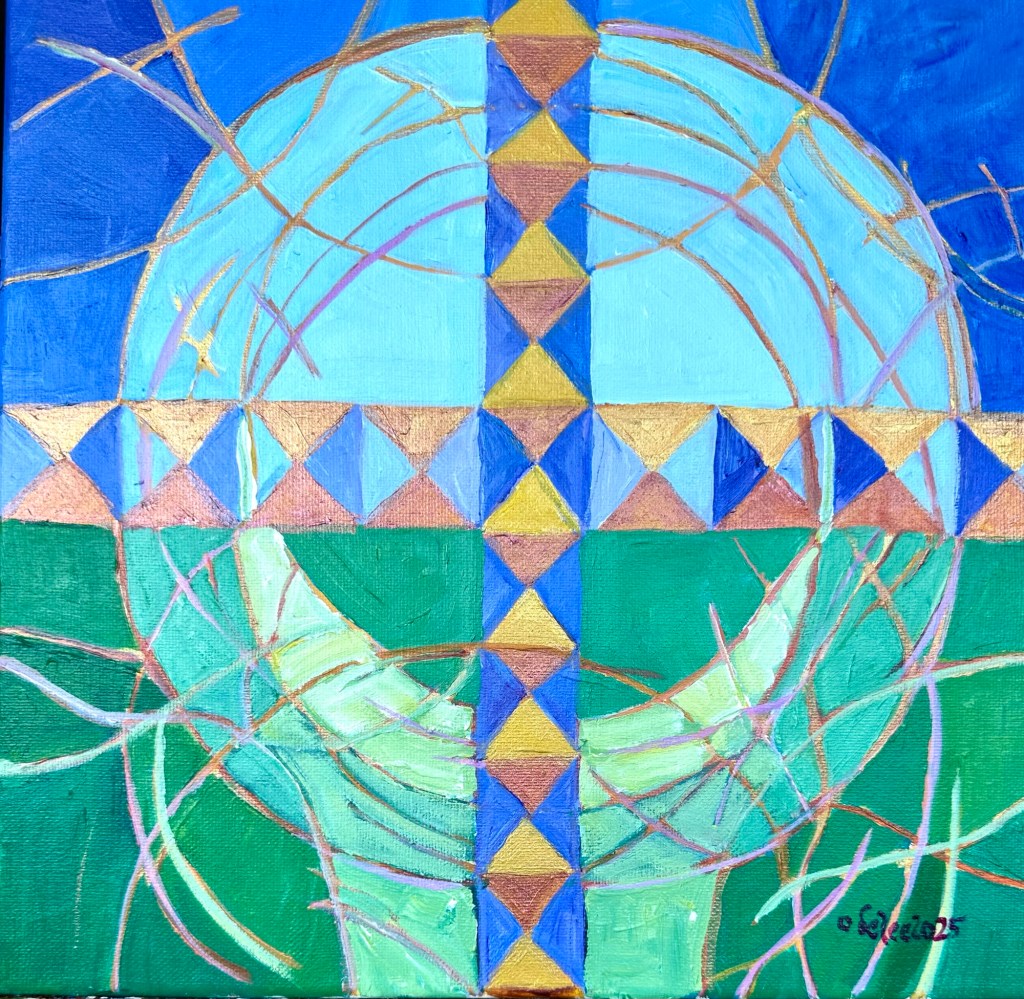
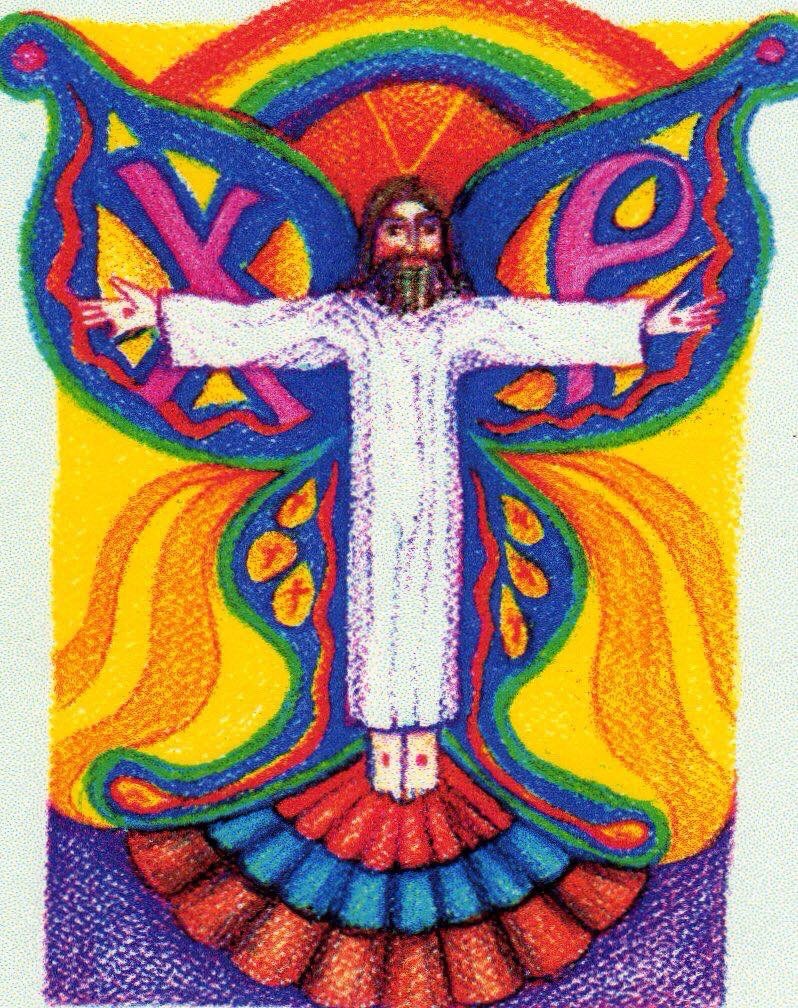
DeLee: Christ Offers the Word, acrylic on canvas, 8” x 10”, 2025
Nature has always revealed the presence of God to me, not just the in the act of creation and the beauty of nature, which I see presented daily from sunrise to sunset, but also in the transits of the stars in the night skies. From the myths of our ancestors trying to make sense of their world to our current search for the mysterious ninth planet (sorry, Pluto, I still love you, even if you’ve been demoted to a dwarf planet), and to the great nebulas and galaxies beyond our Milky Way, we humans have experienced God among these other mysteries.
While we believe one day we can know all the unknowns, we nevertheless awake to discover we stand on the precipice of yet more mysteries and the need to refine our former truths. The more we know, the more we discover we’ve barely scratched the surface of the depths of what can be known. This search for knowledge is what keeps the curious alive and ever on the quest for the outer boundaries.
Hildegard: Scivias III.1: The One upon the throne. Rupertsberg MS, fol. 122v.
The creative mind believes a heart touched by God’s creative spirit has unique insights to give to the world, which needs beauty to confront the mess we can see outside our doorsteps and on our nightly newscasts. Creating an icon is one way to pray and enter a holy space. The circle stands for the halo, but also to identify the image portrayed as a holy or important figure. When I need to recenter myself, I always paint an icon. I pray twice—once in the act of painting and again in observing and meditating upon the image of the icon. This icon has not only the halo of Christ, but the cruciform halo, which serves to differentiate the Trinity from the non-divine saints, dignitaries, and angels. It appears on images of God the Father and the Hand of God, Christ and the Lamb of God, and the Dove of the Holy Spirit.
Rebecca Boyle describes the science of creation in “The Universe’s First Light Could Reveal Secrets of the Cosmic Dawn:”
Everything started in the tremendous burst of energy known as the big bang. Within a few seconds the universe cooled enough for the first protons, neutrons, electrons, and photons to spark into existence, and within a few minutes those building blocks came together to form the first nuclei of hydrogen and helium. After about 380,000 years, the universe was sufficiently cool for those protons and neutrons to grab free-flying electrons and form the first electrically neutral atoms. For the first time, photons stopped colliding with free electrons and were able to flow through the universe. This process, confusingly called recombination—it was actually the first true combination of atomic components—released the cosmic microwave background (CMB) light that pervades all of space. The most detailed map of this background is from the Planck satellite, a European space observatory that launched in 2009 to study this light.
DeLee: “All things came into being through him, and without him not one thing came into being.” —John 1:3
I made this second creation painting during this healing time by intuitively wrapping strings around the stretched canvas. Then I took assorted sizes of plastic lids which I couldn’t recycle, but I was “needing to find a use for them” before I relocated them to the trash heap. I belong to the generation of “waste not, want not.” (Yes, my nannie had the famed ball of string and one of tinfoil also.)
As I placed the various sized circles around the canvas, I thought of the many hours my childhood friends and I would pass the leisure of our hot summertime days with scribble challenges. One of us would make random marks on a paper for the other to decorate or to discover a magical creature of our imagination. As we grew older, these became more developed into different textures and patterns. As I painted the circles and straight lines, I saw the bright cross amid the heat of the great power of creation, with all the elements created in that first burst of light.
Hildegard: Liber Divinorum Operum II.1: The Parts of the Earth: Living, Dying, and Purgatory. Biblioteca Statale di Lucca, MS 1942, fol. 88v (early 13th CE.).
As Hildegard reminds us, “Humankind, full of all creative possibilities, is God’s work. God calls humankind alone to assist God. Humankind are co-creators. With nature’s help, humankind can set into creation all that is necessary and life-sustaining.”
One of our last days in the art class I teach at a local church to adults who are willing to pursue the challenge of treading beyond their comfort zones, I was fooling around with a compass and a straight edge. It wasn’t a ruler, but I found the center of the canvas with the compass intersections instead. I used a piece of cardboard as my straight edge. I ended up with multiple intersecting lines, all of which I left on the surface.
When I got home, I found them interesting. These I pursued, but not all of them. The art is in deciding which ones to ignore! While painting, I reflected on God’s creation. The Holy Trinity has always existed and has always shared the work of creation. Also, there is no such entity as a “Holy Binity” or just the Father and Spirit only. The Son has always existed and has always shared the work of the entire Godhead, which we often refer in a shorthand as “God.”
DeLee: The Dome of the Waters, acrylic on canvas, 10” x 10”, 2025
And God said, “Let there be a dome in the midst of the waters, and let it separate the waters from the waters.” So God made the dome and separated the waters that were under the dome from the waters that were above the dome. And it was so. God called the dome Sky. And there was evening and there was morning, the second day. —Genesis 1:6-8
As I painted more, the dark blues above the light blue represented the waters above the “firmament” of the pale cerulean sky. When it rains, the holes in the dome of the sky let the water leak out, or so I’ve heard the old folks say. I never heard their explanation for why it doesn’t rain all the time, but perhaps “angels are involved.” They might be busy plugging the holes in the dome with their fingers, but God must have many angels working hard on our behalf.
The area below is in greens for all the growing and thriving things. There is an upside-down dome, or a Cheshire Cat smile pale green eighth moon shape for the underground water sources. All the intersecting compass marks are the energy signatures, which God’s power unleashes when God makes a new thing or renews an old thing. If we are sensitive to God’s creative spirit, we cannot help but be in awe of the magic and mystery of not only the minutiae of nature, but also the grandeur of the cosmos.
The great landscape photographer Ansel Adams was one of the voices of those who found inspiration in nature, especially our national parks. He spoke the same sensible words for our age: “As the fisherman depends upon the rivers, lakes and seas, and the farmer upon the land for his existence, so does mankind in general depend upon the beauty of the world about him for his spiritual and emotional existence.” (From a speech to the Wilderness Society, May 9, 1980).
The natural world is meant for humankind to care for, tend, and enjoy with respect, just as we would care for a beloved partner. Not everyone sees the world with the eyes of God, who so loved the world—both the humans, the creatures, and the earth itself—God gave God’s only Begotten son to save the world, “For God did not send his Son into the world (kosmon|κόσμον) to condemn the world (kosmon|κόσμον), but so that the world (kosmos|κόσμος) might be saved through him.” (John 3:17) What God created, God loves and will sustain. Can we do anything less and still be faithful to God’s calling on our hearts?
Joy and peace,
Cornelia
U.S. Church Membership Falls Below Majority for First Time
Trans. by Nathaniel Campbell, from the Latin text of Hildegard of Bingen, Liber Divinorum Operum, ed. A. Derolez and P. Dronke, in CCCM 92 (Turnhout: Brepols, 1996), pp. 47-9. (Musical Score)
International Society of Hildegard von Bingen Studies: Karitas habundat
The Book of Divine Works. | Library of Congress: Fully digitized copy of Hildegard’s final tome of 353 magnificently illustrated pages, late 12th century CE.
In most adults, learning and thinking plateaus and then begins to decline after age 30 or 40. The old adage, “Don’t trust anyone over thirty” takes on new meaning in regards to creativity. People after this age start to perform worse in tests of cognitive abilities such as processing speed, the rate at which someone does a mental task. The slide becomes even steeper after 60 years of age. We also notice a similar learning decline in children after summer vacation, which results in the fall semester becoming a “reteaching opportunity.”
As one who is also “growing long in tooth,” I have passed this yardstick by a mile. I notice I have a “slower processing speed” in my creative writing. I don’t consider it a reason to quit, but a reason to better organize my other time-wasting behaviors (social media, newsletters, newspapers, etc.). I can always ignore cleaning the condominium! Creativity before housework, is my motto.
Housecleaning Meme
We often think older adults are on a downward slope with unrecoverable loss. “Use it or lose it,” the saying goes. Recent research suggests we need to apply a more hopeful mindset and vocabulary when discussing older people—much like that used for childhood or early adulthood. Decline, as we so often see it, may not be inevitable. In fact, learning a new skill and practicing it for three months has shown benefits beyond the the practice time.
Adults often have limited time or resources, so if we encourage learning a new skill, this may help them step out of their comfort zones. In people’s later years, many personal and societal changes—such as moving out of state to be closer to family members, switching jobs or coping with physical distance from loved ones—make learning new skills necessary to adapt and succeed.
For example, taking a class to improve technological skills could aid seniors’ success in an increasingly digital world, such as helping them use Telehealth or online banking platforms. Learning new skills in an art class allows a person to express their feelings and solve problems in creative ways. Each person can find their own path to success in artistic practice.
Potholder Loom, just like the one I had back in the day.
Our art class is trying a new thing: weaving. We have been painting for quite a while, so this is really a hands-on project. Some of us had the benefit of making woven potholders as children, or weaving newspaper “sit-upons” at summer camp. The technique isn’t unknown, but making a creative design interpretation is how we take our basic skill forward into a stimulating and creative brain challenge.
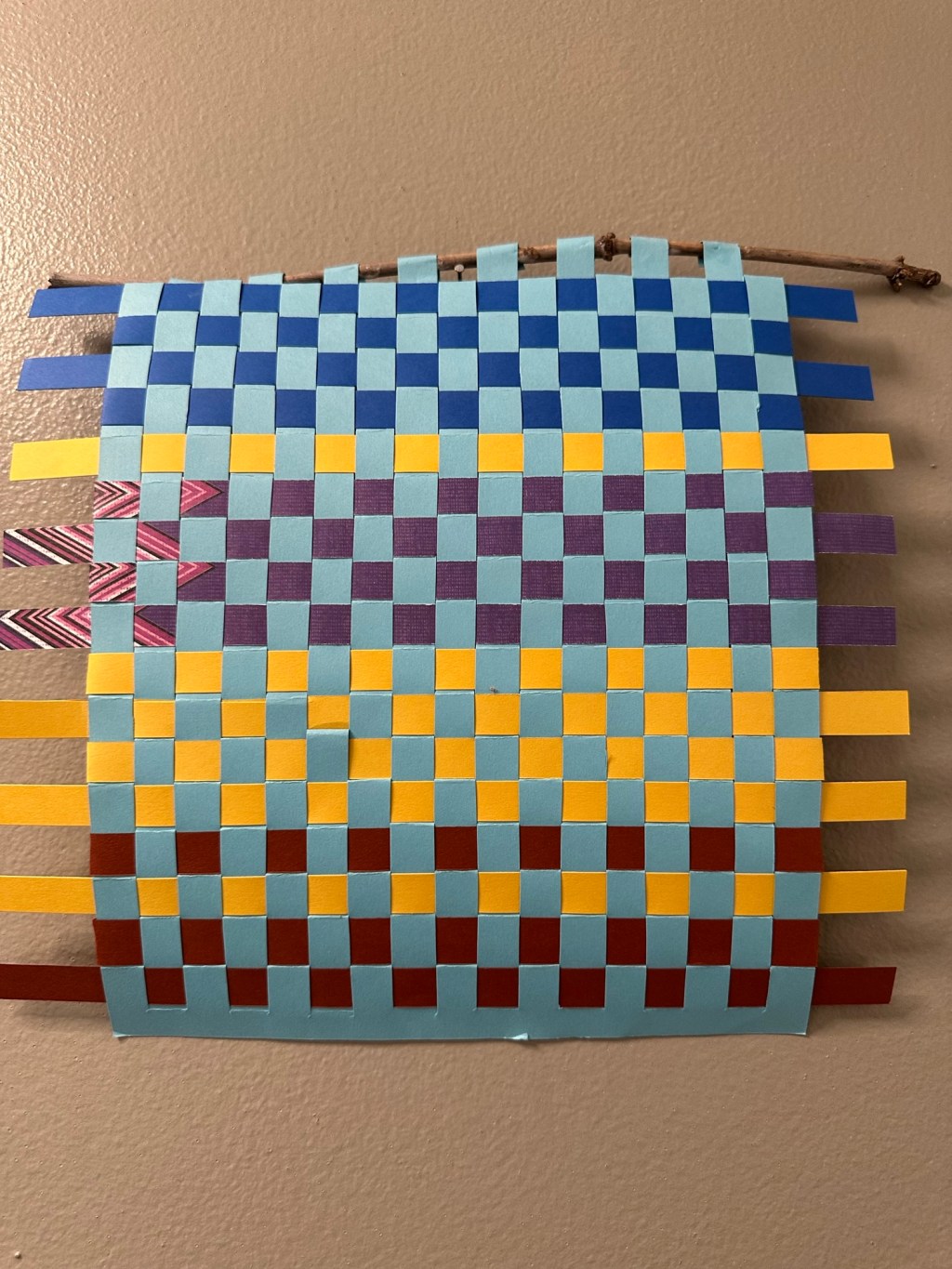
DeLee: Woven Paper on a Stick (Earth and Sky)
We could just repeat what we already know, but this doesn’t build us new neurons in our brains. If we keep the same old paths and don’t create new ones, we aren’t flexible when we meet new situations. Since we live in a rapidly changing world, building a brain capable of rapidly adapting is important to live independently and vibrantly for as long as possible.
I remember how my Daddy could only use the old tv remote to change the channel for the original non cable stations. When “Murder, She Wrote” came on the cable channel, my Mother had to use the cable remote to change the station for him. His Alzheimer’s disease prevented him from learning new skills, but he remembered all of his previous medical training and could diagnose his condition and boss the emergency room doctors when he was admitted to the hospital for a fall. Our brains are a mystery indeed.
Mike jumped the gun on Valentine’s Day and created a woven heart. These were big in the Danish and German communities and very popular in the 19th century in America. During the Civil War, soldiers made many of these in elaborate forms to send to their loved ones back home.
Unknown Artist: Affirmation Weaving
The brain is a fantastic and mysterious organ. If we make a habit of learning something new every day, of whatever interests us, we have the opportunity to keep our lucidity for a longer time. We also we meet the quickening changes of modern life with a steadfast heart and mind. We stress less when we know we can adapt and change in our own lives. We don’t have to be the people who say, “You can’t teach an old dog new tricks.” We can teach and we can learn, but we might need to be more patient with the old dog. In some corners, we call that “grace.”
I watched my Granddaughter’s Daddy Daughter Dance
Our group was in and out during the several weeks devoted to this project. One of us was sick, one was grieving the death of a beloved pet, another had pressing work issues, and the teacher went to Florida to see her granddaughter get married. Amazingly, life goes on. People dropped in for spiritual support, which is a side benefit of the community of art class. I managed to get mine mostly done, and Gail S. finished hers completely. Sometimes life interrupts our best intentions and we move on. We will learn new lessons on the next project.
Gail S’s “Eye of God” weaving
Gail S’s “Eye of God” weaving incorporates yarns from two different mop heads, some sticks, and a bird feather. Gail almost always keeps a realist focus in her works, so her eye of God has a bird feather to mark the pupil. The upper field of grey and white mop yarns represent the cloudy sky, while the blue yarn stands for the water and the brown for the land. God watches over all of God’s creation. Gail S’s love of the outdoors and all of nature is evident in all her work.
Cornelia’s Cross on a Hill (unfinished)
I also recycled some old paintings and cords which I’d used in the preparatory work of other paintings. In addition, I used some recycled strips of Amazon shipping parcels as well as a wire shape which once belonged to a butterfly wing. In repurposing these items into the weaving along with two old brushes bound together with a God’s eye, I invoke the renewal of life after death.
We people of faith have two opportunities for a renewal of life after death. The first is by our profession of faith in Christ and his life, death, and resurrection on our behalf for our salvation. This gives us a living faith in this world. The second renewal is for the resurrection from death itself. This gives us a life beyond this world. Our faith is worthless if it doesn’t change us for our walk upon this world. If we don’t have the heart and mind of Christ within us, and if we aren’t earnestly seeking to be made perfect in the love of Christ daily, our United Methodist heritage tells us we’ve not yet been converted.
Yet Christ desires to save all, as John records in 12:32, Jesus tells the crowd,
“And I, when I am lifted up from the earth, will draw all people to myself.”
Not just some people, or only the best, or even just us United Methodists, but ALL people. Most of us aren’t able to understand such a wide ranging love, for we live in a world of tribal loyalties. If we look at creation, which is God’s first work, God loves that which God created. God loves everything God created. We humans are the ones who choose sides and introduce boundaries and hate into God’s singular creation. The world or Kosmos is the creation first and then the people in it.
Today we tend to ascribe “world” to the “culture,” or secular society in general, but its plain meaning is creation and the human presence, for good or ill. The ancient Greeks and Romans divided the world into the material (bad) and the spiritual or mind (good), but the Jewish theology conceived the unity of both as part of God’s gift to humankind.
In the fifty-fourth chapter of On the Incarnation, St. Athanasius of Alexandria wrote a sentence that has echoed down through the centuries even into our own time as a brilliant summary of the Gospel. He wrote this: “God became man so that man might become god” (54:3).
This doctrine is called theosis or acquiring the whole nature of God. We United Methodists call this state Christian Perfection, or “a heart so full of love of God and neighbor that nothing else exists.” Our Wesleyan heritage was influenced by the Wesley brothers’ deep love for the Greek Orthodox fathers of the early church. To focus only on fallen nature is to deny the power of God to redeem us and all creation and to make all things new. We humans and nature aren’t more powerful than God!
If we cut off part of our God given self, we deny the incarnation of Christ, who became human for us that we might become divine. We need to remember what John 3:16 so succinctly states:
“For God so loved the world that he gave his only Son, so that everyone who believes in him may not perish but may have eternal life.”
Art is a way to open our eyes and hearts to a new way of seeing spiritual truths. Art is also reflective of the artist’s soul and spirit. A sensitive viewer can read the tale of trauma or the struggle for survival in an artist’s body of work. More than this, we can listen for their voices straining to be heard. Most people have been silenced and conformed to the “cause no trouble, don’t get out of step” mantra of the public school system training our youth for the workplace.
In art class, we can lose our fear of being different because being different gets rewarded! Being original gets an attaboy or attagirl. I find such joy helping people find new courage and creativity they didn’t know existed within themselves. My students keep me young too. I feel blessed beyond measure.
Joy and peace,
Cornelia
To Stay Sharp as You Age, Learn New Skills | Scientific American
The gospels remind us the story of Christ’s birth isn’t necessary for our salvation. Only our faith in Christ’s saving work for us on the cross is necessary “to transform our humble body that it may be conformed to the body of his glory, by the power that also enables him to make all things subject to himself.” (Philippians 3:21, alternate translation). Mark has no infancy narrative at all, while John’s gospel speaks of the Greek Logos (Word), who is present with God at creation and as co-creator.
Luke and Matthew both have birth stories. Matthew gives us the ancestry of Jesus, the Wise Men or Magi from the East, and the massacre of the innocents. John the Baptist also figures large in Matthew’s text. Luke brings in the shepherds, the host of angels, and the angel’s annunciation to Mary of her impending birth of a savior.
Luke 2:6-7 notes this point about the birth of the Christ child: “While they were there, the time came for her to deliver her child. And she gave birth to her firstborn son and wrapped him in bands of cloth, and laid him in a manger, because there was no place for them in the inn.”
Gail W. painted a simple nativity in one class session.
This bit of text sets the scene for all the artists of every era to exercise their imagination. What does a first century CE manger look like? What animals would be there? Would the visitors come by day or night? Who would visit a woman who got pregnant while she was still “betrothed?” In every age, gossip travels fast, even without the internet. Traveling traders and business people carried news from town to town.
After all, word had spread how Joseph, “being a righteous man and unwilling to expose her to public disgrace, planned to dismiss her quietly.” (Matthew 1:19). No wonder there was no room for them at the inn. No respectable place would have them. Or we could be generous to the local folk and say Mary and Joseph travelled slowly because her imminent due date was the cause of frequent stops. A donkey ride might not be the most comfortable ride in one’s late trimester. Either way, if they were late arriving, the rooms may have been booked full already.
The Church of the Nativity, which dates to the 4th CE, was built over the cave in Bethlehem where early Christians believed Christ was born. From Apocryphal sources we learn the traditions of the cave and the stable. The Infancy Gospel of James (chapter 18) also places the Nativity in a cave, but the Gospel of Pseudo-Matthew combines the two locations, explaining that on the third day after the birth “Mary went out of the cave and, entering a stable, placed the child in the manger” (chapter 14).
Roman Sarcophagus of Stilicho. It’s found today beneath the pulpit of Sant’Ambrogio basilica in Milan, Italy.
The earliest images of the nativity which currently exist are from 3rd CE sarcophagus panels. The earliest Nativity scene in art was carved into a sarcophagus lid once thought to be for a Roman general, Stilicho, who died in 408 CE. The ox and the ass and two birds are the only figures that appear in addition to Jesus, swaddled in his manger. Our typical cast of characters, including Mary and Joseph, do not appear may be because this sculpture illustrates a prophecy from the Old Testament. Isaiah 1:3 reads, “The ox knows its master, the donkey its owner’s manger…” This Nativity also has relevance to the Eucharist because believers are nourished by the “fodder” of Christ’s flesh, just as the animals receive their sustenance from the manger’s hay. The animals aren’t mentioned in the New Testament, but from the Apocryphal sources mentioned above.
Tim’s Nativity: simplicity rules here—only the lights of the great star, the light of the Christ child, and the minor lights of the heavens.
Nativity with Flight to Egypt in the upper part—from the 4th and 5th centuries, Athens, from before the Middle Ages, and technically “Roman” art. (often referred to as “Early Christian”).
Next added were the shepherds, during the 4th and 5th CE, such as this example from the Palazzo Massimo. We find it on the sarcophagus Marcus Claudianus, on the upper tier, on the left. This dates from around 350 CE, found today in the Museo Nazionale Romano, Palazzo Massimo alle Terme, Rome.
Sarcophagus of Marcus Claudianus (Rome, Italy), Palazzo Massimo: Early Christian art is interesting because it can be hard to spot the stories as you know them. Except it seems, the Nativity, in the upper left corner, 330-335CE.
The sculptor carved the sarcophagus in the style called “continuous frieze” because all the figures line up and their heads are of equal height. The appearance of grape harvest imagery on the lid is ambiguous; it appears on both pagan/secular and Christian sarcophagi with identical elements. From left to right on the lid: nativity scene of Jesus, sacrifice of Isaac, an inscription naming the deceased, an image of the deceased as scholar, and a grape harvest scene.
Carvings on the front of the Marcus Claudianus sarcophagus include: Arrest of Peter, miracle of water and wine (with a possible baptism reference), an orant or praying figure, miracle of loaves, healing a man born blind, prediction of Peter’s denial, resurrection of Lazarus and supplication of Lazarus’ sister.
This stone relief carving depicts the detail of the Nativity from the 4th and 5th centuries from the Palazzo Massimo, on the Sarcophagus of Marcus Claudianus (Rome, Italy).
A Carolingian Era (751-887) Nativity scene from the British Museum
Eastern Orthodox icons retain the cave imagery while the Western art traditions use a stable or ruins of a classical structure in the nativity scenes. The first is according to tradition and the western imagery reminds the viewer the ancient past with its many gods is no longer ascendant.
The one change we see in the 6th century is the inclusion of Mary lying on a mattress type bed. It may have appeared earlier in art, but we have no surviving example to date an earlier occurrence. Later, we see more actors in the drama appearing, but often they don’t arrive all at once. The wise men visit, or the shepherds visit, but not in the same artwork.
Wise Men Visiting the Birth of Christ, 6th CE
A 10th century ivory panel from Trier, still very much following the now 700+ year old Roman models; things changed much more slowly in the Middle Ages than they do now.
By the time of the 11th CE, the nativity scene was becoming more elaborate , but was not yet in full flower. By the 13th CE, the magnificent portal of the St. Lawrence cathedral, in Trogir, Croatia, by the Master Radovan and his associates has a strong narrative of the many parts of the nativity story. The city of Trogir, a World Heritage Site since 1997, is known as one of the best-preserved Romanesque-Gothic cities, the core of which consists of forts, religious and secular buildings, with the Rector’s Palace and the City Loggia standing out. Its Romanesque churches are supplemented with Renaissance and Baroque edifices.
Romanesque style portal of the St. Lawrence cathedral, in Trogir, Croatia, by the Master Radovan and his associates
The detail of the portal is worth a closer look. In the center, in between the curtained “bunkbeds,” the Virgin and Child rest on the upper tier. The animals also look on in this section. Below the manger scene is a ritual bath. In my Christian world view, I called this the “baptism of Jesus.” In his Hebrew life, he would have undergone a ritual cleansing immersion bath before going to the temple for his circumcision. This ritual would mark him as a covenant member of the nation and people of God. The two elderly people on the left of this scene are most likely Simeon and Anna, prophets who speak to the child’s fulfillment of scripture.
Details of Romanesque style Portal of St Lawrence cathedral in Trogir, Croatia.
Above all this at the center top are the star, with the angels on the left and on the right. Filling the space on the left side of the portal are the shepherds and their herds, while the Magi and their steeds occupy the right side. The Magi ride horses, unlike our modern nativities which have camels.
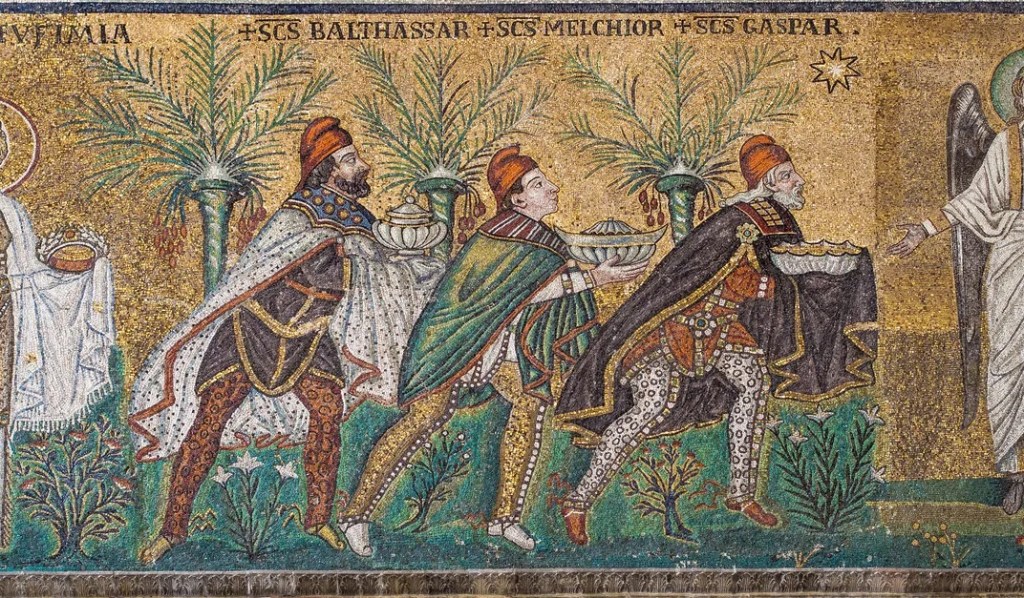
Sixth-century CE mosaic at the Basilica of Sant’Apollinare Nuovo in Ravenna, Italy
In England, the Venerable Bede (d. 735) wrote the Magi were symbols of the three parts of the world—Asia, Africa, and Europe. They signified the three sons of Noah, who fathered the races of these three continents (Genesis, chapter 10). By the late Middle Ages, this idea found expression in art, and artists began to depict one of the kings as a black African. The kings sometimes have their retinues, which include animals from their presumed places of origin: camels, horses, and elephants are the most common. As with the shepherds, the artists often represented the three kings in the various stages of life: young, middle aged, and old age.
Gentile da Fabriano’s Adoration of the Magi, 1423
Artists added more exotic animals to the nativity scenes in the 15th CE when trade and travel were expanding beyond the continent. Gentile da Fabriano’s Adoration of the Magi (painted in 1423) presents a remarkable range of animals. Alongside the traditional ox, donkey, sheep (and a couple of dogs thrown in for good measure), the chaotic scene includes a camel, cheetah (or leopard), hawks and monkeys.
“Cabinet of Curiosities” Engraving from Ferrante Imperato, Dell’Historia Naturale (Naples 1599)
The inclusion of animals which were not native to Europe helped Gentile da Fabriano to emphasize the three wise men’s journey from the Far East, but also to impress viewers with its exoticism and visual richness. This would have reflected very well on the painting’s patron, the rich Florentine banker Palla Strozzi, as it reinforced his connections to foreign lands. In this era, many rich citizens had a collection of exotic animals and imported wares, just as wealthy people today have collections of art, yachts, or sports cars to showcase their riches.
Sandro Botticelli, “Mystic Nativity” (1500), oil on canvas, 42.7 × 29.5 inches (108.5 × 74.9 cm) (image via Wikimedia Commons), now in National Gallery of London.
An even more elaborate nativity comes from the hand of Botticelli, who worked in the wealthy merchant city of Florence, Italy, in 1500. Savonarola was a fanatical preacher who aimed to morally reform the city of Florence, which had a global reputation for artistic output and lavish lifestyles. Savonarola condemned secular art and literature, decried the city as a corrupt and vice-ridden place bloated with material wealth, and, after warning of a great scourge approaching, saved the Florentines by convincing the French king and military to deoccupy and recede during the Italian War of 1494–98.
The people thought of him as a prophet and came from miles around just to hear him preach his apocalyptic message. He preached a sermon telling the people of Florence they could become the new Jerusalem “if only its civilians would part with and burn their luxuries, opulent fineries, and give up their pagan or secular iconographies.”
Botticelli fell under Savonarola’s influence during this time, for his art changed from decorative to religious. The 12 angels at the base of the composition each hold a ribbon that the artist inscribed with the 12 privileges or virtues of the Virgin Mary, which came from a sermon Savonarola delivered about a vision he once experienced. Another unusual aspect is that the three kings welcome Jesus empty-handed, rather than with gold, frankincense, and myrrh — influenced by Savonarola’s sermon, though it could be their ultimate gifts are their prayers and devotion.
Mike brought his good humor to class with a Grinch portrait
Sometimes it’s impossible to know whether the artist was inspired by a non-biblical element or by an apocryphal text in a Nativity scene or if the artistic depiction came first. In their book, Art and the Christian Apocrypha, David R. Cartlidge and J. Keith Elliott contend in the making of early Christian art, written and visual sources are interdependent. “The developing consensus is that oral traditions, texts (rhetorical arts) and the pictorial arts all interact so that all the arts demonstrate the church’s ‘thinking out loud’ in both rhetorical and pictorial images” (2001, xv).
Gail W.’s open perspective nativity inspired by the renaissance artists
When we artists imagine the nativity today, we add to the basic scripture text all of the Hollywood movies we’ve seen, the stories we’ve heard around the fireplaces and altars of our instruction, and every Christmas card and artwork we’ve ever seen. Our memories of Christmas are often more important than Christmas itself. This is because we have an idea of how Christmas is supposed to BE, but the birth of Christ wasn’t what either Mary or Joseph thought it was going to be. Just as most of us, they hoped to be at home and near family, not “away in a manger, no crib for a bed.”
Cornelia worked in the geometry of the scene. I might rework the sky.
God brought the Savior of all into our world into a humble setting, not to a royal palace. God brought to the birthplace of Christ strangers from distant lands and marginalized people from their homeland to have the first opportunity to worship the newborn king. God excluded the political rulers because they were out to destroy this unusual king.
We are part of the Christian community now, so we sometimes miss the disruptive nature of Christ’s birth. As part of the in/dominant group today, we might have a tough time reading the Bible’s challenges to self-satisfaction and complacency.
Birth of Alexander the Great, mosaic, Roman villa near Baalbek, Lebanon, 4th CE
We often forget while these depictions of the Nativity were evolving, the segment of the Roman Empire that was still pagan were also representing famous births, that predate the standard depictions of the Nativity of Christ. For example, in a Roman villa near Baalbek, Lebanon a fourth century mosaic of the Birth of Alexander the Great at first sight almost exactly resembles what later became a standard depiction of the Nativity of Christ. This mosaic, today in the National Museum of Beirut, shows the newborn Alexander the Great being bathed in a circular fluted basin by a female figure labelled ‘Nymphe’, while his mother Olympias reclines on a bed watched by an attendant.
Compare this with the icon of the Wise Men Visiting the Birth of Christ, from the 6th CE pictured above. In the lower right corner of this nativity scene, we see a small depiction of the Christ child being bathed, with water being poured over his head. (Obviously a United Methodist, but a precursor since John Wesley wasn’t born yet!) Our Christian iconography is derived from pagan sources. By this I mean we reimagined the pagan iconography and repurposed it for our own spiritual practices and purposes.
One of our other challenges is the calendar. We in the West use the Gregorian calendar, from the 16th CE, while the Orthodox Church still follows the Julian calendar, which was in use during the time of Christ. This is why the Orthodox community still celebrates Christmas and Easter on different dates than the Western churches. In the Orthodox Church, they celebrate Epiphany as the baptism of Jesus rather than the arrival of the Magi (Three wise men), which the Western Church celebrates on 6 January. On the Gregorian calendar, this Orthodox Epiphany celebration is January 19th. They celebrate this date as the Baptism of Jesus, rather than the arrival of the wise men. Their Epiphany is located in the baptism rather than the nativity. That’s a whole other theological discussion beyond the iconography of the nativity!
DeLee: The No Room Inn, mixed media, private collection
I mention this fact of the two calendars because I’m always “calendar challenged.” It’s not a senior citizen thing, because this was my problem even when I was in my twenties also. Sometimes I put too many commitments on my calendar, and other times I underestimate the time to complete my tasks. Then again, there’s always the unexpected interruptions. Always the interruptions. I came to understand in my ministry my list of tasks to do were not my actual work, but instead these interruptions were the opportunities which God would bring to me to do God’s chosen ministry.
So, I’m a few days late on the Western calendar for the visit of the Three Kings, having missed January 6th, and I’m a few days early for the Orthodox calendar. As Goldilocks said, “Not too hot, not too cold, but just right!”
Mike’s impression of the Nativity
The last art pieces our class made in 2024 before the holidays and the snowstorms were our nativity paintings. I asked each person to use their imagination and to bring the essence of the nativity to their creative process. Some of us quickly realized our images and used our second meeting to do a personal project or another version of the nativity scene. Others of us took both sessions to perfect our one image. I blame the Christmas cookies and our lack of hand and mouth coordination. Sometimes it’s hard to chew and paint at the same time!
Our first class of 2025 was an instance of “calendar challenge”—I thought we were having it, but the group didn’t. The next week, a major snow storm canceled class every where for everyone. Friday, January 17, should be a good day to begin a new project! We’re going to do some mixed media, along with weaving projects in the days and weeks to come. You don’t need skills, but a willingness to try.
What is the key to open the door to the hidden mysteries? For Frodo and his fellow travelers in The Lord of the Rings trilogy, they needed to know the elvish answer to the riddle, “Speak friend and enter.” Gandalf knows this language, so they enter with ease. For years, the Egyptian hieroglyphics were unintelligible because we had no living person who knew the ancient language. After the discovery of the Rosetta Stone in Egypt with its three languages depicting the same text, the race was on to translate the pictographic writing.
Rosetta Stone, British Museum
In art school my fellow students and I worked in our shared studio classes daily, but sometimes we never made any progress. Then the day would come when the light bulb clicked on in one of our brains. When we took a break, instead of giving everyone’s work a cursory glance before going out for a snack, we would linger and take in the special magic of a unique vision. Where does this special insight come from? Is it a visitation from above? Or a piercing of the soul by divine artistic insight? Sometimes I think the rare and the strange shock us out of our ease and complacency.
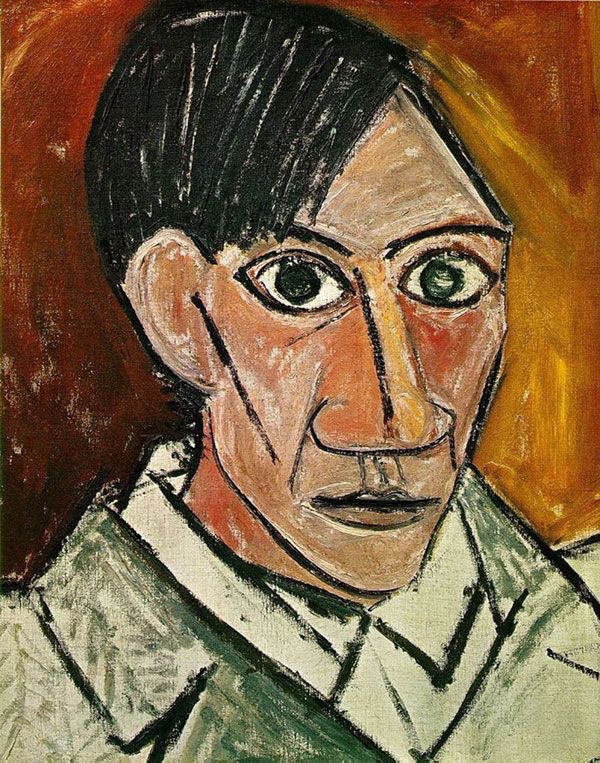
Picasso: Self Portrait, oil on canvas, 1907.
Art historians divide Picasso’s early periods into his Blue Period (1901-1904), the Rose Period (1905-1907), the African-influenced Period (1908-1909), and Cubism (1909-1919). Some art historians call Picasso’s African Period his “Proto-Cubist” or primitive period. It lasted from 1907 to 1909. Picasso was 24 years old when he saw an exhibit of African art at the ethnographic museum at Palais du Trocadéro. He experienced a “revelation” and began to explore African art further. African masks and sculptures strongly influenced Picasso’s art for several years, when he began to paint in sculptural forms, earth tones, and in flattened sharpened shapes.
Pablo Picasso in his Montmartre Studio,1908, via The Guardian
Picasso had first seen an African mask at Gertrude Stein’s home. Recalling his visit to the Trocadéro Museum of Ethnology (now the Musée de l’Homme), Picasso said of the museum:
“A smell of mould and neglect caught me by the throat. I was so depressed that I would have chosen to leave immediately. But I forced myself to stay, to examine these masks, all these objects that people had created with a sacred, magical purpose, to serve as intermediaries between them and the unknown, hostile forces surrounding them, trying in that way to overcome their fears by giving them color and form. And then I understood what painting really meant. It’s not an aesthetic process; it’s a form of magic that interposes itself between us and the hostile universe, a means of seizing power by imposing a form on our terrors as well as on our desires. The day I understood this, I had found my path.”
That path led Picasso to what he called his “periode nègre” (black period) or African period. It lasted only a few years, to 1909, but it turned Picasso into an avid collector of African art, masks, and sculptures that inspired him for the rest of his career.
Picasso: Woman with joined hands, 1907, Paris.
In our art class we chatted about how these masks inspired Picasso. Picasso used a palette of earthy tones, overlapping browns, and yellows with dark reds. By using Cubism, he explored a simplified geometry and the redefinition of perspectives. He tried to reveal objects from a different vantage point—from the mind, not only how the eyes perceive them. His Les Demoiselles d’Avignon signified a radical break from the naturalism that had defined Western art since the Renaissance, derailing former notions of what art was supposed to look like.
Picasso: Les Demoiselles d’Avignon (1907), oil on canvas.
People criticized Picasso’s two-dimensional women as unfeminine, for their confrontational demeanor was a complete departure from the traditional depiction of female beauty. Artists and critics alike received the work negatively and saw its menacing sex workers as promiscuous and unfit for Paris salons. Picasso rolled up the canvas, considered scandalous even amongst his innermost circle, and stored it in his studio for years to come. Yet this groundbreaking painting influenced his future works.
As Thomas Merton wrote in No Man Is an Island:
“In an aesthetic experience, in the creation or the contemplation of a work of art, the psychological conscience is able to attain some of its highest and most perfect fulfillments. Art enables us to find ourselves and lose ourselves at the same time.”
Picasso broke through the accepted boundaries of Western culture and discovered his true spirit in through the voices of the ancestors speaking from the African past. He met the other and found himself. By bringing the African masks into his studio, Picasso lived out the message of Hebrews 13:2—
“Do not neglect to show hospitality to strangers, for by doing that some have entertained angels without knowing it.”
As artists today, who seek to find their own true self and unique voice, we must both find ourselves and lose ourselves. We must lose our preconceived notions of who we should be and discover our true selves. Some artists use this as license to be caricatures of an artist, but actual artists have work ethics because they have obligations to galleries and clients. Looking like an artist and being an artist are two different things. Finding our true selves is not only a task for creatives, but also a lifetime journey for all people engaged in spiritual growth. We all can recover the image of God, which is our true self, by both God’s grace and our cooperation in doing good to all.
We artists are not here to make pretty pictures, but to break down the boundaries between our walls that keep us estranged from God and neighbor. We are not as bold as Picasso! Most of us are not risk takers. Willingness to leap out in faith is what marks a famous artist. That same riskiness is what marks the prophets of the Bible. Prophets never praise the status quo, but remind the people of the nature of their God:
“For the LORD your God is God of gods and Lord of lords, the great God, mighty and awesome, who is not partial and takes no bribe, who executes justice for the orphan and the widow, and who loves the strangers, providing them food and clothing.” (Deuteronomy 10:17-18)
Isaiah 1:17 reminded the people of his day, “learn to do good; seek justice, rescue the oppressed, defend the orphan, and plead for the widow.” Jesus will pick up this same voice in Matthew 25:40, “And the king will answer them, ‘Truly I tell you, just as you did it to one of the least of these who are members of my family, you did it to me.’”
So how will we find our unique voice and creative expression today? The more we steep our heart and mind in the great spiritual writings of the ages, particularly those of whom have come through great suffering or difficulties, the closer we will come to understanding our own challenges in life. These hardships are not hurdles or barriers to our progress, but refiners of any weakness that needed to be strengthened.
As my teachers always said, “We test you, not to see how ignorant you are, but to see what we failed to teach well.”
I always liked their attitude better! I did not feel so dumb when I missed the right answer on their tests. I always liked art better, for more than one answer could be correct. If we work within the parameters of the assignment, we can interpret the art with our own vision and style.
Our recent class with the African masks was a big diversion from our usual method of working. First, the masks are from a different culture. They are as much of a culture shock to us as they were to Picasso. He had the privilege of buying them in the Parisian curio shops, so they sat around in his environment. We only had images. The mystery of these objects might not connect to us as they did to him.
Mike’s Mask
Mike brought several masks from his home collection. He decided to paint one that spoke to him. Like Picasso, he had an emotional connection to this mask. He made a successful rendering of the object before him. Unfinished, he would bring it back to the next class.
Tim’s First Layers
Tim worked on a mask representing his wife. He first painted his background with a dark wash, then began drawing a lighter design on top of it. The contrast of the dark and light without the middle tone was difficult for me to look at, but he seemed to be enjoying getting the big shapes down. I often let people work without jumping into change their activity. I figure they will learn more from going down a dead-end road by themselves than if I stop them before they go there. They will ask about this, and we will talk about it. They will not do it again. A little suffering leads to learning if we do no harm to the body.
Gail’s First Layets
Gail S. understood the concept of simplifying the faces into a mask. She chose a photo of herself and her granddaughter. With two mask shapes, she had multiple decisions to make. As with the others, her work was unfinished at the end of class.
This was a difficult and challenging lesson for everyone. Asking students to make an emotional connection and render the object also was aspirational. It also gave me an opportunity to see where they were on this learning journey. I will not issue this sort of challenge again for a while. I was afraid I had been boring them, but maybe not. I may need to bring brownies next Friday to make up to them. For some, they may be “grief snacks,” while for others, they will be “encouragement food.” If my bunged-up shoulder permits, I will indulge in grief baking. Otherwise, I will just eat the chocolate ice cream in my freezer, and ask for understanding.
Cornelia’s Trump Portrait
I painted a Trump mask to get my emotions out and not have them bottled up inside. If we dislike an attribute in another person, it is because we have that attribute in our own life. I can get incredibly angry, but I bottle it up and it hurts me. I do not often let anyone else see it, so it can make me sick from holding it in. Whenever someone calls you a name, I remember the old song my parents taught me when I was a child:
“Sticks and stones may break my bones, but words will never hurt me.”
Anger is a difficult emotion for many people, especially for women. It is a “culturally unacceptable behavior,” for we have always expected strong emotions from men, but this expectation is changing over the generations. Proverbs 14:29 reminds all of us,
“Whoever is slow to anger has great understanding, but one who has a hasty temper exalts folly.”
The Old Testament often speaks of God’s anger, but this is because God’s people keep finding other gods to worship instead of the one true God. Psalms 145:8-9 reminds us of God’s true nature:
“The LORD is gracious and merciful, slow to anger and abounding in steadfast love.
The LORD is good to all, and his compassion is over all that he has made.”
The hidden mystery is in plain sight. It is the word of hope we hear: We are not sinners in the hand of an angry God. We are all beloved and God’s everlasting grace is redeeming us always. When things fall apart, God works to reframe and renew, even if we have difficulty recognizing God’s new creation or wanting to take part in God’s plans for the new heaven and the new earth.
Joy, peace, and recovery,
Cornelia
Historical Influence of African Art in the Modern Art Movement – ARTDEX
Einstein never said, “If we do the same thing every time, but expect a different result, this is the definition of insanity.” So why do artists return over and over to the still life? For that matter, why do preachers repeatedly use the same scripture texts for their sermons? Some of my former congregation members might have said I was overly fond of certain verses. The scalawags among them might have thought I did not get my point across the first five times I preached a version of the sermon text. As Jesus was wont to say in Luke 14:34-35 about Salt:
Picasso: Self Portrait, 1907, oil on canvas, National Gallery of Prague
“Salt is good; but if salt has lost its taste,
how can its saltiness be restored?
It is fit neither for the soil nor for the manure pile;
they throw it away.
Let anyone with ears to hear listen!”
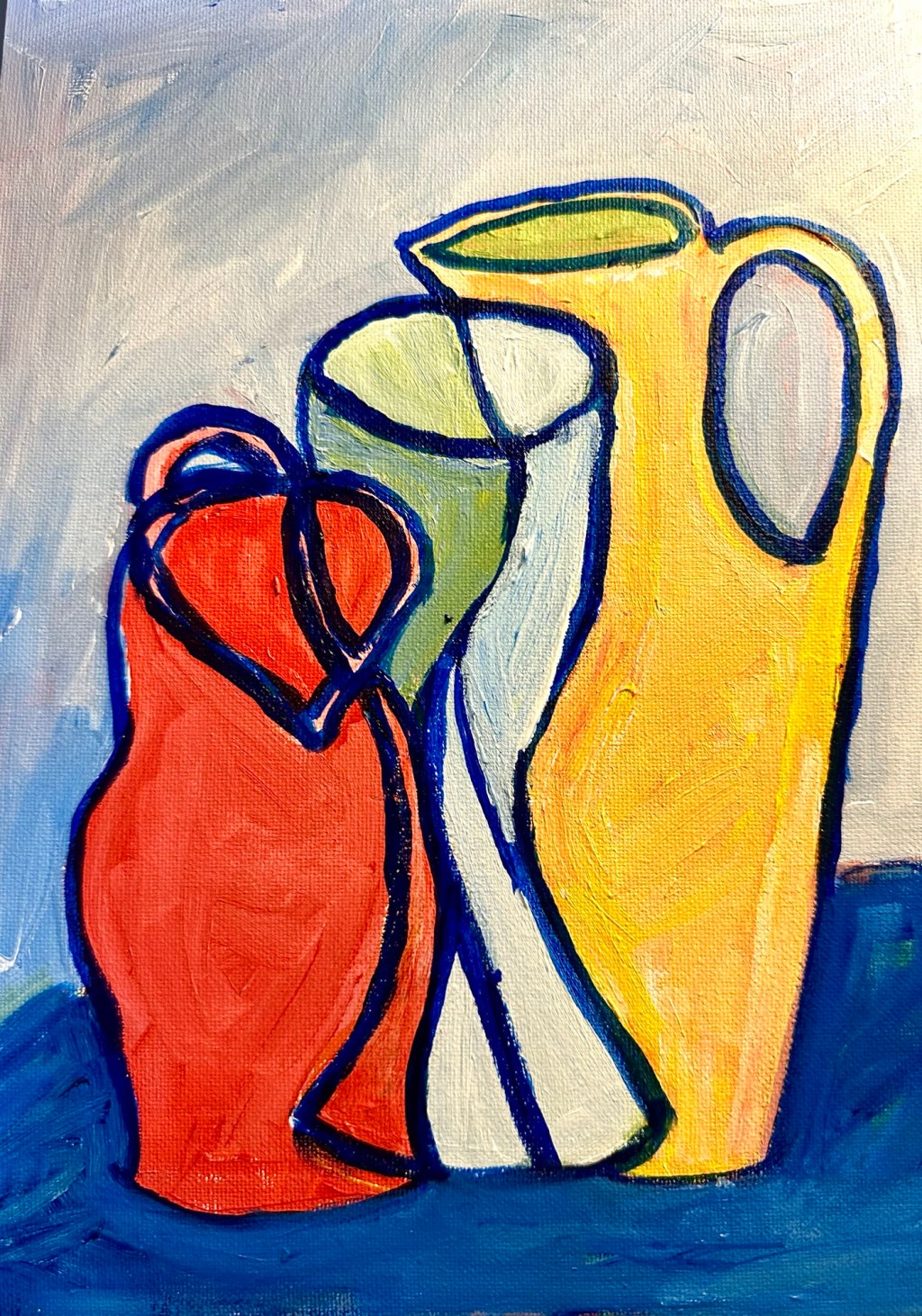
Three Sacramental Vessels
I always kept my sermon notes just in case I had a difficult week and might need a backup sermon, but I never used these notes. I wrote each of those sermons for a time and a place, but they were never useful for the current time or the present location. Likewise, an artist brings their emotions and experiences of the present time to each working session in the studio. Sometimes an artist is chock full of energy and power, full of joy and life. Their paintings or works exude these same emotions. At other times, the cares and chaos of the world intrude into the otherwise peaceful precincts of the artist’s workplace. These emotions and troubles will also be visible in their work, for artists are in tune with their times.
Picasso: Still Life with Dead Pigeon, oil on canvas, 1941, Nagasaki Prefectural Art Museum
This year in the adult art class I’m teaching at Oaklawn UMC, the students are getting lessons not only on how to paint, but on awakening their individual creative voice. These lessons are part art history and part “thinking like an artist” by painting in another artist’s style. The week before, we worked on a typical still life painting. For this session, we worked on what we saw in front of us, but tried to make an emotional connection with the objects. When most of our energy is going to getting proportions in proper order, shadows cast in the right direction, following the shape of the objects, and the colors correct, putting our emotions into the work comes in a distant fifth or last.
Morandi still life: he painted the same vessels so often, they became as friends who shared their innermost secret thoughts with him.
To be sure, our class is still analyzing the containers as physical objects more than feeling or experiencing the vessels as objects with personality. We have not yet become friends with the objects, or really gotten to know them on a deep and intimate level. This is also a problem in our society today. We are not willing to know others too deeply, and we aren’t likely to let many others know us too deeply either.
Gail S in the first week: realism
This isn’t a problem confined to older people. For my own demographic, meeting new people seems a mite risky these days in the online world because we never know who is behind that chatbot or Facebook account who seems so charming. For younger people, who sometimes never seem to come up for air from the online world, this online reality can seem more real than the three-dimensional world in which we live. (I was today old years when I learned the latest online AI fad is personalizing your own chatbot companion. I wonder if these chatbots have Asimov’s 3 Laws of Robotics ingrained in their program guardrails.)
Gail W in the first week: realism
Having empathy with inanimate objects is difficult. Artists bring into their own studio the objects which interest them. A teacher brings in objects her students can approach, given their skill level. I will blow that concept out of the water this Friday with some crazy Halloween pumpkins but, if the subject matter is consistently too difficult, many students will give up if the challenge is too far out of reach.
Picasso Still Life, oil on canvas, 1937, private collection.
In the second session when our class saw these same liturgical vessels, we chatted about Picasso and cubism. Cubism had several different forms of expression, but we focused on synthetic cubism, a later phase of the cubist style dating from about 1912 to 1914. It had simpler shapes and brighter colors. Synthetic cubist works also often include collaged real elements such as newspapers and cardboard. These works have interesting designs, such as multiple points of view (perspective), overlapping shapes which make their own patterns, and linear outlines. This style is an outgrowth of the work of Cézanne, who said: “A work of art which did not begin in emotion is not art.”
Gail S. took a cubist vision to our same three pots
If you’ve ever tried to put on your socks in the morning beginning with a different foot than normal, you can begin to appreciate how difficult it is to imagine how to create an artwork in a fresh style. If we were to ever have a stroke or a traumatic brain injury, relearning how to do simple tasks is much the same.
Tim’s first effort. He was one week out from surgery. His body was devoted to recovery, not to thinking about cubism.
Our brains can handle the rebuilding project, but we will feel strange doing it! This is because we are building new neural circuits and pathways in our brains. Going to work or the grocery store by taking a different route also feels strange, as does a golfer trying to reconstruct their swing pattern.
Tim took a second week to elaborate on his still life. It’s a better solution! Amazing what happens when our bodies have extra energy to give to creative projects.
As a comparison, we can look at the great hurricane which came through North Carolina recently and took out the big interstate highway that runs through the mountains and valleys. The sooner the highway construction engineers can come inspect the ground, the better. They must decide if the land is safe for rebuilding and then check the infrastructure also. They may need to redesign the road to current standards and also the underlying roadbed. When the great 1900 hurricane hit Galveston, rebuilding the city took twelve years. People were still living there, and life was going on, but the city began a process of raising the land levels and building a sea wall that took that extensive time.
Cornelia’s overlapping shapes and shifting perspectives
Change doesn’t happen overnight. Every sales or leadership training session I’ve been in has emphasized the idea “Three weeks are necessary to build a habit.” The origin of this myth has nothing to do with habit formation. Instead it comes from a 1960 self-help book Psycho-Cybernetics, in which plastic surgeon Maxwell Maltz wrote how his patients took about 21 days to become used to their new appearance after surgery.
He did no double blind, peer reviewed study to verify this, but his book applied this 21-day timeline to many other wide-ranging aspects of self-transformation in life. He also believed three weeks was the time people needed to adapt to a new house or change their mind about their beliefs. (He also didn’t live with a preteen girl child who enjoyed rearranging the living room every night just to see how her mom negotiated a new obstacle pattern in the dark when she came home from a sales call.)
If artists want to make paintings which are technically proficient and resemble the objects they see, they are only halfway to creating a good painting. They must also bring who they are and allow the voice of God to speak through their hand to make a masterpiece. In this way we separate artists into the good and the great, the ordinary and the masters. Not all of us will be prophets who listen to God’s word, but all of us can and should silence our hearts and minds of the world’s chatter and claims so the word of God can pierce our hearts.
Picasso: Guernica, 1937, 11’ x 25.5’, Museo Nacional Centro de Arte Reina Sofía (MNCARS), Madrid, Spain
Rabbi Nahum Ward-Lev describes how the ancient prophets listened for God’s liberating word:
“At its heart, the prophetic witness was a way of listening, listening beyond the social norms of the day, listening to the word of the liberating God. The prophets urged the people to listen to God’s word because the discourse of the king, princes, and wealthy landowners was too narrow and was limited to the interests of these elites. This conversation did not include the voices of suffering people. The prophets, in God’s name, offered a much broader discourse, a conversation that listened to and addressed the needs of the poor and the disadvantaged….
The prophetic listening tradition is alive today to inspire people to listen beyond the established conversation. The prophetic tradition challenges us to listen especially to the cries of those who suffer and to listen to the voice of alternative possibility, to the voice of God.”
Picasso: Still Life—fruits and pitcher, oil and enamel on canvas, 10 3/4 x 16 1/8 inches, Guggenheim Art Museum, NYC.
Making a painting is quite different from making a work of art. This is why house painters aren’t called artists. They may cover a surface with color and not make a mess, but their heart and soul isn’t in their work. Learning to risk our vulnerability and emotional expression is also part of art class, just as much as learning what colors to mix to make orange or green. Picasso, quoted in Alfred H. Barr Jr.’s Picasso: Fifty Years of his Art (1946), understood this:
“The artist is a receptacle for emotions that come from all over the place: from the sky, from the earth, from a scrap of paper, from a passing shape, from a spider’s web.”
We have these same experiences also, but we don’t realize these are part of the artist’s toolbox. These ordinary moments of life are also the extraordinary means of God speaking to us, if only we have ears to hear and a heart and hands ready to be used by God for God’s good purposes.
Joy, peace, and prophecy,
Cornelia
Quote Origin: Insanity Is Doing the Same Thing Over and Over Again and Expecting Different Results—Quote Investigator®. The origin of the quote is misattributed to Albert Einstein, but it originated in the 12-Step Anonymous groups in the 1980’s.
The first bright light of creation must have been an awesome sight. Of course, only God was there to see it or hear it. The earth was a formless void, and darkness covered the face of the deep. Genesis 1:3 tells us, “Then God said, “Let there be light;” and there was light.”
John Martin: The Creation of Light, Mezzotint, 1825, Royal Collection of the Arts, London.
I have often wondered if God’s creation of light was accomplished with sound. If at one time only darkness existed, then suddenly light appeared, would this sudden change happen like an atomic bomb flash? Not with the bomb’s destructive evil and force, but with the creative and life-giving energy of God’s power and love. While scripture tells us we hear God’s voice in the sheer silence (1 Kings 19:11-12), this is after God has created everything which we humans might worship instead of God. When God first created light, what was the power behind God’s words?
George Richmond: The Creation of Light, Tempera, gold, and silver on mahogany, 1826, support: 480 × 417 mm, frame: 602 × 539 × 66 mm, Tate Gallery, London.
Maybe no one cares, for if no one is in a forest to hear a mighty oak fall, can we say it ever made a sound? Just because human beings weren’t created yet does not mean the light did not come into existence or make a noise. We might as well say bombs are not leveling towns in Ukraine and Gaza merely because we are not running from the falling bricks and dust. Yet, we can see the pictures on television and know these facts as true.
We are in a trickier situation when we try to find information to prove the existence of the creation of the first light and the facts of its origin. We are certain light was created, for light now exists. Tracking light’s history to its birth story is the challenge!
The Creation of Day and Night, by Francisco de Holanda, De Aetatibus Mundi Imagines, 1543.
When the Old Testament says God created light, the ancient readers understood this word to mean a special light, not the light of the sun, moon, or the stars. God created these lesser lights on a later day, so they possess a different form of light from the first light. The early Hebrew philosophers distinguished between chomer, matter, and tzurah, the form or function of an object. A raw material has chomer, matter, but once it’s made into an object, it acquires the form or tzurah.
Michelangelo’s The Separation of Light from Darkness, (c. 1512), the first of nine central panels that run along the centre of the Sistine Chapel ceiling.
At the beginning of creation, nothing had form. It was all matter. Then God created the Ohr Ha-Ganuz, or the Hidden Light. This special light played a critical role in Creation. Just as regular light allows us to see and relate to our surroundings, the Hidden Light enabled the different elements of creation to interact with one another. It dispelled the initial state of darkness when all objects were isolated and disconnected from one another. Through this special light, the universe’s myriad objects acquired purpose and function and were able to work together towards a common goal.
About 13.8 billion years ago, our universe ballooned outward at an incredible speed. Everything we see today, which was once packed tightly together, expanded in a roiling mass of light and particles. It took 380,000 years for this hot, dense soup to thin and cool enough to allow light to travel through it. This first light, dating back to the formation of early atoms, we call the cosmic microwave background and we can still detect it today.
Creation: Bright Beam, stage 1
The Advanced Simons Observatory in the Atacama Desert in Chile is on the forefront of research for detecting cosmic microwave background radiation to give us a better picture of the early universe, its evolution, and the many phenomena within it. Beyond the cosmic microwave background, they will hunt for and study the birthplaces of distant stars, the contents of interstellar dust, exo-Oort clouds—spherical shells of ice and dust at the edges of solar systems—and several other phenomena. But, given the unique capabilities of this observatory, they are also open to finding some unexpected and unexplained puzzle pieces in the universe that we did not know we were missing.
Creation: Bright Beam, stage 2
Before there were any stars or galaxies, 13.8 billion years ago, our universe was just a ball of hot plasma—a mixture of electrons, protons, and light. Sound waves shook this infant universe, triggered by minute, or “quantum,” fluctuations happening just moments after the big bang that created our universe. The question we first asked, “Did the creation of light make an audible sound?” is related to the “cosmic wave background radiation” that the observatory in the Chilean desert is seeking.
Although scientists call this moment the Big Bang, it was not a loud explosion. Instead, it was more like an imperceptible humming because this first moment happened when the universe was denser than the air on Earth and sound waves could travel through it. This covered the first 100,000 to 700,000 years. As the universe cooled and expanded, the sound waves grew longer and and the sounds lower. As the universe continued to expand, the wavelengths became so long the sounds became inaudible to the human ear.
NASA Sound File Magnified of Big Bang Microwave Radiation
For this sound file, the patterns in the sky the Planck Observatory observed were translated to audible frequencies. This sound mapping represents a 50-octave compression, going from the actual wavelengths of the primordial sound waves (around 450,000 light-years, or around 47 octaves below the lowest note on the piano), to wavelengths we can hear.
Creation: Bright Beam, stage 3 in the studio
Maybe as you read this, you wonder, why do artists have an interest in science? This is an attribute of artists from Leonardo in the Renaissance down through the Impressionists who studied the play of light and atmospheres on surfaces in the 19th century. Today we know the speed of light means we are always seeing a “late arriving sunbeam.” The speed of light gives us an amazing tool for studying the universe. Because light only travels a mere 300,000 kilometers per second, when we see distant objects, we’re always looking back in time. If we the universe clock backwards, right to the beginning, and you get to a place that was hotter and denser than it is today. So dense that the entire universe shortly after the Big Bang was just a soup of protons, neutrons, and electrons, with nothing holding them together.
Lentil and ancient grains pasta soup, held together by melted cheese—metaphor for the early universe
The moment of first light in the universe, between 240,000 and 300,000 years after the Big Bang, is known as the Era of Recombination. The first time that photons could rest for a second, attached as electrons to atoms. It was at this point that the universe went from being opaque, to transparent. The earliest possible light astronomers can see is the cosmic microwave background radiation. Because the universe has been expanding over the 13.8 billion years from then until now, those earliest photons were stretched out, or red-shifted, from ultraviolet and visible light into the microwave end of the spectrum.
Today we have tools unavailable to the 15th or 19th centuries, but what we have in common is the human mind. Because we are created in the image of God, we have the same desire to create and shape our world and to understand our place in it. For some people, they find placing their trust in God’s absolute power over all creation and events as a way of understanding the problem of good and evil in the world. This justifies suffering and allows them to ignore the plight of the poor. Prosperity religion, which preaches the good prosper and the bad suffer, is a classic example of this theological belief. We United Methodists believe in doing good to all people, as often as possible, with all the means we can. As the gospel says in Matthew 25:37-40—
Then the righteous will answer him, ‘Lord, when was it that we saw you hungry and gave you food, or thirsty and gave you something to drink? And when was it that we saw you a stranger and welcomed you, or naked and gave you clothing? And when was it that we saw you sick or in prison and visited you?’ And the king will answer them, ‘Truly I tell you, just as you did it to one of the least of these who are members of my family, you did it to me.’
We know Jesus as the Light of the World (John 8:12)—
Jesus spoke to them, saying, “I am the light of the world. Whoever follows me will never walk in darkness but will have the light of life.”
Perhaps this ancient light of creation has not yet reached everyone who reads these words. I can only guess they ignore even the voice of the Old Testament prophet Isaiah (58:10):
“If you offer your food to the hungry and satisfy the needs of the afflicted, then your light shall rise in the darkness and your gloom be like the noonday.”
The sun will always shine when we help others. The light of Christ will burn bright in us to burn away our gloom and despair when we give a hand to others who are in need. Their lives will be brighter in turn. We often turn away from people in hard circumstances because we do not want to face the prospect that we one day might need a hand up. This strikes at our self image of invincibility and self sufficiency. We keep remembering “God loves a cheerful giver.” If we think only of this part of the verse outside of its context, we might think God only loves the giver. God also must love the one in need to provide the blessing for the giver. As we read in 2 Corinthians 9:7-8—
Cornelia DeLee: Creation: Bright Beam, acrylic on canvas, 16” x 20”, 2024.
“Each of you must give as you have made up your mind, not reluctantly or under compulsion, for God loves a cheerful giver. And God is able to provide you with every blessing in abundance, so that by always having enough of everything, you may share abundantly in every good work.”
As an old mentor of mine taught me, “Don’t do all the work for your people. You’ll rob them of the blessing of serving the Lord.” None of us can replace the eternal light of Christ, which has been traveling to us since the dawn of time, although the Light has been with God since before time began. This Light is even now permeating the universe, in a prevenient journey to the furthest distances of creation. There is no place the Light will not go before us. Even as we attempt a return to the moon and hope to go to Mars in the future, the light of Christ has already gone before us.
If this does not give you hope in what many think is a dark and despairing world, refocusing on the Light with us instead of the darkness that always seems so near might help to change your attitude.
The great and wonderful part of art is exercising imagination and discovering new ways to solve problems. One of my favorite memories in art school was the day our professor came to class with a single red clay brick. Our first thought was this is going to be the most boring drawing class ever, but then he asked us, “How many uses can you find for a brick?”
Thick as a Brick
After we quickly named multiple uses for a single brick—doorstop, paperweight, weapon, counterweight, and bookend—we were at a loss to name much more. As we scratched our heads, our teacher prompted us, “Did I restrict you to a single brick?” And we were off to the races! Wall, fireplace, house, road, sidewalk, planter, sculpture, picnic table, bookshelf, and more. I can’t remember if this was an early morning class or we were just dense, but I’ve come to believe we can teach creativity. At the very least, we need to give people permission to accept “multiple art answers can be true” and give them the opportunity to consider “other possibilities.”
Canvas bound in strings
When I taught art years ago, children who were troublemakers in regular classrooms were usually well behaved in art class. I attribute this outcome to their ability to express their own individuality in solving the weekly art assignments. Math always has a right answer; there is no “alternative fact” to 2 + 2 = 4. History is the same: the Confederacy seceded from the Union to keep their economic system of enslavement. There was no “states rights movement,” no matter what the Lost Cause proponents pushed in our state approved textbooks. All we had to do was look at the original source documents from the 1860’s.
Simple Color Wheel
Adults usually conform to socially acceptable norms. Helping adults with creative thinking is important because the creative process is more important than the tangible result. Most adults give up the idea they will ever paint the Sistine Chapel ceiling, while children are humble enough to realize they need many more years of practice before they get that kind of opportunity. Also, what we know about creativity can’t be applied in the same way to all creative endeavors because they involve different subjective decisions and processes.
Gino Severini: Expansion of Light. (Centrifugal and Centripetal), ca. 1913 – 1914, Oil on Canvas. 65 x 43.3 cm Museo Nacional Thyssen-Bornemisza, Madrid
Creative insight depends in part on new combinations of existing ideas, concepts, and perceptions that the brain has stored over time. This is why we begin each class looking at famous art works. We need good art influences and inspiration to “prime our creative pumps” so we can draw up from the pure wellsprings of our own creativity. Just as we need spiritual food for our soul, we need beauty for our creative ideas.
First stage
Last year we worked on copying the color wheel and matching it. That is an intellectual skill. To make this into a creative, intuitive activity, we took strings and wrapped our canvases. This made multiple shapes for our colors. Using the primary colors—red, yellow, and blue, plus white—we mixed various combinations and surprised ourselves with the results.
Gail W’s first stage
Our first class was lightly attended, due to doctor appointments and vacations, so we still have room for anyone else who wants to come. All skill levels are welcome, for I’ve taught from K-5 to adults. Everyone progresses from their own level, so the longer you sit and think you wish you were good enough for lessons is merely time wasted when you could be working with a practiced teacher! Anyway, the lessons are free; you bring your materials and discover your unknown abilities and gifts. We journey with fellow travelers. Plus it keeps your brain young.
We will continue to work on this project next Friday at 10 am.
Joy and peace,
Cornelia
National Endowment for the Arts: Creativity and the Brain
In the dead heat of summer, our gardens aren’t putting forth the fruit of our planting. Maybe the animals of our neighborhood have made their too frequent nightly visitations, so our harvest is skimpy. We can forget God is a both a creating god and a recreating god as well. The first words of the alternate NRSV translation of the Bible’s first book Genesis (a word meaning “origin”) are—
First stage: string, fabric scraps, and under painting
“When God began to create…”
In the old KJV, Genesis 1:1 reads—“In the beginning, God created the heaven and the earth.”
I appreciate even more the next verse from Genesis 1:2—
“The earth was a formless void and darkness covered the face of the deep, while a wind from God swept over the face of the waters.”
Alternate translations read— “while the spirit of God or while a mighty wind” swept over the face of the waters. This reminds us nothingness and darkness aren’t problems for God, who is able to bring glorious light to any situation.
Psalms 139:12 speaks of the nature of God:
“Even the darkness is not dark to you; the night is as bright as the day, for darkness is as light to you.”
I’ve lived for over half a century with chronic depression, so I can recognize darkness, not only in my own life, but also in the lives of others. Most of my ministry and even my secular work was done with a calling to bring others to the light of hope and confidence that anything was possible.
In art classes, I asked my students to trust in ABC—Attitude, Behavior, and Consequences. If they had a Positive Attitude, they would have Positive Behavior and work on their assignments. If they worked, they would see Positive Consequences or Improvement over time. Asking people who’ve been told they can’t do art to believe they can learn even if they aren’t “talented” is a big ask, but if they have faith in this promise, they discover it’s true.
When I sold insurance, I asked people to trust in the idea of making a small sacrifice now to prevent a greater loss later. Also, if they had no loss, they shared in a community to underwrite the group losses and keep the cost of protecting their own property low. Not everyone has the light to see this benefit of community, but for those who do, I could help keep their consequences from being a disaster.
Second stage: overpainting, printed circles, and added ruler lines
When I entered the ministry, I discovered congregations who had lost their faith in the God who could make something out of nothing This began with the creation story, the choosing of the nation of Israel to be God’s people (even though they were once no one’s people), and feeding them in the extended wilderness wandering before they arrived at the promised land. The Bible is full of examples of God’s providing more when people have too little to sustain them: Elijah and the widow of Zarephath, the feeding of the crowds with a few fish and loaves, and the water turned into wine. These modern people didn’t have a “recreating faith” that God could work in their lives today, just as God had once worked in the lives of others in the days of Christ.
That is what we call a “dead faith,” or as John Wesley put it in his notes on the New Testament at 2 Timothy 3:5— “An appearance of godliness, but not regarding, nay, even denying and blaspheming, the inward power and reality of it.”
It’s dead, because the Spirit isn’t at work in it. I used to tell my beloved evangelism professor, the late Dr. Billy Abraham, the first place we needed to do evangelism was in the local church, because folks hadn’t heard the good news. If they weren’t excited enough to have a living faith, they wouldn’t go out and spread the good news to others.
I’ve never been a cheerleader, although I did have some time in my high school pep squad. I was more often involved in making the football banners and pep posters for the other sports activities. Also debate team took up much of my time. One of the best practices I learned in debate was positive points sell better than negative ones. Also, it’s better to make the same point over and over with different facts and examples.
When I say our God is a creating and recreating God, I can point to the beautiful verses of John 1:1-5—
“In the beginning was the Word, and the Word was with God, and the Word was God. He was in the beginning with God. All things came into being through him, and without him not one thing came into being. What has come into being in him was life, and the life was the light of all people. The light shines in the darkness, and the darkness did not overcome it.”
In the beginning was the Word
As believers in the Holy Trinity, the Word made flesh is Christ, so he was co-creating with God the Father and God the Holy Spirit from the beginning. By virtue of the incarnation, Christ takes on our flesh to redeem us and make us whole again. This comes to completion through the cross. When we place our faith in Christ’s act of love for all creation, we are made one with Christ, and one with God. The Holy Spirit brings us ever closer to the true nature of Christ, until we’re perfected in love of God and neighbor.
I painted on unprimed canvas, just to see what would happen. Also, because I knew the paint surface would be different than the usual texture on the primed canvas. After I painted several different colors in blocks with the scrap pieces of cut canvas used as “masking tape,” I decided to use a mix of iridescent gold and silver acrylic paints to glaze over the under painting. I also added some circles and straight lines. I’ve collected a few jar tops recently, I used some string elements, and I had a school ruler left from my last teaching job back in the 1980’s. (Yes, I keep things. They are tools of the trade. My Sears Craftsman staple gun from art school finally died after half a century of use.)
I’ll be working some more of these experiments for a while. Creating and recreating our lives is what keeps us new every morning. As someone who has been renewed and recreated more than one time can attest, along with the prophet Jeremiah,
“For surely I know the plans I have for you, says the LORD, plans for your welfare and not for harm, to give you a future with hope.” (29:11)
Joy and peace,
Cornelia
John Wesley’s Notes on The New Testament, 1755:
2 Timothy 3:5—“holding to the outward form of godliness but denying its power. Avoid them!”
We are a people who follow Jesus, “the pioneer and perfecter of our faith, who for the sake of the joy that was set before him endured the cross, disregarding its shame, and (who) has taken his seat at the right hand of the throne of God,” as the writer of Hebrews 12:2 reminds us. The suffering servant motif of Christ was once a model all early Christians expected to inherit and emulate.
The Suffering Servant
Paul spoke to this suffering model in his letter to the Romans:
“…How can we who died to sin go on living in it? Do you not know that all of us who have been baptized into Christ Jesus were baptized into his death? Therefore, we have been buried with him by baptism into death, so that, just as Christ was raised from the dead by the glory of the Father, so we too might walk in newness of life. For if we have been united with him in a death like his, we will certainly be united with him in a resurrection like his.” (6:2-5)
Paul’s first sentence is perceptive because he recognizes many who call on the name of Christ nevertheless go on living an unchristlike life. In the early Christian centuries, many didn’t get baptized until they were near death because they weren’t ready to change their wicked ways. The early Christian habit of hyper-delayed baptism is well attested by the later fourth century. Apparently, the reasoning behind waiting until fairly late in life was the belief baptism cleansed sin once and only once. Consequently, any meaningful sin after baptism could leave one in a serious lurch in the economy of salvation. We have the well-known example of the early 4th CE Emperor Constantine who delayed baptism until his deathbed.
Of course, this is a misunderstanding of the Holy Spirit’s work of perfecting our human nature, but it took many centuries to work this out. We can thank John Wesley for our understanding the works of grace in the ongoing process of Christian Perfection. Baptism washes us from the stain of original sin, which is common to all humanity. Baptism also anoints us with the Holy Spirit to be continually with us and bring us to know God’s saving love in Jesus Christ.
As we grow in faith and the Spirit of God calls us to give our lives to Christ, we are justified from past sins. Some faith communities stop here, so they need over and over justification. They have no ongoing theology of sanctifying grace. We United Methodists do have this great gift, which we can give to the world. When we aren’t going on to perfection in love quite as fast as our neighbors wish we were, it’s because we’re being stubborn and resisting God’s grace.
W. H. Auden says it best:
“We would rather be ruined than changed,
We would rather die in our dread
Than climb the cross of the moment
And let our illusions die.”
The Cross and Self-Denial
The cross is ever a witness to our willingness or unwillingness to bear the cross of Christ. As Jesus told his disciples:
“If any want to become my followers, let them deny themselves and take up their cross and follow me. For those who want to save their life will lose it, and those who lose their life for my sake will find it. For what will it profit them if they gain the whole world but forfeit their life? Or what will they give in return for their life? (Matthew 16:24-26)
Often we interpret this verse in terms of giving up material possessions, but we can never give up outward things unless we’re first willing to give up our false images of ourselves. We might want to be large and in charge, or soft and sweet. Perhaps our self image is invested in being holy and serious. We may even be the class clown. These are only masks behind which we hide our truths and vulnerabilities.
Jesus spoke a parable in John 12:24-25—
“Very truly, I tell you, unless a grain of wheat falls into the earth and dies, it remains just a single grain; but if it dies, it bears much fruit. Those who love their life lose it, and those who hate their life in this world will keep it for eternal life.”
If we want to be changed, we must die to our ordinary selves, and then rise as a new creation. If we remain the same, we won’t be much, but if we’re willing to take on the image of Christ, we can be a new creation of the first order.
How The Witness was made
Ukrainian children’s hospital bombed by Russia
This is how art gets made. I saw an image of a bombed-out children’s hospital in Ukraine. Because the photographer had cropped it in a certain way, I saw an image of a cross on the brickwork. Those rectangular bricks contrasted with the diamond shaped wire work in the darkened areas in the four outer quadrants. I usually weave the whole painting surface, but this time I wove only the cross area. That was a challenge. I had to invent a new way to secure the woven canvas strips on the wooden stretcher strips.
Weaving two paintings together
As I painted the first layer, I made all the contrast of bright colors in the cross and dark blues and reds in the outer quadrants. The next day, I added a gold wash over the cross squares and painted diamond line patterns over the dark quadrants. I came back to add silver into the diamond shapes and to touch up the diagonal lines. I also painted the sides of the canvas to unify it.
Adding blocks of color to the cross of witness
I began with a gritty black and white image, but ended up with bright colors, silver and gold. This too is a metaphor for for the change which we undergo when we die to old selves and begin our transformation into the wholeness of the new creation in Christ. As Paul wrote to the Corinthians:
Gold cross and diamond shapes in the dark quadrants
“So if anyone is in Christ, there is a new creation: everything old has passed away; see, everything has become new! All this is from God, who reconciled us to himself through Christ, and has given us the ministry of reconciliation; that is, in Christ God was reconciling the world to himself, not counting their trespasses against them, and entrusting the message of reconciliation to us.” (2 Corinthians 5:17-19)
Finished painting: Cross of Witness
The cross isn’t a means to divide us from one another, just because we hold varying views on baptism, holy communion, pastoral authority, and scriptural authority or interpretation. The cross stands as a witness to all who are willing to give up their identities to their old egos and claim the only one uniting all persons every day.
Unity through the Cross
This is the Christ, whose love was so great for all creation, he was willing to be lifted up on the cross to draw all humankind unto himself. As Jesus said in John 12:32-33—
“And I, when I am lifted up from the earth, will draw all people to myself.” (He said this to indicate the kind of death he was to die.)
We want to have our Big Mac and Eat it too.
Delusional Mathematics
As we self interested people today have difficulty with many of the words of Christ, we resort to our cafeteria style of choosing which bites we want to enjoy. If a dish in the line is too expensive or not on our diet plan, we can ignore it. The problem with Christ is how we can ignore one claim upon our faith, reject another, and keep another. As a dieter from way back days, I splurged on many a Big Mac or Whopper and large fries, which I washed down with a giant Diet Coke. Unfortunately, my body didn’t follow the same mathematical logic of my mind. I was practicing delusional math.
“Cheeseburger and fries, with a side of Diet Coke.”
“This is my commandment, that you love one another as I have loved you. No one has greater love than this, to lay down one’s life for one’s friends. You are my friends if you do what I command you” (John 15:12-14). John Wesley, in his sermon, The Almost Christian, talks about those who have the outward form of Christianity, but not the inward being. They can be recognized by their attendance at Sunday services, their good deeds, and their attention to the outward shows of ritual. Inside, however, their hearts aren’t filled with love, but with anger, spite, or mere duty instead. They lack sincerity, which is a classic characteristic of one who wears a false mask.
The Last Presidential Assassination
When Ronald Regan was shot by a would-be assassin, his diary recorded his thoughts on his excruciating experience.
“Getting shot hurts. Still my fear was growing because no matter how hard I tried to breathe it seemed I was getting less & less air. I focused on that tiled ceiling and prayed. But I realized I couldn’t ask for God’s help while at the same time I felt hatred for the mixed-up young man who had shot me. Isn’t that the meaning of the lost sheep? We are all God’s children & therefore equally beloved by him. I began to pray for his soul and that he would find his way back to the fold.”
The Altogether Christian
To be a Christian in the true sense, Wesley says the “Altogether Christian” requires us both to “love God and neighbor in our hearts until nothing else exists.” This means even our enemies. I personally find this the most difficult part. I can hold a grudge with the best of the nonbelievers. Yet I don’t find myself calling those people evil or deranged, like so many others who seek to find a reason for their scapegoating.
I can still see people, even myself, as part of flawed and fallen humanity.
Christian Perfection
Wesley defines the pure faith: “Now, whatsoever has this faith, which purifies the heart, (by the power of God, who dwelleth therein,) from pride, anger, desire, from all unrighteousness, from all filthiness of flesh or spirit; which fills it with love stronger than death, both to God and to all mankind; love that doth the works of God, glorying to spend and be spent for all men, and that endureth with joy, not only the reproach of Christ, the being mocked, despised, and hated of all men, but whatsoever the wisdom of God permits the malice of men or devils to inflict: whosoever has this faith, thus working by love is not almost only, but altogether a Christian.”
Under John Wesley’s exacting standards, we may all be “almost Christians,” but the good news is we can always hope in the one who gave his life to begin a new life in us and others. If we pray for our enemies’ faults, which we spot so easily because they are our own, God will help to heal both them and us.
Mending Broken Hearts
The Cross Supplants Division
An ancient wisdom story told among the rabbis says the students were questioned on the difference between night and day. All their answers marked divisions: some prayers are said only at certain hours, or there isn’t enough light to distinguish one field or a house from another. The rabbi grew frustrated and cut them off. “You only know how to divide! Daylight begins when you can look on your neighbor’s face and see a friend, not an enemy.”
In this time of division, the witness of the cross reminds us Christ died for all humanity, so no one is outside the love of Christ. If we’re to love our neighbor as ourselves, caring for the poor and marginalized should be a priority for the people of faith. Our neighbors don’t stop at our borders, for our world is interconnected.
Migrations were a fact back in Abraham’s day, when Egypt was the land of opportunity. We ought to treat immigrants better than the Pharaohs treated the Hebrew people. Moreover, in our current political landscape, we might want to quit name calling and playing to the lowest denominator of our bases. Policy statements won’t get sound bites on television, but that’s a good thing. Sound bites play to our false selves and not to our true selves in Christ Jesus.
DeLee: Sun Mandala, 2022, private collection
I can close with a poem from the Persian poet Rumi:
I only speak of the Sun because the Sun is my Beloved I worship even the dust at His feet.
I am not a night-lover and do not praise sleep I am the messenger of the Sun ! Secretly I will ask Him and pass the answers to you.
Like the Sun I shine on those who are forsaken I may look drunk and disheveled but I speak the Truth.
Tear off the mask, your face is glorious, your heart may be cold as stone but I will warm it with my raging fire.
No longer will I speak of sunsets or rising Moons, I will bring you love’s wine for I am born of the Sun I am a King !
Joy, peace, and sacrificial love,
Cornelia
—W. H. Auden, The Age of Anxiety: A Baroque Eclogue (Princeton, NJ: Princeton University Press, 2011), 105.