Two Types of Color Wheels

adult learning, art, color Wheel, Creativity, flowers, Painting, picasso, Rumi

Rumi, the 13th CE Persian poet and theologian, once said, “Inside you there’s an artist you don’t know about…say yes quickly, if you know, if you’ve known it from before the beginning of the universe.” Most of us live unawakened to this talent. When we were children, we had no thoughts of “trying to be an artist.” We picked up colors or clay and made our shapes and designs without a care in the world. Our loved ones praised our projects, and we felt good.

Johannes Itten: In the beginning

Somewhere along the 4th or 5th grade, many of us lost touch with that artist within. As Picasso said, “It took me my whole life to learn to draw like a child.” What Picasso meant is he learned all the adult rules for a good painting first and then unlearned them so he could create something completely new. When children are between 9 to 13 years old, they try to draw more naturalistic figures and landscapes by using shadows and perspective. They also start comparing their work with others, but this discourages those who are not discovering the new visual language of realism.

Picasso: Great Still Life on Pedestal, 1931, oil on canvas

As a result, by the time many children reach middle school, they are no longer in touch with their inner artist. Young children do not worry about whether they are wrong. They will forge bravely into unfamiliar territory, even knowing they may make a wrong decision. However, as we mature, we quickly learn that being wrong often has negative consequences. We learn quickly in school that making mistakes brings negative consequences. Not studying for the test brings a bad grade. Talking too much might get a time out in the dark cloak room (traumatic 3rd grade experiences).

Jeannie: Color Wheel Flower

Teaching art to middle school students who say, “I can’t draw a straight line without a ruler” always got my retort, “We don’t have straight lines in nature, so you won’t have that problem in this class!” They learned working would bring improvement. This is a lesson learned well by the folks who have been with me for the last five years since Pastor Russ Brashears invited me to teach classes here. While we are saved by faith, not by works, in art class we need to have faith that our work will bring us closer to perfection. (Of course, there’s always an exception …)

Frank Stella: Harran II, 1967, Polymer and fluorescent polymer paint on canvas

At work, the boss penalizes us for being wrong. According to Sir Ken Robinson, an expert in creativity, “If you are not prepared to be wrong, you will never produce anything original. Since creativity inherently requires a willingness to be wrong, we begin to avoid it. For many of us, we become so good at avoiding it that we convince ourselves we are “not creative.” Another destroyer of creativity is current need to teach to the test standards. The one right answer for this important test leads children to think many questions have one answer, when in truth, multiple answers might be worthy.

Gail: Color Wheel Designs

In addition, many factors that seem related to the self-controlled aspect of ourselves—like research, facts, or being grounded in reality—feel like they are helping us mitigate the risk of being wrong. Therefore, we rely more on our executive function skills and behaviors, and less on our imaginative behaviors. Psychologists at Cornell University conducted a study that showed that we have an implicit bias against less conventional, practical-seeming ideas. We tend to like what everyone else likes, rather than original or creative ideas.

Johannes Itten: Bau Haus Color Star with Shades, 1921

This tendency runs deep since studies going back to the 1950’s have shown people are prone to conforming to popular opinions and perspectives. Research suggests that the rote learning and direct instruction used in schools often drives out whatever nonconformist tendencies we may have as children. This type of instruction may counteract our more exploratory and creative modes of thinking and learning. The Fauves, or “wild beasts,” were a group of French artists who scandalized the Academic standards by painting in wild and unnatural colors to evoke emotion, rather than observable reality. Of course, we love their works today.

Mike: Age of Aquarius: moon in 7th house

Half our class has been doing the color wheel multiple times, while the other half is getting their first exposure to it. Gail and Mike have made enough color wheels that I would not ask them to make another unless we changed our medium. Then it is always worthwhile to see how a new set of colors behaves when mixed. I gave them the guide, “Choose any design you want, and mix up the colors to make an interesting design.” Of course, they are two different personalities, so they produced two different paintings.

Basic Color Wheel

The basic premise for the beginner’s color wheel exercise is to take the 3 primary colors of red, yellow, and blue, and mix them to form the 3 secondary colors of orange, green, and violet. The tertiary colors are the “in between color” of each primary and secondary color. I was pleased that both Jeannie and Tonya mixed the colors well and kept their brushes clean in between the varied colors. This showed concentration and care, which are attributes of good craftsmanship. This will pay off in the future when we paint more complicated three-dimensional objects.

They also took time to add backgrounds. Jeannie made her color wheel into a giant flower on a green stem, with a softly sun kissed leaf. Tonya set hers against a night sky, as if it were a cosmic wheel of time. I enjoyed the burst of enthusiasm from their hearts when they added these parts of their own imaginations.

DeLee: Doves returning with green leaves after the flood

One of my goals as a teacher is to release the artist within each person. Some people keep a tight rein on that creative genius living within them. Society has acculturated us adults to conform to the common denominator, so most of us have lost our spark of creativity. This is not an individual problem, but a societal fact. Creativity scores among adults have been declining since the 1990’s, even though intelligence scores are rising worldwide due to better health care and nutrition.

If I can have a second opportunity to help create minds which are more flexible, more imaginative, and more productive over the long term, I will have fulfilled my call to teach another generation the joys of the creative life. My own example is from the Genesis story (8:10-11):

“He waited another seven days, and again he sent out the dove from the ark; and the dove came back to him in the evening, and there in its beak was a freshly plucked olive leaf; so Noah knew that the waters had subsided from the earth.”

The square is a symbol from the language of the icons for the earth, so I painted it primarily in earth colors. The surrounding is in various shades of blue or blue blacks. The abstract doves hold an edge of green in their beaks. Is it too abstract to understand? This is a creative solution to “color wheel,” not a travel book. It is a painting, not a map. If you need to find Mount Ararat, ask your GPS for directions. Not everything has to be functional. Some things can be “art for art’s sake.”

Leaving you with thoughts and the hope you dream more,

Joy and peace,

Cornelia


Why Art — Give Kids Art

https://www.givekidsart.org/why-art

 7 Surprising Facts About Creativity, According to Science – Fast Company

https://www.fastcompany.com/3063626/7-surprising-facts-about-creativity-according-to-science

Kyung Hee Kim (2011): The Creativity Crisis: The Decrease in Creative Thinking Scores on the Torrance

Tests of Creative Thinking, Creativity Research Journal, 23:4, 285-295

http://dx.doi.org/10.1080/10400419.2011.627805

Frank Stella, Harran II, 1967. Polymer and fluorescent polymer paint on canvas, 10 x 20 feet (304.8 x 609.6 cm), Solomon R. Guggenheim Museum, New York Gift, Mr. Irving Blum, 1982. © 2023 Frank Stella / Artists Rights Society (ARS), New York

Picasso: Great Still Life on Pedestal, 1931, oil on canvas, Picasso Museum, Paris France. 195 x 135 cm


Intuitive Color Wheels

adult learning, art, at risk kids, cognitive decline, color Wheel, Creativity, Imagination, inspiration, Lost Cause, Ministry, Painting, renewal, vision

The great and wonderful part of art is exercising imagination and discovering new ways to solve problems. One of my favorite memories in art school was the day our professor came to class with a single red clay brick. Our first thought was this is going to be the most boring drawing class ever, but then he asked us, “How many uses can you find for a brick?”

Thick as a Brick

After we quickly named multiple uses for a single brick—doorstop, paperweight, weapon, counterweight, and bookend—we were at a loss to name much more. As we scratched our heads, our teacher prompted us, “Did I restrict you to a single brick?” And we were off to the races! Wall, fireplace, house, road, sidewalk, planter, sculpture, picnic table, bookshelf, and more. I can’t remember if this was an early morning class or we were just dense, but I’ve come to believe we can teach creativity. At the very least, we need to give people permission to accept “multiple art answers can be true” and give them the opportunity to consider “other possibilities.”

Canvas bound in strings

When I taught art years ago, children who were troublemakers in regular classrooms were usually well behaved in art class. I attribute this outcome to their ability to express their own individuality in solving the weekly art assignments. Math always has a right answer; there is no “alternative fact” to 2 + 2 = 4. History is the same: the Confederacy seceded from the Union to keep their economic system of enslavement. There was no “states rights movement,” no matter what the Lost Cause proponents pushed in our state approved textbooks. All we had to do was look at the original source documents from the 1860’s.

Simple Color Wheel

Adults usually conform to socially acceptable norms. Helping adults with creative thinking is important because the creative process is more important than the tangible result. Most adults give up the idea they will ever paint the Sistine Chapel ceiling, while children are humble enough to realize they need many more years of practice before they get that kind of opportunity. Also, what we know about creativity can’t be applied in the same way to all creative endeavors because they involve different subjective decisions and processes.


Gino Severini: Expansion of Light. (Centrifugal and Centripetal), ca. 1913 – 1914, Oil on Canvas. 65 x 43.3 cm
Museo Nacional Thyssen-Bornemisza, Madrid

Creative insight depends in part on new combinations of existing ideas, concepts, and perceptions that the brain has stored over time. This is why we begin each class looking at famous art works. We need good art influences and inspiration to “prime our creative pumps” so we can draw up from the pure wellsprings of our own creativity. Just as we need spiritual food for our soul, we need beauty for our creative ideas.

First stage

Last year we worked on copying the color wheel and matching it. That is an intellectual skill. To make this into a creative, intuitive activity, we took strings and wrapped our canvases. This made multiple shapes for our colors. Using the primary colors—red, yellow, and blue, plus white—we mixed various combinations and surprised ourselves with the results.

Gail W’s first stage

Our first class was lightly attended, due to doctor appointments and vacations, so we still have room for anyone else who wants to come. All skill levels are welcome, for I’ve taught from K-5 to adults. Everyone progresses from their own level, so the longer you sit and think you wish you were good enough for lessons is merely time wasted when you could be working with a practiced teacher! Anyway, the lessons are free; you bring your materials and discover your unknown abilities and gifts. We journey with fellow travelers. Plus it keeps your brain young.

We will continue to work on this project next Friday at 10 am.

 Joy and peace,

Cornelia

National Endowment for the Arts: Creativity and the Brain

https://www.arts.gov/sites/default/files/how-creativity-works-in-the-brain-report.pdf

Music of the Spheres

adult learning, Aristotle, art, color Wheel, Creativity, Faith, Holy Spirit, Horeb, Icarus, Imagination, nature, Painting, Prayer, Pythagorean Cosmology, Silence, Spirituality, vision

One of my favorite hymns growing up in the church was “This Is My Father’s World,” by Maltbie D. Babcock, a Presbyterian minister. Written in 1901, to the tune Terra Beata, or Blessed Earth, the song was originally a traditional English folk tune, but composer Franklin L. Sheppard arranged a variation specifically for this text. This hymn and “The Church in the Valley in the Wildwood” were my mother’s and my grandmother’s two favorites to sing. I loved them both also because of their location in nature.

This is my Father’s world,
And to my listening ears
All nature sings, and round me rings
The music of the spheres.
This is my Father’s world:
I rest me in the thought
Of rocks and trees, of skies and seas–
His hand the wonders wrought.

As Paul wrote in Romans 1:20—

“Ever since the creation of the world (God’s) eternal power and divine nature, invisible though they are, have been understood and seen through the things (God) has made.”

Tracing history backwards from the 1st CE, the Pythagoreans (active from the late 6th to the mid 5th century BCE) thought the music of the spheres was an ethereal harmony produced by the vibration of the celestial spheres.

Aristotle said the Pythagoreans believed things are numbers or they are made out of numbers by noticing more similarities between things and numbers than between things and the elements, such as fire and water, as adopted by earlier thinkers. The Pythagoreans thus concluded things were numbers or were made of numbers. Therefore, the principles of numbers, the odd and the even, are the principles of all things. The odd was limited and the even was unlimited.

Aristotle criticized the Pythagoreans for being so enamored of numerical order that they imposed it on the world even where it wasn’t suggested by the phenomena. Thus, appearances suggested there were nine heavenly bodies orbiting in the heavens but, since they regarded ten as the perfect number, they supposed there must be a tenth heavenly body, the counter-earth, which we cannot see.

Pythagoreans presented the principles of reality as consisting of ten pairs of opposites:

1. limited—unlimited

2. odd—even

3. unity—plurality

4. right—left

5. male—female

6. rest—motion

7. straight—crooked

8. light—darkness

9. good—bad

10. square—oblong

In art we have similar categories which we use to create dynamic images. If our painting is all of one value—all white, all black, or all middle value—it lacks visual interest. We are drawn to images which have contrasting values covering multiple values. As with everything, too much of a good thing can become a bad thing! In medicine, a small dose of Botox can make wrinkles disappear, but a large dose could poison a person. As I tell folks, some things require experts, not DIY practitioners.

The Middle Path is safest and best—
Unknown Artist: The fall of Icarus., Fresco of the Third style from Pompeii, 50—75 CE. (H. 35.5, W. 34.5 cm.),
London, British Museum.

I’ve probably mentioned before my encounter with the Hostess chocolate cupcakes. When I realized I could buy a whole box for slightly more money than a package of two tiny cakes, of course my starving art school student budget sprung for the box. That’s when I ate chocolate cupcakes for breakfast, lunch and dinner. By the end of that box, I was cured of my chocolate cupcake desire for a very long time. This is a classic case of “too much of a good thing,” or “knowing when to stop.” The Greeks recognized the need to curb human behavior of our “all or nothing” thinking by prescribing the idea of the Golden Mean, or “nothing to excess.” I definitely went to excess on my cupcake journey.


Mies van der Rohe’s Tugendhat Armchair was designed for the Tugendhat House in Brno, the Czech Republic in 1929 and is one of several different furniture pieces designed for the home of Greta Weiss and Fritz Tugendhat.   In the design of the home, Mies designed nearly every detail down to the furniture used.  He also prescribed the placement of each furniture piece in the home to maintain spatial composition.

Mies van der Rohe, whose architecture and furniture design exemplified his style, “less is more,” never reduced his work to nothing. His work was faithful to the new industrial materials of steel and glass being used in skyscrapers. Our excess in art is never to nothingness, but we don’t over elaborate or over decorate, just for the sake of filling the space.

So, what do we do and how we proceed? When faced with the challenge of all we see before us, what do we select to make our images? I believe this is where the creating Spirit comes into play, for we can walk past a tree all day long, but on a certain day, the tree comes alive for us. When Moses was herding his father-in-law’s sheep out in the wilderness, his mind was on the sheep, his current family, and his past life and deeds. Scripture doesn’t tell us how long the bush burned on that mountain before Moses noticed it and said, “I must turn aside and look at this great sight, and see why the bush is not burned up.” (Exodus 3:3)

Likewise, we walk past inspiring images daily when we’re preoccupied with our day-to-day concerns. We also have difficulty finding time to create because others want our attention first. One of my seminary professors lectured us in class about taking time to keep our spiritual lives front and center as we moved through school and our church appointments. She said our spouses and children would want to be first, plus our congregations also would want to be first. We’d most likely want to put our careers first to get a bigger steeple or to please our supervisors. However, if we put anything or anyone before God, our spiritual lives would suffer, and like dominos, everything else would fall also. “Many are called, but few are chosen,” as Jesus says in Matthew 22:14.

In art as in life, we need to be deeply rooted in the life of the Spirit. I can tell when I’m going through the motions, but I keep on painting, for I figure I’ll at least learn something from my adequate work, so I’ll be found ready when the creative Spirit strikes. Sometimes I’m more present to the cares and concerns of this world and my work suffers for it. Other times, I’m under the creating power of a Greater Power and my work is altogether more inspired because of that energy. We’d all be more vigorous and creative in our everyday lives if we spent more time in prayer, contemplation, and searching the scriptures to hear God’s voice speak in the silent corners of our hearts and minds.

Mike: Sun and Moon, quick painting

Last week, only Mike and I showed up for art class. Everyone else was either tied up with doctor appointments or at home with rehab or otherwise occupied. Mike and I explored making different colors with the 8 Color Prang Watercolor Set. We can make interesting colors by combining the complementary colors or the tertiary colors. Mike’s first landscape painting got the energies of his competing needs out of the way.

Mike’s Second start—just beginning

As in journaling, we often need to make a habit of writing our thoughts so our deepest feelings can get expressed. He began a second painting with more focus on the goal of mixing new colors.

Music of the Spheres: watercolor

I started my painting with the circles by using yellow watercolor to outline intersecting circles of the same size on my paper. Then I mixed some primary colors together, some secondary colors together and some tertiary colors together. I painted different sections of the overlapping circles. Some of the paint I thinned to a wash, and others I laid on fully. When I got home, I painted in the background, allowing some areas to be a wash and other parts to be thicker.

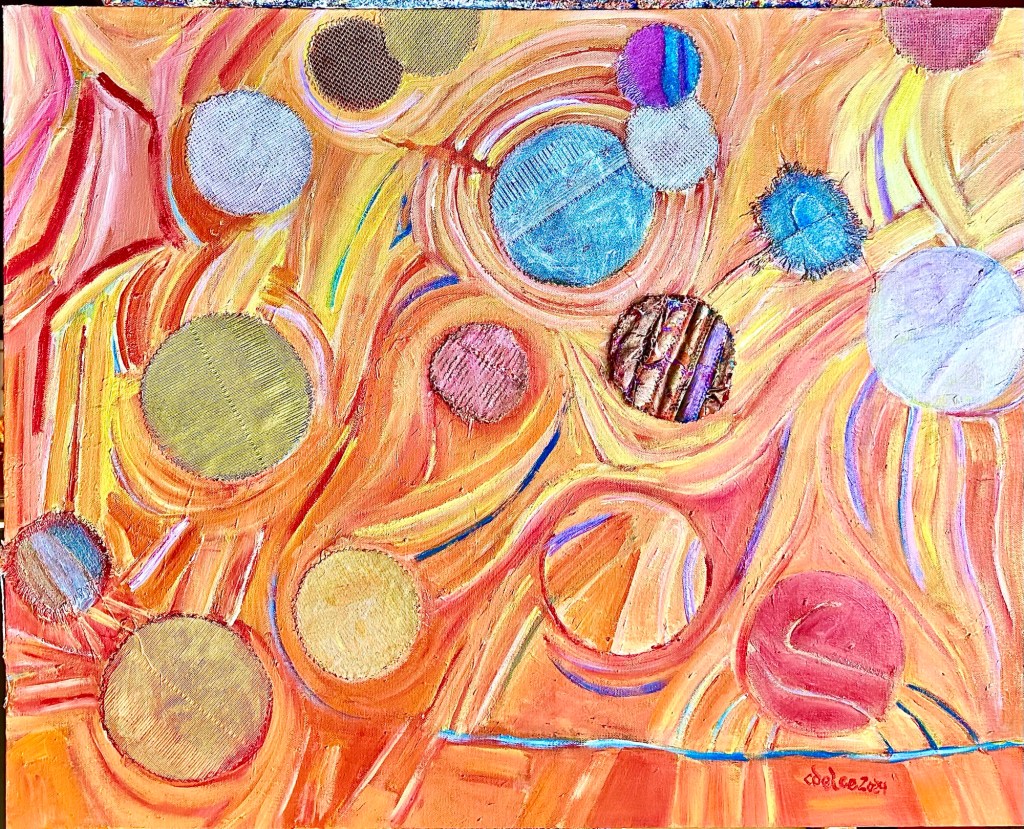
Music of the Spheres: Creation Energy, acrylic

I finished at home an acrylic painting, which explores some of the same themes as the watercolors we’ve worked on in class. In this I used various material with different textures for my spheres. One of the circles is more three dimensional because it’s from a handmade cloth mask left over from the pandemic. I painted parts of it, also. The background has lines of “energy” all about.

While the Pythagoreans attempted to see unity and harmony in the creation in numbers, our Judeo-Christian faith recognizes God as creator of nature and nature revealing the Creator. One of the best texts to understand this distinction is 1 Kings 19: 11-13, in which Elijah meets the LORD on the mountain at Horeb:

(God) said, “Go out and stand on the mountain before the LORD, for the LORD is about to pass by.” Now there was a great wind, so strong that it was splitting mountains and breaking rocks in pieces before the LORD, but the LORD was not in the wind; and after the wind an earthquake, but the LORD was not in the earthquake; and after the earthquake a fire, but the LORD was not in the fire; and after the fire a sound of sheer silence.

When Elijah heard it, he wrapped his face in his mantle and went out and stood at the entrance of the cave. Then there came a voice to him that said, “What are you doing here, Elijah?”

No one has ever heard the music of the spheres, and the voice of God arrives in the sound of sheer silence. Perhaps that “polar opposite” of the Pythagorean’s world view was on to something after all. If we’re very quiet and still, we may hear both the music of the spheres and the voice of God in the great silence.

Joy and peace,

Cornelia


This Is My Father’s World | Hymnary.org

https://hymnary.org/text/this_is_my_fathers_world_and_to_my

Counterfeit Version of Botox Found in Multiple States | FDA

https://www.fda.gov/drugs/drug-safety-and-availability/counterfeit-version-botox-found-multiple-states

Pythagoreanism (Stanford Encyclopedia of Philosophy)

https://plato.stanford.edu/entries/pythagoreanism/

Introducing Watercolor Painting

adult learning, art, brain plasticity, Cesanne, Children, cognitive decline, color Wheel, Faith, Imagination, John Ruskin, Painting, perfection, quilting, renewal, United Methodist Church

Our art class has worked in acrylic paint for several years, but toward the end of last year, they expressed an interest in learning about watercolors. I said, “Sure, we’ll do that. It’ll build on the color theory you already know, but you’re going to have to learn to plan ahead and learn not to rush to overwork one area. Transparencies are the mark of watercolor, so leaving your painting underworked is better than overdoing it.”

Transparent Watercolor Model

I was met with silence. Then laughter. “What the heck! We’re up for it! Bring it on!”

I love this group. They’re always up for a challenge. I think they’ve bought into my philosophy we aren’t going to be perfect, but we’re always going to learn from everything we do. As a teacher, I reminded parents their children wanted to engage with the medium to learn how far they can mix the colors before the image becomes a dark gray smudge. Then they might even push it even further until it’s solidly black. If you ask a child about their story, they might say, “The family took shelter in the house, but the storm came and blew it all away.” The story would evolve as they pushed the medium to the maximum. They learned the limitations on that day and wouldn’t go as far the next day. The process, not the product, is important.

Young children aren’t ready to draw subject matter from life but prefer illustrating stories from their imagination. They use symbols, rather than attempt to construct two dimensional designs to represent three dimensional objects. Somewhere around age 11 to 14, children begin to try to construct a realistic world in their art. While their drawings at this stage display the use of value, perspective, and light, children are extremely critical of their own success. They consider their drawing only as good as the level of realism they achieve, and they’re easily frustrated. Most people quit making art works about this age, so even as adults, their “functional artistic age” is somewhere between 11 and 14.

When my mother was teaching ceramic classes at her church, she once complained to me how her students, all senior citizens, were like “spoiled children, who each needed to have their own fresh jar of glaze to paint from.”

I asked if she was putting all the new paint jars out in the workroom, or if she kept them hidden in the supply closet. You might have thought I’d just pulled the clouds back from the sun from the way her face lit up.

“Of course! I should have thought of that! I’ll just pour out the colors they need and tell them that’s how it’s going to be. They can share.”

Paul Cézanne: The Park of the Chateau Noir with Well, 1904, graphite and watercolour, Private Collection

The old masters didn’t teach their students light, dark, shading, values, perspective, color mixing, temperature, or any other aspect of the art trade until the apprentice reached around age 10 or so. The rule when I was growing up was a child had to be able to write in cursive. That rule won’t work today, but another hand-eye coordination achievement will take its place.

It takes a while for me to know a new student’s nature, so I can give them the appropriate nurture. Some of my students will go ahead and do exactly what they want to do anyway because they have to see for themselves. They have a high tolerance for “learning,” and “experimentation.” Other students need to be kept from these excesses, because they can’t stand “failures.” Some students need to creep up to the edges of failure in order to progress, since they are so fond of being in control. Gaining the confidence to let go and let the medium have its way will be a growth opportunity which watercolor offers. Other students I can leave well enough alone, and come over when I sense they’re at a struggle point. I can recognize this when they quit working or begin to sigh loudly as they push back from their work area.

Cutting on the Fold

I’ve actually had some grownups in art classes cry because they couldn’t master a technique on the first go around. I always expected at least one child in my kindergarten class to shed a few tears when they were first learning to cut on the fold, but didn’t “hold the fold” when it was time to cut. I can repeat this rhyme, ask them to check, and then cut, but at least one will hold the open edges, which leads to two half pieces. I always have to remind them I’ve been practicing this skill longer than they’ve been alive. One day they’ll get good at it also. Effort will pay off. The same encouragement goes for adults, though most of them are too proud to shed tears.

For our first class, belated as it was due to the recent weather and my brief hospitalization for a small blood clot at the turn of the year, we chatted about the difference between acrylic and watercolor painting. Acrylic painting is more forgiving, since we can paint over our less precise marks. We saw some Cezanne watercolor landscapes to see how a real master draws and paints.

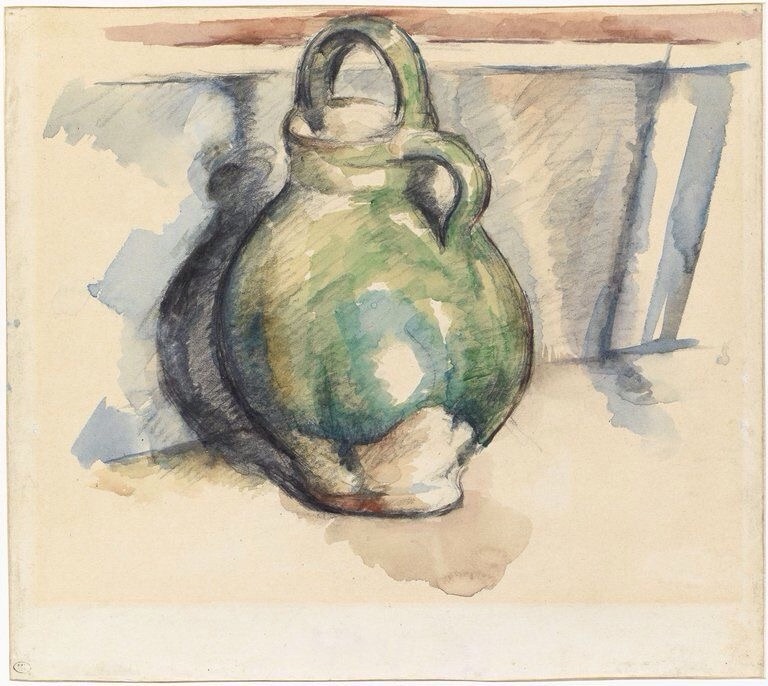
Paul Cezanne: Le cruchon vert, watercolor, 1885/1887, Louvre, Paris.

Watercolor’s luminosity depends on the sheet on which it is painted, for its brilliance is a balance between transparent washes of pigment and the light bouncing off the bright paper back to the viewer’s eyes.  At first, Cézanne worked much as he did in his oil painting, applying the watercolor densely, filling in underlying pencil outlines, covering the paper completely, and highlighting with white gouache. Later he thinned his watercolor and laid down veils of color, incorporating blank paper for highlights. He often applied watercolor to dry, semi-absorbent paper, creating layers of crisply defined brushstrokes with ridges of pigment at their edges.

Our class, because they are used to the dense pigments of the acrylic paints, painted much like the early Cezanne gouache works. It takes a while to learn a new medium, especially one so radically different from their prior experiences. But just as it takes time to learn, it also takes time to unlearn! Ask my golf coach about changing my swing sometime. We’ll get the hang of it eventually.

After checking out the master, we then worked on mixing the secondary and tertiary colors from the primary colors from our Prang 8 Color palettes on our 140-pound watercolor paper (not sketchbook paper, which is thinner and will buckle under the slightest bit of water).

Cornelia’s psychedelic mushroom rainbow

I was still on painkillers for my shingles, so my painted circle never quite closed itself. Instead, it was more of a rainbow, an image of hope after all this rain and my health troubles. My secondary colors looked like rainbow mushrooms popping up from the rainbow. The wetness of some areas bled into some of the colors, giving me the tertiary colors. I had a bit more success working the wet in wet in the blue grey cloudy sky.

Gail W’s Flower

One of our new students, Gail W., imagined her color wheel as a flower in a field. Tim W. focused on the colors as patterns. I had the sense I was looking at a portion of a quilt in progress. While we had the color wheel as an image, we weren’t bound to recreate a wheel.

Tim W’s quilt patterns

Tim B. Always has a unique viewpoint, so his color wheel is moving through space. Mike used some pastel colors in addition to the Prang colors to experiment with the difference between them. He’s used to thick paint with his acrylics, so allowing more water to flood the surface and allow the light to bounce back through the paint will allow his painting to glow more brightly.

Tim B’s flying color wheel

Gail S. finished out her wheel in good form. She has good transparency of paint and mixing of colors of the three sets of colors on the wheel. Gail typically paints with thinner washes in acrylics, so her technique in that medium passes over easily to watercolors.

Gail S’s transparent color wheel

As a first start, we’re on the way. Next week we’ll try a small still life. I hope to be in less pain, so I’ll have more of my brain cells available, or at least they’ll be within hailing distance. I have some great Cezanne still life watercolors to share. A still life will test our drawing skills and our painting skills both. The Victorian art critic John Ruskin said, “No good work whatever can be perfect; and the demand for perfection is always a sign of a misunderstanding of the ends of art.”

Mike’s color wheel with Prang and opaque watercolors

We aren’t being graded, so when I say “test,” no one ever fails. We only find out what we’ve learned and what we need to improve upon. Trust me, “we’re all going on to perfection, by the grace of God.” After all, this is a United Methodist art class. If I may quote Ruskin again, “The highest reward for a person’s toil is not what they get for it, but what they become by it.” By this he means, art changes us. Art also opens new horizons, allows us to overcome challenges, imagine new solutions, eases our stress, finds companionship, learn resilience, appreciate culture, and develop new skills. At every age, art builds confidence, teaches us compassion for ourselves and others who try new things, and helps us keep an optimistic attitude. I personally believe art keeps our inner child alive and well. May God renew you daily in joy.

Joy and Peace,

Cornelia


Drawing Development in Children: The Stages from 0 to 17 Years https://www.littlebigartists.com/articles/drawing-development-in-children-the-stages-from-0-to-17-years/

John Ruskin—The Stones of Venice

A Guide to Cézanne’s Mark-Making and Materials | Magazine https://www.moma.org/magazine/articles/589

Cezanne’s Watercolor Pigments.   https://cool.culturalheritage.org/coolaic/sg/bpg/annual/v14/bp14-09.html#:~:text=C%C3%A9zanne%27s%20watercolor%20technique%20allowed%20the,before%20application%20to%20the%20paper.


Pears and Apples

adult learning, Altars, apples, Aristotle, art, brain plasticity, change, cognitive decline, color Wheel, Creativity, exercise, Fear, Habits, Holy Spirit, inspiration, Lent, Leonardo da Vinci, Painting, perfection, Physical Training, purpose, risk, Thomas Merton, Van Gogh

Still Life with canvas, pallet, and brushes

Aristotle said in his Poetics, “The aim of art is to represent not the outward appearance of things, but their inward significance, and this, and not the external manner and detail, is true reality.”

He spoke mainly about poetry, which was the highest art of his age, but his words also apply to the fine arts. Today, many people are still mesmerized by artists who practice various styles of realism, but they overlook the artists who show us the realities of emotion and inner vision.

The good news about art.

“Art enables us to find ourselves and lose ourselves at the same time,” said the spiritual writer, Thomas Merton. Some people use art as a cathartic exercise, and pour out their inner emotions on the canvas or their chosen media. Jackson Pollock’s drip paintings and Van Gogh’s late works are good examples of emotional expression. We all know folks who have a project going in their garage. They go work on “that worthless piece of junk” to focus their attention and energy on fixing something on which they can make a difference, instead of getting tied up in knots about things they can’t change and must accept. Gardening and knitting are also good hobbies for focusing this energy.

We know our nervous system grows to the modes in which it has been exercised. This is what we call building a habit over time. Just as a child doesn’t walk straight out of the womb, they have preparatory skills that must be acquired by stages as they grow. Exercising their muscles by rolling over also helps to strengthen their necks to hold their heads up. Crawling leads to pulling up, and that leads to letting go to learn balance.

Each time a child repeats these movements, he or she will simplify the movements required to achieve the needed result, make them more accurate, and diminish fatigue. In this, they’re building habits that bring them closer to walking. Rushing them to achieve “early” walking actually puts them behind cognitively.

Not only are there twenty five body parts in a baby’s body that are used in the crawl movement, but crawling also strengthens the hip sockets, so the baby will have a strong platform on which to stand. Crawling helps the corpus callosum, which is a band of nerve fibers between the hemispheres of the brain. Criss-cross crawling on the knees and hands stimulates the corpus callosum to develop in a balanced way, facilitating the hemispheres of the brain to communicate. These cross lateral movements work both sides of the body evenly and involve coordinated movements of the eyes, ears, hands, feet, and core muscles. This helps support cognitive function, problem solving, and ease of learning. Exploring the floor in a baby proofed home allows your baby to achieve his or her optimal potential.

Gail’s Painting

“Practice makes perfect” is only as true as the practice is directed in a true direction. This is where a teacher, a parent, a coach, or a spiritual guide comes into play. Only one who’s been led well can lead others with grace. We don’t tear down the learner, but ask questions, give guidance, help them see alternative paths, and allow them a safe place to explore their choices.

Art class isn’t brain surgery. No one will die if the painting isn’t successful, and no one’s salvation is at risk if the painting doesn’t come out the way we hoped it might. Art class is a safe place to take risks, unlike jumping from a tall tower without a parachute. Learning to accept failure on our canvases and coming back next time to try again is a mark of resilience and courage. Every time we fail closer to our target, we realize we’re gaining on it! We never say I CAN’T in art class.

Crawl before you Walk or Run

The sad reality is we can teach and expand the horizons of young people up til the age of 25 or 30. After that, they seem to lose energy and desire to learn more or to change. They “habitually” repeat their previous acts, for good or for ill. We’ve all heard the old saying, “You can’t teach an old dog new tricks.” Those of us who are no longer young have sometimes been accused of being set in our ways. Some of us are afraid we won’t excel at a new challenge, for we’ve always been held to a high standard of achievement. Since none of us will be the next Georgia O’Keefe or Leonardo da Vinci, we can set that worry aside. They both had more years to practice than we have left in front of us. Instead, we should give our remaining time our most focused attention, so we can get the most from our experience.

My high school chemistry book had the same information in it which my daddy’s college chemistry book covered. He was amazed I was learning “advanced” ideas at my young age. In 1982 R. Buckminister Fuller introduced the idea of the “knowledge doubling curve.” Up until 1900, knowledge doubled every century. By 1945, knowledge doubled every 25 years and by 1982, it doubled every year. Some say it’s now doubling twice a day! The newest computer we buy off the shelf today is already obsolete.

We can’t train our students for the jobs of today because these jobs likely won’t exist tomorrow. We need to train people to be lifetime learners instead. Luckily, we don’t have to know all things, but we do need the skills to find the knowledge and sort through the best sources for the best possible information.

1930-2006

Today, knowledge we acquire in high school, college, graduate school, and our last job may already be obsolete. (I’m one who still grieves the loss of Pluto as a planet; it exists but is a dwarf planet in the Kuiper Belt). This is especially true in fast moving fields like technology. As futurist Alvin Toffler wrote, “the illiterate of the 21st century will not be those who cannot read and write, but those who cannot learn, unlearn, and relearn.”

This means all of us will need to become lifelong learners or we’ll risk losing touch with an ever evolving world. Maybe we think our brains can’t handle something new, for we’ve heard about the effect of aging. Cognitive process studies with older brains show learning, memory, and problem-solving in humans are often less efficient in these areas.

However, it has recently been established that dogs show many of the same kind of age related changes that humans do. A study in Vienna showed that older dogs learned new tasks just as well as younger dogs, although they took longer to do so and required more repetitive corrections. This aptitude is also known as “resilience training.”

I think it’s also important to know why we want to keep our brains agile as we move into our later years. John Wesley was fond of repeating William Law’s summary from the Practical Treatise on Christian Perfection,

“Do all the good you can, to all you can,
by any means you can, as long as you can.”

Because Wesley was better known than William Law, this quote is now attributed to Wesley alone. We Methodists have made it our own, however, and have carried its banner around the globe in our world wide mission efforts made possible by our Connectional ministries. Wesley thought enough of Law’s writing to reprint 19 editions of his work.

My late mother, at the age of eighty, learned how to use a laptop computer. She was motivated because she wanted to see emailed photos of her grandchildren, but then she realized she also could find recipes. When a child in her hometown needed a Mercy Flight, she used her new skills to get him transportation to an out of state hospital for treatment. I occasionally had to reteach her on how to double click quickly on her icons, rather than slowly, but she finally caught on.

iPad drawing of pear and apple

If we want to keep our brains agile throughout our middle, silver, and golden years, we always need to try new things. Doing art challenges makes our brain build new neural pathways. Every time we look at a still life or a landscape, we have to make multiple decisions: what shapes do I see—circles, squares, triangles, or rectangles; how do these shapes relate to one another on the plane of our canvas; what is most important; what colors will I use; what emotions do I want to express; and where will I begin?

Eventually, we will find our “style.” We don’t find a style by copying another’s work, but we create enough works until our hand becomes one with our spirit. Since God has placed a special spark of God’s own creative Spirit within each of us, eventually we’ll experience the joy of being one with God when we are in our painting moments. As Paul said to the Romans (8:16):

“The Spirit Himself bears witness with our spirit
that we are children of God.”

Last Friday we had a simple still life as our inspiration. Half our class was out sick with spring pollen troubles, but it was good to see those who could come after a two week hiatus. After a brief show and tell to get us inspired by other artists’ takes on the subject for the day, we got started. I reminded everyone not to make the fruit too tiny, so it wouldn’t get lost on the canvas. I believe everyone succeeded with this goal!

Mike’s painting

Mike painted his whole canvas with one brush. This gave the fruit a certain texture with contrasting colors, and the background, which was in a close value, didn’t show much brush strokes or texture. I like the perspective he chose, which brings the viewer in close to these fruit.

Gail tried a larger canvas with bolder colors than she normally uses. It was more dramatic and stronger in contrast than usual, while she kept her smooth strokes of paint as usual. She also took a view from above.

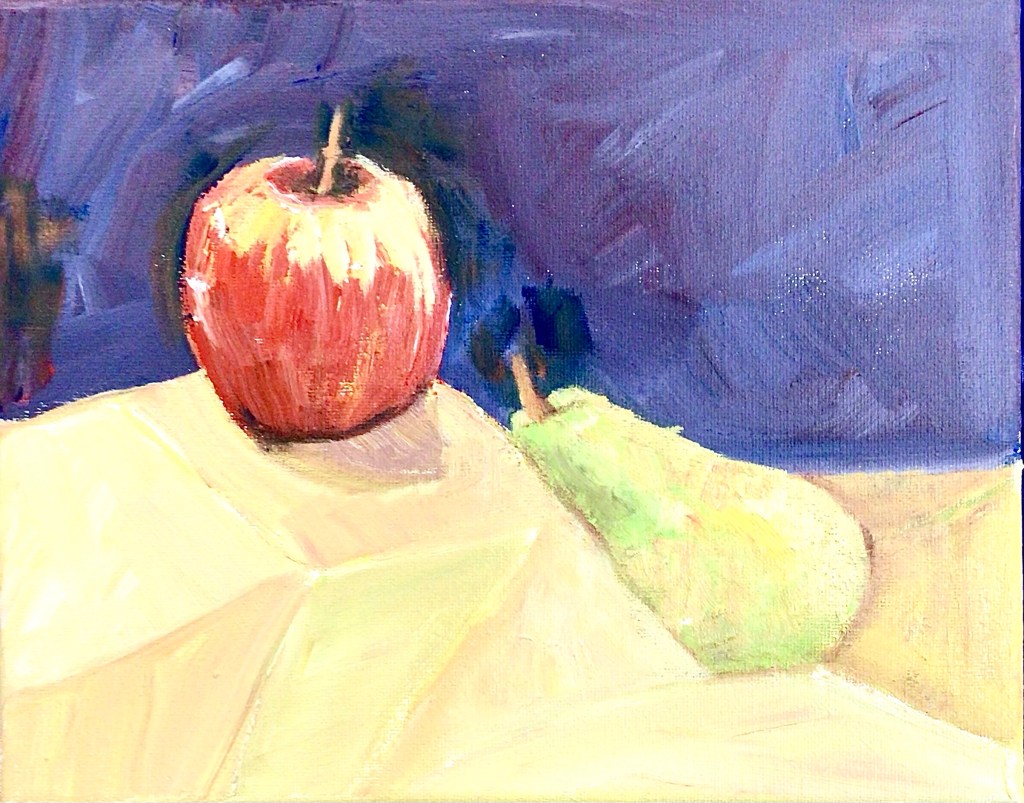
Cornelia’s Fruits

I stuck to a traditional rendering of the still life, since I do many abstract paintings in my own studio. I’d call these two Day and Night, for the Apple is quite awake and the Pear seems to need a little nap. It’s a study in contrasts: red and green, blue violet and yellow orange—a color wheel study masquerading as a still life.

Next week we’re in the season of Lent. As Christ turns his face towards Jerusalem, we’ll begin a study on the icons. This will be accessible and interesting. You’ll end up with your own icon for your personal worship center also.

Joy and Peace,

Cornelia

Classics in the History of Psychology — James (1890) Chapter 4
https://psychclassics.yorku.ca/James/Principles/prin4.htm

Crawling is important for childhood brain development
https://thefnc.com/research/crawling-is-important-for-childhood-brain-development/

You Can Teach an Old Dog New Tricks | Psychology Today
https://www.psychologytoday.com/us/blog/canine-corner/201602/you-can-teach-old-dog-new-tricks

Letters of John Wesley – John Wesley, Augustine Birrell – Google Books, p.423
https://books.google.com/books/about/Letters_of_John_Wesley.html?id=zgYu6NpqWDEC

What It Takes To Change Your Brain’s Patterns After Age 25 https://www.fastcompany.com/3045424/what-it-takes-to-change-your-brains-patterns-after-age-25

Year End Art Class Notes

adult learning, Arches National Park, arkansas, art, Christmas, color Wheel, Creativity, Faith, holidays, Imagination, inspiration, Ministry, nature, Painting, photography, shadows

While some are counting the days until Christmas, some of us are are counting the remaining days left in the old year of 2022. Somehow I always get a cleaning burst of energy around the end of the year. Maybe I hear my mother’s voice urging me, “Let’s get the house straightened up, so Santa will find it neat and clean. There’s no way the jolly old man can find the tree when the house is in this much mess!”

My mother’s idea of a mess was a line not perpendicular to its base, or a fragment of paper left on the table. She mostly cleaned to the grooves while my grandmother was alive, for she slacked off after Nannie passed on. The Christmas tree was ensconced in the NONO ROOM, also known as the living room. It acquired the NONO nickname because our parents never let us into it, for we weren’t allowed to touch anything inside it. We lived in the den, like the pack of wild animals we were. We weren’t raised by wolves, but our parents were never able to wring the wolf out of their brood.

I confess I still organize my large spices by size on one shelf and the smaller ones alphabetically on another shelf. I can’t understand anyone who sets their spices on the shelf willy nilly, so they have to search for them every time. Then again, I sort my paints by color and temperature. Organization is one thing I did learn from my folks, even if I didn’t inherit an obsession for daily cleaning.

However, with less than two weeks before Santa comes to visit and Christmas Eve services will bring the birth of Christ to mind once more., my inner mother began to notice strange flecks of dust on the high cabinet doors, as well as dust bunnies rolling out from behind the sofa. Some people have visits from the Ghosts of Christmas Past. My mother comes to visit me. At least I can still climb ladders.

While I’m cleaning up the house, I should catch up on some art works our Oakland UMC art class has been doing. I took off for a month to visit California, came down with a couch bug that made me so congested I couldn’t think, paint, or do doodly. For some reason, Mike moved faster than I could get my camera out, so I don’t have all his photos. Also, sometimes he was tied up in court doing good for others. I promise to do better in the New Year.

Delaunay: View of Paris, Eiffel Tower

The following three paintings began with the idea of circles and lines. As usual, I showed a few different examples from well known artists whose work hangs in museums. This quality inspiration helps students come up with better ideas.

Gail’s Circles

Gail combined her lines with her change of colors. Those boundary lines set up a line which carried through the subtle colors of the background. Limiting her color scheme helps to define these lines. She likes to plan her ideas out in her head first, imagine how they will look, and then paint.

Mike’s circles and lines in the image below reflect his more exuberant personality. Using both the compass and the ruler, he came up with a variety of circles and lines. Mike paints as the spirit moves him. Whatever feels good, that’s where he goes next. He’ll adjust as he goes.

Mike’s Circles

Either of these methods are fine. If one doesn’t get you down the road to the place you want to go, then maybe it’s time try a different route. I never force anyone down a particular fork in the road. I let them explore in one direction until they learn all they can or hit a dead end. Then they can follow the “road not taken.” Everyone gets to try both roads eventually, and learn the ancient wisdom, “All roads lead to Rome.”

This Road May Lead To Rome Eventually

In the art world, “Rome is the fullest experience of both order and emotion.” Some of us prefer one over the other, just as I prefer order in my spice rack, but I’m willing to throw the spices into the soup by sight and not by measuring spoons. We can get too organized or too exuberant, as the Greeks were fond of saying, “The middle path is safest and best.”

Klee: In the Beginning

During this time, the Russian attack on the largest nuclear power plant in Europe was ongoing. Not only was the electricity at the plant cut, an act which blacked out Ukraine and much of Eastern Europe, but it also threatened the stability of the nuclear reactors there. The Ukrainian engineers at the plant were prisoners of foreign soldiers, who knew nothing about the dangers of their stronghold. The world held its breath as fighting broke out around this sensitive target.

Cornelia’s Ukrainian Power-plant Under Attack

Thanks to satellite imagery, today we can see via the internet, what we waited to see in newsreels at the theater, the last time we fought on European soil. We had to wait until the evening news to see film from Vietnam. Now cable news breaks every half hour with the same old news and we might get an update if we’re lucky. Not all can afford to send reporters to distant lands anymore.

By the grace of God, that power plant still stands. However, Europe and Ukraine will have a cold and costly winter. We should not complain if our prices rise, for it’s a small price to pay for democracy and freedom. There are still nations who would oppress smaller countries, just as the Roman Empire did back in the time of Christ’s birth. As we remember in Matthew’s story of The Visit of the Wise Men (2:1-2):

In the time of King Herod, after Jesus was born in Bethlehem of Judea, wise men from the East came to Jerusalem, asking, “Where is the child who has been born king of the Jews? For we observed his star at its rising, and have come to pay him homage.”

This information led Herod to kill all the innocents, the children under two years old in and around the town of Bethlehem (Matthew 2:16-18). Brutality and mass executions aren’t a recent invention of despots desperate to retain power at any cost. The ethical term is utilitarianism, where one uses others as means to gain their own ends. The test question for this type of ethics is “Does the end justify the means?” At what point can you excuse bad or corrupt behavior to get good results?” A moral person answers, “I prefer good means for good ends and will use those unless I’m in a life or death situation.”

I returned, no worse for wear, from my vacation and texted the group to bring a vacation landscape photo to work from. Of course, Gail brought her latest vacation dream destination and Mike brought several island maps to combine into one image. It was the same island where he and his wife had vacationed, but one had tourist attractions, another was history, and the other natural beauty. He has a flair for combining things. Unfortunately, his busy life gets in the way of keeping all his art supplies in one place, so between his work chaos and organizing chaos, plus my slow phone draw, I failed to get his interesting map. It was a good idea.

Gail’s Mars Elevation

The new Mars rover has been sending back some awesome images. The folks at NASA must be over the moon, without a rocket. Gail worked on this elevation image for two weeks, with colors representing different heights in the landscape. It’s a good copy of the image. In the new year we need to go back to three dimensional work again, but we have had fun with color mixing and texture.

Cornelia’s Western Landscape

While out west, I visited as many national parks as I could manage. I did see many volcanoes and convened in a cave, plus I visited Roswell, NM, but wasn’t abducted by aliens. I was impressed with Arches National Park, and hiked about it most of a day. It’s a stark place, with strong rock formations jutting into a brilliant blue sky. The bright sunshine makes strong patterns of light and dark across the landscape. Most of what grows out in the desert is short grasses or a scrub brush, but on occasion, I would find a gnarled tree in dark shade.

Gail’s Christmas Tree

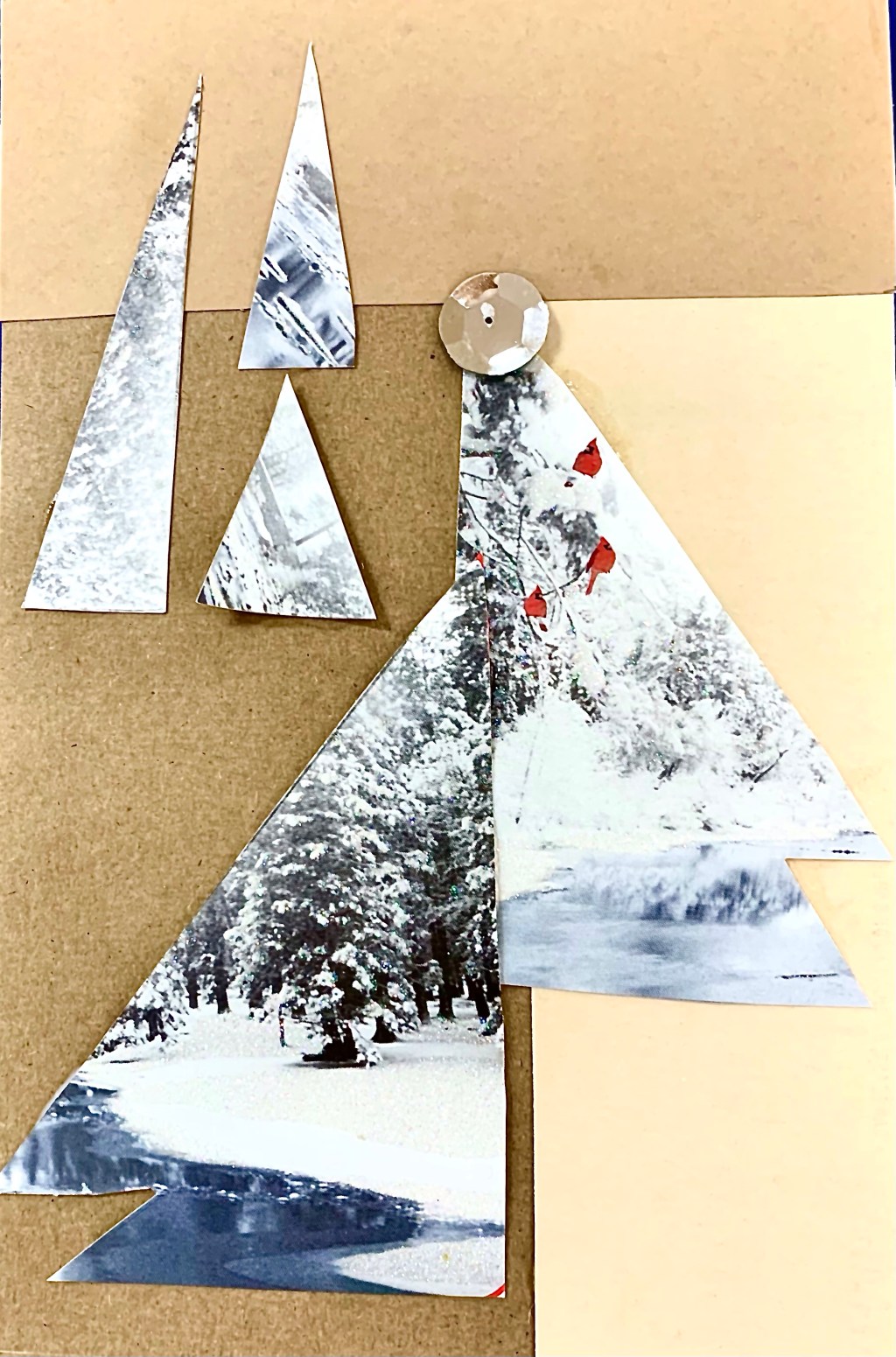
At Mike’s request, we made Christmas cards, but he had to work that day. Probably helping someone with legal matters, because that’s his calling. Gail and I had fun working on the cut paper cards. I was thankful she brought me a coffee. Whatever bug I had took a while to clear my system. Caffeine helped. She rearranged these triangles several different ways on a horizontal plane and never felt satisfied with the way they looked. Because she was wise enough not to glue them down first, she could see her ideas weren’t hitting her happy place.

Then she turned everything straight up, and organized the design on a perpendicular. Now her tree has its happy red birds, a sequin star, and little trees in the background.

Cornelia’s Card

I brought one of my many boxes of colored paper from my scrapbook stash. I know the Christmas colors are red and green, but I made an Advent Tree. This is why it’s violet and pink and blue. Anyway, we don’t have to follow the rules for Christmas trees. If we want a pale purple tree, we can have one. It’s our tree. Santa will still put a present under it, and the color of our tree doesn’t impair our salvation. A nativity set looks just fine under any color tree.

I know we have at least one more class in December on the 16th. Depending on if my plumber is coming over on the 23rd, we might not meet that day. He said he’s behind, so I don’t know. I’ll be on vacation on the 30th, so we’ll see each other in the New Year of 2023!

I always say, “if I ever get totally organized, the world is coming to an end.” Maybe it’s the providence of God that I always bite off more than I can chew, because I’m never totally organized! But I am going on to organization.

Joy, peace, and a better filing system,

Cornelia

Color Theory Paintings

adult learning, Altars, art, color Wheel, Creativity, Faith, Hilma af Klint, Imagination, inspiration, Ministry, mystery, Painting, shadows, Spirituality

Cezanne: Four Apples, 1880-1881, oil on canvas

Cezanne once said, “We live in a rainbow of chaos.” Perhaps he meant we’re surrounded by colors, in various and sundry shades, and through art, we try to find some order to this chaos, even if our resulting work seems outwardly disorderly. In his own lifetime, Cezanne was accused of being a madman, “afflicted while painting with delirium tremens.” His response was to shrug off the guardians of the Academy: “With an apple I want to astonish Paris.” He worked in isolation for a very long time, only gaining financial success in the last ten years of his life.

Jackson Pollock: Number 32, 1949, auctioned in 2018 at Sotheby’s

Another artist who broke ground is Jackson Pollock. When we view a Pollock action painting, we realize there’s actually an order to this chaos. The drips and pours are more like calligraphy and live in tension with one another. They vary in color, size, and energy, not unlike a song. The action paintings are not just “drip paintings,” but energies expressing emotions by means of fluid dynamics. This is why we don’t say, “My grandkid could do this.” People try to forge Pollocks and fail. Even Pollock had difficulty creating these unique works, the best of which belong primarily to a two year period when he refrained from his alcohol habit, which affected his depressive disorder.

As compositions, each of Pollock’s drip pictures simultaneously dissolves into a chaotic jumble of individual lines, while also coming together as a structurally uniform, whole field. We’re mostly used to works best viewed from a single fixed point, such as a High Renaissance painting. Instead, to view a Pollock, we must move across the whole surface, and look deep into the layers. His works draw their audience in to inspect the details closely, passage by passage, and at the same time overwhelm the viewer with their monumental size. Their coloristic and textural richness emphasizes the expansive surface, yet the elaborate and totally visible overlay of multiple layers of paint (and sand, cigarette butts, glass, and other materials) create a very real depth and space. It’s definitely not your grandchild’s artwork.

HANS HOFMANN: Elysium, 1960, oil on canvas, BLANTON MUSEUM OF ART

Hans Hofmann, a 20th C American abstract expressionist, once said, “Colors must fit together as pieces in a puzzle or cogs in a wheel.” Often we use the colors straight out of the tube, or we flail around trying to figure out which yellow and which blue will give us the shade of green we want to use. Experience is the best teacher, for learning how to see the colors of life is like solving a puzzle that doesn’t have a photo for a guide. Once we begin to recognize their composite colors, we begin to see the order in the midst of chaos. Then we have the cogs to the wheel and it will turn the next wheel in good order. Experience becomes our Rosetta Stone for decoding the other mysterious languages of color we hear around us every day.

Color Wheel with Neutral Grey at Center

One of the cues we’ve come to recognize in our painting class is the color of our brush wash water. If it’s a lovely neutral gray, like the center circle in the wheel above, we’ve balanced the warm and cool colors on our canvas. Most of our group in attendance chose colors from this wheel.

Paul Klee: Watercolor Word Study

We saw a number of color theory examples from history, including Paul Klee’s geometric watercolors, which vary from color blocks, landscapes, and written images.

Hilma af Klint: Primordial Chaos, Number 7

A little known colorist is the Swedish artist, Hilma af Klint, who was one of the earliest abstract painters. She developed a language, or visual imagery, to share the spiritual experiences she received during her participation in automatic drawing. As with many others of her era at the turn of the 20th century, she and her friends, in the group called The Five, mixed elements of traditional Christianity with seances and beliefs in a mystical guiding higher spirit. If she lived today, we’d likely call her beliefs “new age.” She also incorporated new advances in science for her time in her explorations.

Hilma af Klint: Altar Piece, Number 1

Her work for The Temple was heroic in size, with each of the 193 paintings measuring about 7 x 9 feet.These were completed between 1906 and 1915. The whole sequence can perhaps be understood as af Klint’s pursuit of an original “oneness,”or the basic unity which she believed existed at the world’s creation. She believed this integrity had since been lost, giving way instead to a world of polarities: good and evil, woman and man, matter and spirit. In her work after 1912, af Klint seemed to move stylistically away from techniques related to spirit channeling, such as the fluid lines of The Five’s automatic drawings. Her use of Christian iconography and geometric forms increased. By 1917, af Klint stopped producing art through a spirit altogether. Her 2,000 plus works are owned and administered by The Hilma af Klint Foundation in Stockholm, Sweden.

Dusty: Circle in Space

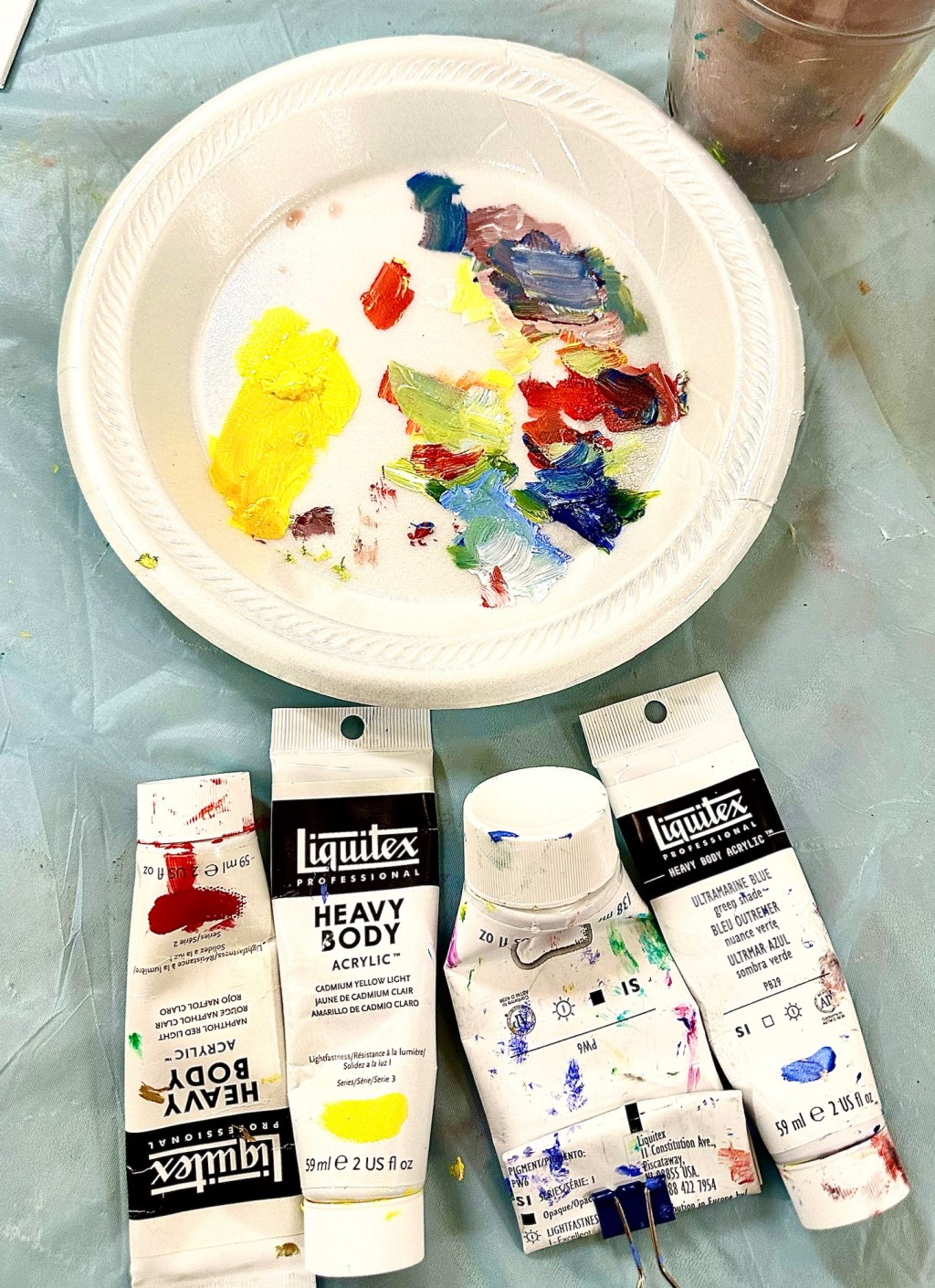
Dusty used a plastic plate to draw his circle. This plate served a secondary purpose as well: it was also his palette to mix his colors. “Art imitates life, even in abstraction.” He used the ruler to measure out equal pie shaped segments, and divided the background planes. I almost stopped him in the midst of his planning, but I wasn’t about to stop that train of thought. I could only admire it for its balance and symmetry. He mixed the shades of the colors, and filled in the spaces. Then he added a few “motion” marks to indicate the movement of the disc in the atmosphere.

Gail: Sun and Waves

Gail pulled a plastic French curve drawing shape out of her toolbox to make the unique shapes in her painting. The blue and green curves are the waves of the sea and the central oranges of the resulting negative shape is the sun above the water. I always appreciate her paintings, which connect to her love of nature and have a sense of order to them.

Lauralei: Geometric Shapes

I think I have this painting right side up. I followed the path of the brush strokes. Lauralei wins the prize for most different number of colors mixed on the palette. So often we get accustomed to using the same familiar colors over and over. Everyone had a café au lait colored interior two decades ago, then we all went white, and gray predominated for a while. Maybe soon we’ll paint our homes actual colors instead of following the crowd.

Mike: Rainbow Cross

Mike had this idea percolating in his mind before he came to class, but didn’t have time to work on it at home. As soon as he saw our inspiration works, he decided to follow his inner guide, which had opened this image to him. He took the ruler to mark off some guide lines, then focused on bringing this idea to life. The radiating energy bolts of dynamic rainbow colors coming from the cross remind us of God’s love in Jesus Christ for all things and all people. We’re also one in Christ and belong to the one family of God, no matter how we worship, or what our understanding of God is.

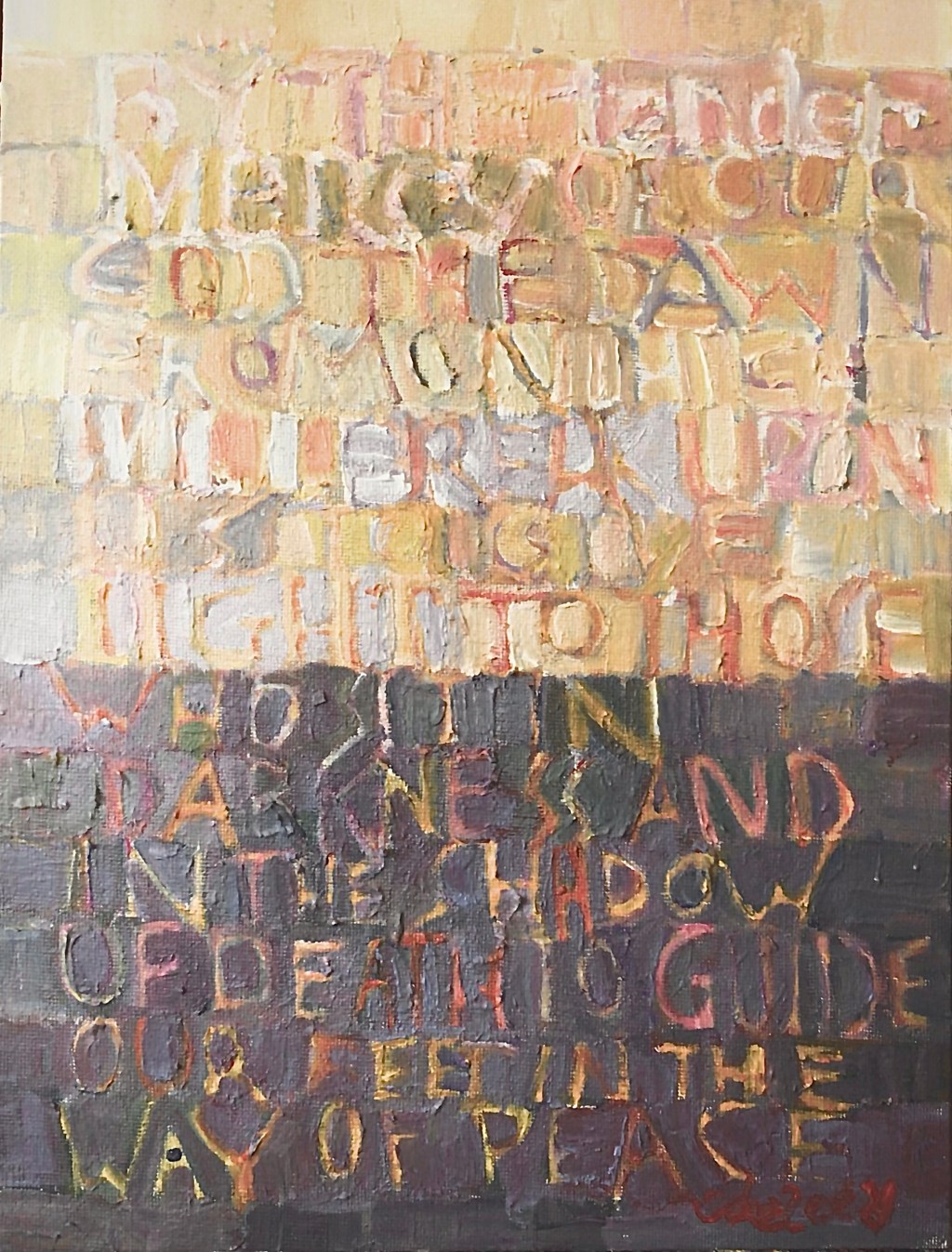
Cornelia’s First Stage: Light and Dark

I began my little painting as a homage to Klee, but I didn’t get far in the 90 minutes we have for painting. I attempted to leave the negative space for the letters, but my brush was either too large or my painting surface was too small for the text I chose. I brought it home and worked another six or seven hours on it in the following week.

Cornelia’s Final Stage: Light and Dark

In the quiet of my studio, I realized I wasn’t paying attention to the emotions of the words, but only to the technical aspects of mixing the colors. I reread again my text from Luke 1:78-79:

“By the tender mercy of our God,
the dawn from on high will break upon us,
to give light to those who sit in darkness
and in the shadow of death,
to guide our feet into the way of peace.”

At this time, I saw the upper half needed to be light, while the lower part of the painting needed to be in darkness, since the two verses broke in this direction. This also gave my painting a landscape feel, as if the dark earth hadn’t yet seen the dawn of God’s light. As I painted, I began to lose the sense of the letters and the words, and the patches of color became more important than trying to keep the sentence legible.

I’m very impressed with this group, who’ve taken to heart my teaching mantra: Everyone will find their own voice if they engage in creative thinking and do the work. In the spiritual life, we’re saved by faith, but in art, we do find “works righteousness.” Amazingly, we get better the more we practice, especially if we have positive critiques and goal oriented lessons designed to help us grow. This provides fertile ground to awaken the spirit living within each of us, so that we can become co-creators in God’s renewal of the world. Maybe Hilma af Klimt was on to something special after all.

Our next class will be The City. We can either treat this as a lesson in perspective, poster design, abstraction, or a close up view of a building. Vacation photos are a good resource to bring, if you have a special place you want to remember. Antique photos are good too. Till next time, keep your hearts full of

Joy and Peace,

Cornelia

The Fascinating Physics of Jackson Pollock’s “Drip” Paintings
http://hyperallergic.com/526383/the-fascinating-physics-of-jackson-pollocks-drip-paintings/

Jackson Pollock’s Paintings: Characteristics of Drip Painting Technique
http://www.visual-arts-cork.com/famous-artists/jackson-pollock-paintings.htm

Paintings for the Temple | The Guggenheim Museums and Foundation
https://www.guggenheim.org/teaching-materials/hilma-af-klint-paintings-for-the-future/paintings-for-the-temple

Hilma af Klint The Paintings for the Temple 1906–1915 ARTBOOK | D.A.P. 2021 Catalog Bokförlaget Stolpe 9789189069114
https://www.artbook.com/9789189069114.html