What’s the Point of Suffering?

art, city, Creativity, inspiration, Israel, Megiddo, Painting, righteousness, Solomon’s Temple, suffering

I’ve visited the Holy Land twice, and I’m always surprised how small this country is. So much history and events of our faith happened here, yet the land isn’t much bigger than Vermont. This land is a place of great suffering, marked by the historic sites of Masada, Megiddo, and Golgotha. It’s also the place of great joy, as evidenced in the Church of the Nativity in Bethlehem, the Church of the Holy Sepulcher in Jerusalem, and the Western Wall of the Temple in Jerusalem.

Map Painting: Temple Mount of Jerusalem

When we speak of the Holy Land, we include the ancient kingdoms of Judea and Israel, as well as modern day Palestine. The modern state of Israel was formed in 1948, as a homeland for diaspora Jews, who are the ones whom conquering foreign nations had exiled from their homeland over the centuries.

The history of the Hebrew people has been marked by suffering. As Deuteronomy relates, they are a “people holy to the LORD your God; the LORD your God has chosen you out of all the peoples on earth to be his people, his treasured possession. It was not because you were more numerous than any other people that the LORD set his heart on you and chose you—for you were the fewest of all peoples” (7:6-7).

They endured slavery in Egypt, wandering in the wilderness until they entered the promised land, and then were at the mercy of stronger nations who wanted to control the trade routes, which intersected inside the borders of Israel.

The earliest diaspora was the Babylonian exile in 586 BCE, plus a later exile to Alexandria, Egypt, in the 1st century BCE. That first exile was marked by the trauma of the Jews’ loss of Solomon’s Temple and their residency in the holy city. They’d always depended on these two as permanent and a source of God’s special protection. However, their failure to honor God completely negated this protection. In the exile, the people learned how to live as God’s chosen people by studying God’s word, keeping the law, and separating themselves from the Gentiles.

About five million Jews lived outside of Palestine during the Roman era, but most of them lived within the confines of the Roman Empire. Even before the destruction of the Jerusalem Temple in 70 CE, diaspora Jews outnumbered those who lived within the bounds of the territory of the Holy Land.

Western Wall of Temple, Men’s prayer area nearby and Women’s area in distance, 2019

After World War II, with the Nazi massacre of over 6,000,000 Jewish individuals of all ages and sexes, this Holocaust ignited the desire within those others who shared with Jews the same values they represented in the world. Social justice and compassionate assistance to the weak stood in the way of Hitler’s regime, for he believed Jews opposed the Nazi natural order, which was the powerful exercise unrestrained power on behalf of the superior white race. In Hitler’s view, any restraint on the exercise of white power would inevitably lead to the weakening, even the defeat, of this master race. (We hear echoes of this heretical view in the current replacement conspiracy, which claims migrants are poisoning the blood of our nation.)

Harvard Center for Geographic Analysis: Comparative Size of Israel and Occupied Territories to State of Vermont (11,200 square miles to 9,200 square miles)

An entire book in the Old Testament is dedicated to the question of suffering, especially the question of do the righteous suffer. Under the retribution theory of justice, a good person should not suffer, and a sinful person deserves suffering. However, all of us know infants born with dread physical conditions, who obviously haven’t had a chance to sin. In the Old Testament view, his parents’ sin would have caused his suffering, but Jesus reminds us in John 9:3–

“Neither this man nor his parents sinned; he was born blind so that God’s works might be revealed in him.”

Ossip Zadkine’s The Destroyed City (1951) is a man without a heart and is dedicated to the city of Rotterdam, destroyed by the Nazi Luftwaffe.

The book of Job reminds us suffering happens to all of us, and how we react to it is evidence of our transformation into the image of God. Do we seek mere retribution, or will we let suffering transform us? This is a moral question for us today, especially in our suffering adverse society. Yet, we’ll let those on the margins suffer, while we avoid suffering ourselves. The 31st chapter of Job lists the acts of a righteous man who cares for the widows, orphans, and strangers in his land, yet he suffers. But Job is no quitter, even if he is a complainer. He asks God, “Why do the righteous suffer?”

The Gaza Strip, where all the fighting between the Israeli army and the Hamas militants is currently ongoing, is slightly more than twice the size of Washington, DC., our nation’s Capitol. The Capitol is 68.35 square miles, while the Gaza Strip is just shy of 139 square miles. As a comparison, Little Rock, Arkansas, is 123 square miles in area. Little Rock has a 2024 population of 200,546. Compare this with the two million people live in the Gaza Strip. After living in rural Arkansas most of my ministry, I find Little Rock crowded. The Gaza Strip is 10 times more crowded than our state capital.

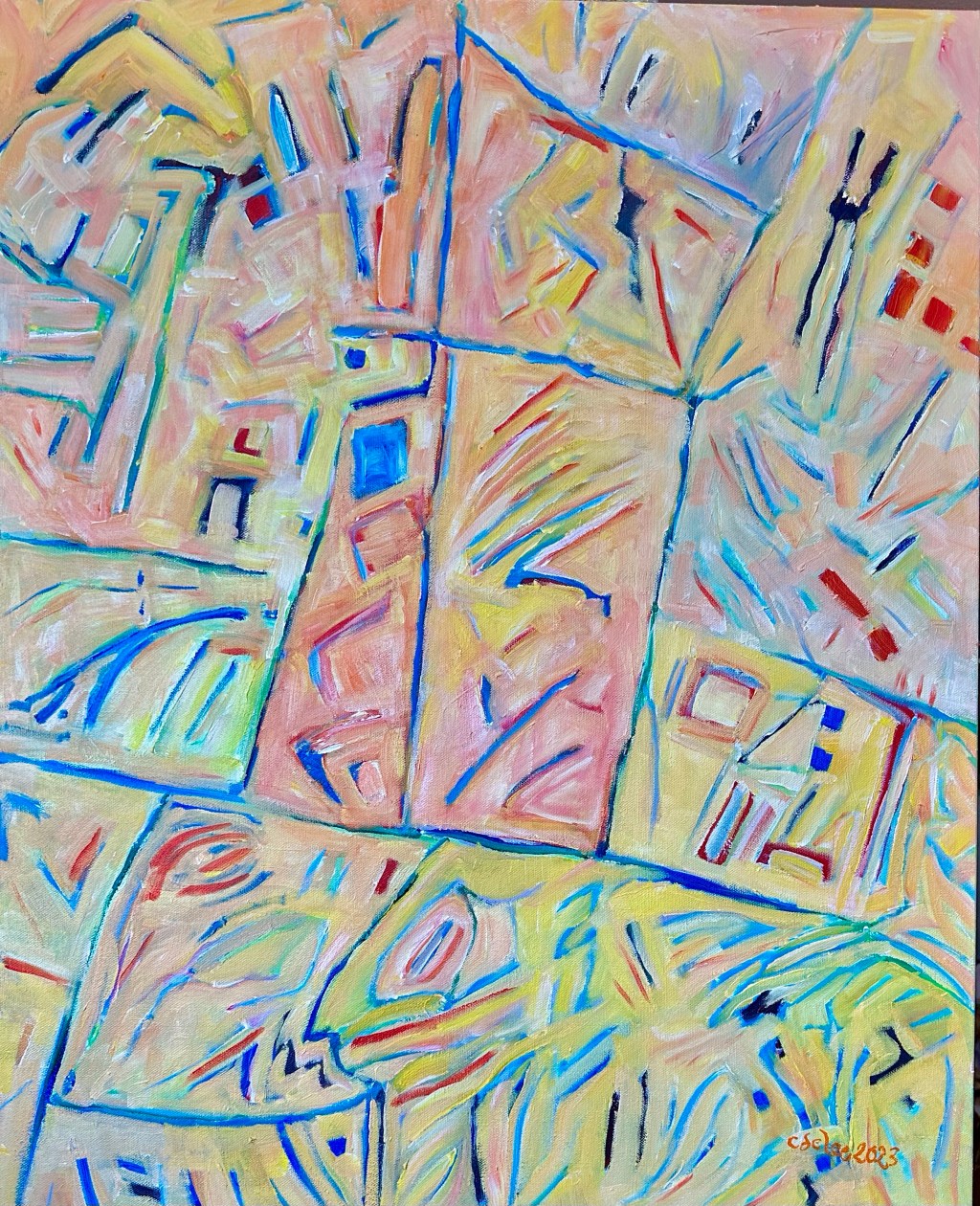
September Megiddo Painting 2023

Why do I mention this? When a tornado rips through a town or a city in Arkansas, it causes damage on a large scale to those people in that area. Because we don’t have densely populated areas, our suffering is limited to a few. This doesn’t discount their particular suffering, but it does mean suffering is limited, for which we can be thankful. When 2,000 pound bombs drop on high rise dwellings, numerous people are made homeless, and the possibility of injuries is high. Perhaps we don’t see this suffering because it’s in a distant land, or because some of the injured call god by another name. If we can’t recognize human suffering as the suffering of another child of God, we’re losing our ability to see the world as God sees God’s world.

The famous Banksy’s Armored Dove of Peace, the painting of a peace dove wearing a flak jacket. The dove is painted on a wall near the separation wall between Bethlehem (Palestinian Territories) and Israel. Nov. 18, 2023

Rebuilding Gaza will be a massive undertaking because Israel’s bombardment has caused mass destruction. Current estimates are at least a half million Palestinians in the enclave won’t have a home to return to when the war ends, according to the UN aid office. By the end of 2023, about 1.9 million people had been displaced, or nearly the entire population, some more than once, as people moved in search of safety. Because of bombing, by the end of 2023, about 65,000 housing units across Gaza Strip have been destroyed or rendered uninhabitable. In addition, over 290,000 housing units had been damaged, according to the Government Media Office in Gaza. Officials estimate many more will be unable to return immediately due to the level of damage to surrounding infrastructure, as well as the risk posed by of Explosive Remnants of War.

The Greek Orthodox Church of Saint Porphyrius in Gaza, believed to be the third oldest church in the world, was hit by missiles as hundreds of Palestinians sought shelter there during a Israeli missile strike in its war against Hamas.

Currently residents in Gaza are facing famine, for the existing World Food Program ready-to-eat food options are falling short of meeting people’s crucial caloric needs. Bread, made from fortified flour, holds the potential to address some of the unmet requirements for essential vitamins and minerals, which the current ready-to-eat baskets fail to provide. Moreover, providing bread as a no-cook food option is crucial when households lack the means to cook meals. Thus, incorporating bread into aid provisions is not only as a practical solution, but also is a key strategy to fulfill immediate nutritional needs.

Children try to get food relief in the southern Gaza Strip city of Rafah, on December 31, 2023.

I first visited the Holy Land in 2000, just before the intifada of 2001. At the time, the Gaza Strip was under Israeli control. Following the 1948 Arab-Israeli War, Egypt administered the newly formed Gaza Strip; Israel captured it in the Six-Day War in 1967. Under a series of agreements known as the Oslo Accords signed between 1993 and 1999, Israel transferred to the newly created Palestinian Authority (PA) security and civilian responsibility for many Palestinian-populated areas of the Gaza Strip as well as the West Bank.

After June 2007, when HAMAS took over the Gaza Strip, Israel and Egypt have enforced tight restrictions on movement and access of goods and individuals into and out of Gaza. Fatah, another political movement, and HAMAS have since reached a series of agreements aimed at restoring political unity between the Gaza Strip and the West Bank but have struggled to enact them. Therefore, Egypt and Israel have maintained border control over the Gaza Strip, determining who and what enters or leaves.

Since Hamas’ surprise attack on the music festival and the settlement nearby, not only have the Jewish people suffered harm due to 1,200 immediate deaths but also the continued terror of those held captive by the Hamas terrorists. Some say Christ suffers only for those who go on to have faith in his saving work on the cross. I was asked once on an Emmaus walk, “Are we saved when we profess our faith in Christ, or when Christ died on the cross for us?”

Byzantine Mosaic apsidal, San Clemente, Rome

They were surprised when I answered, “Yes.” It’s not an either-or question. After all, Christ died once, for all, as an act of saving grace. God raised him from the dead to make him the first of many to cast off the chains of sin and death. When we, centuries later, profess our faith in Christ, we accept his suffering on our behalf and his resurrection as our promise of a life to come. As Christians, we often base our world view on our claim to the promises of God, but we forget Christ’s death and resurrection is a promise to all people, even to those who haven’t professed faith in Christ. As the writer of Hebrews (1:8-9) once said:

“Now in subjecting all things to them, God left nothing outside their control. As it is, we do not yet see everything in subjection to them, but we do see Jesus, who for a little while was made lower than the angels, now crowned with glory and honor because of the suffering of death, so that by the grace of God he might taste death for everyone.”

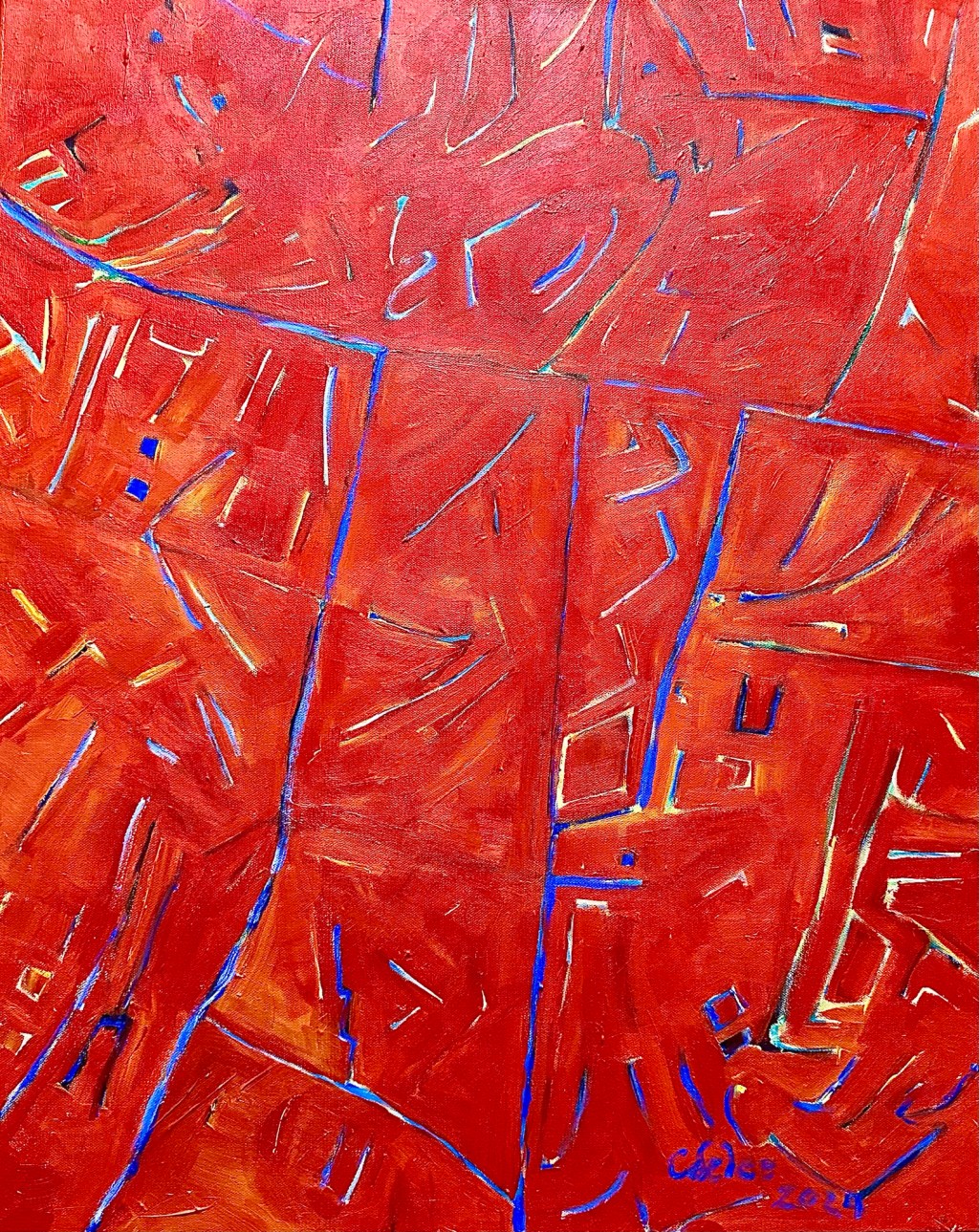
Red Megiddo Cross

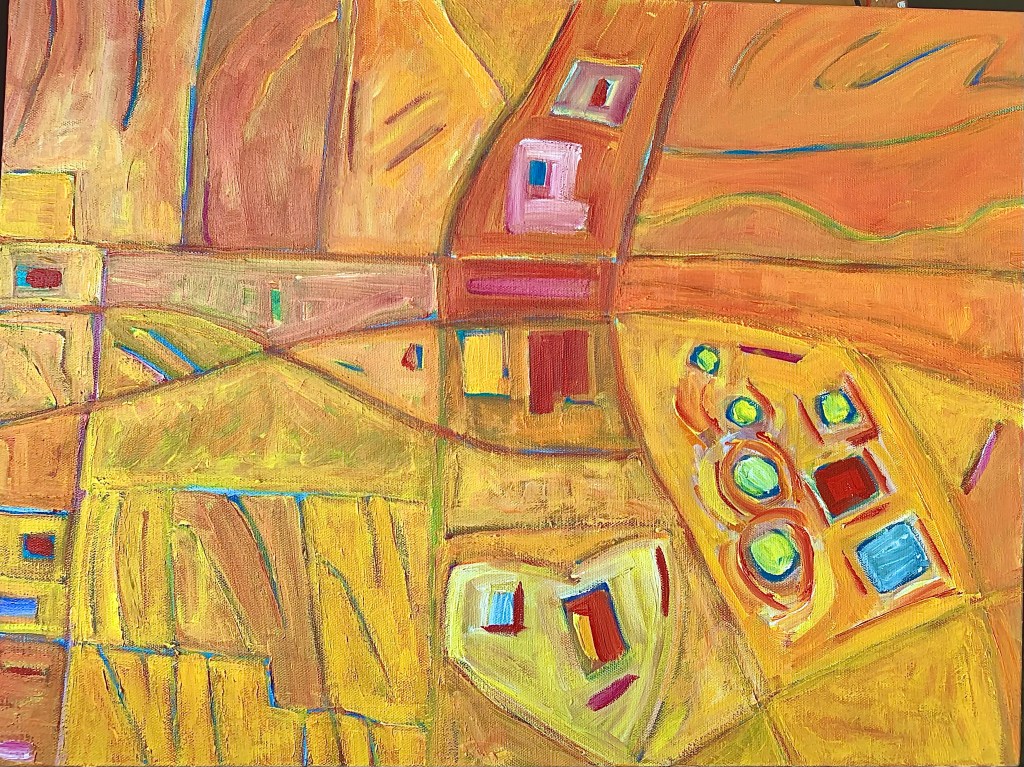
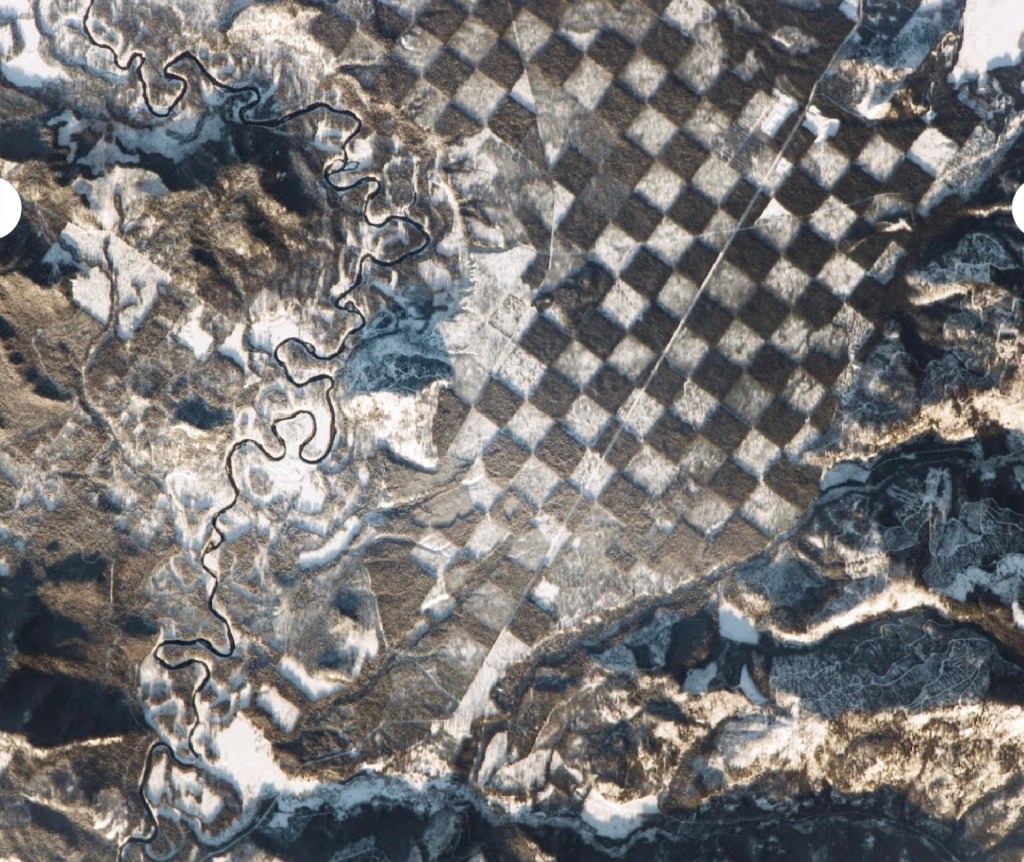
As I worked on my painting, it went through several iterations. First it stayed close to the map of the ruins of Megiddo, which I painted in yellows. Megiddo is the site of the battle to end all battles, and the place where the forces of good meet the forces of evil. Because Israel is on the crossroads of many trade routes, nations have always met there to contest for dominance. I left many scar scribbles on the canvas to represent the destroyed walls of the ancient city. As is my usual practice, I hung up my canvas to live with it awhile, but the longer my painting hung on my wall, the more unsatisfied I was. I can always tell when my inner vision isn’t meshing with finished work. When I took the work down, I flipped it 180 degrees and repainted it in red, for the bloodshed of this most recent war. As I painted out most of the scribbles, I saw the cross appear out of the image. By destroying the remnants of destruction, I had simplified the image down to its essence.

In all things, the cross is crucial. We moderns don’t understand suffering or pain. We deny it, reject it or medicate it with something that keeps us from feeling it. My personal medicinal choices are ice cream and chocolate. If I can combine them in one substance, so much the better! A recent bout with the shingles this past December had me consuming both foods for medicinal relief. Other people use wine, TikTok, or another medication of choice to escape from emotional or physical pain.

The winter of my discontent, brought by Mayhem

Revenge is is a dish best served cold because if we take revenge in the heat of the moment, we’ll over do our response and won’t know when to stop. If we wait, cooler heads will prevail, and a more limited response will likely be our action. Less damage, and less mayhem, but we humans don’t seem to be built this way. Those who have suffered will often return suffering in kind as a “hair of the dog cure.” This is why abuse and family violence is generational. The ancient Hebrews practiced the BAN, or a primitive religious practice of dedicating for destruction an entire group of people and their possessions to the LORD. This was done to cleanse the land and keep the Hebrew people pure from idolatry. Paul had Deuteronomy in mind when he wrote in Romans 12:19—

“Beloved, never avenge yourselves, but leave room for the wrath of God; for it is written, “Vengeance is mine, I will repay, says the Lord.”

While the western world has the crusade mentality, which is similar to the extreme ban, we also have the just war theory. Modern wars are fought by democracies mostly with this mindset, for the international community is in agreement the ends should justify the means. Unfortunately, terrorists don’t agree and fight according to their own extremist beliefs. We have to ask ourselves what happens to us when we adopt their policies and inflict extreme suffering on civilians to the point of causing starvation and homelessness by destroying their homeland. If we act the same as those whom as we despise, have we become them instead? We lose the moral high ground when this happens. It’s time to draw back and reconsider our motives and our methods: how can we be just, compassionate, and holy, as God is holy? Otherwise, we’re suffering for nothing or causing others to suffer meaninglessly.

When we read scripture, God’s Holy Spirit should work in our hearts and minds to make a change in us to confront and conform us into God’s holy nature. If no change happens, we need to ask God to open our hearts and minds to be conformed to God’s Holy Spirit. If it’s painful to read scripture, remember Christ suffered for us. Many of us can’t read the scriptures to be transformed, for change is difficult and painful. However, staying the same is also difficult and painful. (Maybe this is why only 10% of Americans read their Bible daily.) I find God has compassion on those who suffer, especially those who do so while “working out their own salvation in fear and trembling.”

Remember God has compassion and is near to the broken hearted,

Joy and Peace,

Cornelia

Gaza Strip – The World Factbook
https://www.cia.gov/the-world-factbook/countries/gaza-strip/

Hostilities in the Gaza Strip and Israel | Flash Update #85 | United Nations Office for the Coordination of Humanitarian Affairs – occupied Palestinian territory
https://www.ochaopt.org/content/hostilities-gaza-strip-and-israel-flash-update-85

Holocaust | Definition, Concentration Camps, History, & Facts | Britannica
https://www.britannica.com/event/Holocaust

Little Rock, Arkansas Population 2024
https://worldpopulationreview.com/us-cities/little-rock-ar-population

Ban – Encyclopedia of The Bible – Bible Gateway
https://www.biblegateway.com/resources/encyclopedia-of-the-bible/Ban

Report: 26 Million Americans Stopped Reading the Bible Reg…… | News & Reporting | Christianity Today https://www.christianitytoday.com/news/2022/april/state-of-bible-reading-decline-report-26-million.html

Megiddo: Marks and Memories

Altars, art, city, Creativity, Degas, Faith, Forgiveness, Healing, Holy Spirit, Israel, Megiddo, Monet, Painting, perfection, Prayer, risk, salvation, Spirituality, Travel, United Methodist Church, vision

Study for Megiddo Memories

My most recent studio work explores my memories of my pilgrimage to the ancient ruins of Tel Megiddo. Why am I interested enough to make an entire series of drawings and paintings of this site, which I visited over two decades ago? First, the city was continuously occupied from the 7th or 6th millennium BCE, with the ancient tel generally left untouched and intact since its decline and subsequent abandonment around the 4th century BCE. The tels at Megiddo, Hazor, and Beer Sheba all have retained their authenticity and each have acquired the characteristic conical shape with a flattish top, protruding above the surrounding countryside. These three tels are now UNESCO Heritage Sites.

Megiddo: Marks and Memories

Excavations at Tel Meggido have uncovered about 26 layers of settlements dating back to the Chalcolithic period, or the early Bronze Age, about 5,000 years ago. Other sources say 30 layers exist at Tel Megiddo. The first four layers have been identified. This site was a Canaanite city, an Egyptian fortress, a Chariot City during Biblical times, and a prominent Assyrian and Persian city. King Solomon ruled the city in its prime in the 10th century BCE.

Megiddo: First Recorded Battle in History

The city has seen more battles than any other location in the world because of its location at the crossroads of the ancient world. The first written reference to Megiddo also happens to be the first recorded battle in history: a detailed account of the 1479 B.C.E. invasion of the Egyptian Pharaoh Thutmose III. When King Thutmose III of Egypt conquered Megiddo 3,500 years ago, the pharaoh left with, among other things: 1,929 head of cattle, 2,000 goats, 20,500 sheep, 204 horses, 200 army uniforms, and 502 bows. Megiddo is also the first recorded use of the composite bow and the first body count. All details of the battle come from Egyptian sources — primarily the hieroglyphic writings on the Hall of Annals in the Temple of Amun-Re at Karnak, Thebes (now Luxor), by the military scribe Tjaneni. Megiddo is also the site of a large chariot stable complex, called Solomon’s Stables, even though we now know they were built by Solomon’s successor King Ahab during the 9th century B.C.E.

Megiddo: Blue Version, Motions and Moods

Fortress cities sit on the 10 acre summit of Megiddo Hill or Tel Megiddo, rising 21.33 meters (about 70 feet) above the valley. Megiddo is located in the Lower Galilee region of northern Israel. Its critical location dominated the Aruna Pass (Wadi Ara or Megiddo Pass), which was the entrance to one of the few passes through the Carmel Mountains. Megiddo controlled the Via Maris, the main route between Egypt and Mesopotamia, also known as the Egyptian Way of the Sea. Christians regard this area as “Armageddon,” where the final Biblical battle between good and evil will occur.

Circular altar-like shrine from the Early Bronze Age at Megiddo. (Credit: Hanay)

The early Bronze Age temple compound at Megiddo is unparalleled for its number of temples, the continuity of cult activity and the record of ritual activity. The late Bronze Age palace is the most elaborate in Israel, and one of the best in the Levant. For the Iron Age remains, the elaborate orthogonal town plan of Megiddo has few parallels in the Levant. All three tels have impressive remains of their underground water catchments systems, which demonstrate sophisticated and geographically responsive engineering solutions to water storage. Megiddo is significant because the entire sequence of the Bronze Age and Iron Age is not only represented and excavated, but radiocarbon dated.

Megiddo: Moonlight Cityscape

Those are the travelogue statements. When on pilgrimage, one place full of stones begins to look like another after many days on the bus. Even though I was keeping notes of my journey in my paper journal, by the second week, I was hitting information overload. Each and every place was of the utmost importance, but my body was feeling the stress of constant traveling on a bus as well as the lack of good sleep from a different bed in a new hotel every single night.

Only strong coffee, lots of water, and eating three good meals a day were keeping me going. I was so excited during my pilgrimage, I was in an altered state of mind for weeks after my return home. Time slowed down and I could see more clearly for a long time. I would swear I could see individual oxygen molecules in the air, even though in my rational mind I knew this wasn’t possible. Pilgrimage is a spiritual journey, not a tourist trip of checking off various sites to say “I’ve been there and done that.” Even when surrounded by a “great cloud of witnesses” both physical and immaterial, I always knew I was walking on holy ground.

Megiddo: Motions and Moods, number 2

What does it mean to walk in the places where people have lived and died? Especially where they have clashed violently in war? The last time Americans fought a war on our home front was the Civil War. That internecine conflict was a horrific wound on our nation, an injury that hasn’t yet healed for some. I know my own daddy still carried the scars of his ancestors who fought on the battlefield to preserve slavery. He never understood why I thought that was a bad choice and why I worked to undo the damage of the war’s legacy on all Americans.

Cannon at Shiloh National Military Park

While traveling back home from viewing the Great American Eclipse, I met a man at Shiloh National Military Park, a Civil War memorial battle field. He visits these historic sites to pray for the deceased. He was from New Orleans, Louisiana, and believed those who died a violent death still wandered about, since their souls weren’t at peace. I don’t know if I believe this, but it gave him comfort to pray for the release of the hate and violence people can store up in their bodies and spirits and cause them to war upon one another.

I can say on that autumn day while I walked those killing fields, I felt the somber mystery of death and life, dignity and indignity as I walked about the silent hills and valleys. No longer do we hear the crack of the rifle or the thunder of the cannons. Rain has washed away the blood from the grassy knolls and pastures. Sunlight has dressed the wildflowers in beauty. If not for the explanatory signage, I’d never know about the extraordinary happenings at Shiloh National Military Park.

Perhaps I’m painting these historic sites of conflict because we are in a time of strife, not only abroad but at home. The actual shooting wars are going on beyond our shores, but conflicts at home are no less serious. I’m heartbroken by the devastation of the Ukrainian homeland by the Russian aggressors, and remember the ongoing tussle over the Temple Mount by the various faiths of the world. If there’s conflict beyond us, likely there’s conflict within our our own groups. The outer world usually reflects our inner world.

The stress of our United Methodist Church becoming the “Untied Methodist Church” has been rough on me. I’m carrying my stress in my neck and shoulders so much I’ve pinched the nerve to my pinky and ring fingers. They are now numb. I’m now in physical therapy for this. Medication and relaxation exercises will certainly help. One of my condo residents prayed for a “miracle cure” for me. My theology typically considers “miracles” to be reserved for situations beyond the usual care of physicians, but I know lay people use “miracles” more loosely than we clergy. Nevertheless, I appreciated their well meaning prayer for my healing. After all, God cares for both small and large problems, as Jesus reminds us in Luke 12:24,

“Consider the ravens: they neither sow nor reap, they have neither storehouse nor barn, and yet God feeds them. Of how much more value are you than the birds!”

Moonlight over Megiddo, number 1

I look at that second painting and compare it to the first painting I completed. While I attempted to keep the surface flat, I got involved in the recreation of the old city in my imagination. I connected the moonlight outside with the lamplight inside. I also added an abstract figure in the foreground. The red marks don’t work for me anymore,so I’m likely to destroy this art work. The second one I may keep, only because I learned some new colors and was brave enough to experiment with colors I don’t normally use.

Megiddo #3

In this final work, I chose only a portion of the satellite image. This allowed me to eliminate the areas which were causing me problems in the earlier works, especially the large, repeating curves. Although I’m back to my favorite yellow—I confess to being a Van Gogh fan—I used a greater variety of tints, rather than painting straight from the tubes.

Pablo Picasso once said, “Painting is just another way of keeping a diary.” If our outer world is in conflict, this drama will wash over into our inner world. It will show up in our dreams, our health, our relationships, and in other parts of our lives. If we think the late pandemic and current politics have broken relationships or distressed families, imagine what this has done to our churches. Most people go to church as an escape from this drama, hoping to find a sacred place where everyone is Imitating Christ’s Humility:

“If then there is any encouragement in Christ, any consolation from love, any sharing in the Spirit, any compassion and sympathy, make my joy complete: be of the same mind, having the same love, being in full accord and of one mind. Do nothing from selfish ambition or conceit, but in humility regard others as better than yourselves” (Philippians 2:1-3).

Unfortunately, all people bring their imperfect selves to Christ. Although Christ forgives our old sins, our sin habits remain. Most of us forget this. As an artist, I understand better than anyone the process of “going on to perfection” is both a gift of the Holy Spirit and our own work. While God could gift perfection completely, most often it’s a cooperative endeavor. This is why the studio product is sometimes a thrill, but other times a disappointment. Yet even in the disappointments, we can learn from our mistakes. We might need to “mistake a bunch of times” until we get focused on a new direction. We have to trust the process. Canvas is cheap. It can be reused or recycled. Plus, our salvation isn’t impaired by our detours in the studio.

Yet too often we’re hung up on the product as a reflection of our personal value or worth. If we are hurt, damaged, ill, broken,or harmed in any way, art is a therapeutic exercise for us. Monet tied the brushes to his hands when his arthritis made holding the brush too difficult. His later paintings also had freer brushwork. He could have quit, but he adjusted his expectations and his style to keep creating. As Monet once said, “I’m never finished with my paintings; the further I get, the more I seek the impossible and the more powerless I feel.” Degas was fond of saying, “Only when he no longer knows what he is doing does the painter do good things.”

If we’re in the safe, but shallow waters of certainty, we’re unlikely to grow to the deeper depths of either the spiritual or artistic realms. Most of us are afraid to cast off the anchors that keep us bound close to well known shores. We want to hear the praise of the crowd, and if we sail off for the unknown horizon, we will leave those familiar voices of the crowd’s approval behind. We can only discover the new world by leaving the old one behind, by risking a journey in faith others are not willing to undertake. Sometimes we may need to get out of the boat and risk walking across the water to meet Jesus who calls us to meet us in the midst of the strong winds and high waves.

I don’t worry about these feelings anymore, for I know they will come up, I’ll meet them, and then I’ll let them go. Our feelings of the moment are not the feelings of forever. Only one is the same yesterday, today and forever—the Lord Jesus Christ. The rest of us are still a work in progress.

Joy and peace,

Cornelia

Chalcolithic Period – an overview | ScienceDirect Topics. https://www.sciencedirect.com/topics/social-sciences/chalcolithic-period

The Battle of Megiddo – Ancient Egyptian culture https://www.donsmaps.com/egypt2cb.html

Megiddo https://www.jewishvirtuallibrary.org/vie-megiddo

Armageddon Time: How Discoveries at Megiddo Retell the Story of Ancient Israel – Archaeology – Haaretz.com https://www.haaretz.com/archaeology/2023-01-22/ty-article-magazine/armageddon-time-how-discoveries-at-megiddo-retell-the-story-of-ancient-israel/00000185-d960-d2d9-ab95-ffe0729e0000

Kingdoms of the Levant—Megiddo (Canaan)—date contested. https://www.historyfiles.co.uk/KingListsMiddEast/CanaanMegiddo.htm

Megiddo – Tourist Israel https://www.touristisrael.com/megiddo/9448/

Biblical Tels – Megiddo, Hazor, Beer Sheba – UNESCO World Heritage Centre https://whc.unesco.org/en/list/1108/

20 Quotes from Claude Monet | Denver Art Museum

20 Quotes from Edgar Degas | Denver Art Museum

Rabbit! Rabbit!

adult learning, at risk kids, brain plasticity, Children, city, Dreamscape, Faith, Family, flowers, Healing, holidays, Icons, Love, mandala, Mandylion, Ministry, ministry, nature, Prayer, purpose, rabbits, Reflection, renewal, risk, school shootings, shame, Spirituality, Stonehenge, summer solstice, texas, Uncategorized

Welcome to June! I’ve found my sunshades and my flip flops, so this rabbit is ready for a summer vacation. Old school teachers never die, they just take the summer off. And teachers, as well as students, will need a summer off, along with some intensive counseling, to get them ready to return in a healthy frame of mind next fall.

Summer Solstice Mandala

In my early years in ministry, I served in a certain county where many people were caught up in despair. I often complained to my district superintendent of my desire to pour mood elevators into the public water supply.

“You do know drugging the water supply isn’t exactly an acceptable activity for a Methodist minister?”

“Oh, yeah, but it sure would make my job easier.”

Rabbits Love One Another

Remember, June 3 is Love Conquerors All Day. I need to remind myself of this on occasion when I want to take the easy road. As Jesus reminds us in Matthew 7:13—

“Enter through the narrow gate; for the gate is wide
and the road is easy that leads to destruction,
and there are many who take it.”

Taking the easy way out isn’t always the best choice, but it’s the one we rabbits most often choose. We rabbits don’t like to rock the boat, and we like to make all the other rabbits happy if at all possible. The only problem is if we please A, B gets upset. If we please B, A gets upset. We don’t even try to please C, since C is so cranky, even the good Lord Jesus couldn’t fry an egg to please them. We set our hearts and minds on pleasing God, as best we can, and hope to hear the words, “Well done, good and faithful servant, enter into the joy of your master.”

Make Mine Chocolate Ice Cream Day

Chocolate ice cream brings me joy any day of the year, but June 7 is a day dedicated to this frozen delight. Don’t worry about frying eggs, but keep it frozen. I like mine plain, but fresh strawberries or peaches are a nice addition, plus some chopped nuts. Always go for complex, unless you just can’t wait. Then grab a spoon and eat it straight from the pint. (Mark it with your name, since you ate from it.)

Often we cut the Gordian Knot and go for the shortcut to our complex problems. Sometimes this is a good solution, for the shortest distance between two points is a straight line. My daughter used to call my vacation navigation shortcuts “the long cuts,” since I’m directionally challenged. Most of the time, that straight line went through swamp land and alligators. I can hear her voice now, “NOOOOO!!!” I’m known for taking the scenic route, so I often see America’s less known sights, which are off the beaten path.

In the gospel of Luke (14:34), Jesus quotes a proverbial saying:

“Salt is good; but if salt has lost its taste, how can its saltiness be restored?”

Another translation of the latter portion of this verse is “how can it be used for seasoning?”

When I think of loss, I think of a life snuffed out. Some people are burned out, so we can say they’ve lost their seasoning ability. There’s no vim or vigor in them. Other lives are cut short and aren’t able to fulfill their purpose to season the great soup of our community. Our past month was marked by 47 mass shooting incidents in May alone. A mass shooting incident is defined as one in which at least four people are injured or killed, not including the shooter. Suicides aren’t included.

Suicides are also a public health problem. They are the “deaths of despair” that leave ripples of grief and hopelessness in the survivors. They’re the ultimate shortcut solution to a problem, the placing of a period where life has placed a comma or a semicolon. My daughter once attempted suicide by downing half a bottle of aspirin. I noticed the open bottle and pills scattered across the floor. She said the “dog ate it.”

“That’s too bad, I’m going to miss that dog. She won’t be long for this world. We’ll need to make burial plans for her.”

“Well, actually, I’m the one who ate the aspirin.”

“Then we’re going to the hospital. You aren’t going to like getting your stomach pumped, but it’s better than being dead. You want to have a chance to grow up and have a good life. A dog we can replace. You—not so much.”

It was a rough time in her life, and mine too. But God was with us. And we had support from counselors, friends, family, and our church family. My work family and my clients supported me too. I must be the most extroverted rabbit in the patch, because I asked everyone for help. It turned out my problem was shared by everyone else. I discovered I wasn’t alone, but was the most ordinary of rabbits around.

This is a humbling experience, especially when you’re a first child and the only girl. I admit to being spoiled, but don’t let my brother rabbits hear me say this. I’ll deny it to my last breath: I’m like every other rabbit I know. I want to think I’m someone special, even when I’m just as fluffy as every other bunny out there on Gods green earth.

June 21—Summer Solstice

Unfortunately, half the suicides today are committed with a gun, not aspirins. When looking at overall gun deaths, roughly two-thirds are attributed to suicides—a proportion that is consistent across most states. Gun suicides are on the rise and data also indicates men, white Americans, older people, and individuals living in rural areas present higher rates of gun suicides. Another group presenting a unique risk for suicide is current and former members of the armed forces, especially those with PTSD.

Compared with the general population, current and former military members have significantly higher rates of gun ownership. According to a 2015 study, nearly 50% of U.S. veterans own a gun. In contrast, studies suggest that only about 22% of the general U.S. population owns firearms. Similarly, the age groups of 50 to 64 years old and 65 and older have the highest rates of gun ownership, according to a 2017 Pew Research Center study. This can further explain the high rates of suicide among older veterans.

According to data from the U.S. Department of Veterans Affairs (VA), in 2019, close to 4,332 veterans died by gun suicide in the United States, representing close to 18 percent of the total number of gun suicides reported by the Centers for Disease Control and Prevention (CDC) during that year. Perhaps more alarming is the fact this figure shows a veteran is killed by gun suicide every two hours. In 2019, active duty military members committed suicide by gun 64% of the 498 total (318), almost one gun suicide per day.

Why isn’t anyone speaking about this? For all the lip service our politicians give to the flag and to the armed service members, they seem to forget them once they’re no longer useful to fight their wars or march in their parades. Perhaps because Congress won’t devote any money to study the effects of gun violence on the citizens of our Beautiful America, so we have to fund private studies here and there to piece together a patchwork of facts of this scourge on the peace of our people.

My young neighbor, only 8 years old, was in a panic as he knocked on my door the other day. His parents hadn’t come straight up the elevator, as they’d said they would. He was crying to beat the band and was sure something bad had happened to them. I invited him inside and left the door open so we could see them come past. He was so worked up, he couldn’t sit down. I suggested a call to his daddy, but they came walking past just at that moment.

June 19—Father’s Day

We don’t realize what terror these school shootings put our children through. There’s no safe place for them any more, no matter how “hardened” we make the buildings. Some person always breaks the shell at the most inopportune moment.

Some rabbits will have empty seats at their family reunion tables because someone decided to act impulsively. Father’s Day (June 19) won’t be a celebration without the son or daughter to give Dad the tie, the golf balls, or breakfast in bed.

I think back to my own childhood. We worried in the 1950’s more about the urban legends of Halloween candy poisoning, when we were more likely to get killed crossing Highway 1, a four lane highway running through our town. My mother rabbit would wait for me to ride the trolley home from school. She would wait until the near lane of traffic cleared before she walked out to the center median and time this so the far lane’s cars would finish passing so she could walk across the newly empty lanes to meet me on the other side. We held hands and crossed in the same manner on the way back to our home.

This was our routine from the start of school until sometime in the autumn. Mother was delayed one day, so I sat down to wait for her and opened my book to read. I was wearing a brown jacket against the early cool spell, and my dirty blonde hair blended in with the pile of dry leaves on the ground. Intent on my book, I failed to see her come outside. She overlooked me and went inside thinking I’d missed my ride.

A bit later, I decided if she wasn’t coming for me, I’d come to her. Gathering up my possessions, I stood on the curbside. I watched the comings and goings of the quickly moving traffic. Once I saw the break in the pattern, I walked out into the clearing, waited at the median, and crossed behind the trailing traffic of the second lane. When I walked inside, my mother had a conniption fit. After this, I began riding my bicycle to school, and my brother got to come with me.

Brain Functions

Not everyone is mature enough to cross a four lane busy highway by themselves when they’re in the fourth grade, which is the same age as the children who lost their lives at Robb Elementary in Uvalde, Texas. . Some people still need to be supervised at work even in their 20’s. The brain keeps maturing past age 21, as the frontal lobes, which are home to key components of the neural circuitry underlying “executive functions” (such as planning, working memory, and impulse control) are among the last areas of the brain to mature; they may not be fully developed until halfway through the third decade of life. Although neuroscience has been called upon to determine adulthood, there is little empirical evidence to support age 18, the current legal age of majority, as an accurate marker of adult capacities.

Since May 24, the date of this tragedy in Uvalde, Texas, the gunviolencearchive.org has recorded 16 mass shootings in six days, with 79 killed or wounded. Some of these are high school graduation parties where uninvited guests arrived and gunfire broke out, others are the result of young people wandering about in the late hours and getting into trouble with guns. During my time of ministry, youth, alcohol, and firearms were usually a recipe for trouble. Maybe parental rabbits’ brains are still developing too, if they aren’t able to put their rabbit foot down and tell the junior rabbits to leave their weapons at home. Visiting Jack Rabbit in jail for accidental death or intentional use of a firearm will throw a curve into your best laid plans for your progeny.

Rabbits in Cars Going for a Joyride

Instead, cities may have to reinstitute curfews after dark to curtail the opportunities for gun violence. Or they could raise the age to buy a weapon and require a longer waiting time and a more thorough background check. I wouldn’t be opposed to a training class and a test to see if the owner knows how to use the weapon safely. After all, we do this for the 2 ton weapon of mass destruction known as the family automobile. So what if the founding fathers never had autos; they also never had automatic pistols or large magazine weapons, modeled on the ones used in combat.

Did I mention June is National Safety Month? Its emphasis is workplace safety, but as a former teacher, this old rabbit reminds you, between 2009 and 2020, teachers’ workplaces are in schools, which is where 30% of mass shootings occurred in public places (schools, malls, or bars), while 61% of mass shootings occurred entirely in the home and another 9% occurred partially in a home and partially in a public location. The common factor in these is the gun and the presence of domestic violence. In at least 53 percent of mass shootings between 2009 and 2020, the perpetrator shot a current or former intimate partner or family member during the rampage.

Richard Small seen posing with his rifle before turning it over to police.
(Joshua Lott/The Washington Post)

I know y’all usually expect a bright and cheery note from me at the beginning of the month, but my heart is broken. Thoughts and prayers are nice, but they don’t stop the carnage. We need to make some changes. At least one man has turned in his assault weapon to his local police station, so it doesn’t fall into the wrong hands. He couldn’t bear the thought of it being used to perpetrate a similar crime if he were to sell it. If we parents don’t say no to our children, if we keep voting for politicians who are doing nothing, then we get to keep the distinction of having the highest rate of violent gun deaths for any of the developed countries.

That’s not the American Exceptionalism I believe in. We can do better. These are crimes against the common good and against the innocent. The shooter shares the primary blame, but everyone who does nothing to change our society for the better also shares the blame and shame for the next group of victims. At the rate we’re going, we’re having about one mass shooting per day. Eventually this scourge will come to YourTown, USA, and your small town police force will be just as flabbergasted as poor Uvalde’s. How could this happen in our little corner of the world?

I cry along with Jeremiah ( 8:21-22):

For the hurt of my poor people I am hurt,
I mourn, and dismay has taken hold of me.
Is there no balm in Gilead?
Is there no physician there?
Why then has the health of my poor people
not been restored?

Time Magazine Cover from 2019 with all the Mass Shooting Locations Named

Sometimes we go along with the attributes of cultural Christianity, rather than practicing the Christianity of Jesus Christ. Romans 12:2 reminds us

“Do not be conformed to this world, but be transformed
by the renewing of your minds, so that you may discern
what is the will of God—what is good and acceptable and perfect.”

Joy, peace, and balm for hurting souls,

Rev. Cornelia

Deadly Dreams: What Motivates School Shootings? – Scientific American
https://www.scientificamerican.com/article/deadly-dreams/

You can view a report of any 2022 mass shooting incident by visiting the list on the Gun Violence Archive’s website:
https://www.gunviolencearchive.org/reports/mass-shooting

Poisoned Halloween Candy | Snopes.com
https://www.scientificamerican.com/article/deadly-dreams/

Mass Shootings in America | Everytown Research & Policy | Everytown Research & Policy
https://everytownresearch.org/maps/mass-shootings-in-america/

Adolescent Maturity and the Brain: The Promise and Pitfalls of Neuroscience Research in Adolescent Health Policy – PMC
https://www.ncbi.nlm.nih.gov/pmc/articles/PMC2892678/

Guns and Mass Shootings: Data Show Why US Is Outlier on Deaths From Firearms
https://www.bloomberg.com/graphics/2022-us-gun-violence-world-comparison/

Texas romance with guns tested by Uvalde school shooting – The Washington Post
https://www.washingtonpost.com/nation/2022/05/30/uvalde-shooting-guns/

To Be or Not To Be

Alexander the Great, art, city, Civil War, cognitive maps, Creativity, Faith, Forgiveness, Healing, Holy Spirit, hope, inspiration, Painting, picasso, Reflection, renewal, Spirituality, vision

Hamlet’s famous soliloquy begins with these very words,”To be, or not to be: that is the question.” In seminary I learned one of those big fifty cent words I often had to check my dictionary for its meaning. Ontological is a word we don’t throw around in ordinary conversations. I never used it in a sermon, for its strangeness would have been a stumbling block to folks without similar training. Who am I kidding? It was often a stumbling block when I tripped over it in my reading. I finally understood it after my first year of Greek. I needed to know its meaning fully and completely to comprehend it.

Current events, however, make an auspicious teaching moment for this weird word. Ontology is a branch of metaphysics concerned with the nature and relations of being. Ontology is the the branch of philosophy which deals with abstract entities. It’s concerned with the nature of being or the kinds of things that have existence, but are outside objective experience. It deals with the first principles of things, including abstract concepts such as being, knowing, substance, cause, identity, time, and space. Our word essence carries the meaning well, for it means “the permanent as contrasted with the accidental elements of being.”

An example of an ontological statement in scripture is the discussion Jesus has in John 8:56-58 with some of the Jews who opposed him:

“Your ancestor Abraham rejoiced that he would see my day; he saw it and was glad.”

Then the Jews said to him, “You are not yet fifty years old, and have you seen Abraham?”

Jesus said to them, “Very truly, I tell you, before Abraham was, I am.”

In Shakespeare’s play of the same name, Hamlet’s whole soliloquy is about his existence, and whether he should live or die:

Whether ’tis nobler in the mind to suffer
The slings and arrows of outrageous fortune,
Or to take arms against a sea of troubles,
And by opposing end them? To die: to sleep;
No more; and by a sleep to say we end
The heart-ache and the thousand natural shocks
That flesh is heir to, ’tis a consummation
Devoutly to be wish’d. To die, to sleep;

Ontology comes from the Greek root ontos, ōn, which is the present participle of einai, of the verb to be. As I’ve watched the unfolding horror of this “Russian special exercise” on Ukrainian soil, I’m struck by the sense of Hamlet’s description of the struggles of life:

To sleep: perchance to dream: ay, there’s the rub;
For in that sleep of death what dreams may come
When we have shuffled off this mortal coil,
Must give us pause: there’s the respect
That makes calamity of so long life;
For who would bear the whips and scorns of time,
The oppressor’s wrong, the proud man’s contumely,
The pangs of despised love, the law’s delay,
The insolence of office and the spurns
That patient merit of the unworthy takes,
When he himself might his quietus make
With a bare bodkin?

“To be” is the ontological insistence for the Ukrainians, for they desire to exist as a free people in a free nation. They resist occupation and occupiers. Dictatorship isn’t in their five year plan, or in their distant future, if they can help it. The surrounding nations have suddenly come alive in their recognition of Russia’s unfortunate foray into this breadbasket of Europe.

Yet even as the Ukrainian people are being killed in their streets, for no reason other than their citizenship; and their homes, hospitals, museums, and public buildings are reduced to smithereens by cluster bombs and artillery fire; they fight for their land and their freedom. I watch for one hour on the evening news, for I believe our world must stand witness to this horror.

Yes, some will turn away, for they have too much trauma in their own lives to bear the pain of others. Others will watch and say this isn’t our problem. If we remember our scripture, the chosen disciples abandoned Jesus in his hour of pain and need, but the women stayed by his side until his last breath. Then they came to dress his dead body’s wounds, but found an empty grave, while the men were holed up in a locked room for fear of the Jews (John 20:19).

Humanity is always our concern and when inhumane acts or conditions prevail, the human responsibility is to bear witness and to share the burden. As Paul writes in Galatians 6:2—

“Bear one another’s burdens, and in this way you will fulfill the law of Christ.”

Hamlet muses on, dithering as contemplates taking his own life, but he takes no action for fear of what awaits him in the world beyond.

who would fardels (burdens) bear,
To grunt and sweat under a weary life,
But that the dread of something after death,
The undiscover’d country from whose bourn (boundary)
No traveller returns, puzzles the will
And makes us rather bear those ills we have
Than fly to others that we know not of?
Thus conscience does make cowards of us all;
And thus the native hue of resolution
Is sicklied o’er with the pale cast of thought,
And enterprises of great pith and moment
With this regard their currents turn awry,
And lose the name of action.

While none of us know with certainty what lies beyond this world, for no one has ever returned with souvenirs, people of faith have trusted God to be always with them, even in the worst of times. As Paul writes in Romans 8:35, 37-39—

“Who will separate us from the love of Christ? Will hardship, or distress, or persecution, or famine, or nakedness, or peril, or sword?…No, in all these things we are more than conquerors through him who loved us. For I am convinced that neither death, nor life, nor angels, nor rulers, nor things present, nor things to come, nor powers, nor height, nor depth, nor anything else in all creation, will be able to separate us from the love of God in Christ Jesus our Lord.”

Battle of Issus Mosaic, Detail: Portrait of Alexander the Great

Artists across the centuries have responded to the horrors of war, if they aren’t held in thrall to the purveyors of such deeds. Those who exist to magnify the glories of battle are there as servants of powerful leaders, not as representatives of the fragility of the human condition. Think of Alexander the Great and his route to deification, first as a glorious leader, then as a god.

The Alexander Mosaic depicts a moment of victory in Battle of Issus in which Alexander has broken through to Darius of Persia, whom he defeated and shocked, before Darius was at the verge of fleeing. The mosaic is as great as Alexander himself, for it’s about 9 feet by 17 feet in size and contains over 1.5 million individual blocks of color, or tesserae. This Roman copy of an original Greek fourth century BCE painting dates from the second century BCE and is in the Museo Nazionale, Naples, Italy.

Goya: The 3rd of May 1808 in Madrid, or “The Executions”, oil on canvas, 1814, Prado Museum, Spain.

Here we see Goya painting the horrors of war and its impact on humanity. His inspiration comes from the French army’s assassination of a group of Spanish patriots during the 1808 rebellion. The Spanish heroes are illuminated by the intense light, but their faceless enemies aren’t easily visible in the darkness from which they operate. Not only does the design make plain Goya’s feelings, but his psychological understanding of the scene as well.

As Matthew writes in Jesus’ teaching kernel known as “The Sound Eye,”

“The eye is the lamp of the body. So, if your eye is healthy, your whole body will be full of light; but if your eye is unhealthy, your whole body will be full of darkness. If then the light in you is darkness, how great is the darkness!” (6:22-23)

Picasso: Guernica

Probably the best known war painting of our modern era is Picasso’s Guernica. He painted it in response to the Nazi bombing of Guernica, a Spanish town in the Basque region during the Spanish Civil War. At about 16:30 on Monday, 26 April 1937, warplanes of the German Condor Legion, commanded by Colonel Wolfram von Richthofen, bombed Guernica for about two hours. Germany, at this time led by Hitler, had lent material support to the Nationalists and were using the war as an opportunity to test out new weapons and tactics. Later, intense aerial bombardment became a crucial preliminary step in the Blitzkrieg tactic.

Guernica, Picasso’s most important political painting, has remained relevant as a work of art and as a symbol of protest. It has kept the memory of the Basque town’s nightmare alive. While Picasso was living in Nazi-occupied Paris during World War II, one German officer allegedly asked him, upon seeing a photo of Guernica in his apartment, “Did you do that?” Picasso responded, “No, you did.”

Käthe Kollwitz, Woman with Dead Child, 1903, etching on paper. Courtesy: © Getty Research Institute, Los Angeles and Artists Rights Society (ARS), New York

Lest we forget, while wars are often started by those in power, it’s the mothers who suffer when young soldiers are killed in action. Some are fortunate enough to have the body of their loved one to hold, but it’s a sad consolation prize. How heart rending it must be for the families whose children were left behind as casualties of war. As the old Cold War era 1985 Sting song about nuclear war reminds us—

There’s no such thing as a winnable war
It’s a lie we don’t believe anymore…
We share the same biology, regardless of ideology
But what might save us, me and you
Is if the Russians love their children too.

The great sadness of this brutal war foisted on the Ukrainian people is while we’re free to see and own the pain inflicted on others, too many of us will turn away. Then again, we often have difficulty acknowledging our own pain and weakness, for we prefer to see ourselves as whole, strong, and unconquerable. All of us have a weak place and we all have an emptiness that needs to be filled. Some of us fill this emptiness by seeking power and control, while others choose various substances or activities to overuse. A few will let God’s Spirit fill us, as Paul writes in 2 Corinthians 4:7—

“But we have this treasure in clay jars, so that it may be made clear that this extraordinary power belongs to God and does not come from us.”

Cornelia DeLee: Obliterated Ukrainian Landscape, Maxar Satellite Image, Apple Pencil, 2022.

When I see the satellite imagery of the obliterated Ukrainian towns, I recall my childhood memories of the old ones in my family repeating their ancestors’ stories of the troubled times during the Civil War. I can easily imagine in Ukraine, for several generations to come, all the stories of pain, survival, and resilience that will be told as they rebuild their nation from the ground up. In the midst of this ongoing disaster, they’re already thinking “How can we build back better?”

This is a great lesson for all of us. If our life hits a major roadblock, we can either give up, scale the wall, or find a way around the wall. Another option is to make peace with the wall and find a way to be happy there. Since Putin is tearing down all the walls for the Ukrainian people, they’ve decided to double down on being Ukrainian. “To be me” is “to be free” and that means “to be Ukrainian.” As their land lies in ashes about them, those who once also spoke Russian, a similar language to Ukrainian, now find that language dead as ashes in their mouths.

Cornelia DeLee: Ukrainian Town Reduced to Ashes, acrylic on canvas, 2022.

To win friends and influence people requires a gentle hand, not the ham-fist of a dictator. I only wonder if the Russian people will ever understand this. But they may have been slaves of their state for so long, they don’t know the sweet taste of freedom. Perhaps only those who believe in a forgiving God, who allows God’s people the freedom to make mistakes and gives them through the reconciling grace of renewed fellowship, are able to come through such disasters. Those who are “sinners in the hands of an angry god” must think their fate is destiny and accept it.

So the questions remain:

  1. What IS the nature of YOUR God?
  2. How does God’s nature affect your understanding of human nature?
  3. Does your view of humanity reflect your image of God or do you see humanity through “God’s eyes?”
  4. Read the Prodigal Son in Luke 15:11-30 and answer the questions again

Some days I AM Joy and Peace,
Cornelia

Hamlet, Act III, Scene I [To be, or not to be] by William Shakespeare
https://poets.org/poem/hamlet-act-iii-scene-i-be-or-not-be

Why is the Alexander mosaic significant?
https://www.rampfesthudson.com/why-is-the-alexander-mosaic-significant/

The 3rd of May 1808 in Madrid, or “The Executions” – The Collection – Museo Nacional del Prado
https://www.museodelprado.es/en/the-collection/art-work/the-3rd-of-may-1808-in-madrid-or-the-executions/5e177409-2993-4240-97fb-847a02c6496c

Pablo Picasso: Guernica
https://www.pablopicasso.org/guernica.jsp

The Heart of the City

arkansas, art, change, city, cognitive maps, Creativity, Historic neighborhood, hope, Imagination, mystery, Painting, trees

Cities are growing organisms, each having their central growth from their place of origin. Some begin on a waterfront, as a place of trade. Other communities began along a creek, where people would meet to connect, trade, and settle differences in peace. These were safe spaces, welcoming places, but they existed only so long as everyone acknowledged them.

In our cities today, safe spaces are rare. Some reasons are we don’t know everyone anymore, since our populations are so large. We don’t know who to trust, so we trust no one. If we’re anonymous, we think can do what we want, since no one knows who we are and we don’t know whom we harm. Of course, this is absurd, for if we do harm to another, we aren’t living out our best life, not to mention we’re not living out the wisdom of “Do unto others what you want done unto yourself.”

“Who knows what lurks in the heart of man?” the old radio program asked. “The Shadow knows,” was the answer. Most of what we know as the city is hidden behind the layers of paint, wallpaper, and various accretions of dust in our historic district. In Hot Springs, we can eat hamburgers in buildings where mobsters would hang out, walk the streets where old time baseball players strolled, and take hot baths where our ancestors took the “cure” for every disease known to humankind. They got clean, but the cure didn’t take.

Autumn Facade, Downtown Hot Springs

We have a civic interest in renewing our old buildings, for they attract tourists and provide incomes for owners and workers in our restaurants, shops, and hotels of all sizes and qualities. We have dive bars and first-class accommodations within a mile of each other. This is a sure sign of a community in transition. I won’t name either, but if Hot Springs were to be the setting of an old-time radio show, it wouldn’t lack for interesting characters or venues.

During this pandemic era, for it’s stretched long enough now to be called such a lengthy time, I’ve been working on a group of cognitive maps. A cognitive map is any visual representation of a person’s (or a group’s) mental model for a given process or concept. Cognitive maps have no visual rules they need to obey. There’s also no restriction on how the concepts and the relationships between them are visually represented. If we were to take a number of people to the same place, we’d most likely end up with the same number of maps. Some parts might overlap, but everyone would notice different aspects of the landscape.

My own cognitive maps start with a screen shot of a google map of a place I’ve been prepandemic, and work in process through sketches, then several layers of paint, and finally, the end product. This last stopping point sometimes comes only after I think I’ve finished the painting, but I leave it sitting out where I can look at it some more. In the looking, I discover, I’m not ready to release this image out to the world. It lacks unity, power, focus, or some other defining quality I can’t put words to. I only know I am unhappy with it the longer I look at it.

When I cook a recipe, I have a certainty if I follow the directions, I measure correctly, and my oven is true to temperature, I’ll come out with a good approximation of the original recipe. Afterall, I’m recreating someone else’s process and instructions. Making something new, from the imagination is part of the creative process. Sometimes the end product arrives easily, but other times, its birth is a struggle, and the child arrives crying to beat the band.

Creekside Landscape, Hot Springs, 2021 springtime

Most of us are used to seeing the landscape from our upright view, for we walk through our world with our head up every day as we reconnoiter along our daily paths. Some of us keep our heads buried in our phones, so we depend on the good nature of others to keep us from bumping into them, or these people must have particularly good side vision to avoid collisions with other walkers. We don’t have the bird’s eye view of the city, so we don’t see how the streets connect or how they follow the elevation changes. We also don’t get to see the patterns of tree growth, or the hidden waterways. Mostly we have a patchwork vision of just the immediate areas we inhabit, but not a vision of the whole.

Greenway Park Map: Apple Pencil Drawing on Google Map

I saved a screenshot to my iPad so I could draw on it. Color for me has emotional energy, so as I drew, I over laid the first colors with others. The changes the drawing went through prepared me for the changes through which the painting would transition. This pandemic has certainly been a time of change, but life has always been changing. One of my old friends always said, “Human beings are meant to change. We’re brand-new people every 27 days! That’s how often we get a whole new skin.”

I spent many years in the church, an organization not noted for changing. It’s not the organization that doesn’t want to change, but the people. We find those same people resistant to change in NASCAR fans, football fans, and any other group you want to name. As one wag said, “It was the 56th Super Bowl and they finally had rap music in Los Angeles, and NASCAR had Pit Bull at the LA Coliseum for the Clash for the first time in 43 years. If you have a point, it’s time to make it.” If we don’t like change, we should quit washing our bodies, since we’re just hurrying those dead skin cells off to their final demise.

First Stage of Greenway Park Map Painting

Artists must embrace change, however, for the moment we put a mark on a canvas or tap a stone with a chisel and hammer, we’ve changed the surface before us. We can’t be afraid to go into the emptiness or the unknown, for there we’ll find the beauty of the unspoken or the hope of the silence in which we work.

This stage of the painting adheres closely to the drawn image. The blue streets define the city blocks and a few building shapes are notated. It’s a complicated street map from one of our older sections of town.

Second Stage of Greenway Park Map Painting

On this repainting, I balanced the colors better, but kept the greens and oranges. I signed it, for I thought I was “finished.” I set it down in my living room to observe it for a while. I often do this with my work, for if it still looks good after six months, I think it’ll survive for a year. If it lasts a year, I think it’ll last longer. If I look at it three years later and it doesn’t survive, I’ll destroy it. This was painted during the winter, with the worst low light of the season. No wonder it looked grim under the brightening light of the returning sun.

Final Stage Greenway Map

Some sunshine has come into my life here in the middle of February. I’m very sensitive to the transition of light across the seasons, so when it begins to leave in October, I start shutting down. When the light begins to return again, I awake, as if from a hibernation. Perhaps this is the reason I took all my yellows and reds and overpainted the other colors on the canvas. Now my canvas is almost monochromatic, except for small streaks and blobs of color in places. You can still see the city blocks and streets, but now the over all feeling is less of a map and more of an energy record of the city area.

This is the city as it grows, as it lives, and as it changes. The dynamics and life blood of the city move and pulse as it transforms. Hot Springs is unique in that we keep as much of our old as possible and build new when we must. I’m thankful for this city, for its love of the arts, and its honor of its history, as well as its embrace of the future.

After all, that’s all any of us can do, is remember who we are, whose we are, and give thanks to the one whose steadfast love remains forever.

Joy and Peace,

Cornelia

How Often Does the Epidermis Renew?
https://www.webmd.com/beauty/cosmetic-procedures-overview-skin

The City

adult learning, art, city, cognitive maps, Creativity, hope, Imagination, inspiration, Painting, pandemic

As an itinerant Methodist pastor I, along with my sisters and brothers, have had the privilege of answering God’s call to minister in different cities and towns. Sometimes I questioned the wisdom of the Holy Spirit working through my district superintendents and bishop, but I wasn’t alone in this. Other clergy have wondered why they were sent to “exile cities, ” just as our congregations often wondered why the bishop sent them the very last person at the bottom of the clergy bucket.

The prophet Jeremiah spoke to the people taken from their homeland into exile in Babylon after the fall of Jerusalem in 587 BCE:

“But seek the welfare of the city where I have sent you into exile, and pray to the LORD on its behalf, for in its welfare you will find your welfare.” (29:7)

God has a way of putting us where we need to be, just as God has a way of providing the leaders we need. Maybe not the leader we want, but the leader we need. Also maybe not the location we’d put at the top of our bucket list, but the place where God needs us to be in this present moment.

Making a painting has some of this same expectation and disappointment. In class we had the inspiration of “The City.” We don’t paint just the shapes, but also the emotions we feel about the subject matter. If we like the city, we’ll respond well, but if the idea of the city is distressing to us, we might not even be able to work at all. If I don’t have sufficient caffeine by 10 am, my creative juices don’t flow swiftly.

City in the Dark of Night

This was one of the inspiration images. It may be best understood as, “Who knows what evil lurks in the hearts of men? The Shadow knows!” Also a poem, “The Cities Inside Us,” by Alberto Ríos, says “what the Shadow knows:”

We live in secret cities
And we travel unmapped roads.

We speak words between us that we recognize
But which cannot be looked up.

They are our words.
They come from very far inside our mouths.

You and I, we are the secret citizens of the city
Inside us, and inside us

There go all the cars we have driven
And seen, there are all the people

We know and have known, there
Are all the places that are

But which used to be as well. This is where
They went. They did not disappear.

We each take a piece
Through the eye and through the ear.

It’s loud inside us, in there, and when we speak
In the outside world

We have to hope that some of that sound
Does not come out, that an arm

Not reach out
In place of the tongue.

Overpainted Houses

These brightly colored houses are the last layer of a heavily overpainted canvas. Underneath the house shapes with their gabled roofs, we can still see the faint images of rectangular buildings. The artist also scratched through the paint in places for texture and stumbled colors on top of other colors. This technique takes more time than two hours, since the bottom layers need to dry before the upper layers are added. The quality of paint is different also, since thin paint isn’t able to handle this type of work. It yields a much livelier and more optimistic image than the dark one above.

Seaside Houses

This image has not only the brightly colored houses of a seaside city, but also their reflections in the water below. The sky is broken up into planes of various tints of blue. There’s three distinct sections: foreground, middle ground, and background. It’s located in a real space, even though it’s rendered in flat and decorative colors.

Dusty’s Buildings on the Lawn

Dusty painted his buildings on a green lawn for a nice landscape setting. While he didn’t have time to render any details in our short class time, I could tell he was thoughtful about the placement of his colors and shapes.

Mike’s Atmospheric Sky and Cityscape

I asked Mike what his Myers Briggs Type was, since he has no trouble making a plan and executing it. My guess his first and last letters are E and J, and most likely S and T in the middle. Not everyone can make a plan right away, but some have to work on the canvas and let the painting begin to call itself into being. It becomes more of a conversation between the artist and the artwork.

Mike enjoyed bringing to life the night sky with its clouds and full moon. The mystery of a city and its buildings’ windows blazing with light in the night must be a memory he holds dear.

Lauralei’s City Under the Clouds

Lauralei’s city had some moody, overhanging clouds. The buildings underneath were transparent and fragile. It was as if they were a glass city, and a threatening storm cloud hung over the city. Worry and stress can wear a person down. I know anxiety is something I’ve had to deal with my whole life. “You can’t cross the bridge until you get to it,” my mother always said. My Nannie would chime in, “Today’s trouble is enough. Don’t go borrowing trouble from tomorrow!” It’s best sometimes to put the work down and try again after giving our concerns over to God:

“The prayer of the humble pierces the clouds,
and it will not rest until it reaches its goal;
it will not desist until the Most High responds.”
~~ Sirach 35:21

Sally’s City

Sally would have liked to work some more on last week’s painting, but tried this project instead. She’s still learning the limits of her paints, so this is why the building on the left has one green dot darker than the others. It was painted into the wet ground, so it picked up that color and dulled it. I saw that move out of the corner of my eye and suggested she let the building dry first. If we work all over the surface, or “do the big before the small,” we have a good chance our colors will stay clean and fresh. If we want grayed colors, we go ahead and paint into wet areas. The orange and blue complementary colors contrast nicely with the grays and violets.

Gail’s Copenhagen Painting

Gail used a photo to do her painting at home while under quarantine. She made a good rendering. I’d suggested to the group the week before we would do a city scene, so if they had a photo on their phone, or a postcard from a vacation, they were welcome to bring it. I guess the dog ate everyone’s homework! Except for Gail.

Gail’s inspiration image and painting
Cornelia’s Cognitive Map—1

My work went through several stages, rather like our continuing COVID pandemic. The map covers the area between our two city hospitals, National Park Medical Center and CHI St. Vincent. The former is at 100% occupancy in its ICU beds and the latter is at half capacity. National Park’s regular beds are almost 80% full, while CHI’s are about 55% full. In class time, I laid down some base colors according to a pattern from Google maps. Then it was time to pick up, clean our tools, and go home.

Cognitive Map—2

At home, after I recovered from a weekend of four exciting football games, I took several of my oldest fabric face masks, which are inadequate for our latest highly transmissible omicron variant. Abandoned masks are a common sight, joining the rest of the urban detritus that sully our city sidewalks now. I also added some of my grandmother’s crocheted rickrack for one of the main streets. I overpainted the bright colors with dark blue colors. Somehow rolling into the third year of this pandemic has sucked some of the energy out of me.

Cognitive Map—3

The dark night of COVID couldn’t last long for me, for I always have hope. I picked up my iridescent colors: silver, gold, and bronze. Mixing these, as I scumbled them over the base colors, I thought of the Psalmist (104:30):

“When you send forth your spirit, they are created;
and you renew the face of the ground.”

Cognitive Map—4

I wasn’t truly satisfied until I pulled the gold, silver, and bronze mix over all the whole surface. Only a few of the bright colors from the original under painting remained as key notes to bring the eye around the canvas. I think I might have to make more three dimensional areas in another work. This one doesn’t have quite enough.

When I taught young children, I used to remind their parents children have a different purpose in art than adults do. Children are excited about the process, while adults want a finished image. Kids will push a work beyond its “boundary” just to experience the activity of making art, while adults often hold themselves back for fear they might go over the edge. We grownups need to have more of that childlike abandon, since going over the edge in art isn’t going to threaten life or limb.

This week we’ll paint from wildflowers. Drawing from our imagination is difficult if we haven’t practiced this skill. Drawing from an object we can see is much easier. We can look at it and sort out the basic shapes and lines. We can check the proportions to see if they relate to one another correctly. Sometimes we discover drawing from real life is actually just as hard as making something up out of our own creative ideas. Actually, everything about art is equally easy and difficult at one and the same time. We just have to relax and make the colors and shapes appear on the surface.

Remember the words of hope from Jeremiah to the captives in Babylon:

“For surely I know the plans I have for you, says the LORD, plans for your welfare and not for harm, to give you a future with hope. Then when you call upon me and come and pray to me, I will hear you. When you search for me, you will find me; if you seek me with all your heart, I will let you find me, says the LORD, and I will restore your fortunes and gather you from all the nations and all the places where I have driven you, says the LORD, and I will bring you back to the place from which I sent you into exile (29:11-14).”

Joy and peace,

Cornelia

The Cities Inside Us by Alberto Ríos – Poems | Academy of American Poets
https://poets.org/poem/cities-inside-us

COVID-19 (Coronavirus) Hospital Capacity in Garland County, Arkansas
https://data.progress-index.com/covid-19-hospital-capacity/arkansas/05/garland-county/05051/