Four Pears Still Life

art, Cezanne, Creativity, failure, nature, Painting, Pompeii, Transfiguration

We painted a still life of four pears and a handmade blue bowl in our recent Friday art class. After looking at some art prompts and reminding the class, “Pears are just variations on spheres piled on top of each other,” we got down to business. In art class this means spending some time looking. Unless we’re designing an abstract creation, we usually have a desire to make our images reflect what we see. Yet each of us sees from a unique perspective and we each have a special creative use of color and line. This is our creative genius which lives within each of us. My goal as a teacher is to lead this genius out of each person and set it free to feel confident to exercise its own voice.

Pompeii Genius mural, House of Lares

The genius is a Greco Roman idea like our guardian angel, in that each person has a guardian spirit. The Romans put the father at the head of the family, so the genius was the spirit of the male head of the household. In the family altar areas lares, (guardians of the family, who protect the household from external threats) stand on either side of the genius, who wears a toga and makes a sacrifice. Beneath them all is a serpent. The murals often depict snakes in the lararia because the Romans believed they were also guardian spirits of the family and as well as messengers to the underworld.

The poet Horace half-seriously said only the genius knows what makes one person so different from another, adding the genius is a god who is born and dies with each one of us. Individuals worshipped their own individual genii, especially on their own birthdays. Today we use the term genius to mean “gifted or special,” but each of us has special abilities of our own genius, just by the grace of God at birth. As Romans 12:6 reminds us,

“We have gifts that differ according to the grace given to us: prophecy, in proportion to faith; ministry, in ministering; the teacher, in teaching; the exhorter, in exhortation; the giver, in generosity; the leader, in diligence; the compassionate, in cheerfulness.”

Some of us may be rich in gifts, and some of us may be letting our gifts lie fallow, but we can all work at increasing the gift we have. Some of us may discover a hitherto unknown gift! None of us would ever want to be like the third servant who received the one talent and promptly buried it out in the back yard in a coffee can, only to return it to the master without even added interest. He was so afraid of failure and loss, and worried about future punishment, that he did not even loan the money out at interest. (Matthew 25:24ff)

Samuel Beckett in in Westward Ho (1983), said:

“Ever tried. Ever failed. No matter. Try Again.

Fail again. Fail better.”

This quote was written on the back of a envelope in my grandmother’s art studio up on the second floor of the big wooden Victorian home my granddaddy built for them when he was promoted to conductor on the railroad. He had an eighth grade education, but made sure his boys had more. My grandmother was not going to let anything stop them.

Failure is how we learn what we don’t know. Then we learn some more things and discover we still don’t know everything! We become lifetime learners because the world is always changing, whether we want it to or not. We too will transform, because this is the truth of the Christian life.

Test of Vanguard launch vehicle for U.S. International Geophysical Year (IGY) program

Most of life in the art studio is a process of failing upward. Most people think failing is always a negative activity, but children always fall before they can consistently walk. We give them joy, cookies, and hugs. I am old enough to remember rocket ships blowing up on the launchpad more often than streaking into the great beyond. NASA had a few kinks to work out before we sent chimpanzees or humans into space. Even then, space has claimed its heroes. We don’t call NASA a failed organization. These sacrifices taught us much. We are infinitely more careful and do not want to move so fast that we break humanity. Break the technology but care for the humanity.

In my own work, I can learn so much on one painting, I will look at it a month later and want to “fix it.” I realized long ago I needed to let that feeling go. If I were to work with new insights on the old work, I would have to totally repaint it. I would be better off beginning all over. I’m now in a new place and have new skills. My individual genius is ready for a new challenge. I will learn so much on the new work, I will be eager to start on the next one.

Transfiguration Icon

Art is like life. We get a new day to do better and another opportunity to do better. There are cynics among us who believe people cannot do better, or they will never change. Those of us, who afflicted with incurable optimism, believe change is possible and a better life awaits. We would have no teachers, healers, or community leaders, much less no clergy of any faith, if we didn’t believe in transformation or think we have no part in bringing it to fruition. I am not one to settle for chaos and despair. I keep saying this world has enough negativity, and I will not contribute to that excess.

Henri Rousseau: Pears, Apples, and Teapot, c.1910, oil on canvas, private collection

Simplifying what we see before us is a first step in drawing from life. The KISS Principle works in art class too: “Keep It Simple Silly.” Most of us try to eat the elephant all at once. We look at a houseful of boxes and collapse: where to start? After years of itinerating, I can say with certainty, “The one nearest to you at the moment.” If it took three weeks to pack, expect the same amount of time to unpack. Hooray, you get to eat out until you find the kitchen gear. Likewise with a painting, we make a mark with a light-colored wash. If it is in the wrong place or the wrong size, we can overpaint it. No one will ever know.

Our Four Pears: One View

Mike kept his pear painting simple. He made a study of the one pear which called his name. Just because I brought four pears and a blue bowl didn’t mean he felt the need to paint the whole still life. This is his unique genius. In his work life he can find the primary truths and key facts to support his clients’ cases. Those same attributes will show up in his artwork. At the end of the class, he was unhappy, however.

“Use your words,” I always say, “or at least point to where you are unhappy with your work.”

Pointing to the waistline of the pear, he said, “This section here looks wrong.”

“That’s where you quit looking at the pear and were just putting paint on the canvas.”

“OK, I thought that was what was bothering me about this, but I didn’t know why.”

Mike: Four Pears are The One Pear

“We have to keep looking at the objects while painting. Our memories aren’t that good to keep the image in mind for long.” We can train our memories by the technique of blind drawing, which is the technique of only looking at the objects, but never at our drawing. This trains our hand to connect to our eye. Our first drawings are very lopsided because the right side usually won’t match up to the left side. Yet with practice, these blind drawings will look somewhat realistic.

Gail S: Four Pears

Gail S has a more reflective and introspective approach, so she will dissect the major elements of the still life before she makes a mark on the canvas. Some people can imagine three dimensional objects as two dimensional patterns without making marks visible. I consider this a particular form of genius, for they also can usually access their thoughts without having to write them down, which is what extroverted thinkers need to do. This is another example of how different people approach art from their own specific genius: if we all were all alike, we would produce indistinguishable results as if from a factory. Art class isn’t a factory production line, but an experience and opportunity to get in touch with our creative selves.

Cornelia: Four Pears

I managed to catch the personality of the different pear species. I was painting on a raw, unprimed canvas, so my first layers of paint soaked into the weave. The successive layers built up the colors. I ignored the drapery and the busy background of the actual setting, but I added the rainbow clouds of my own. The violet grey of the tablecloth might read to some eyes as a mountain. Then the size context of the pears and the bowl becomes questionable. Are they normal sized pears on a table or giant-sized pears on a mountain? The tension is part of the painting.

Rembrandt: The Night Watch, 1642

Once the artist makes their work, they give it a title for what it is meant to say to others. That is its “birth name.” Much like a sermon, once the word or image gets out into the public, people interpret it according to their own lived experiences and prejudices. As an example, historians have misinterpreted Rembrandt’s Night Watch, which wasn’t its original title.

Contrary to popular myth, the commissioners did not reject painting, but it has suffered many indignities in its almost 400 year history. In 1715, the townspeople pared it down to fit between two doors in Amsterdam’s Town Hall, and its current name arrived at the end of the 18th century on account of varnish and dirt that had darkened it into a nighttime scene. The action takes place at dawn’s first light, a fact revealed after a recent 2013 cleaning.

Paul Cézanne: Still Life with Apples and Pears, ca. 1891–92, Oil on canvas, 17 5/8 x 23 1/8 in. (44.8 x 58.7 cm), Metropolitan Museum of Art, New York, NY.

The same goes with any spoken word or sermon. If we wonder how so many people can get so many different meanings from a preacher’s sermon, or how people can read the same Bible, but produce wildly different interpretations of the claim Christ has on their lives from the same holy word, it might be because we all come from differing perspectives, environments, cultures, and therefore have unique “geniuses.”

In the seminary we try our best to strip all our preconceived notions away from our hearts and minds and hear the texts as the authors originally spoke to those who wrote them down. Then we ask, “What meaning do they have for us today? What is Christ calling us to be? What are we to do to bring God’s kingdom one step closer?” If the scripture cannot touch us, transform us, and call us to action, we will be as John Wesley once feared, only “almost Christians.” To be fully Christian we need to have not only the outward appearance of the Christian life but also have “the love of God and neighbor shed abroad in our hearts.” That is the mark of the “altogether Christian,” rather than the one who is only just as good as the “honest heathen.”

Wesley never minced his words, as you can read in his sermon, “The Almost Christian.” When our toes tingle, we might want to give some thought to our strongly held beliefs. If scripture contradicts them, then we might want to look deeper into the background of that text and see if the rest of the Bible speaks with the same voice. We also might want to consider if this word has meaning for today (for instance, we no longer make animal sacrifices to God, since Christ made that need irrelevant by his gift on the cross).

Cezanne: Still life with three pears, Pencil and watercolor on paper, 1880-82, 12.6 x 20.8 cm, Museum Boijmans Van Beuningen, Rotterdam, Koenigs Collection

When we struggle in learning a new art technique, we are also undergoing a transformation. We sometimes must unlearn an old comfortable habit to learn a better one. Anyone who has played a sport knows the difficulty of making a swing change or adjusting their throwing motion. We are creatures of habit and want to take the well traveled path. We fear any disruption from the ordinary. Yet it’s in the challenge of the new where we learn. Iron sharpens iron. We never hear the metaphor, “Wool sharpens steel.”

We will do Day of the Dead T shirts next and turban pumpkins after that. It is always an interesting time in Friday Art Class. You can join us and begin at your level. Bring your own acrylic paints, brushes, and a small canvas or canvas panel.

Joy and peace,

Cornelia


Genius | Ancient Beliefs & Practices

https://www.britannica.com/topic/genius-Roman-religion

Revealing the Secret History of Rembrandt’s ‘The Night Watch’

https://news.artnet.com/art-world/secrets-of-rembrandt-the-night-watch-2627404

BBC – History – Ancient History in depth: Pompeii Art and Architecture Gallery

https://www.bbc.co.uk/history/ancient/romans/pompeii_art_gallery_08.shtml

Wesley’s Sermon Reprints: The Almost Christian | Christian History Magazine

https://christianhistoryinstitute.org/magazine/article/wesleys-sermon-reprints-almost-christian

Test of Vanguard launch vehicle for U.S. International Geophysical Year (IGY) program to place satellite in Earth orbit to determine atmospheric density and conduct geodetic measurements. Malfunction in first stage caused vehicle to lose thrust after two seconds and Mission Control destroyed the vehicle.


Creating a Picasso Still Life

art, brain plasticity, Cezanne, change, Creativity, Habits, Healing, Imagination, inspiration, Painting, perspective, picasso, purpose, renewal, Spirituality, vision, war

Einstein never said, “If we do the same thing every time, but expect a different result, this is the definition of insanity.” So why do artists return over and over to the still life? For that matter, why do preachers repeatedly use the same scripture texts for their sermons? Some of my former congregation members might have said I was overly fond of certain verses. The scalawags among them might have thought I did not get my point across the first five times I preached a version of the sermon text. As Jesus was wont to say in Luke 14:34-35 about Salt:

Picasso: Self Portrait, 1907, oil on canvas, National Gallery of Prague

“Salt is good; but if salt has lost its taste,

how can its saltiness be restored?

It is fit neither for the soil nor for the manure pile;

they throw it away.

Let anyone with ears to hear listen!”

Three Sacramental Vessels

I always kept my sermon notes just in case I had a difficult week and might need a backup sermon, but I never used these notes. I wrote each of those sermons for a time and a place, but they were never useful for the current time or the present location. Likewise, an artist brings their emotions and experiences of the present time to each working session in the studio. Sometimes an artist is chock full of energy and power, full of joy and life. Their paintings or works exude these same emotions. At other times, the cares and chaos of the world intrude into the otherwise peaceful precincts of the artist’s workplace. These emotions and troubles will also be visible in their work, for artists are in tune with their times.

Picasso: Still Life with Dead Pigeon, oil on canvas, 1941, Nagasaki Prefectural Art Museum

This year in the adult art class I’m teaching at Oaklawn UMC, the students are getting lessons not only on how to paint, but on awakening their individual creative voice. These lessons are part art history and part “thinking like an artist” by painting in another artist’s style. The week before, we worked on a typical still life painting. For this session, we worked on what we saw in front of us, but tried to make an emotional connection with the objects. When most of our energy is going to getting proportions in proper order, shadows cast in the right direction, following the shape of the objects, and the colors correct, putting our emotions into the work comes in a distant fifth or last.

Morandi still life: he painted the same vessels so often, they became as friends who shared their innermost secret thoughts with him.

To be sure, our class is still analyzing the containers as physical objects more than feeling or experiencing the vessels as objects with personality. We have not yet become friends with the objects, or really gotten to know them on a deep and intimate level. This is also a problem in our society today. We are not willing to know others too deeply, and we aren’t likely to let many others know us too deeply either.

Gail S in the first week: realism

This isn’t a problem confined to older people. For my own demographic, meeting new people seems a mite risky these days in the online world because we never know who is behind that chatbot or Facebook account who seems so charming. For younger people, who sometimes never seem to come up for air from the online world, this online reality can seem more real than the three-dimensional world in which we live. (I was today old years when I learned the latest online AI fad is personalizing your own chatbot companion. I wonder if these chatbots have Asimov’s 3 Laws of Robotics ingrained in their program guardrails.)

Gail W in the first week: realism

Having empathy with inanimate objects is difficult. Artists bring into their own studio the objects which interest them. A teacher brings in objects her students can approach, given their skill level. I will blow that concept out of the water this Friday with some crazy Halloween pumpkins but, if the subject matter is consistently too difficult, many students will give up if the challenge is too far out of reach.

Picasso Still Life, oil on canvas, 1937, private collection.

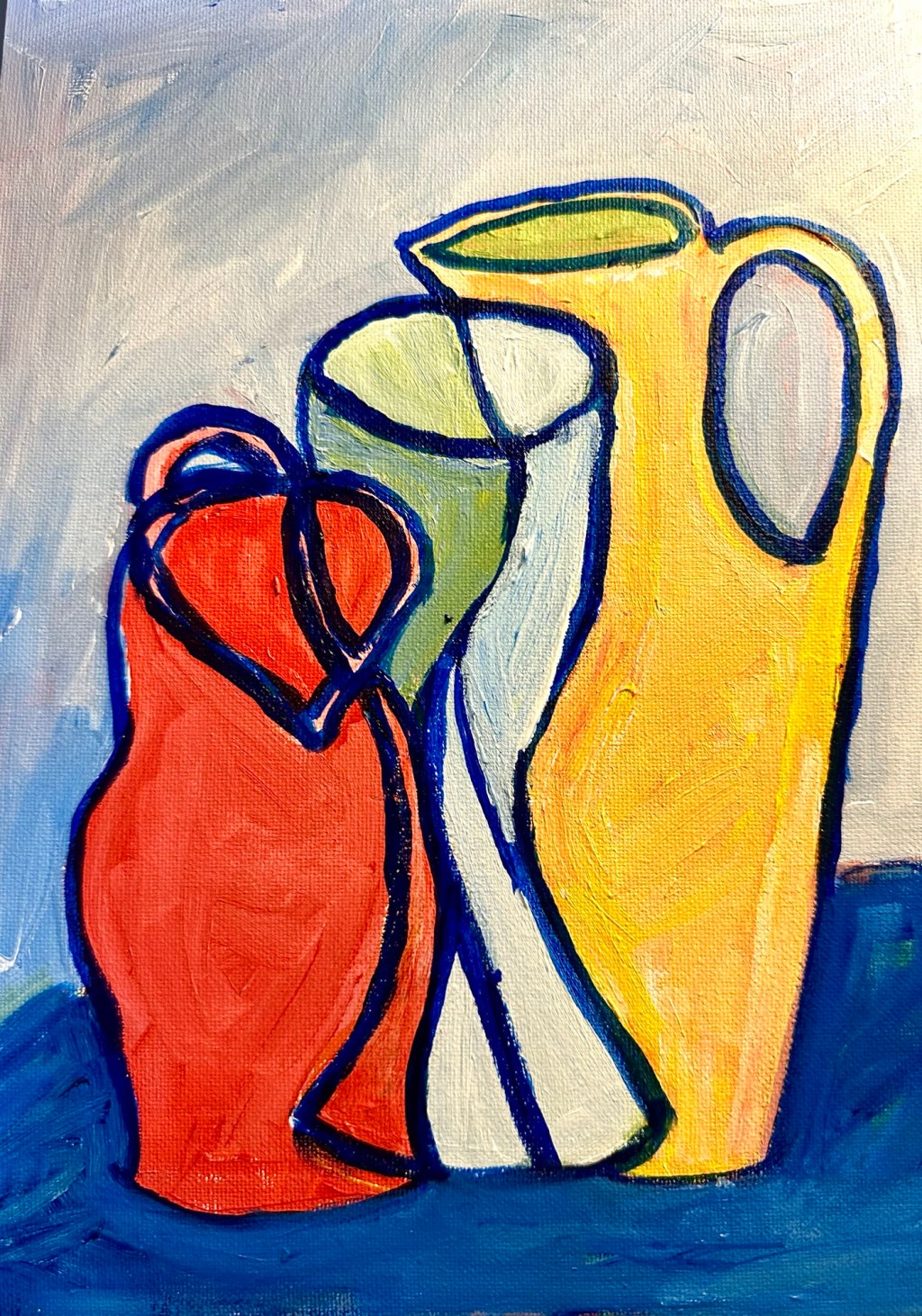
In the second session when our class saw these same liturgical vessels, we chatted about Picasso and cubism. Cubism had several different forms of expression, but we focused on synthetic cubism, a later phase of the cubist style dating from about 1912 to 1914. It had simpler shapes and brighter colors. Synthetic cubist works also often include collaged real elements such as newspapers and cardboard. These works have interesting designs, such as multiple points of view (perspective), overlapping shapes which make their own patterns, and linear outlines. This style is an outgrowth of the work of Cézanne, who said: “A work of art which did not begin in emotion is not art.”

Gail S. took a cubist vision to our same three pots

If you’ve ever tried to put on your socks in the morning beginning with a different foot than normal, you can begin to appreciate how difficult it is to imagine how to create an artwork in a fresh style. If we were to ever have a stroke or a traumatic brain injury, relearning how to do simple tasks is much the same.

Tim’s first effort. He was one week out from surgery. His body was devoted to recovery, not to thinking about cubism.

Our brains can handle the rebuilding project, but we will feel strange doing it! This is because we are building new neural circuits and pathways in our brains. Going to work or the grocery store by taking a different route also feels strange, as does a golfer trying to reconstruct their swing pattern.

Tim took a second week to elaborate on his still life. It’s a better solution! Amazing what happens when our bodies have extra energy to give to creative projects.

As a comparison, we can look at the great hurricane which came through North Carolina recently and took out the big interstate highway that runs through the mountains and valleys. The sooner the highway construction engineers can come inspect the ground, the better. They must decide if the land is safe for rebuilding and then check the infrastructure also. They may need to redesign the road to current standards and also the underlying roadbed. When the great 1900 hurricane hit Galveston, rebuilding the city took twelve years. People were still living there, and life was going on, but the city began a process of raising the land levels and building a sea wall that took that extensive time.

Cornelia’s overlapping shapes and shifting perspectives

Change doesn’t happen overnight. Every sales or leadership training session I’ve been in has emphasized the idea “Three weeks are necessary to build a habit.” The origin of this myth has nothing to do with habit formation. Instead it comes from a 1960 self-help book Psycho-Cybernetics, in which plastic surgeon Maxwell Maltz wrote how his patients took about 21 days to become used to their new appearance after surgery.

He did no double blind, peer reviewed study to verify this, but his book applied this 21-day timeline to many other wide-ranging aspects of self-transformation in life. He also believed three weeks was the time people needed to adapt to a new house or change their mind about their beliefs. (He also didn’t live with a preteen girl child who enjoyed rearranging the living room every night just to see how her mom negotiated a new obstacle pattern in the dark when she came home from a sales call.)

If artists want to make paintings which are technically proficient and resemble the objects they see, they are only halfway to creating a good painting. They must also bring who they are and allow the voice of God to speak through their hand to make a masterpiece. In this way we separate artists into the good and the great, the ordinary and the masters. Not all of us will be prophets who listen to God’s word, but all of us can and should silence our hearts and minds of the world’s chatter and claims so the word of God can pierce our hearts.

Picasso: Guernica, 1937, 11’ x 25.5’,
Museo Nacional Centro de Arte Reina Sofía (MNCARS), Madrid, Spain

Rabbi Nahum Ward-Lev describes how the ancient prophets listened for God’s liberating word: 

“At its heart, the prophetic witness was a way of listening, listening beyond the social norms of the day, listening to the word of the liberating God. The prophets urged the people to listen to God’s word because the discourse of the king, princes, and wealthy landowners was too narrow and was limited to the interests of these elites. This conversation did not include the voices of suffering people. The prophets, in God’s name, offered a much broader discourse, a conversation that listened to and addressed the needs of the poor and the disadvantaged….

The prophetic listening tradition is alive today to inspire people to listen beyond the established conversation. The prophetic tradition challenges us to listen especially to the cries of those who suffer and to listen to the voice of alternative possibility, to the voice of God.”

Picasso: Still Life—fruits and pitcher, oil and enamel on canvas, 10 3/4 x 16 1/8 inches, Guggenheim Art Museum, NYC.

Making a painting is quite different from making a work of art. This is why house painters aren’t called artists. They may cover a surface with color and not make a mess, but their heart and soul isn’t in their work. Learning to risk our vulnerability and emotional expression is also part of art class, just as much as learning what colors to mix to make orange or green. Picasso, quoted in Alfred H. Barr Jr.’s Picasso: Fifty Years of his Art (1946), understood this:

“The artist is a receptacle for emotions that come from all over the place: from the sky, from the earth, from a scrap of paper, from a passing shape, from a spider’s web.”

We have these same experiences also, but we don’t realize these are part of the artist’s toolbox. These ordinary moments of life are also the extraordinary means of God speaking to us, if only we have ears to hear and a heart and hands ready to be used by God for God’s good purposes.

Joy, peace, and prophecy,

Cornelia


Quote Origin: Insanity Is Doing the Same Thing Over and Over Again and Expecting Different Results—Quote Investigator®. The origin of the quote is misattributed to Albert Einstein, but it originated in the 12-Step Anonymous groups in the 1980’s.

https://quoteinvestigator.com/2017/03/23/same/

Isaac Asimov’s “Three Laws of Robotics”:

  1. A robot may not injure a human being or, through inaction, allow a human being to come to harm.
  2. A robot must obey orders given it by human beings except where such orders would conflict with the First Law.
  3. A robot must protect its own existence as long as such protection does not conflict with the First or Second Law.

https://webhome.auburn.edu/~vestmon/robotics.html#:~:text=A%20robot%20may%20not

How Long Does It Really Take to Form a Habit? | Scientific American

https://www.scientificamerican.com/article/how-long-does-it-really-take-to-form-a-habit/

Nahum Ward-Lev, The Liberating Path of the Hebrew Prophets: Then and Now (Maryknoll, NY: Orbis Books, 2019), 133, 134, 135–136.                         

https://cac.org/daily-meditations/living-presence-liberating-journey/

 Meet My AI Friends, by Kevin Roose, NYTimes gift article

https://www.nytimes.com/2024/05/09/technology/meet-my-ai-friends.html?unlocked_article_code=1.Uk4.9sLW.VYS9bW4dc3ib&smid=nytcore-ios-share&referringSource=articleShare

Pablo Picasso – Oxford Reference
https://www.oxfordreference.com/display/10.1093/acref/9780191826719.001.0001/q-oro-


It’s Not Under Control!

adult learning, art, Attitudes, bottles, brain plasticity, Cezanne, Creativity, failure, Family, Fear, Healing, Lent, Marcus Aurelius, Painting, perspective, Ralph Waldo Emerson, renewal, risk, samuel Beckett, shadows, Stress, Super Bowl

All things will renew themselves in good season, yet we have only the present moment before us. We can’t live in the past, nor can we control the future. We have to recognize even our present moments aren’t always in our control, as we witnessed in the big Super Bowl game last Sunday.

Random Actions Often Determine the Outcomes of Sporting Events

Who would ever believe a punt would hit a receiving teammate’s foot, and suddenly become a live ball? Then get recovered by the Chiefs for a quick touchdown? If you think you can control your circumstances or the actions of others, just watch the NASCAR races at Daytona this weekend. The wonder is they don’t wreck in every turn, but only occasionally during the 500 mile race on Sunday.

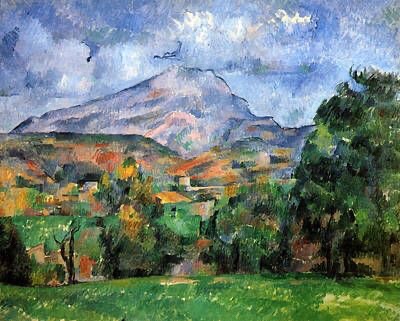
Cezanne Watercolor “Mont Sainte-Victoire (La Montagne Sainte-Victoire vue des Lauves)”( 1902–06) by Paul Cézanne. (The Museum of Modern Art, New York/Photo © 2021 MoMA, NY)

Watercolor is more difficult medium to manage than acrylic paints because it’s wetter and refuses to dry as quickly as we want to paint in that same area. It’s not being obnoxious; it’s just being its own true self. Cezanne used watercolors to think out his ideas beforehand, and then worked in oils. Often, he tossed aside the watercolor work, sometimes even leaving it out in the landscape which he’d just painted. He’d learned all he could from it and now was ready to paint his new image, but not a copy of the original painting. This mountain shows up in sixty of Cezanne’s artworks.

Paul Cézanne: La Montagne Sainte-Victoire, 1888, oil, The Stedelijk Museum, Amsterdam.

The stoic philosopher and Roman Emperor Marcus Aurelius wrote a series of meditations on life. In one he speaks of all life experiences as being the same. This attitude keeps him from getting too high or too low about what happens in his life. He takes it as it comes. Even death, which some fear as a loss, doesn’t bother him, for if he isn’t bothered about the present, he can’t be bothered about losing that too. Marcus Aurelius wasn’t a Christian, but his quest for equanimity is admirable. Take life as it comes and worry not:

“First, that all things in the world from all eternity, by a perpetual revolution of the same times and things ever continued and renewed, are of one kind and nature; so that whether for a hundred or two hundred years only, or for an infinite space of time, a man see those things which are still the same, it can be no matter of great moment. And secondly, that that life which any the longest liver, or the shortest liver parts with, is for length and duration the very same, for that only which is present, is that, which either of them can lose, as being that only which they have; for that which he hath not, no man can truly be said to lose.”

The Still Life in Our Classroom

When we work in watercolor, we have to take what the watercolor gives us. While we can plan, design, and control the outcomes to a certain extent, watercolor often goes its own way. If we work over the whole surface, rather than noodling around in one little space like a puppy sniffing a single spot while out on its morning constitutional walk, we get more done, just as the puppy is more likely to get its “business” done.

One of the reasons we work in a new medium is for the challenge. In school, when I was bored, I’d take notes in class by writing upside down. When that got too easy, I began using my left hand to write upside down. This was a true challenge! I didn’t have any ingrained pathways in my brain for left-handedness, much less the upside-down images. I was truly bored, however, so I struggled on until I got serviceable images. This was the year in which I went to art school as a midyear junior and was taking a freshman level history course.

Tim’s Painting

Tim has voluntarily switched to his left hand because he will have surgery on his right side, which will knock out his ability to use that arm for several months as he recovers. This is a good effort for his non dominant hand. You can tell he focused on the scoop, for it has the most detail. Training our alternate hand to do the work of our dominant hand requires resetting the brain to prefer the new hand. If you try brushing your teeth with your other hand, you’ll see exactly how strange it feels to use a different hand. This is because you have no well-worn pathways in your brain circuitry that makes this routine effort possible.

The fancy pants word for this is neuroplasticicy. We meet this concept with stroke survivors who do physical therapy to rewire their brain connections to make new pathways so they can speak, write, or walk. Everyone who tries a new game, learns a new language, or tries a new hobby also builds new pathways in their brains. Be learners for life, if you want to keep your mind healthy.

Gail’s Painting

Our still life was challenging today. It had solid shapes, a clear bottle, and a metal scoop. Not only were there multiple colors, but textures and transparency also. Gail has had several years of drawing under her belt, so she was able to render the perspective of the still life well. Note the clear blue bottle, which has a wonderful oval bottom. The lemons and limes are distinct also. The grey shape is an antique scoop, sans the handle.

In 2008, J.K. Rowling spoke at the Harvard commencement exercises, telling the graduates, “Talent and intelligence never yet inoculated anyone against the caprice of the Fates.” Because we don’t know what tomorrow will bring, taking care for today is the best preparation for the future. Rowling studied the Classics at Harvard, a subject most people would consider useless for this modern era. Yet after a divorce, as a single parent working for Amnesty International, she began writing her wizard novels. Harry Potter is now part of our cultural heritage.

As Jesus said in Luke 12:25-26–

“And can any of you by worrying add a single hour to your span of life? If then you are not able to do so small a thing as that, why do you worry about the rest?”

Worry is stressful, for sure, and it’s an example of “bad stress,” along with traumatic events, such as adverse childhood experiences (ACE), disease, divorce, and death of a loved one. We also endure “good stress,” as when we challenge ourselves to lift heavier weights, cook a new recipe, or learn a new language. As Ralph Waldo Emerson wrote in his 1841 essay Heroics, paragraph 14:

“The characteristic of a genuine heroism is its persistency. All men have wandering impulses, fits and starts of generosity. But when you have chosen your part, abide by it, and do not weakly try to reconcile yourself with the world. The heroic cannot be the common, nor the common the heroic. Yet we have the weakness to expect the sympathy of people in those actions whose excellence is that they outrun sympathy, and appeal to a tardy justice. If you would serve your brother, because it is fit for you to serve him, do not take back your words when you find that prudent people do not commend you.

“Adhere to your own act and congratulate yourself if you have done something strange and extravagant, and broken the monotony of a decorous age. It was a high counsel that I once heard given to a young person, —”Always do what you are afraid to do.”

When I was in high school, the ancient Latin teacher, who had taught my daddy when he went to school, tossed out the challenge, “No one has ever made 100% on my final Latin exam.”

I bit on that challenge like a starving dog bites on a bone, even if it has no scrap of flesh remaining on it. I made flash cards and studied for an hour every night before bed, I was so determined to be the exception to the rule. On the test, I got all the Latin correct, but lost ½ point for misspelling an English word. I never followed up on her retirement, but I fully expect her record remained unblemished. Also, I’m still spelling challenged. I’m thankful for SpellCheck in our writing apps.

Gail W.’s Painting

Gail W. paid attention to the still life and took care to lay down a close image in a pale wash before she began to add darker washes of color. Her left lime is most successful, with at least six shades of green and yellow in the shape. I also like the highlight on the central lemon. These two images capture the essence of the watercolor medium. Her perspective on the bottle bottom indicates it sits well on the cloth.

Failure teaches us what we don’t know, so we can improve the next time. This is what we call resilience. When I taught art, my students had to find three things they did well in their work before they named anything they needed help on. This was to build up their confidence. For some of them, just making a mark on the page was a start. If we fear making a mistake, we can sketch in a pale-yellow wash. This is very forgiving, like a whisper in the wind. If it’s not quite right, the next few marks may be nearer our desired outcome.

This Is Fine—Leave Me Alone, I’m Having a Crisis

Our mindset is what controls how we react to events in our lives. As one of my friends would remind me, “Not everything is a hair on fire moment.” Of course, when I was a young teen, the least slight or distress caused me to fling myself over my bed in a paroxysm of sobs, wailing loudly, “I’m going to die!” My parents would look at each other and shrug, “What boy is it now?” Fifteen minutes later I’d be in the kitchen looking for a snack, having cried my eyes out, and now I was on to the next thing. As I had more experiences, I learned to roll with the moment. Sometimes you need to wait for the next wave to rise before you take your ride. God’s timing is always right, for our experiences, both the failures and successes, prepare us for what comes next in our lives.

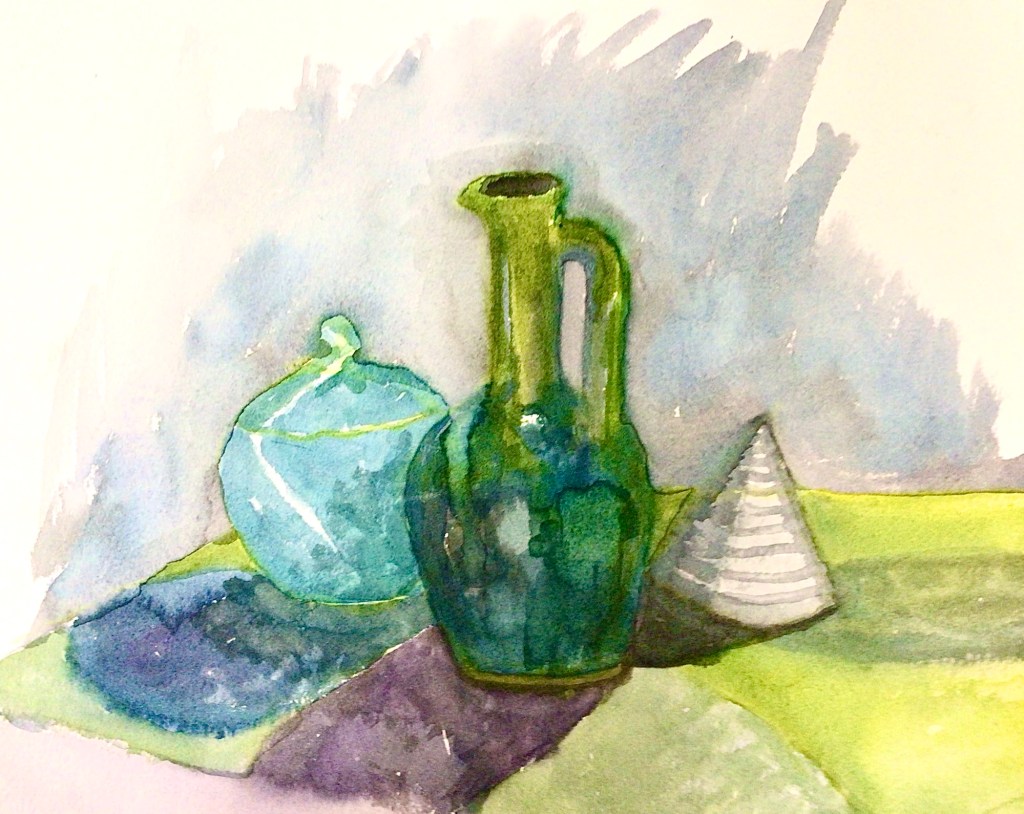
Cornelia’s Watercolor

I had some of the same perspective problems as everyone else, especially with the base of the bottle. Actually, it’s a challenge to get a “transparent three-dimensional object on a flat surface” to appear as if it’s actually sitting on a flat surface in two dimensions. Learning some shading techniques and remembering a round bottle bottom becomes an ellipse helps to bring off this sleight of hand. I got my paint too dark on the front of the bottle base and had to let it dry so I could come back in with some clear water and an almost dry brush to pick up the color. This gave me the highlight I needed.

Cornelia’s Drawing over the Watercolor

When I got home, I noticed my eyesight seems to be going amiss with my increased age. Lately I’ve not been careful to paint my verticals straight. Either I’m being lazy, or I’m tilting my head as I look at the subject. Maybe my neck injury has something to do with it. I duplicated the photo and used the Apple Pencil to straighten up the bottle and even up its symmetry. I also touched up a few of the lemons and limes. Maybe I’m still the puppy that likes to noodle around and sniff about until I can wrest all I can get from a work. This way I learn all I can from it. Like a kindergartner, if my work ends up a huge grey blob, I can say, “That was a great learning experience!”

My grandmother, who painted portraits and still lifes, kept a saying written on the back of an envelope, near her easel:  “Ever tried. Ever failed. No matter. Try again.” She passed in 1970. Years later, Samuel Beckett, in his 1983 story, Worstword, Ho wrote:

“Ever tried. Ever failed. No matter. Try again. Fail again. Fail better.”

We need to be like great artists and athletes, or the Michelin chefs who just keep trying, falling short, until they get close enough to qualify for their stars. Persistence makes all things possible, and if we “fail,” we’re only getting closer to perfection.

I hope for you a blessed Lent,

Joy and peace,

Cornelia


Emperor of Rome Marcus Aurelius: Meditations, XII   https://books.apple.com/us/book/meditations/id396136148

Neuroplasticity: re-wiring the brain | Stroke Association

https://www.stroke.org.uk/effects-of-stroke/neuroplasticity-rewiring-the-brain

10 Brain Exercises to Help Boost Memory

https://www.everydayhealth.com/longevity/mental-fitness/brain-exercises-for-memory.aspx

Neurobiological and Systemic Effects of Chronic Stress – PMC

https://www.ncbi.nlm.nih.gov/pmc/articles/PMC5573220/

​“Try Again. Fail Again. Fail Better”: Beckett’s unlikely Mantra – Goethe-Institut Los Angeles – USA

https://www.goethe.de/ins/us/en/sta/los/bib/feh/21891928.html


The Project Gutenberg eBook of Essays, by Ralph Waldo Emerson

https://www.gutenberg.org/files/16643/16643-h/16643-h.htm#HEROISM


Lifetime of Learning

adult learning, art, Cezanne, cognitive decline, Habits, John Ruskin, Transfer of Learning

Art and Math

“Transfer of Learning” is a concept in which anything learned in one situation or environment can be applied in another. When I taught art, I would have my students use mathematics and fractions when they cut mats to present their work for exhibition. “Why do we have to use math in art?” they whined, “We’re never going to use it in our lives again.”

“Are you going to buy a house, a car, or shop for clothes or groceries? How will you know you’re getting a good deal?” They got out their pencils and rulers, even though they hated fractions.

Step 1: draw a light under painting

This was decades ago, before “Train for Today’s Workplaces” became a mantra among some politicians. The only problem with training for today is the ever-changing nature of the modern workplace, which can make skills obsolete in a mere two years. Executives believe nearly half of the skills that exist in today’s workforce won’t be relevant just two years from now, thanks to artificial intelligence. However, human creativity will always be needed to guide AI. Folks who want white collar jobs today will need to buy into continuous learning, since the current job market will require ever changing skills.

Step 2: add some thin washes to build up the solid surfaces

We’ve all heard the saying, “Jack of All Trades vs Master of None,” but this might be the best possible scenario for our modern world. In our highly professionalized society, we all want the best physician and the top-notch lawyer on our case. Not everyone has the goods to acquire their services. We get the best we can afford. This is the capitalist society in which we live. In a utopian society, the poorest among us would get the same high quality medical care as the President of the United States.

Step 3: add details once surface is dry enough the paint won’t bleed. Doing background while waiting for objects to dry allows you to tighten up the edges of the objects.

“Those who can’t, teach” is a misconception, similar to the Jack of All Trades. Art Teachers can’t stick only to their specialty, but also must offer the gamut of skills from drawing to painting, paper cutting to plaster sculpture, clay pottery to cloth dyeing, and even more multimedia experiences. They have to be able to reach students with a wide range of talents, interests, and expertise, as well as encourage those who are ashamed of their work. Plus, they need to convince the talented to work and improve so they fulfill their promise.

This background discussion brings me to our class’s second experience in watercolor. I noted some instances of Transfer of Learning I can point out when we meet again.

Gail’s Still Life

When we paint a house, we dip our brush in a bucket of paint, apply it to the wall in one stroke, and then go back to the bucket for another dip. We don’t keep wiping the same spot on the wall over and over trying to make this one spot look better. In fact, the damp brush is just picking up the paint off the wall! Move along and cover the wall.

Tim’s Still Life

Don’t take your eye off the ball. If you want to catch a ball in any sport, you have to track it into your hands or the mitt. I noticed the ones who looked up, drew, looked, drew, checked, drew again, adjusted, and drew some more, had closer proportions in their drawings.

Measure twice, cut once. This is similar to the above sports metaphor. I learned it in the art school wood shop when I was cutting wood for my stretcher strips. Using the thumb or a brush to note the proportions of the still life objects and comparing them to the proportions of your own work helps get an accurate drawing. Check once, measure, check again, measure, and then cut. Air drawing or visualization helps to imagine the proportions before drawing the lines. Drawing lightly so you can draw over the less appropriate shape is an example of measuring twice, and cutting once.

Gail W’s Still Life

Sheep will eat the grass down to the roots, but goats will move on. Actually, I have zero experience with sheep and goats. My shepherd experience is limited to leading a congregation, none of whom could be accused of being either sheep or goats. I only know this fact from Bible Study lessons, and no one rents out sheep to clear a pasture of weeds, but they use goats because goats are smart enough to move on. In art, we need to take a lesson from the goats and move on to another section of our painting to let our colors dry, so we can avoid our colors running into each other.

Cornelia’s Still Life

Our group isn’t training for a new occupation, but keeping a challenge on our plates is a good idea for anyone of any age. Whether you’re trying new recipes or learning to play an instrument or taking up an exercise routine, whatever change you make in your life is important. Doing creative writing or crafts or arts is especially crucial for keeping our brains healthy, for these activities build new pathways in our brains. As we age, having redundant brain pathways is important to keep our minds healthy.

Participation in arts interventions have been linked with improving cognitive function and memory, general self-esteem and well-being, as well as reducing stress and other common symptoms of dementia, such as aggression, agitation, and apathy. According to the National Endowment for the Arts, the interventions which promote social interaction, have multiple psychosocial benefits. While none of our group are experiencing these effects, participation also staves off the same symptoms. Researchers found visual arts programs reduced depression, improved socializing, and increased self-esteem among participants.

Expressive arts activities also help individuals relax, provide a sense of control, reduce depression and anxiety, encourage playfulness and a sense of humor, as well as improve cognition and self-esteem. Making art also nurtures spirituality and reduces boredom. Art also can reflect the emotional and cognitive condition of the artist.

Watercolor with Prang Oval 8 Student Palettes

In the classes I teach, I encourage each person finding their own voice, rather than copying my style. In the art education classes I took in college, the goals of teaching were for students to recreate the closest replica of the teacher’s model, as they followed the instructional steps to the letter.

I’m thankful I never had those teachers growing up, but by the 1980’s, regimented lesson plans were all the vogue. When I began to teach, I gave certain boundaries or requirements for each lesson, such as the use of certain color schemes or coiling verses slab built in clay sculpture, but the rest was left up to each student’s creative interpretation.

My principals were always surprised by the lack of discipline problems in my class, but when young people are given an opportunity to develop their imagination in a positive direction, rather than use it in negative behaviors, life is good. They especially liked the “hand-mouth pop quizzes” I would occasionally make them take, especially when they discovered cookies or chewing gum were involved.

Years later when I went to seminary, I constantly heard the refrain, “Will I be able to put this in my toolbox and use it in the local church?”

As a person who was preparing to be a fifth career pastor, I could only roll my eyes in silence. Every job I’d ever had prepared me for the ministry: renovating old apartments, teaching, preparing lesson plans, selling insurance, studying art history and painting, and learning how to renew and retrain my old skills for a new career. The idea of having a single toolbox that would never need new tools never crossed my mind. Seminary was where my skills to be a lifelong learner were reinforced.

I was writing this on My Daddy’s birthday. He would have been 105 if he’d lived so long. He always maintained an interest in archaeology until Parkinson’s and dementia robbed him in his late 70’s of his memories and his brilliance. He would take us on arrowhead hunting field trips on Saturdays when we were children. Armed with a cooler of lemonade and sandwiches from home, we’d go out to the countryside to walk in a farmer’s newly plowed field, with his permission of course.

In his early retirement, he enjoyed giving tours to school children at the LSUS campus Pioneer Heritage Center and driving the church bus to the food pantry to pick up the monthly food rations for distribution to the neighborhood. Staying active, engaged, and eating a healthy diet are other ways we can keep our minds building new neurons.

One of the interesting research opportunities in art and the brain is the question of whether neurodegenerative brain disorders will show up in an artist’s body of work. The progressive loss of neurons causes changes in the brain, which leads to a number of symptoms, from altered multi-sensory processing to difficulty moving and using one’s body, to subtle changes in mood, emotions, personality, social interactions; to major, disabling cognitive and behavioral impairments. Although we currently only offer art therapy for the elderly, perhaps we ought to be emphasizing the arts from earlier ages and integrate it into all of our studies to help everyone develop limber learning skills to last for our lifetimes.

Joy and peace,

Cornelia


Half Of All Skills Will Be Outdated Within Two Years, Study Suggests

https://www.forbes.com/sites/joemckendrick/2023/10/14/half-of-all-skills-will-be-outdated-within-two-years-study-suggests/

National Endowment for the Arts Study: “Research Gaps and Opportunities for Exploring the relationship of the Arts to Health and Well-Being in Older Adults,” Published by the national endowment for the Arts Office of Research & Analysis

Pioneer Heritage Center

https://www.lsus.edu/community/pioneer-heritage-center

Can we really ‘read’ art to see the changing brain? A review and empirical assessment of clinical case reports and published artworks for systematic evidence of quality and style changes linked to damage or neurodegenerative disease

Physics of Life Reviews 43 (2022) 32–95