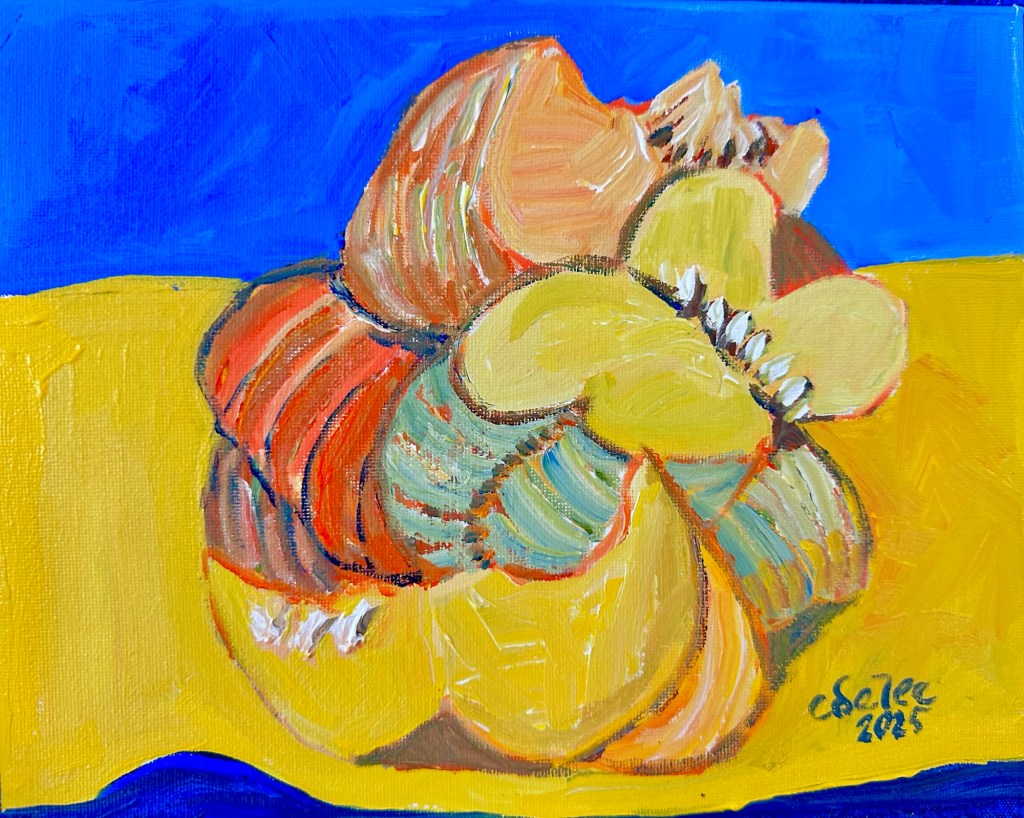

During chaos, we humans search for order. We are not good in the storm! Jesus may sleep comfortably in the boat while the waves crash against the sides of the boat and the wind threatens to rip the sail to shreds, but like the disciples we scream,
“Master, Master, we are perishing!” And he woke up and rebuked the wind and the raging waves; they ceased, and there was a calm. (Luke 8:24)
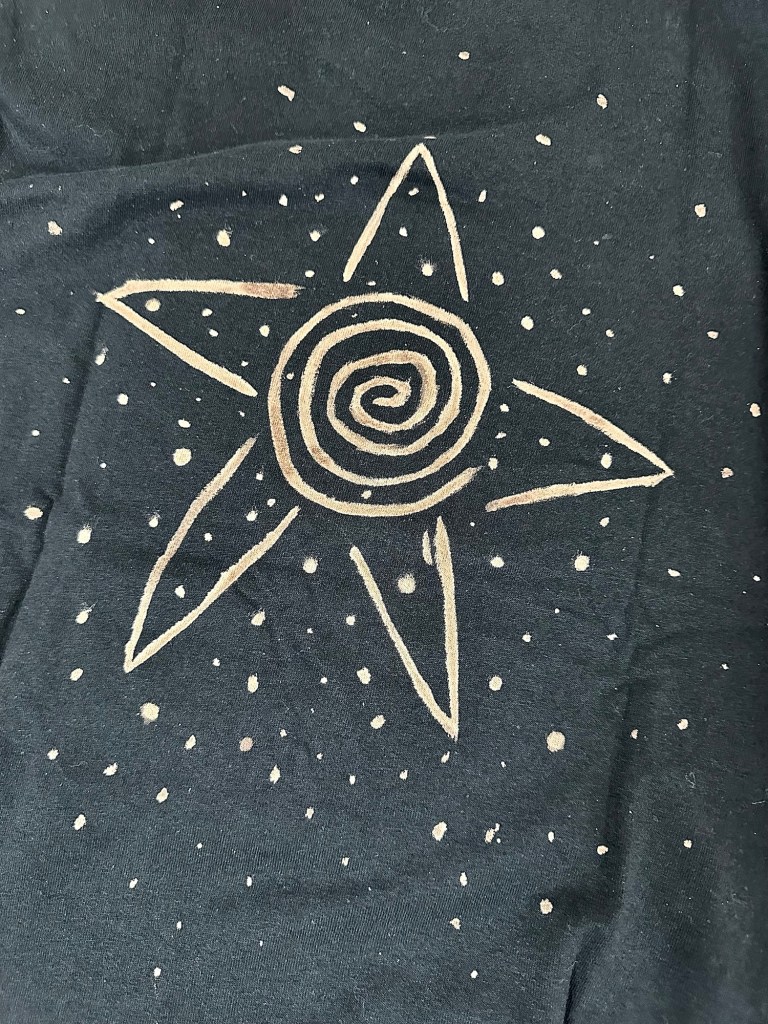
Gel bleach on black T-shirt
Change is a constant in our lives. We are each constantly renewed every 28 days. At least, our skin is a new creation, even if we have not undergone a spiritual transformation. Due to the constant formation of new basal cells in the lowest layer of our epidermis, the new cells push the overlying cells further upwards, where they slowly dry out, become keratinized and become dry, dead skin flakes.

These new skin cells replace the old skin cells by moving them upwards towards the surface of the skin. This entire rejuvenation process takes an average of 28 days and is known as a skin cycle.
We have other cycles in our bodies, for our bodies are always renewing themselves. We might feel old and worn out but we are just comparing ourselves to our younger selves. Old is a state of mind; old means we are no longer curious, no longer open to hope, and no longer open to change. Old has become fixed in place. Old is not an age on the calendar. Old is an attitude.

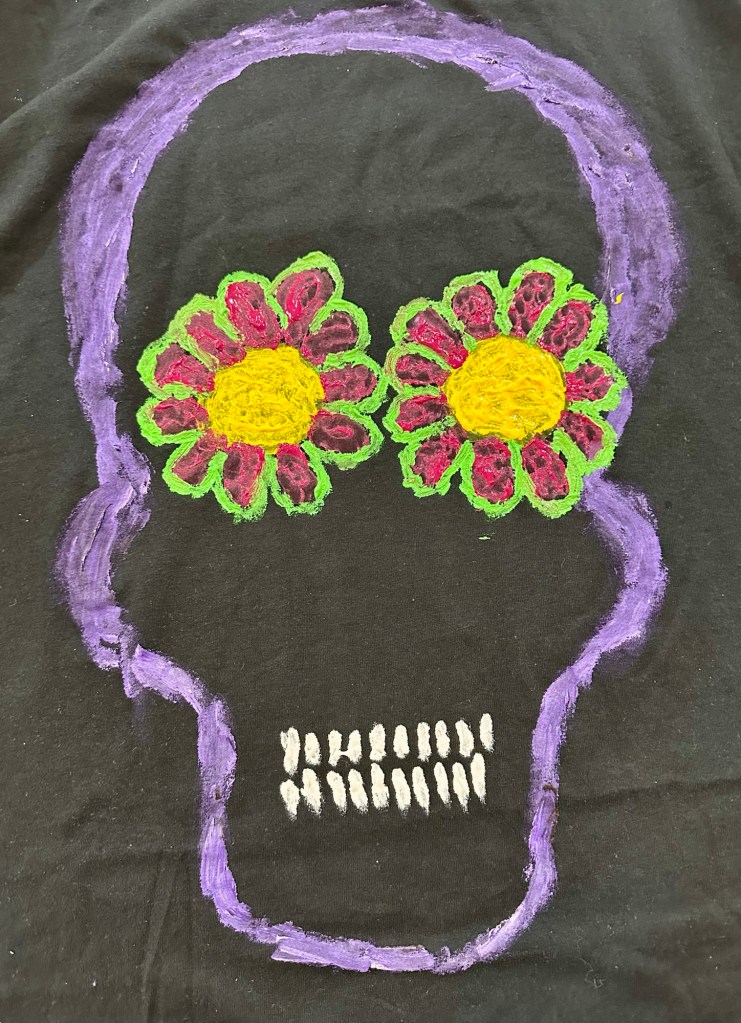
We nod to old traditions and seek to interpret them in new ways in our Friday Art Class. The past two weeks we have used the Day of the Dead skull motif and turban pumpkins as our inspiration. These both have the October vibe about them. The Mexican festival of Dia de los Muertes is kin to our All Saints Day, since it is a veneration of the ancestors and a celebratory feast in their honor.

The skull motif comes from the cookie or sugar “offerenda” gifts offered at the family altars and the grave sites for the benefit of the ancestors. The pumpkins stand for the harvest (and the ubiquitous pumpkin spice in everything edible or not) during this time of year. Some years we do ordinary pumpkins, but this year I went hog wild. (Unfortunately it didn’t help our Razorback football team get their mojo back!)

We painted turban pumpkins this year, with a twist. I asked Mike to cut a chunk out of one of the pumpkins so we could see the seeds inside. The seeds represent the small bits of life which look nothing like the final product, but contain the whole germ for a full life. The seeds are part of the transformation process of life: hidden underground, the mystery of growth takes place. The ground may appear dead and lifeless, but underneath, energies we cannot see are at work.
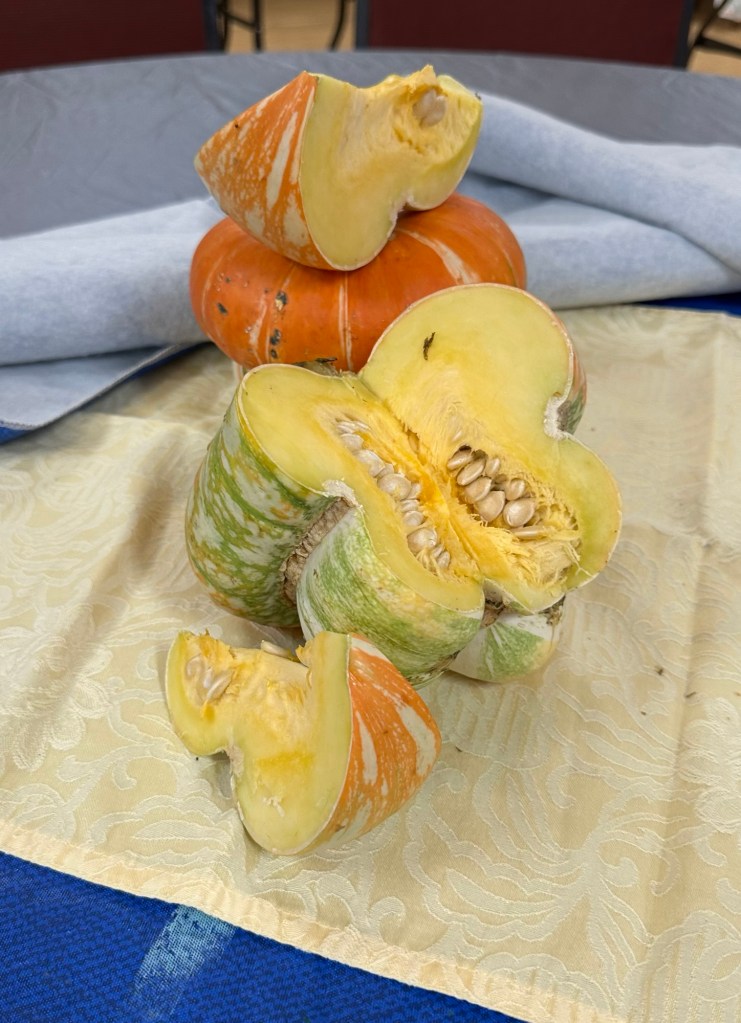
So it is with the Christian life and the creative life. A seed planted may not come to life right away. We farmers might want to walk away from this field or plow it under and start over with a new crop. We don’t understand how the seed we plant may have settled in an unprepared field. We might need to bring some fertilizer to this field and nurture it a bit more, or in art class, we need to continue teaching the same lesson in different forms.

When people are learning a new skill or changing behaviors, the process takes time. This is why John Wesley believed it was possible to become perfect in Christian love in a moment by God’s grace, but most people would do so over time.
In art school, after hours of practice and challenge, some few of us would be fortunate enough to have the other students come by our easels to inspect our scrawlings. Not that these works were ready for museums yet, but they did show a unique hand, which the others lacked. That uniqueness is the individuality of personality that comes through the expression of the artist’s hand.

In the 18th CE, Europe was at the heights of both international trade and conflict. This trade began in the 14th CE with the Crusades going to the Middle Eastern countries and returning home with luxurious carpets and other goods. Although coffee houses were prevalent in Constantinople (Istanbul), we have no record of crusaders bringing coffee beans back on their return journey. Merchants began to import coffee beans at various port cities in Italy and France in the 16th CE. When the Turkish government sent ambassadors to the French king, the king enchanted by the group’s exotic dress and the court began to adopt Turkish elements in their daily attire and in their household furnishings. History calls this appropriation style “Turquerie.”

The Ottoman-Austria wars (16-18th CE) made traditional Turkish coffee (“Türkentrank”) popular in Europe, notably in Paris through the war captives. Some cafes inspired from the Turkish-style became a common meeting point of intellectuals and socialites, and even became a symbol of Paris. Turquerie fashion influenced European architecture, design, and even daily items. The Belvedere Palace, which has side domes covered by a tasseled tent design or the Karlskirche, makes the towers reminiscent of minarets and are further examples of this orientalizing trend.

Of course, after this era, the discovery of Herculaneum (1738) and Pompeii (1748) fueled a love for the styles of ancient Greece and Rome that were to form the basis of Neoclassicism, a style popular through the early part of the nineteenth century. Styles in art are continually evolving, depending on the outside forces which currently influence our lives. If we constantly repeat the patterns of the past without any sensitivity to the pulse beats of the lifeblood of this world in which we live, then we are like dry bones in a dryer desert.

Richard Rohr in his book, The Tears of Things, writes:
Ezekiel is forever telling us, “Prophesy to the breath…. Come from the four winds, breath; breathe on these dry bones and let them live!” (Ezekiel 37:9). Our love matters in this universe. Dry bones can still be remade with living flesh. It is God’s very job description, I think. And now ours, too…It is our very own breath—and God’s, too—that we breathe on the dry bones of this world.”
In art class we work with God’s spirit activating our spirit to bring our unique experiences to the fore. The water may be choppy at times, but Jesus always calms our soul. After all, what we paint on a canvas will not impair our salvation. God’s love in Jesus Christ assures us of our salvation, not our ability to make great art or amass riches.
Joy, peace, and assurance,
Cornelia
— The Tears of Things: Prophetic Wisdom for an Age of Outrage by Richard Rohr
(Chapter 9: EZEKIEL—REDEMPTION AND THE GRACE OF GOD)
THE CONVERSATION US: Pumpkins’ journey from ancient food staple to spicy fall obsession spans thousands of years
https://apple.news/AVG9dy_XHSjOMsK-YkTsRXA
VIRTUAL CONSULTATIONS
https://www.drsturm.com/virtual-consultations
History of coffee | Origin, Spread, Ethiopia, Arabia, Facts, & Timeline
https://www.britannica.com/topic/history-of-coffee
Turquerie: Evolution of Turkish theme in European art, style
Hokusai: Under the Wave off Kanagawa (Kanagawa-oki nami-ura), colored wood block print, Publication: 1831, Size: Horizontal ôban; 25.8 x 38 cm (10 3/16 x 14 15/16 in.),

 Artandicon's Blog
Leave a comment